Academic Digest: Intangible Economies – #CCF

tumblr_inline_n6gs5qGydI1sdx8um

Fillip Magazine’s Intangible Economies (2012) tackles the abstract nature of economy in relation to cultural production. Set in the world of cultural/artistic production, the works in this anthology build on the provocative premise of its introduction, providing specialised analyses of the concept of economy as an institutionalised value system.  My response offers a brief look at “Intangible Economies”, the introductory chapter of the anthology. It took me three reads to grasp the salient ideas being expressed in the introductory chapter of the journal (the Footnotes were a saviour !). Making reference to Mauss’ theory of ‘the gift’, Derrida’s theory of representation and the ‘symbolic order’ and Marx’s theory of alienation, Hirsch’s articulation of the relationship between affect and economy raises challenging questions about the value of cultural production in a capitalist economic system.

The above excerpt is from Amanda Haynes’ review of Fillip Magazine’s edition Intangible Economies (2012) this week’s addition to the Fresh Milk Books Tumblr – the online space inviting interaction with our collection in the Colleen Lewis Reading Room.

For new Critical. Creative. Fresh reviews every week, look out for our #CCF Tuesdays  and see the good reads we have available at Fresh Milk!
Cherise Ward ‘My Time’ Residency – Puppet Building Workshop

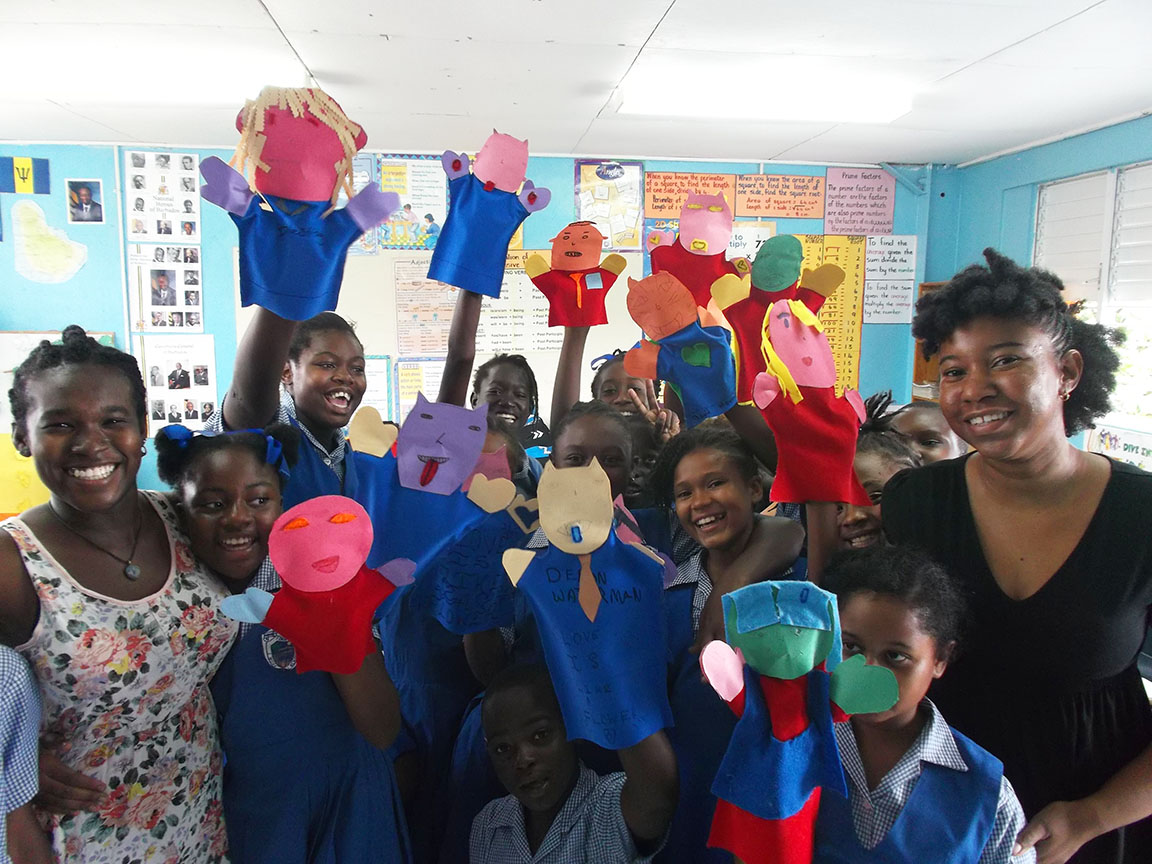
PuppetWrkshp16For my community outreach for the residency, I decided to do a 3 hour Puppet Building Workshop with students from Workmans Primary. The students were from both Class 3 and Class 4.

As part of my preparation, I made a test puppet. I wanted it to be a simple hand puppet that I thought the students would be able to make themselves. I used fabric, felt and construction paper.

On the day of the workshop, I had the assistance of Fresh Milk volunteers Versia and Ronald, and they were a great help.

I started by teaching the students about 3 different types of puppets, and doing a brief demonstration of how they worked using puppets I have made. They took notes, and were interested in trying to operate the puppets themselves. Then we got started making their hand puppets.

The students cut out their templates for the glove part of the puppet, and traced them onto the fabric, and we helped them cut and glue the fabric. They drew the designs for their puppets, and then cut the shapes for the heads and hands, and decorated them using felt, paper, and crayons.

The workshop was really well received. The students were enthusiastic, and excited about the puppets, and we had a great time. Thanks to Versia and Ronald for their help as well as Annalee and the teachers at Workmans Primary.

Follow Cherise on Tumblr for updates on her residency & practice.

John Berger Makes Me Dizzy – #CCF

john berger

How can I review a John Berger book? How do I gather my thoughts on his thoughts, simplify them and concisely and articulately present them in a 500 word summary? I can’t. Whether through my own honest inability or fear of even trying (I’ll give myself the answer to that later), I found it impossible to do. But under the watchful eyes of two of my teammates here at Fresh Milk (Katherine and Amanda) I feel I must say a little something about the man in the photo above.

John Berger is a writer, a poet, and an intellectual. He is one of the few minds of the 20th century able to dissect a wide range of matters and re-present them with precision and clarity. John Berger Selected Essays is a compilation of some of the most prolific writings of his career. The editor, Geoff Dyer, has gathered works from a number of his collections, including: “The Look of Things” (1972), “About Looking” (1980) and “The White Bird” (1985).

The above excerpt is from Versia Harris’ review on Selected Essays of John Bergerthis week’s addition to the Fresh Milk Books Tumblr – the online space inviting interaction with our collection in the Colleen Lewis Reading Room.

For new Critical. Creative. Fresh reviews every week, look out for our #CCF Weekly  and see the good reads we have available at Fresh Milk!

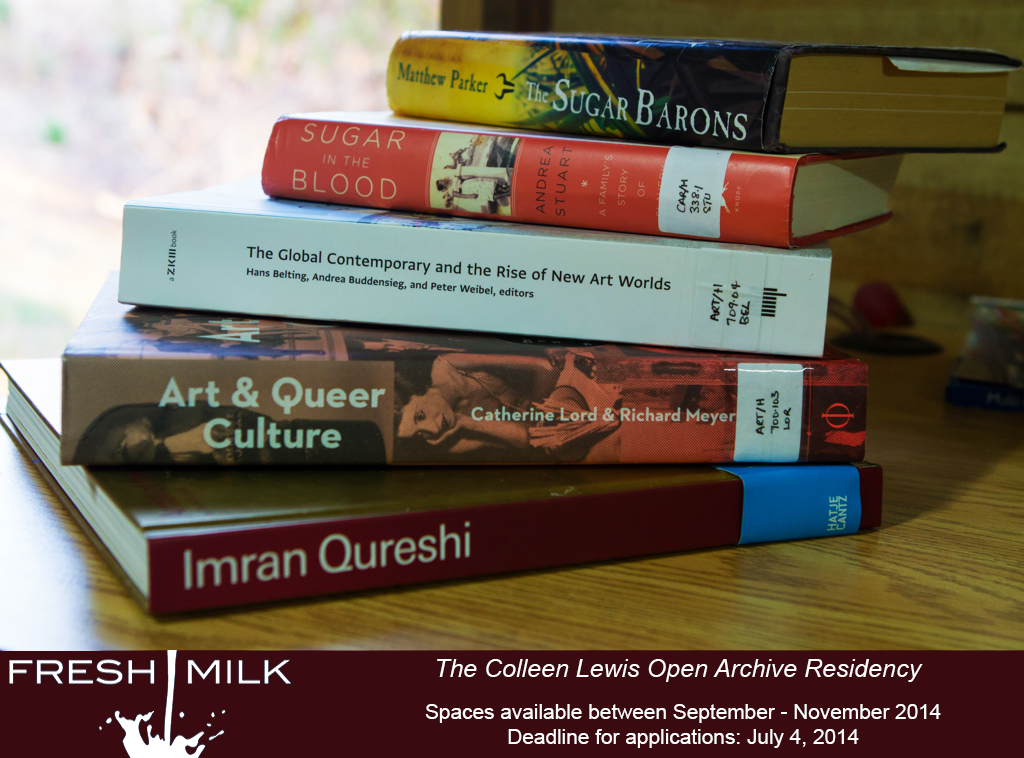
Colleen Lewis Open Archive Residency

The Colleen Lewis Open Archive Residency

FRESH MILK is pleased to announce the Colleen Lewis Open Archive Residency between September and November 2014. Applications from artists worldwide are welcomed. This residency aims to support visual artists, writers and creatives by offering a peaceful working space for a minimum of 4 weeks, and the opportunity to interface with the Colleen Lewis Reading Room (CLRR) as an archive with which to engage, respond and activate. For more on the archive, view our online bibliography.

The CLRR is continually expanding its collection and has a special focus on the visual arts, with particular interest in archiving material on visual arts in the Caribbean. Resident artists will also be able to meet with the Fresh Milk Books team of young creatives on a weekly basis to converse and collaborate.

Spaces are available between September 1st and November 28th, 2014. For more information on the residency and associated costs please visit our International Residency Opportunity page.

Artists wishing to apply for residencies with projects outside of this targeted call are also welcome to submit proposals.

The deadline for applications is July 4th, 2014. 

Frantz Fanon & the Pursuit of ‘the White Girl’ – #CCF

Photo by Sølve Sundsbø

Photo by Sølve Sundsbø

The objectification of the white woman immediately caught my attention. She was to be used: for sexual gratification, to fulfill a ‘ritual of initiation into “authentic manhood”’ (Fanon 52), to ‘de-racialize’ the black man. Wait…what? De-racialize the black man? Fanon’s socio-economic background meant a white partner would have gone a considerable way in establishing his status in society. As for me, while still an ignorant youngster, I always knew that the fairer a girl’s complexion, the prettier she was. It was a fact, but I didn’t know why—just like how Jeun Veneuse, as Fanon noted, didn’t know why he loved Andreé. However, unlike Veneuse and Fanon, I wasn’t acutely aware that there was a problem with my skin colour that needed correcting.

The above excerpt is from Ronald Williams’ review of the chapter ‘The Man of Colour and the White Woman’ in Frantz Fanon’s Black Skin, White Masks, this week’s addition to the Fresh Milk Books Tumblr – the online space inviting interaction with our collection in the Colleen Lewis Reading Room.

For new Critical. Creative. Fresh reviews every week, look out for our #CCF Tuesdays  and see the good reads we have available at Fresh Milk!