Artist Talk with Graham Fagen

On Friday, April 21st, 2017 Glasgow-based artist Graham Fagen will be giving an artist talk from 1:00 – 3:00 pm in the Morningside Gallery at the Barbados Community College (BCC). This lunchtime lecture, presented by BCC, Fresh Milk and the British Council, is free and open to the public.

Graham, who is this year’s external examiner for the BFA students at BCC, is spending some time connecting with several cultural institutions in Barbados and Trinidad and Tobago during the month of April. In addition to the artist talk, he will give an experimental drawing workshop to BCC students. He will also meet with artists while in Barbados to learn about their practice.

__________________

About Graham Fagen:

Graham Fagen is one of the most influential artists working in Scotland today. His work mixes media and crosses continents; combining video, performance, photography and sculpture with text, live music and plants. Fagen’s recurring artistic themes, which include flowers, journeys and popular song, are used as attempts to understand the powerful forces that shape our lives.

Graham Fagen studied at The Glasgow School of Art (1984-1988, BA) and the Kent Institute of Art and Design (1989-1990, MA) and is senior lecturer at Duncan of Jordanstone College of Art & Design in Dundee.

In 1999 Fagen was invited by the Imperial War Museum, London to work as the Official War Artist for Kosovo, and since then has exhibited widely both in the UK and abroad.

Exhibitions include Golden Age, Institute of Contemporary Art, London (1999), The British Art Show (2000), Zenomap, Scotland + Venice at the 50th Venice Biennale (2003), Bloodshed at the Victoria & Albert Museum and Art of the Garden, Tate Britain (2004), Busan Biennale, South Korea and the Art and Industry Biennial, New Zealand (2004).

In 2011 Fagen was the International Artist in Residence at Artpace, San Antonio, concluding with a solo exhibition, Under Heavy Manners. With theatre director Graham Eatough he created The Making of Us, a performance, installation and film, for Glasgow International 2012.

Recent exhibitions include Cabbages in an Orchard at The Glasgow School of Art (2014); participation in GENERATION: 25 Years of Contemporary Art from Scotland (2015) at the Scottish National Gallery of Modern Art in Edinburgh, and In Camera (2015) with Graham Eatough at the Panorama, La Friche, Marseille. The Mighty Scheme with Matt’s Gallery at Dilston Grove and CPG London (2016). Complainte de l’esclave at Galerie de l ‘UQAM, Montreal. (2017).

In 2015 he was selected to represent Scotland at the 56th Venice Biennale.

Digital copies of RA: Representing Artists now housed on the Fresh Milk website

The quarterly Barbadian and Caribbean arts newsletter RA (Representing Artists) was produced in the early nineties, spearheaded by a group of Barbados-based artists who saw the need to create a forum for more critical writing around contemporary arts in the region.

As part of her Tilting Axis Fellowship that has seen her travel to arts spaces throughout the Caribbean, Jamaican writer and curator Nicole Smythe-Johnson has digitized all six editions of this newsletter to make them available for public access on the Fresh Milk website. This inaugural curatorial fellowship is supported by the British Council.

With so many ongoing conversations about the development and future of Caribbean art today, it is important to know the history of spaces and what has laid the foundations for these discussions. Over the last 24 years, how have things changed? What has remained the same? We hope that these texts can be a source of inspiration, evaluation and critique, both for the state of the creative environment then and for encouraging productive discourse moving forward.

Edited by: Annalee Davis
Designed by: Arthur Atkinson (Issues 1-4) and Kristine Dear (Issues 5 & 6)

Contributors: Annalee Davis, Allison Thompson, Ras Akyem, Ras Ishi, Christopher Cozier, Nick Whittle, Alison Greaves, Roger Lipsey, Ken Corsbie, Dominique Brebion, Stan Kuiperi, Marianne de Tolentino, Dennis Tourbin, Petrona Morrison, Gayle Hermick, Geoffrey MacLean, Elizabeth Barnum and Sharen Carmichael

Click here to access the full issues on our Projects Page.

Ayesha Hameed’s Blog Post – Black Atlantis// The Plantationocene

In December 2016, UK-based artist Dr. Ayesha Hameed undertook a 2-week residency at Fresh Milk, where she conducted research for her ongoing project Black Atlantis. Ayesha shares an excerpt from a longer piece about her residency experience, and her exploration of the ‘plantationocene’ – a term which looks at the relationship between agriculture and our current geological era. Read more below:
Black Atlantis// The Plantationocene[1]

*

Speed

This is my first evening at Walkers, once a sugar plantation and now a dairy.  It is dusk.

I step outside of the flat, climb the slightly mossy stairs and turn right into the purpling light. To my left are horse stables, behind me is the house and in front of me are fields of grass.

The sound of the frogs begins at dusk and it gets louder. The paved drive I am walking on ends at the field, and I turn right onto a dirt path.  The grass is long on either side of the path.  When I reach a lone tree to my left, the path dips down a small hill and continues to a line of trees in the distance.  To the right is the South and there are some twinkling lights in the distance.  A small bat swoops over my head.

Underneath the alien and screechy whir of the frogs there is a silence. A black dog runs up to me from the big house and then turns around and goes back, looking back at me as if trying to get me to follow it.  I walk away from it and into the long grass and listen.

The frogs get louder.  The sky turns black.

What is the relationship between climate change and plantation economies?  This is an exploration of many things – the beginnings of a fourth chapter of an ongoing performance called Black Atlantis, visiting the heartland of one of the three stops of the triangular trade, and taking seriously Donna Haraway’s and Anna Tsing’s use of the term ‘plantationocene’ which connects the development of a plantation form of production to the beginning of the current geological era that we are in.

The ‘plantationocene’ is a placeholder for the relationship between agriculture and the new geological era we find ourselves in called the anthropocene.  But the kind of agriculture they are thinking about is the violent replacement of diverse farming tactics, of forests and of pastures by the factory-like extractive structure of plantations – the cultivation of single crops like sugar and cotton for export, produced by enslaved and indentured laboring bodies forcibly transported across vast distances.  Plantations eradicate the diversity of what is cultivated, devastating the land, violently exploiting and expropriating the bodies working on the land and destroying any possible autonomy for self sustenance for those living in these areas.

[we use the term] Plantationocene for the devastating transformation of diverse kinds of human-tended farms, pastures, and forests into extractive and enclosed plantations, relying on slave labor and other forms of exploited, alienated, and usually spatially transported labor… Moving material semiotic generativity around the world for capital accumulation and profit—the rapid displacement and reformulation of germ plasm, genomes, cuttings, and all other names and forms of part organisms and of deracinated plants, animals, and people—is one defining operation of the Plantationocene, Capitalocene, and Anthropocene taken together (Haraway 162).

The plantationocene suggests that the geological force of humans on the planet’s ecosystem had its roots in plantation slavery, its instrumentalisation of the soil for a singular kind of production and its violent enslavement of bodies to be used as machines to cultivate and harvest the cane, and to ideally reproduce and sustain itself.  As Anna Tsing says, the plantationocene is formed of “machines of replication” or “simplified ecologies, such as plantations, in which life worlds are remade as future assets” – in other words it highlights the aftermath of a radical and violent incursion and its effects on lifeworlds that intertwine the human and the natural.

It is a nearly impossible endeavour to read an over three hundred year old history of plantations and their continually evolving social relations in the wake the oldest instance of plantation slavery, and in the continued presence of descendants of slaves and plantation owners and overseers, against the slow temporal swings that mark climate change.  Reading a still living and present history against a slowly unravelling future of increasing frequencies of natural disaster, the warming of the ocean, the jeopardisation of sea life is incommensurable and probably pointless as they operate on such different registers, and the possibility of finding common ground at ground level is nearly nil.

*

Another beginning: It is half past two and I’ve been waiting in the parking lot outside Harrison’s Cave for about thirty minutes. Tour buses and hired taxis efficiently pull in and out of the parking spaces, loading and unloading their American passengers.

Two men are chatting beside me, one of them offers the other one a lift and they walk over to a brightly painted bus.  I figure I have 20 minutes more to wait.

I hear a loud noise and look up from my book to see a diesel powered mini bus hurtling through the lot like a getaway car for a heist. It abruptly stops at a hasty angle near the bus stop where I am sitting.  The sign on the bus just says ‘city’. People climb out quickly with the diesel engine rumbling.

As I climb the stairs the bus speeds up again so fast I trip onto a seat. I pull myself up holding out my 2 Barbadian dollars to the driver with an apologetic ‘excuse me?’ and the man in the passenger seat waves impatiently at me to sit down.

I look out the window as the bus hurtles down dirt roads hewn through fields of cane speckled with sun and dust.  We screech to another stop and the engine grumbles and roars.

Outside are the fields of cane and men and women waiting on the side of the road.
*

*

[1] This is an excerpt from a longer chapter forthcoming in MAP Office’s Catalogue “My Ocean Guide published by Lightbox” (2017).  Research for this work was made possible by a Travel Grant awarded by the Canada Council for the Arts to attend residencies at Alice Yard (Trinidad) and Fresh Milk (Barbados).

_____________________

This residency was supported by the Canada Council for the Arts
Kraig Yearwood’s Residency – Week 3 Blog Post

Barbadian artist Kraig Yearwood shares his third blog post about his Fresh Milk ‘My Time’ Local Residency. Things began to come together both materially and conceptually for Kraig this week, having investigated the properties of concrete and experimented with how it behaves both on its own as well as in combination with other elements.  He also had the opportunity to have a studio visit with Natalie McGuire, manager at the Barbados branch of Gallery NuEdge, where he expanded on his ideas around consumption, mass manufacturing and materialism. Read more below:

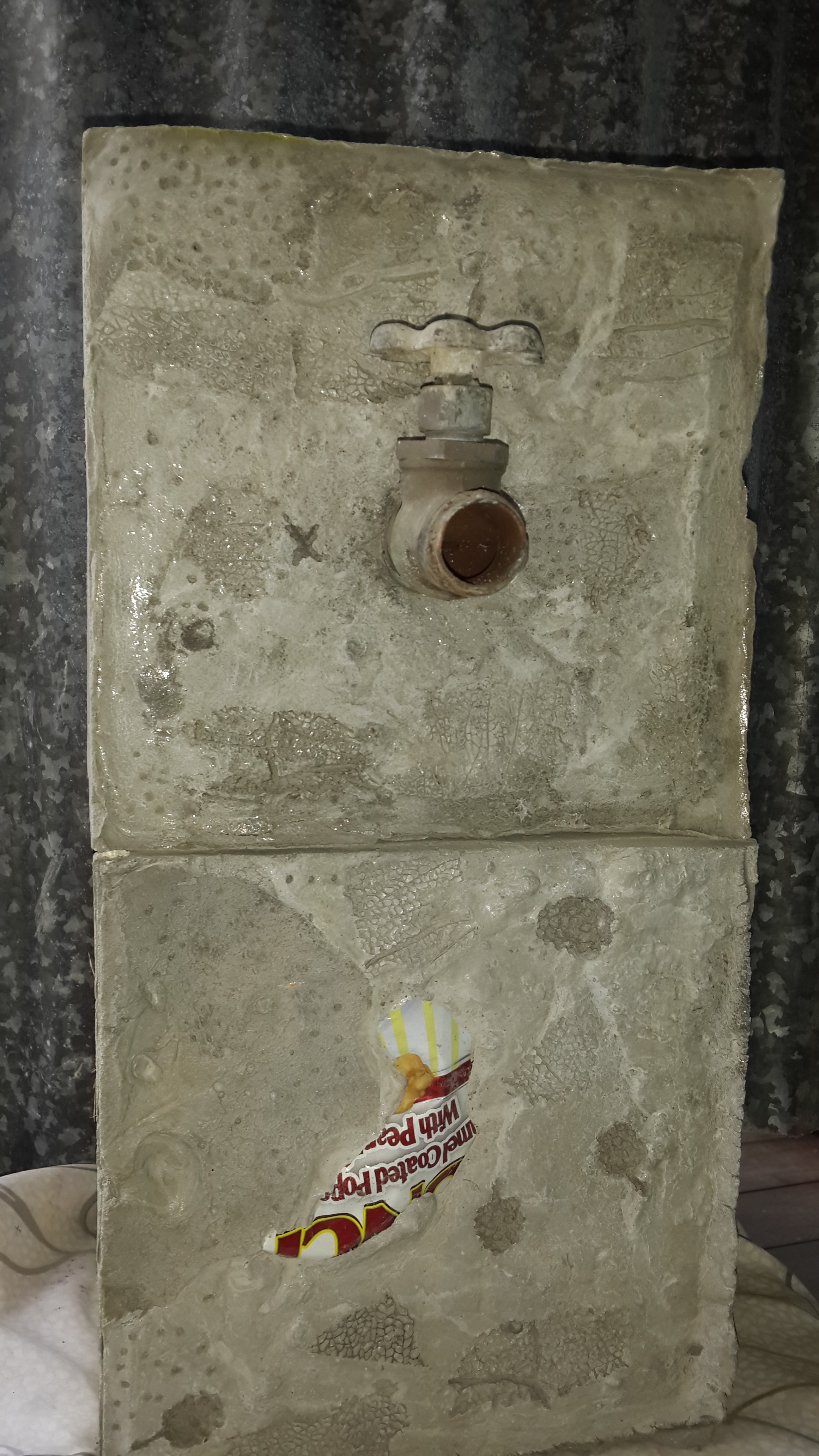
A detailed view of Aquifer

Week number 3 at Fresh Milk has been a mixed bag; and if I’m being totally honest, a bit disjointed.

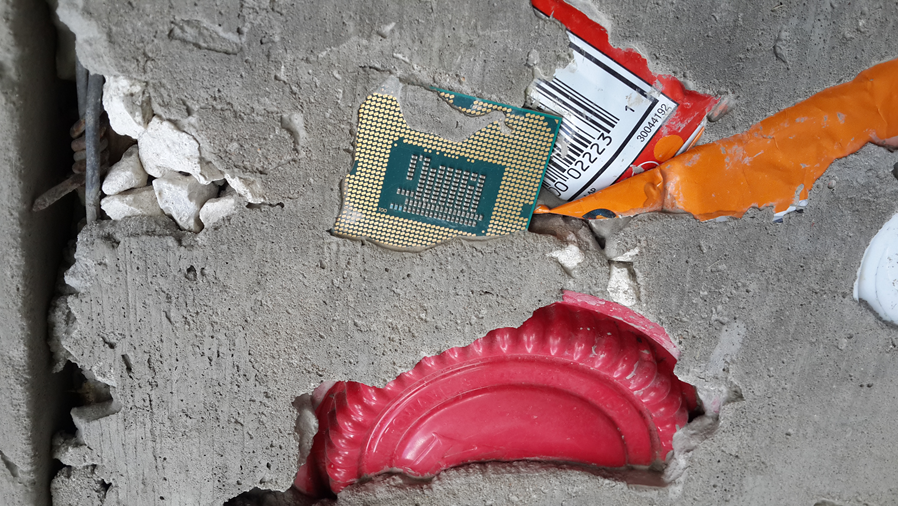
Happily, I’ve really started to get a handle on how the concrete reacts, and as such a better understanding of its characteristics, possibilities and limitations. While I’m loving all its various textural nuances and the ability to embed various materials, getting accustomed to the materials’ prep and drying times has been a challenge since I am not used to using mediums with long drying times. Perhaps this stems from primarily utilizing a hairdryer for most of my acrylic works. This is my preferred method of hurrying the drying process, out of a little impatience and eagerness to allow additions to be made to artwork. However, I am getting used to the wait.

In addition, I’m gaining more clarity conceptually, relative to overall directions I wish to take, on individual pieces I’m working to resolve, and those I have yet to get started on. On Saturday, I was privileged to have a studio visit with Natalie McGuire, Gallery Manager at Gallery NuEdge, where we discussed the themes that I’m currently working on.  I’m interested in using a broader theme of “the shifting philosophies of the traditional Caribbean landscape to one which is littered not only physically but figuratively as well.” The land is becoming a mirror for the mindsets of our people. This main theme of interest is accompanied by satellite themes of consumption, mass manufacturing and materialism.

Work in progress Aquifer

It’s amazing how time flies. At the onset, a month seemed a long time, but with one week left I’ve constantly been feeling like I need to do more. This week I’ve found it hard to balance my output and expectations with all the other projects and commitments outside of the residency. It was only after a chat with an art colleague, that I was reminded that we are artists and not machines, that sometimes things happen in their own time.

So…it’s with that timely reminder that I go into my final week with renewed energy and a plan to focus on things that can realistically be completed by week’s end; with the knowledge that as the residency comes to a close, that the exploration has only just begun.

Experiments

Idyllic Caribbean garden on the grounds of Fresh Milk

Kraig Yearwood’s Residency – Week 2 Blog Post

Barbadian artist Kraig Yearwood shares his second blog post about his Fresh Milk ‘My Time’ Local Residency. Having spent the first week researching and collecting his thoughts, Kraig has progressed into experimenting with materials such as concrete and discarded objects, seeing how these interact and address the conceptual side of his work. Read more below:

3 of the works in progress, each utilizing items of trash encased in concrete.

It’s now the conclusion of my 2nd week at the Fresh Milk residency, and I’m a bit more focused and much more clear on the direction of the work. Usually my mixed media production relies on the use and incorporation of items and found objects that I find some aesthetic quality in, but during this residency my main focus will be exploring the inclusion of garbage and objects mainly acquired during my walks and runs across the length and breath of Barbados, as well as trash generated during my stay.

In the week ahead, it’s my hope continue to work on a few of the themes I’ve been developing and to introduce the use of resin.

During my 1st week and most of my 2nd, I’ve had neither the time nor the head-space to enjoy and appreciate just how beautiful the grounds that are home to Fresh Milk are.  It was while waiting for cement to dry on Friday that I decided to explore the outside of my studio a bit take in the amazing flora and fauna in every corner. Yes, while it’s true the Fresh Milk platform is located a working dairy farm, there’s no shortage of all manner of critters as well as an impressive array of plants and flowers and of course beautiful Caribbean light.