Quid Pro Quo: Skills Exchange Programme at Fresh Milk

The winner of this year’s Fresh Milk ‘My Time’ Local Residency, Anisah Wood, will be in residence with us between June 6 and July 1, 2016. As part of her community outreach during her residency, Anisah will be offering the programme Quid Pro Quo – a series of skill-exchanges at the Fresh Milk studio.

Modeled after the Trade School concept, founded in part by New York based artist Caroline Woolard whose practice “explores intersections between art and the solidarity economy,” these sessions will become a non-traditional space of learning and sharing, emphasizing the value of people’s passions and skills.

Quid Pro Quo will be held at Fresh Milk over a period of four weeks, with the first session being held on Friday, June 10, 2016 at 3:00pm.

Skills Exchange Flyer

The programme will be structured as follows:

  • Each participant must be willing to share either one’s passion, skills or knowledge in exchange for the skills or knowledge of the other participants.
  • Each participant can offer an option of 2 to 3 topics or skills. For example, Anisah will offer: ‘Digital photography 101’, ‘The art of collage’ and ‘How to play warri and potta (traditional board games)’. Note that what is offered does not have to be art oriented. The idea is simply to share knowledge with the expectation of receiving knowledge in exchange.
  • The result is at most a 4 for 1 exchange.
  • The setting in which the information is dispensed will be informal and the manner in which each participant relays the information is completely up to the individual. It can be a discussion, hands on experience, a series of exercises, a presentation etc.
  • Each participant will select from the options offered what they would like to know from the other participants. The option that receives the most votes will be the one discussed.
  • Finally, each participant will be assigned a day in which they will give their presentation, with the option of Tuesdays, Wednesdays or Fridays with flexible hours between 3:00-6:00 pm.
  • There will be a limited number of participants approximately 4-5 in order to allow the exchange to be completed within the duration of the residency.

How to register:

To register, email freshmilkbarbados@gmail.com with the subject line ‘Quid Pro Quo’ and provide your name, contact information and the knowledge to be bartered in exchange for one of the skill-sets Anisah will be offering by June 7, 2016.

From the response, the participants will be selected and informed of their acceptance by June 9, 2016, in time for the initial session on June 10 at 3:00 pm.

During this meeting, each of the participants will be assigned a week from which they will determine what day and time they will be hosting their session. The participants will then vote on the focus of each session based on the options provided.

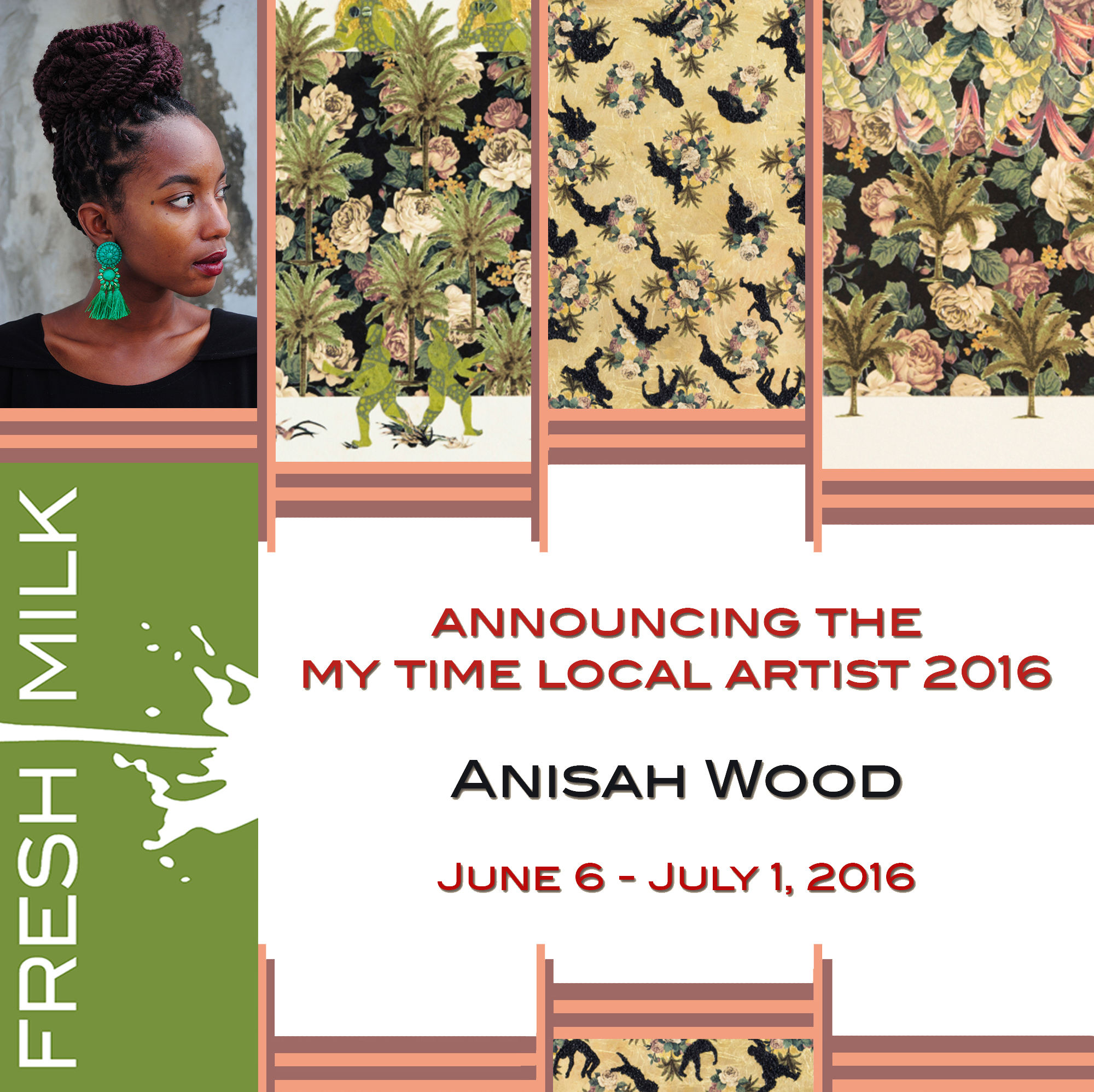
Announcing the Fresh Milk ‘My Time’ Local Resident Artist 2016 – Anisah Wood

Anisah Flyer

Fresh Milk is very pleased to announce Barbadian artist Anisah Wood as the winner of the Fresh Milk ‘My Time’ Local Residency prize for 2016. Congratulations Anisah!

Anisah’s one-month residency runs from Monday June 6 – Friday July 1, 2016.  Her work deals predominantly with the Caribbean landscape and the process of colonialism, particularly the desire to lay claim to and control space. During her residency, she will continue her investigations into the perceptions of her immediate environment and the influence of territoriality on how it is negotiated. She will use this engagement with a fresh environment to stimulate new conceptual ideas.

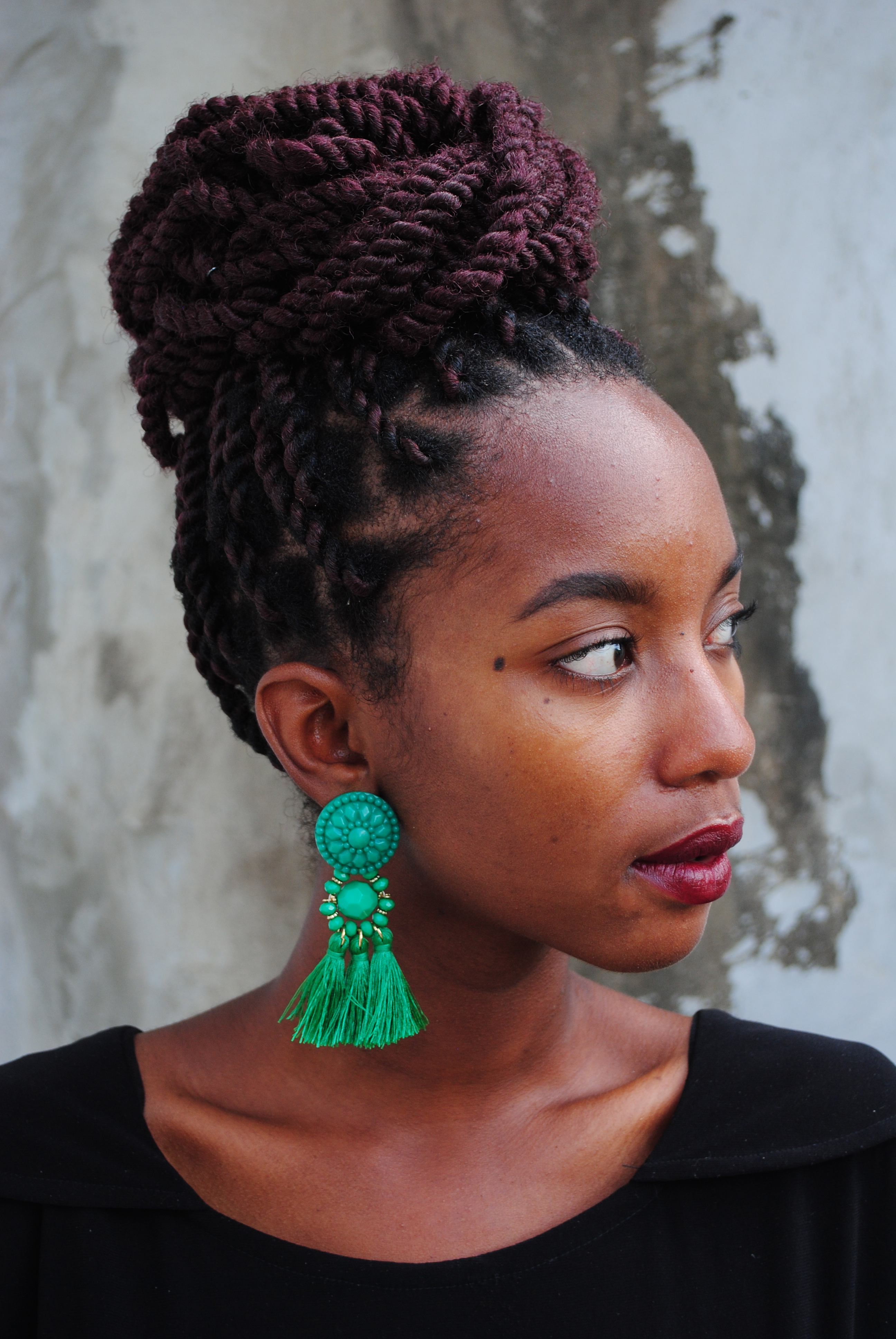
DSC_0012

About Anisah Wood:

Anisah Wood is a visual artist based in Barbados. She is in the process of completing a Bachelor of Fine Arts from the Barbados Community College with a major in Studio Art. Her practice involves video art, digital photography, and installation. She has had the privilege of exhibiting the results of her practice at the Punch Creative Arena, The National Arts Council Barbados and at various national arts competitions.

Artist Statement:

My current body of work maps the transformative effects of territoriality on a physical landscape and the society that engages with such a space. These explorations stem from my immediate environment, the Caribbean region. This region has consistently been labelled a paradise, a description that can be considered an impetus for expressions of territoriality. Therefore, through a multidisciplinary approach, this body of work examines the resultant complex relationships between space and society, and between various societal groups in connection to that space. In addition, while seeking to understand the desire to control a delineated space, the work also questions the authority to lay claim to an area. The work can therefore be considered an alternative vision of the space I occupy.

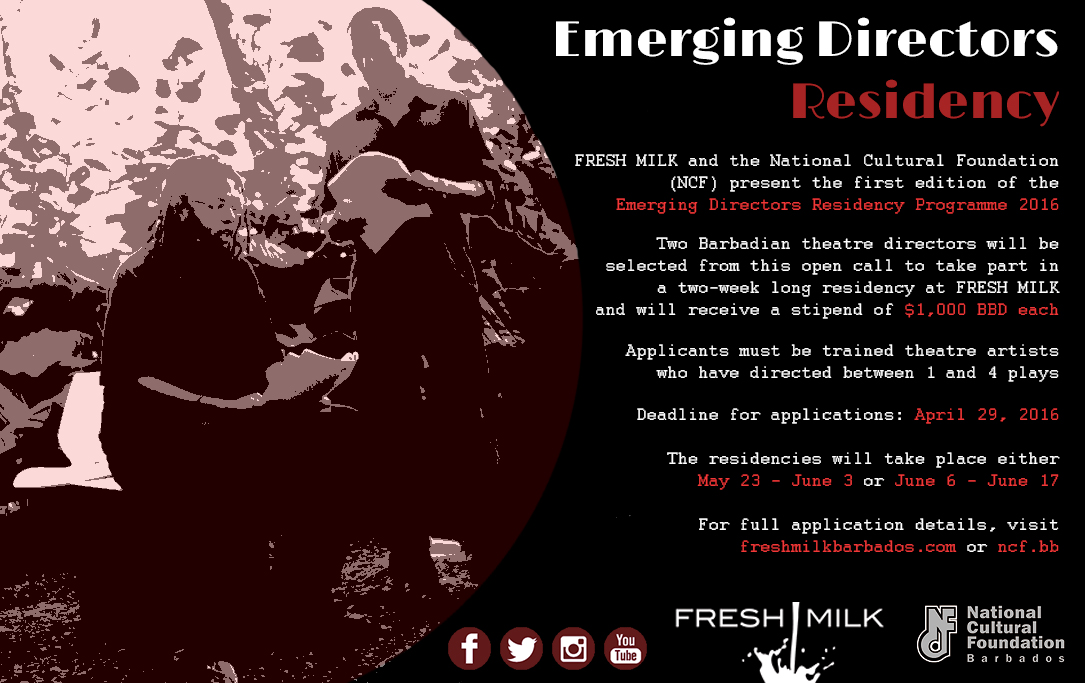
Open Call: Fresh Milk and the NCF announce Emerging Directors Residency

The Fresh Milk Art Platform and the National Cultural Foundation (NCF) are pleased to share an open call for their first collaborative Emerging Directors Residency 2016. This exciting new partnership is a paid artist residency for early career theatre directors, which will provide them with an opportunity to conduct much needed research into Caribbean theatre heritage and to explore and create through theatre form and style.
FM-NCF Emerging Director Residency Flyer

Two residencies will be offered, for two emerging Barbadian directors who will receive a stipend of $1,000.00 BBD each. Each residency, which will be based at the Fresh Milk studio in Walkers, St. George, will run for a 50 hour period which the resident must complete over two weeks. There are two fortnightly time-frames scheduled between May 23 – June 3 or June 6 – June 17, and each candidate may choose which time-frame is suitable for them. The deadline for applications is April 29, 2016.

Residents will be mentored over the course of the programme by a noted Barbadian/Caribbean Director and, at the close of the period, each will present, by way of a small showcase with actors, aspects of the work they have been exploring.

Rationale:

Residency programmes afford professionals time and space away from the demands of daily work life to carry out much needed professional development. Outside of traditional longer term training, a paid residency allows artists time, however short, for contemplative study and exploration. In the Barbadian context, there is much focus on the training of performers, however there are considerably fewer opportunities for those theatre artists with a special interest in directing to hone and develop their skills. Highly skilled, culturally aware and visionary directors are needed, as we move nationally to advance our cultural industries sector, and to enrich the quality of small and large scale staged events, whether drama, music, dance, or indeed multimedia events.

Greater awareness of Barbadian/Caribbean theatre form and style will serve to enhance the ideological and interpretive output of those up and coming directors on the local theatre scene, and equip them to create work that consciously and profoundly engages with Barbadian tradition. ‘Emerging Directors Residency’ offers an opportunity to design and apply staging concepts for ‘alternative spaces’, i.e. the “site-specific”, and otherwise environmental concept. It offers mentorship, access to archival material, and affords time for creativity.

Objectives:

– Partner with local and regional arts platforms to offer developmental opportunities for artists;

– Provide a forum for emerging directors to research their craft through mentorship, and through access to documented and archived material;

– Provide emerging directors with a secure and rigorous environment for practice, and the resources with which he or she may develop emerging work, and/or experiment with new ideas;

– Provide opportunities for actors to work with emerging directors in a developmental and experimental workshop setting.

Eligibility:

The ideal candidate should be a trained Barbadian theatre artist, who has directed between 1 and 4 plays.

Duration of Programme:

1 Session per Resident: 50 hours to be undertaken over EITHER May 23 – June 3, 2016, OR June 6 – 17, 2016.

Application process:

Prospective candidates can apply with the completed application form (which includes a bio/artist statement and project proposal, and can be downloaded here), full CV and portfolio, writing samples from your director’s notebook and 2-3 critical (newspaper, peer or academic) reviews of recent work to the National Cultural Foundation, Theatre Arts Office at the email address ncftheatrearts@gmail.com or lisa-cumberbatch@ncf.bb before midnight on Friday, April 29, 2016. They will be interviewed by a panel comprising NCF and Fresh Milk officials.

Successful candidates for the residency will be offered a stipend of $1,000.00. The resident is required to spend 50 hours at Fresh Milk in Walkers, St. George and should indicate a potential schedule of days and times they might be available during the interview process. The mentor will spend 10 hours in total with each resident over each 50 hour session. Each resident will have access to two actors for 15 hours to experiment and/or create work. At the end of each period, there will be a short showcase where the residents share aspects of the work they have been contemplating.

Expectations:

In addition to the 50 hours spent at Fresh Milk, each resident will be required to keep a weekly blog of text and images documenting their thoughts and processes which will be shared on the Fresh Milk website. At the close of the residency, each resident will also be required to submit a report according to Fresh Milk and the NCF’s guidelines.
Sonia Farmer’s Residency – Week 2 Blog Post

Fresh Milk resident artist & writer Sonia Farmer shares her second blog post. Although she came to Barbados with a specific project in mind, she has found herself drawn to a new idea based on a book in the Colleen Lewis Reading Room collection – ‘A True and Exact History of the Island of Barbadoes’ by Richard Ligon, originally published in 1657. Using a method of  found poetry called erasure, she is responding to the text by identifying words and phrases that stand out to her, changing the meaning and context to create an entirely new piece. She also hosted day two of her book-binding and design workshop ‘The Art of the Book‘. Read more below:

“I found myself a stranger in my own Countrey.”

That line jumped out at me as I combed through the book, A True and Exact History of the Island of Barbadoes by Richard Ligon pulled out of the Colleen Lewis Reading Room library by Annalee when I asked if she had any old local texts. I had planned to use it for an erasure exercise in my first class, which I did, but immediately became obsessed with creating my own response to the book. I could see a new poem emerging from the strange story told from an Englishman’s perspective in the 1600s. Putting aside the project I had planned to focus on in my time here, I’ve allowed this new endeavor to drive my inspiration for the time remaining: an erasure called A True and Exact History, gleaned from this delightful account.

An erasure, as I explained to my students, is the act of removing words from an existing piece of text in order to create a new poem. I’ve always admired the method, specifically in the brilliant ways writer and artist Jen Bervin has used it, but didn’t explore it much myself until a few years ago. I’ve found more and more that I enjoy using one part erasure, one part found language to drive the content of my work—not because I find it difficult to use my own words, but because I love the challenge of such an exercise, finding new narratives from often outdated accounts to construct a contemporary response. I also enjoy using language against itself and out of context to bring attention to its disparities and contradictions.

I used this method a few years ago to form the collection of poetry in ‘Clipping Feathers’, taken from newspaper stories surrounding a major event in Bahamian history shortly after our Independence. With the fantastical narratives I constructed out of sensationalized accounts, I found a way to address the lack of contemporary Bahamian history studies—since, like me, many young Bahamians may not even know about this groundbreaking event, we are left to create our own fictions, a dangerous place from which to glean our national identity.

5

I’m coming from a similar place of ignorance with A True and Exact History. Purposefully, I am not “reading” the text as I seek out its underlying narratives. I also don’t yet fathom how important it has been in Bajan history, though through informal conversations with Bajans, I am starting to get the picture. I did read a little bit into Ligon’s background, finding that he arrived in Barbados late in his life after political upheaval in his home, built a sugar plantation, and then wrote this book in jail upon returning to England from Barbados. I don’t want to research too far, however, holding myself back so as not to directly influence my exercise, not yet anyway. The reason is because I want to be an explorer here in an unknown territory—as I am in these new surroundings. I’d like the narrative to form organically out of that experience.

The resulting narrative so far has been exciting to me in its abstracted exploration of emotional landscapes. I had said before that as a person from the Caribbean, visiting other islands in the region is an exercise in magical realism. This new poem is helping me to explore that and deconstruct it. After all, what does it mean to write a “True and Exact History” of anywhere or anything or anyone? How conceited is that? Recognizing the importance of this text is necessary, but not without the lens of colonialism and privilege. With his own biased eye and with centuries between its inception to now, the text is strangely poetic even at its most problematic moments. It’s a gorgeous text to explore and consider, and I hope it yields an interesting result by the end of my stay.

Week two of my Art of the Book class found us exploring the wonderful world of chapbooks, small presses, and simple sewn binding structures. I gave everyone a crash course in chapbook history and highlighted the work of a number of small, independent presses. Then we reviewed some student projects completed at home using last weeks’ structures and writing challenges. All I can say is I’m one proud teacher! The books they’ve made are awesome, fully engaging with everything these structures have to offer to their individual narratives.

Then we got to work on sewn structures, including the Japanese stab-binding and pamphlet stitch. In order to register for the class, students had to submit a poem of their choice. I gathered these into a simple chapbook called “Fresh Verse” and also made us a special press name, “Fresh Chaps,” under which we made twelve copies—one for every contributor, and two for the Colleen Lewis Reading Room itself. So by the end of the class, everyone got to bind a limited edition anthology of class poems. Who knows, maybe there will be a volume two someday?

Alex Kelly’s Residency – Week 1 Blog Post

Trinbagonian artist Alex Kelly shares his first blog post about his Fresh Milk residency. In the first week, he has been observing his surroundings in Barbados, drawing parallels to his own experiences of his home Trinidad and Tobago and even to Aruba, where he took part in the regional residency Caribbean Linked III in 2015. These familiarities and shared histories, which manifest in different ways and yet connect the region as a whole, have already become a source of inspiration for the artist during his short stay. Read more below:

IMG_2578

Exit the airport, navigate the roundabout and head past the rows of identical houses on route to your destination. Quick stop at a gas station convenience store to collect imported bananas, Blue Waters and a pack of Devon biscuits to hold you over for the night. At some point you pass cane fields and former cane fields only illuminated by the moon and by headlight. All the while you’re discussing economics; the collapse of the sugarcane industry and the ever present anxiety about the need for foreign revenue. One would be forgiven for assuming I was talking about Trinidad.

I have seen landscapes that take me back to Aruba, driven through memories of St George’s and Scarborough and I’ve walked back to my flat at night, under the blessing of a gentle shower of rain, looking over what I might mistake for the Queen’s Park Savannah, if I would only allow it. And in the distance, witnessed hills ablaze with light, as though I were admiring east Port of Spain from afar. And although I’ve developed a curious fixation on identifying the direction of Trinidad and Tobago from whatever spot on the island I might be occupying, I’ve discovered that I’m not so far from home.

I came to Barbados seeking to discover some connective tissue between the islands. I expected that it would be tight and pulled thin under the strain of decades of movement in independent directions. But at every moment I am reminded that I am in the presence of a people whose history is my own and who are shaped by the same education, so that no matter how opposing the forces of change may be, the direction of travel remains tangential to the same circle. The call of history rings out loudly in Barbados. It is a familiar tune, but one that I have never heard as clearly as I do on this island. Except for a few power lines, there are passages through cane fields where one is easily transported to 1816, and “their history” becomes my history.

IMG_2743

These experiences are not nostalgia. Nor do they represent a longing to be elsewhere. Rather, they speak to the wealth of inspiration that I have encountered in my short stay. If I were to return home tomorrow, I would do so satisfied that the ideas given life here would bear fruit for some time to come. One can scarcely imagine what wonders the three remaining weeks will have to offer.

________________________

Tridium

This residency is supported by Tridium Caribbean Limited