I presented my work to art majors at BCC (Barbados Community College) on Monday. Seriously one of the toughest crowds ever. They seemed to have a lot to say based on facial expressions and whispering amongst themselves but would not say much to me no matter how I tried to engage them. I learned afterward that this is common among students here. One student also told me privately after class that the fact that I framed my work as feminist made the males afraid to respond based on what other guys might think of them. He also thought that the young women in the class might be afraid to respond, not wanting the guys to think that they were man-haters. When I mentioned feminism, one male student sadly asked “Why feminism? Why not something that includes everyone?” I tried to quickly define feminism and told him that it does include everyone. Then I prescribed some bell hooks.
I went back the next day with just Annalee’s class (a much smaller group than the day before) to watch Herb & Dorothy. It’s a really sweet documentary about this average couple (librarian & postal worker) who live in a cramped one-bedroom apartment and and spend their 40-something year marriage cramming the space with an amazing art collection worth millions. And then they refused offers to sell the work and instead donated the entire collection to the National Gallery.
After the film there was some very lively debate about what art is and what it is isn’t. Some of the students were quite offended that I’d said in my presentation the day prior that I believe that everything is art. They didn’t raise it during my talk but apparently talked a lot about it afterwards. It was great to hear the students’ views and I really enjoyed engaging with them and getting to see one student’s work after class.
At the end of the week I went with the same group to a gallery called ArtSplash where a local artist exhibiting there spoke with the class about his work. It was nice being able to interact with a local artist and hearing about his practice and process.
I feel like my consciousness is expanding in so many ways. I have been consuming so much beauty here on a daily basis. I have been absorbing art and conversations. I have experienced new levels of solitude. It takes me a long time to process things so I have no idea how all of this is going to manifest in my art in the long-run…
I have been filming a lot (as always). The scenery is magical and I want to capture everything. I also make sure to pause at moments to take it all in without the camera. On Saturday Mark King, another local artist, took me to Bathsheba Beach so that I could get some footage. It was overwhelmingly beautiful and I’m really thankful that he was willing to be so generous with his time.
On Thursday Katherine invited me to her zumba class. It was absolutely amazing! Nothing but soca and dancehall music and a fun opportunity to wine up and wuk up! I learned some new moves to bring back to New York.
The project I came here to work on feels stagnant right now. I am trying to breathe new life into it but I’m not sure how. I feel extremely inspired but it’s like I’m in a completely different dimension than when I began working on the Fresh Performance interviews way back in April. On the positive side, editing the work means deep listening to the words of the artists I’ve interviewed and I am gaining a lot of inspiration and insight from them as well.
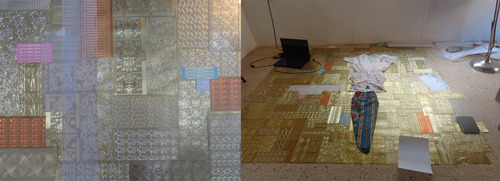
And as you can see in the photos and video, I’m still enjoying covering things in glitter.
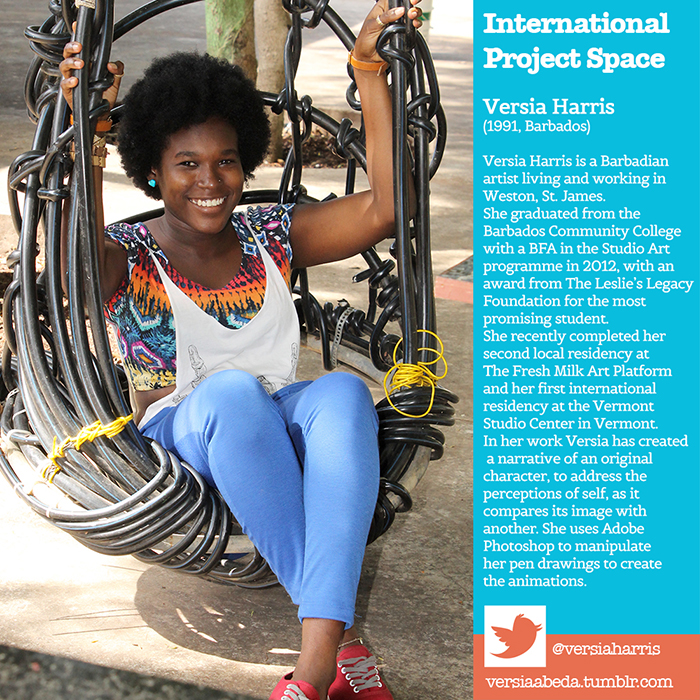
Barbadian artist Versia Harris blogs about her residency at the Instituto Buena Bista (IBB) in Curacao, where she is taking part in their International Project Space programme for the month of October, 2013.
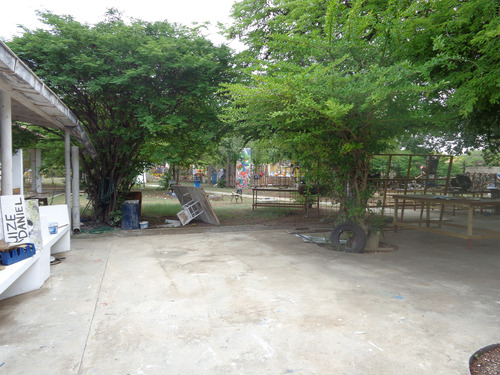
My impression of The Instituto Buena Bista when I first walked through their offices, studios and expansive garden, was that it is a place that supports art experimentation of all kinds. Whether it is audio, video, photography, new media or mixed media, etc, they have rooms and equipment that make these things possible. Scattered everywhere is artwork, both finished and unfinished. The place immediately put me at ease and also made me excited about creating new work.
The IBB courtyard
Most of the first week was just about settling in and getting familiar with Curacao life but by the end of it, I started to flesh out some of the ideas rolling around in my head.
The second week commenced my teaching at the Institute. I opted to demonstrate to the students how I produce my animations so that they could then produce their own. Tutoring so many people is an entirely new experience that came with its ups and downs. On the one hand, most of them are quite receptive and have come up with some nice ideas of what to animate. On the other hand, students will be students. I found it difficult at first to deal with some of the excuses as to why they didn’t do this or that, the very late submissions or complete absences that kept me repeating myself. The experience is exciting and rewarding yet frustrating and exhausting, but it is something that I’m glad I got the opportunity to do.
Outside of my lessons some of the students and I have been discussing and exchanging ideas. I’ve started to toy with some live action video, something I have almost no experience in. It hasn’t gotten very far so I’m not sure how I feel about it yet, but I’m looking forward to what the rest of the time reveals to me about this medium.
Being an artist means being able to trust one’s intuition. Intuition may be viewed as an abstract concept. Some may even think it is nonsense, the kind of foolishness that intellectuals or sensible people do not discuss. Since artists are often dismissed as senseless dreamers, intuition is risky territory for us to cop to. Contemporary art is about research and rigor, strong concepts and aesthetic concerns. Of course all of these elements, as well as technique and skill are crucial to the work. Yet that does not diminish the importance of intuition.
Growing up I remember hearing my mother exclaiming in frustration, “I should have followed my mind!” anytime she ignored her intuition and faced negative consequences. This always stuck with me and as a result I try to follow my own intuition as much as possible, especially when it comes to making art. My practice is very research-based and I love to read and write about a project extensively before, during and after creating it. But at some point I have to surrender to my muse and follow the art wherever it takes me.
Suspecting that other artists might approach their processes similarly, I interviewed Brooklyn-based artist Maria Hupfield, who is a member of Wasauksing First Nation, and Jamaican artist Olivia McGilchrist. Both use their own bodies to explore issues of culture and race in order to address universal concepts such as connectivity and alienation. They both also utilize costumes and props in creating the scenarios in their performances. These artists begin with a clear concept, an ideal vision of how their performances will manifest. But at some point they let go and allow the performance to carry them in order to create change by furthering dialogue about pertinent issues in their respective communities.
Maria Hupfield is a multi-disciplinary artist who creates the objects that she uses in her performances along with bodily gestures and her voice. These tools facilitate her performances, which are part of what she deems “new conversations.” However there is simultaneously a timeless as well a futuristic quality to her work. I met with Maria in her studio in an industrial area of Brooklyn. In performance, Maria is bold and confident. Yet in casual conversation she is soft-spoken and very careful about her thoughts and words. Talking with her it became clear that she applies the same careful consideration to her work so that by the time she arrives in front of an audience she can embody that sense of confidence and clarity.
Olivia McGilchrist was born in Jamaica to a French mother and a Jamaican father. She spent most of her life in Europe and suddenly had to return to Jamaica two years ago. This is the impetus for her alter ego “Whitey.” This work is not only about Olivia’s experiences of whiteness in Jamaica. She hopes to raise questions about whiteness in the Caribbean context. Olivia is using performance to help process these heavy personal as well as societal concerns.
This is my final posting for my six-month off-site residency with Fresh Milk. I am so grateful to Fresh Milk and all of the amazing artists that I have had the opportunity to speak with and learn from during this time.
What I did not reveal is that the six chapters of the Fresh Performance Project were based on the chakras, which are energy centers throughout our body. There are seven that people tend to focus on and I used these as the template for this project, inspired by the work of performance artist Linda Montano.
The first chakra is the root chakra and it is the place of grounding. So chapter one was about defining performance art in order to ground the project.
The second chakra is the sacral chakra and concerns sexual matters and chapter two focused on gender and sexuality.
The third chakra is the solar plexus and is our power center so of course chapter three was about performance and power.
The fourth chakra is the heart chakra and is all about love, as was chapter four.
The fifth chakra is the throat chakra and governs communication. Chapter five discussed how performance communicates.
The sixth chakra is our third eye, which is the space of intuition and here we are at chapter six: intuition and vision.
The seventh chakra, the crown chakra, is about Divine connection and oneness. Instead of a seventh chapter, this chakra will be represented by a full-length documentary bringing together all of the artists I have interviewed over the last six months. The intention of Fresh Performance was to learn about the connections and differences amongst artists working with performance in NYC and those in the Caribbean. I have learned a tremendous amount, not only about performance art and contemporary Caribbean art, but also about kindness, generosity and the ways in which we are all connected.
Thank you so much to all of the artists who have participated and a huge thank you to Fresh Milk and Groundation Grenada! Also, thank you the U.S. Embassy for funding this amazing residency. I am infinitely grateful for this opportunity.
Born in Kingston (Jamaica) in 1981 to a French mother and a Jamaican father and educated in France and the U.K., Olivia McGilchrist moved back to Jamaica in 2011 after completing a Photography M.A. at the London College of Communication (2009-2010). Since this sudden return, her current practice has incorporated her body, remapping it within the tropical picturesque through photographic tableaux and multi-layered videos. She has indulged her alter-ego Whitey in her appropriation of this space of utter difference, Jamaica, by exploring trans-location and physical expressions of emotional states in the search for her cultural identity. McGilchrist was recently awarded the prize for Best New Media artist at the 2013 trinidad+tobago film festival.
Maria Hupfield (born 1975) is from the Georgian Bay region Ontario, Canada and currently based in Brooklyn New York. She is of Anishnaabe (Ojibwa) heritage and a member of Wasauksing First Nation. Hupfield holds an MFA in sculpture from York University, Toronto. She recently participated in: A Conversation on Performance Art: Women Redrawing/Performance, organized by The Feminist Art Project at SOHO20 Chelsea NY; (2013) Wave Hill’s Winter Workspace Program, Glyndor Galley, Bronx, NY; and (2012) Artist Leadership Program, National Museum of the American Indian Smithsonian Institute, Washington DC. She has performed at ACCOLA GRIEFEN GALLERY, Chelsea NY, Grace Gallery, Brooklyn NY and (2012) 7a*11d International Performance Festival, Toronto ON. Hupfield’s work is currently in the traveling exhibitions Beat Nation and Changing Hands III.
Hupfield’s work was featured in the 2011 winter edition of Black Flash Magazine on performance photography and in the North Edition of Fuse Magazine winter for the collaborative artist project “From the Moon to the Belly” with Laakkuluk Williamson.
ART APPRECIATION: WHAT’S THIS THING CALLED CONTEMPORARY ART?
DEADLINE EXTENDED – NEW COURSE DATES
Barbados Community College has extended registration for the Art Appreciation evening course by one week. The class is now scheduled to begin on Thursday October 10th. Registration closes at 3pm on Monday October 7th.
WHERE: Barbados Community College (BCC),Art Division of Fine Arts, Morningside Campus, Art History Room
WHEN: October 10 – December 19, 2013 (Thursday nights)
TIME: 5.30PM – 8.30PM
COST: $400.00 to be paid no later than Monday October 7th. The cashier’s office closes at 3pm.
HOW TO REGISTER: Go to Student Affairs in the Administration block at BCC. The registration form can be downloaded here.
DATES: October 10, 16 (Wednesday), 24, 31; November 7, 14, 21, 28; December 12, 19
COURSE DESCRIPTION: This Art Appreciation Course is designed to provide you with a basic understanding of the contemporary visual arts produced in Barbados, the Caribbean and its diaspora, with a focus on emerging and contemporary practices. Through material covered in this course, you will become familiar with work being produced by select contemporary creatives working in Barbados, the Caribbean and further afield which may include looking at major Caribbean exhibitions. A selection of ART 21 videos will be screened showcasing interviews with contemporary artists from around the world, speaking about their practices. The introductory presentation will speak to ways of looking at art allowing you to develop a strategy to discuss and understand works of art. This course will also cover the increased presence and role of informal art spaces throughout the region and their impact on the contemporary art space. The elements that comprise a developed creative economy will be explored. Guest speakers will join some of the weekly sessions, exposing you to the richness of creatives working in Barbados. At least one off-site class will allow you to experience an event showcasing contemporary creatives sharing and speaking about their practices.
COURSE OBJECTIVE: The objective of this ten-session course is to develop an awareness of and appreciation for contemporary art practice. This framework will enable you to expand your understanding of the contemporary arts arena, stimulate critical thinking generally, and enhance your enjoyment of art. The course is suitable for enhancing your general knowledge about the arts and may stimulate confidence for the budding art collector.
ABOUT THE TUTOR: Annalee Davis is a part-time tutor in the BFA programme at the BCC. She is a practicing visual artist whose work exposes tensions within the larger context of a post-colonial Caribbean history and observes the nature of post-independent (failing) nation states. She explores notions of home, longing and belonging; questions the parameters that define who belong (and who doesn’t), and is concerned with issues surrounding the shifting landscapes of the archipelago. She has exhibited her work throughout the Caribbean and internationally since 1989. Annalee completed a BFA at the Maryland Institute, College of Art and an MFA at the Mason Gross School for the Arts, Rutgers, The State University of New Jersey. She works from her studio, The Milking Parlour in St. George, Barbados. In August 2011 she founded The Fresh Milk Art Platform Inc., a platform for conversation about contemporary art and a space supporting emerging talent.
FRESH MILK and Groundation Grenada are pleased to have NYC-based, Guyanese performance artist Damali Abrams visit our platforms as artist in residence for the month of October, 2013.
Damali, who has been working with FRESH MILK on The Fresh Performance Project which features interviews with Caribbean-based and NYC-based performance artists, will spend three weeks in Barbados and one week in Grenada. In addition to editing a full length documentary around Fresh Performance and producing her own work, Damali will also be conducting workshops and community outreach projects in both islands.
This exciting residency not only marks the first official collaboration between FRESH MILK and Groundation, but will also expand the cultural arena for both NY based and Caribbean based creatives, contributing to critical discourse around performance art.
Fresh Milk and Groundation Grenada wish to engage with the Caribbean diasporic art community in the New York area as well as a wider U.S. audience, and projects of this nature are unique in that they reverse the trend of Caribbean based artists wanting to find relevance for their work in a North American context. In this instance, it is a U.S. based artist who is keen to see how her work resonates within the Caribbean environment.
Given that performance art in the Caribbean is practiced by a small number of artists, this project will contribute to expanding a critical and creative community by offering support to performance artists who often work in isolation. Finally, the project will build cultural bridges between the U.S. and the Caribbean and generate understanding and community through the arts.
Damali will share the outcome of her residency at a public event to be held at FRESH MILK on October 24th. More information on this to follow!




 fresh milk barbados