by Annalee Davis
April Article
A reader of my last article expressed confusion over the term contemporary art. She wondered how it was that Joscelyn Gardner, (www.joscelyngardner.com) could be considered a contemporary artist even though she is working within the old tradition of lithography using stone.

Joscelyn Gardner, Mimosapudica (Yabba) Hand coloured Lithograph 2010
The use of the word ‘contemporary’ is confusing because it can suggest that all art made now is contemporary art. But this is not the case. The term ‘contemporary art’ has become a catch all phrase suggesting that there aren’t other movements happening and that all work produced conforms to some commonly understood manifesto. The reality is more layered and the term ‘contemporary art’ both does and does not make things clear.
So what’s considered contemporary art?
I schooled in the USA in the eighties. Although the work being produced at that time falls into what we still call ‘contemporary art’, there were many different kinds of work being produced at that time. I spent weekends traveling mostly to NYC, as well as to Philadelphia, and Washington DC where I saw Appropriation Art, Video Installation Art, Graffiti Art, Postmodern Art, and Institutional Critique among other types of contemporary art. The education I received visiting museums and galleries was supported by interacting with tutors who were very successful as contemporary visual artists, including Martha Rossler, Emma Amos and Leon Golub. In addition we attended the MFA visiting artist class and were exposed to visiting luminaries such as Hans Haacke and Adrian Piper.
Since my return to the Caribbean throughout the nineties and the noughties I have witnessed the advent internationally of Internet Art, Digital Art, New Media Art, Information Art and the rise of the Young British Artists and more recently VJ Art, Videogame Art, Virtual Art and Relational Art, among others.
Does contemporary art include all of the above? Yes. Does it include everything else being produced by all artists, everywhere, at the same time? No. So what’s the difference?

Bottom Bay – Painting by Steve Bonner
Many museums of contemporary art state that their collections include works made after the second world war. In addition, one of the defining characteristics is that contemporary art refers to works that offer something new in terms of their ideas and/or technical manifestation. In other words, there’s something unexpected and innovative conceptually and/or technically; the work makes us notice something in a fresh way. In response to my reader’s question, contemporary artist Joscelyn Gardner uses the ancient art of stone lithography in a subversive way to explore her identity as a (white) Creole Caribbean woman, with a novel twist to the labour intensive medium she employs as a white woman visually acknowledging the historical toil of black female workers.
Contemporary Art in the Caribbean
There are many people in the Caribbean making artistic things at this particular moment in time, many of which are displayed in scores of art galleries throughout the islands. This often includes watercolours and acrylic or oil paintings that portray the flora, fauna, land and seascapes and portraits of people in ways that may (or may not) stress the technical virtuosity of the practitioner. Buyers of this work may enjoy the technical proficiency and beauty of these pictures. Or, sometimes the images rendered are reminders of a beautiful location and buying this painting allows us to hold the memory in a more tangible way. And yes, it might, on rare occasions, even include a lithograph portraying a riverside scene in a tropical forest.
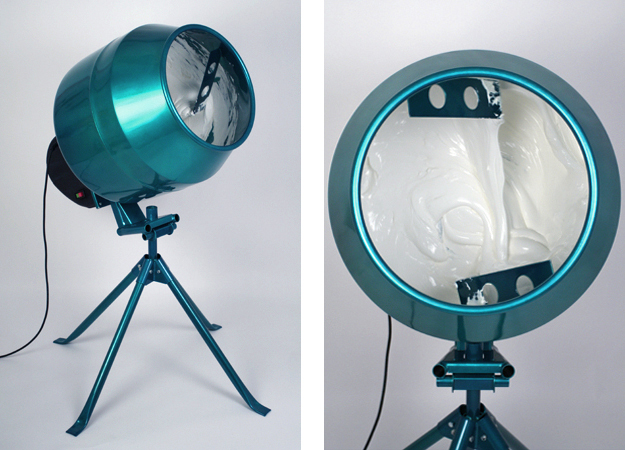
Work by artist Blue Curry using a customised cement mixer filled with sun cream for the 6th Liverpool Biennial.
This is emphatically different from the work contemporary art that I am interested in following and learning more about. It’s work that surprises me when I see it because I have not seen the formula before. Maybe I understand its reflection or its sentiment, not because I am already familiar with the particular image/performance/sound/installation/still or moving image but because it has a curious nature about it which resonates with my own inquiring mind. I respond to this work at a visceral and an intellectual level – the work becomes an experience. And it doesn’t happen often.
When we view the painting of Bottom Bay by English artist, Steve Bonner, those of us who have been to Bottom Bay on the east coast of Barbados, will recognize the rocky coastline and the wide expanse of beach. Some might like this image because it’s familiar or because it evokes a fond memory even though it does not offer a new perspective on our reading of the beach.
Staying with the beach theme, we might view the subversive artwork by Blue Curry, a London based Bahamian artist, which was recently shown at the 6th Liverpool Biennial.
This installation uses an aquamarine coloured, customized cement mixer filled with twenty litres of sun cream. The strong scent of the sun cream elicits memories of a tropical beach and relaxed moments of lying in the sun. On closer examination, we understand that our tropical fantasy has been high-jacked and turned into a humorous even if frightening reflection on a region built as a playground for people from somewhere else, churning out all-inclusive, hedonistic getaways that local Caribbean people work at but don’t leisure in.
Both of these works were made in the same decade – Steven Bonner’s aged representation of a Caribbean seascape was painted in 2009, and Blue Curry’s satirical interpretation of tropical paradise was conceived and manufactured in 2010. Although both art pieces were produced in a similar time about a similar space, they could not be further apart. My sense is that a contemporary art museum might want to acquire only one of these works. Which one do you think that may be?



 fresh milk barbados