If you missed Fresh Milk‘s contribution to The Caribbean Digital conference, a Small Axe event that took place on December 4-5, 2014, you can watch the presentation archived online at Livestream.com, and read the transcription of the paper ‘Fresh Art/Spaces’ presented by Annalee Davis, Amanda Haynes and Yasmine Espert here:

Click here to watch the archived video presentation of Fresh Art/Spaces
Fresh Milk is an artist-led initiative based in Barbados that operates locally, regionally and internationally. It uses a model of social practice to engage with artists collectively, stimulating and fostering individual aesthetic practices, critical thinking and community bonding. When we speak about social practice we refer to the social engagement between people as an art in and of itself. In the spirit of social practice, Fresh Milk hosts “IRL/in real life” events at our working studio, and maintains a digital presence on WordPress, Tumblr, Twitter, Skype and Facebook.
We’ve built digital platforms to meet specific, immediate, and ongoing needs.
Fresh Milk’s most visible project to date is our freely accessible, interactive online map delineating the Caribbean’s brick-and-mortar art spaces from the nineteenth century till now. When sharing the updated map in April, the post reached 10,940 people on Facebook in 24 hours, and was reshared on Facebook by others from our website 684 times. This map is a work in progress and addresses the lack of available information about Barbadian and Caribbean arts at the formal, informal and educational levels. The map is not only a pivotal information hub and educational tool, but a place to witness Edouard Glissant’s poetics of relation manifest across linguistic spaces and epistemic virtues. Fresh Milk sees this as a collectively owned resource where we all become responsible in keeping it current. Suggestions for additions of new and emerging spaces are accepted through our multiple social media outlets. The map reinforces that the art world we see and experience in the Caribbean is a polyphonic arena with multiple centres, undoing the hegemonic discourse that places major metropolitan centers in the north at the pinnacle of artistic production.
Fresh Milk operates out of a dairy farm on the site of a former plantation. I am inspired by the scientific process of phytoremediation which refers to the capacity of some plants’ root systems to absorb toxins from a polluted field and restore harmony to the soil. Similarly, through programming and building relationships, Fresh Milk works to alter the very chemistry of our own soil stained by the traumatic legacy of our colonial history. Located on a former plantation that was once closed, Fresh Milk is now open, a site that was once exclusive is now inclusive, and what was a place of trauma is moving toward a place of nurturing.
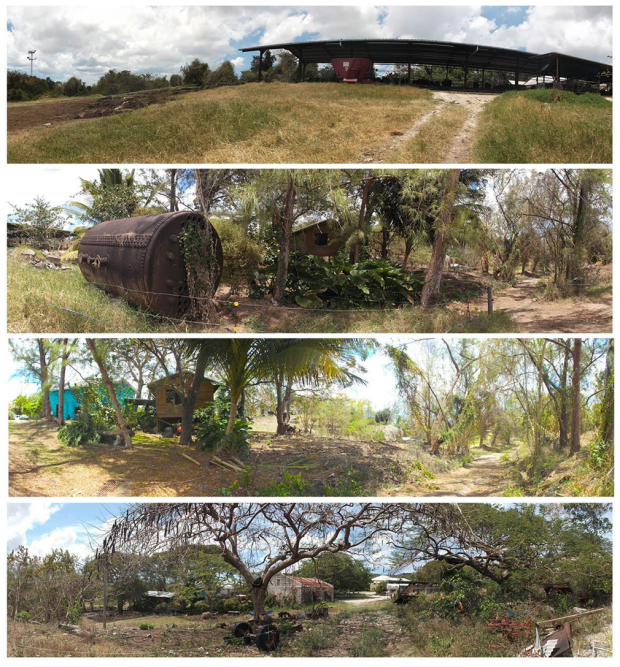
Although we work to shift the ground we operate on, we are aware that the history of Walkers Dairy as a former sugarcane plantation where Fresh Milk is based continues to influence the ways in which some interact with or understand our social practice. Matters of privilege inherent to the plantation economy in some ways reflect our concerns about in/accessibility in the digital realm. For example, who regulates the internet and its protocols? How can non-profit organizations like Fresh Milk use digital platforms to meet the needs of artists in the Caribbean/diaspora?
As we draw lines from one human being to another in real life and on line, Fresh Milk’s programming reinforces Glissant’s poetics of relations, becoming sensitive to and sometimes unlearning the linguistic, racial, classed, and gendered boundaries that have historically separated us. A counterpoint to the master narrative, the network weaves new affinities, confirming multiple states of emergence while employing infinite possibilities of connection even from within the plantation as a network in a continual state of emergence.
While operating out of a very small island has its limitations, the digital platform has become a catalyst, allowing us to participate in communities beyond the limitations of our physical space. Access to the Internet as a creative commons space is opening fields of possibilities which elicit serendipitous encounters continually transforming into tangible relationships and projects.
Amanda Haynes is joining me today to speak about the Colleen Lewis Reading Room and her role in the birth of Fresh Milk Books. We are not unaware of the history of plantations outfitted with bars serving rum rather than outfitting libraries providing books. And although I am sure your NY audience might appreciate some good Bajan rum to warm yourselves with this evening, I’d like to hand over to Amanda who will speak with you all, not about rum, but about the ‘spirit’ of reading.
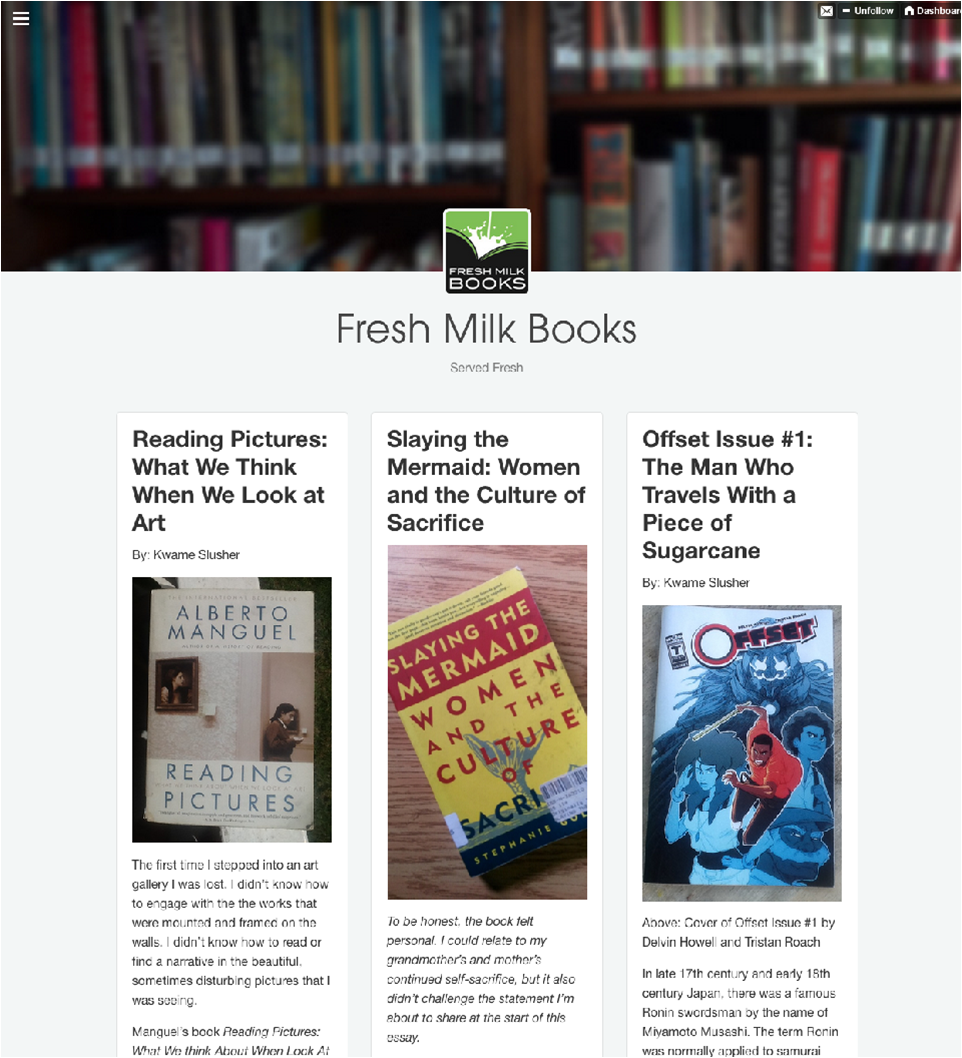
Fresh Milk Books came into existence to activate the Colleen Lewis Reading Room set up to keep the memory of the art historian, Colleen Lewis, alive. The reading room is free and open to the public.
In an age where most of our ideas about the world are shaped by the media we consume, our ability to read images and decode the ideas they represent is vital. Though the dominant collective of our mediated online and offline communications is the marketplace, and ideas transmitted through them, FMBs similarly demonstrates the creative potential allowed by virtual geographies. As an expanded critical space, Fresh Milk Books is reimagining who and what we consider art/spaces/identity to be.
Since the soft launch of the Fresh Milk Books experiment in May 2014, Glissant’s rhizome has been flickering through the ‘tags’ and ‘likes’ of its Tumblr and Facebook. The digital nature of Fresh Milk Books is very much like our Caribbean; a space of relations, diversity, linkages and cross-fertilisation. Our review series #CCF Weekly encourages short, collaborative, multi-media responses to diverse texts in Fresh Milk’s on-site reading room. This initiative propels literacy beyond its linguistic application, to an awareness of the trans-media literacy that digital spaces demand. The connections this online initiative has unveiled in its seven months of existence is proving that the geography of online spaces has radical potential to foster a community of spirit—and a tangible Diaspora. The less optimistic realities of this digital geographic arena will be discussed later in this paper.

While visitors to the FMBs site are from every age group, the target audience is in the 18-24 age range. CCF Review contributors have included recent literature and arts students, educators and publishers. We’ve even received publications from a wide variety of international donors. Most recently, we received a journal from a Mexican poet and editor living and working in Palestine. He heard about FMBs through the Cyprus Dossier and sent a copy of his London-published journal, Dolce Stil Criollo to us.
The success of this on-going experiment that is FMBs is best seen in the steady, diverse and always personal nature of book donations we have received since the initiative was officially launched in May 2014. The response to our email circulated Summer Wish list, which focused on growing our Caribbean History/Theory collection, allowed us to secure over 80% of the texts requested.
We are mapping connections with anyone who ‘identifies’ with the cause–FMB’s identifiers include ‘#creative’, ‘#Caribbean’, ‘#reader’, ‘#human’, subverting polemic notions of identities circulated by popular media. We are living connections. Like any other social network, FMBs activities are driven, mapped and remembered by the Big Data of the internet. The notion of apparent agency afforded by digital publishing raises critical questions about the intangible economics of e-governance, regulation and digital cultural production.
Yet, the internet’s existence as a tangible, global and personal space presents radical potential to connect and engage ‘Caribbeans’ – wherever we are, whoever we are- and wider audiences. It is also vital to note that the digital is just a tool.Through the digital space of FMBs we are channeling our social connections and relationships into socially productive, communal activities within the ‘real’/physical world. This complimentary use of ‘borderless’ digital space and ‘on-the-ground’ work symbolises how we should be thinking about sustainable development today. Increasingly, millennials are identifying more as digital citizens first, and citizens of a nation second. The digital is no longer just a convenient method of mapping, anticipating and participating in social change, it is a necessary one.

Fresh Milk works with partners to create exhibiting, professional development and residency opportunities for artists to show their work to wider audiences, increasing their visibility and allowing them to make valuable connections, enriching their practices and continually expanding the local space. We have had residency applications from places that we can only reach through the internet – Russia, Poland, Afghanistan. At this time, I’d like to share examples of three digitally born projects- one local, one regional and one international.
Fresh Stops is a collaborative partnership with the local initiative Adopt A Stop, a Barbadian company that builds benches for bus stops and bus shelters, to bring art into the public space. The collaboration began in an informal chat on Facebook between me and Barney Gibbs, the owner of Adopt A Stop. We have commissioned six young Barbadian artists to produce original artwork for benches which have been popping up around the island from October.
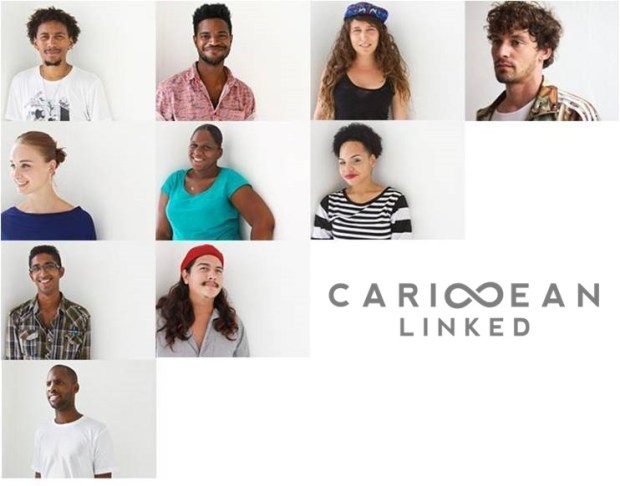
An example of a regional project born online is the Caribbean Linked Artist Residency Program – it is a crucial space for building awareness across disparate creative communities of the Caribbean by finding ways to connect young and emerging artists with each other in Aruba.
This residency exposes Dutch Antillean, Anglophone, Francophone and Hispanic artists to each other through the residency programme and is a collaboration between Ateliers ‘89, ARC magazine and Fresh Milk, currently funded by Stitching DOEN and the Mondriaan Fund.

Wayfinding by Mark King, 2014. Photograph by Rayanne Bushell

Alberta Whittle’s fete posters. Photograph by Rayanne Bushell

Ronald Williams’ work display. Photograph by Rayanne Bushell
Fresh Milk participated in an international digitally born project during the summer of 2014 called International Artist Initiated (IAI) coordinated by the Glasgow based artist led network – the David Dale Gallery and Studios. The project coincided with the Glasgow 2014 Commonwealth Games. David Dale learned of Fresh Milk through their online research. The project acted as a catalyst for discussion and collaboration between six Commonwealth based artist initiated projects including Fillip from Canada, Cyprus Dossier from Cyprus, Clark House Initiative from India, RM from New Zealand and Video Art Network Lagos from Nigeria.
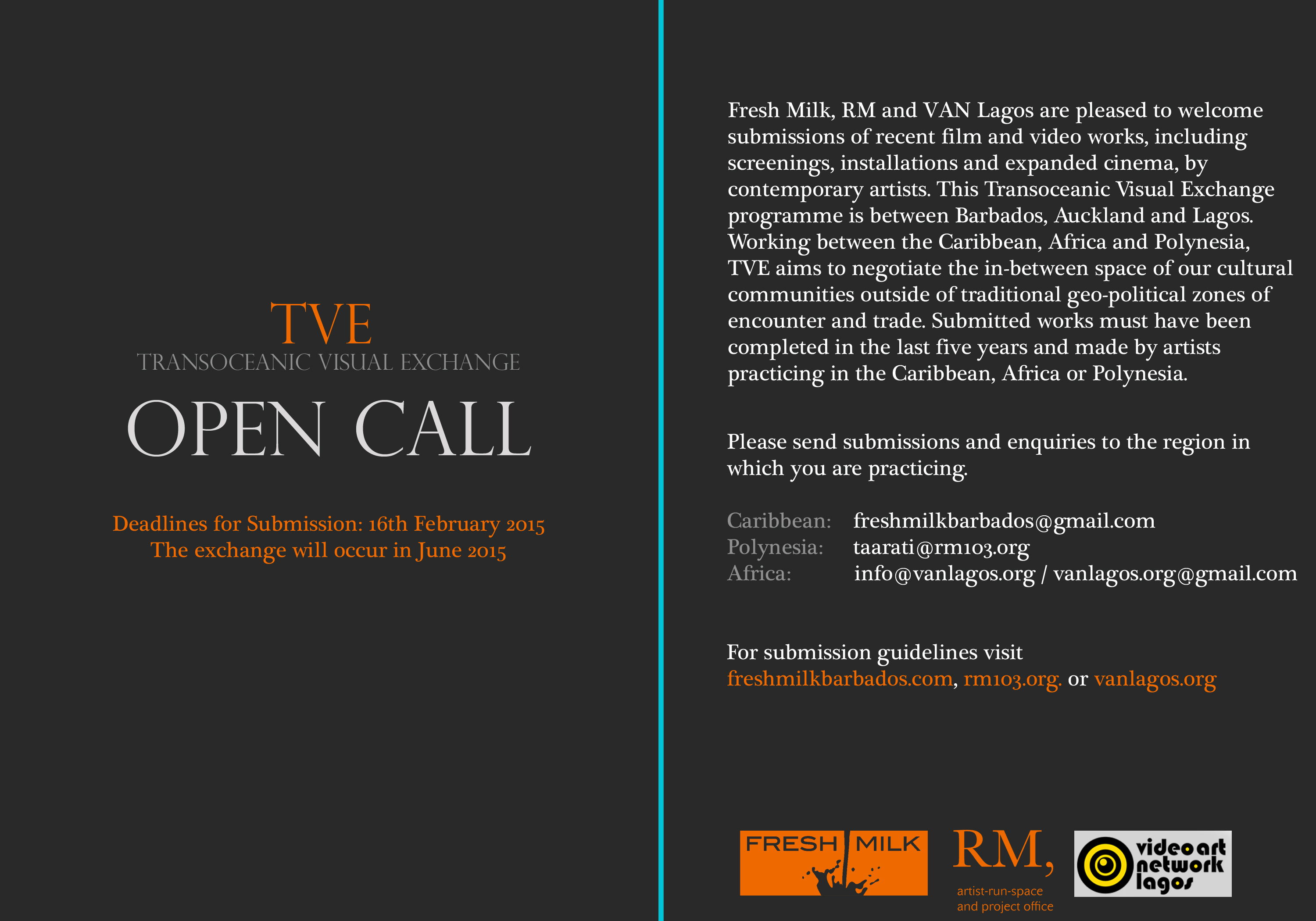
The IAI project has since led to a co-curated artistic exchange currently in development between three of the spaces – Fresh Milk, RM and Video Network Lagos. Transoceanic Visual Exchange or TVE will select video shorts and feature films for an online exhibition of works from the Caribbean, Polynesia and Africa. As a web-based project, it stretches beyond fixed geo-political frameworks, allowing non-traditional relationships to mature, in this case between Barbados, New Zealand and Nigeria.

While proud of our accomplishments and aware of the potent possibilities provided by the digital archipelagos, we are somewhat cynical of the notion of a pure emancipatory digital infrastructure. We must remain cognisant of the need to protect our material, ideas and futures as collectives of artists. Part of our social practice means being responsible about and open to discussing some of the darker realities associated with trusting and functioning in the online space.
While motivated by the digital iteration of Glissant’s poetics of relations and sprawling rhizomatics floating in the air, we consider what it means to have complete faith in something we cannot see or fully understand. The active participants maintaining FM’s online platforms are trying to understand what makes this whole thing work – it’s an ongoing learning process and there is so much that we are not aware of.
On one hand, corporations “allow” us to create projects and communicate fluidly while on the other, companies are not always fully transparent with their users. Governance of the internet is a new and evolving political issue. It is important for us to be aware of the back end so that the potential we so readily embrace and rely on, on a daily basis, does not become a replica of the way some physical spaces and tangible assets have become inaccessible.
CONCLUSION
We close with some questions to be considered:
How do we define an online commons and what is at stake for the individual in the common virtual space?
What entities fund the sites we use on a daily basis and rely on, and what are the ethical implications of these partnerships that may be invisible to us users?
Why is it so important to think in the collective zone instead of the individual?
Why is the digital platform so important to the younger artists and to artistic practice in the Caribbean?
While we continue to make Glissant inspired connections through online platforms, we need to remember that it is our work as creatives that drive some of these engines and be aware of the economics and social engineering behind the engines.
We are witnessing a collective engagement among a community of artists advancing against the failure of national projects like the brick-and-mortar national gallery, which has not yet manifested in Barbados to serve a younger generation of artists.
The internet, as a proactive space, allows us a different perspective on our own cultural environment. Traveling to the moon allowed human beings access to the first image of the pale blue planet seen from afar, spawning the birth of our environmental movement. Similarly, the internet allows us different perspectives on the world in which we live and work. It facilitates increasingly daring digitally born cultural projects that foster human connection, thereby altering the very chemistry of our own soil, bit by bit.

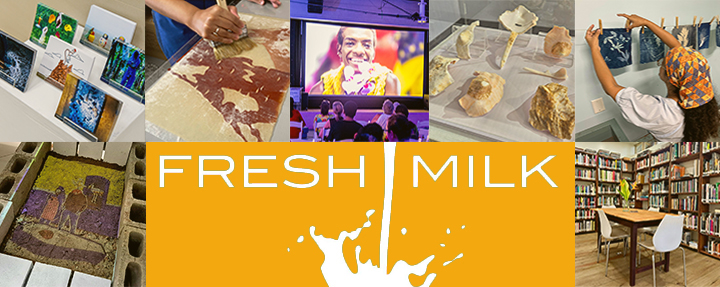







 fresh milk barbados