Maj Hasager & Ask Kæreby – Week 2 Blog Post

Fresh Milk resident artists Maj Hasager and Ask Kæreby share the second blog post about their time in Barbados, outlining their busy week that saw them continuing to learn about the island through research in the Barbados National Archives and by traversing the physical landscape. Both artists also began their community outreach, which included Maj’s first session with BFA students at Barbados Community College and day one of Ask’s experimental sound workshops being held at Fresh Milk. Read more below:

The blessed rain pours down massively. After a dry wet season the plants, trees and animals feel energized and revitalized. Monday is spent in the studio and the rain creates a perfect soundscape on the metal roof, where the sound is intensifying and suddenly loosens its loud grip to make the wind and the surrounding sounds audible. The studio is quiet and we are planning the South Coast trip later in the week. Our plan is to see the majority of the island by local buses and it demands a bit of logistics, good walking shoes and some determination to make this happen – as time is a luxury that many visitors to the island seem short of. Insisting on taking our time is indeed in stark contrast to the past year of activities, and it is highly appreciated.

Annalee is waiting in her car outside the apartment – I (Maj) can hear her beeping and grab my things before closing the door behind me. We move down the hill towards Barbados Community College (BCC) where half an hour later I will give a lecture on my work to a group of students from the fine arts department. Hours later, I am enriched by the level of conversation and questions raised amongst the students, and I can’t wait for the next session where we will go more in depth in terms of a close reading of a text, and thinking through social practice together. As we are leaving the BCC, Annalee takes me to the top of the campus to show me an old derelict building – despite it falling apart you can sense the grandeur of the structure. She tells me that it is a former sugar plantation house and it sits fairly dislocated or perhaps amputated at the edge of campus. Here the generic campus buildings seem to be rejecting a contested past, and the neglect of the house (or perhaps its symbolic meaning of colonial power) seems to be a way to suppress a past by letting it dissolve slowly by time. Though perhaps forgetting, as Annalee mentions, that the first black Chief Justice on the island Sir Conrad Reeves lived in this house too.

History spills out of wooden drawers in the chilled archival hall of the Barbados National Archives where we arrive Wednesday morning. We are slowly chewing our way through archival documents – via neatly organized index cards in perfectly fitted drawers tracing migration movements after the emancipation in the 1830’s – in particular looking at the massive exodus of young Barbadian men leaving for work in Panama either constructing the railway or later digging the Panama Canal. We are following the trail of the “Panama money”, the encouragement – and later restriction ­– of migration, the riots in 1937 and the formation of trade unions. One thing leads to the next as the hours vanish in the archive. The archive itself is somehow stuck in the past, and the sounds of heavy books being dropped on tables echo in the vast space. At 4 pm the archive is slowly shutting down, and we leave the air-conditioned hall with a chill. Outside the archive at 4 pm on the dot, the art historian Therese Hadchity picks us up. She left Denmark 25 years ago, and we spend hours over coffee discussing contemporary art in the Caribbean, social practice and the potential pitfalls of this type of practice – to mention a few of the many topics covered over three hours in good company – definitely a conversation to be continued.

Thursday morning begins with some more work on the hydrophone (underwater microphone) – Ask is still attempting to secure the cable so water is kept out when immersed. Thanks to the Colleen Lewis Soldering Iron, Annalee’s extended family and local hardware and music stores, an improvised solution begins to materialise. The plan is to test it over the weekend when we are walking along the South Coast. Thursday is also the first session of the sound workshop that Ask is teaching. Six people turn up at Fresh Milk for the first dose of soundscape recording and composition – some have a bit of a shell shock. It is a rocky ride through Musique concrète, Pierre Schaeffer, soundscape, acoustic ecology, Murray Schafer and the physics and technology behind it all. As the dust settles, questions arise and a most interesting debate takes form – I am very much looking forward to the continuation.

We head out early Friday morning, and as we leave the apartment at dawn, Annalee’s lovely father offers us a ride to St. Lawrence Gap at the South Coast, and thereby cuts our journey shorter by an hour or more. St. Lawrence Gap is the first place where we immerse the hydrophone fully in seawater, and thank goodness it is water proof despite its very homemade look. Maj has volunteered to be the assistant in the sea (what a dreadful task) and Ask is at shore with the recorder and headphones. Suddenly sounds of sand on the sea bottom are coming through and it is very exciting. The recordings continue throughout the weekend in different locations and both in the Caribbean Sea and Atlantic Ocean.

We end the weekend trip at the Good Life Café near Accra Beach, where we meet the multitalented artist Mark King, who quickly turns out to be a stimulating conversation on both art and global politics.

_____________________________

DanishArtsFound_LOGO_CMYK

This residency is supported in part by the Danish Arts Foundation
Tilting Axis 1.5 Report

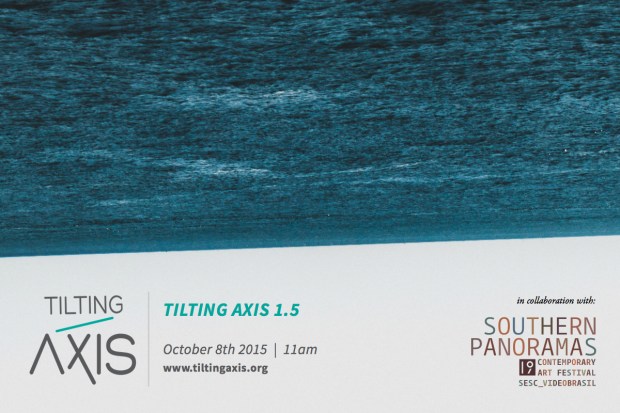
At the invitation of Videobrasil’s director, Solange Farkas, the core organizations of Tilting AxisFresh Milk, ARC Magazine and the Pérez Art Museum Miami – had the opportunity to participate in the Public Programme at the 19th Sesc_Festival in Sao Paulo on October 8th, 2015 to present Tilting Axis 1.5.

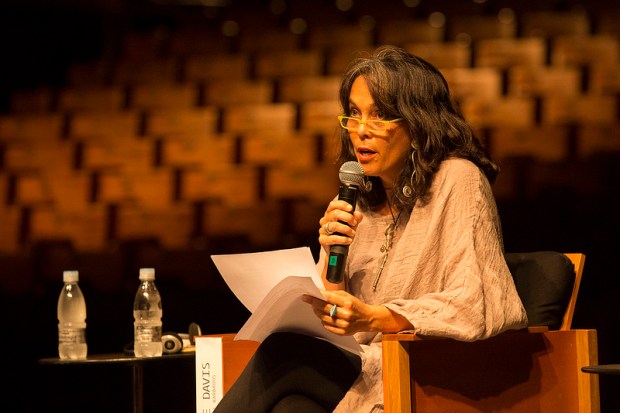
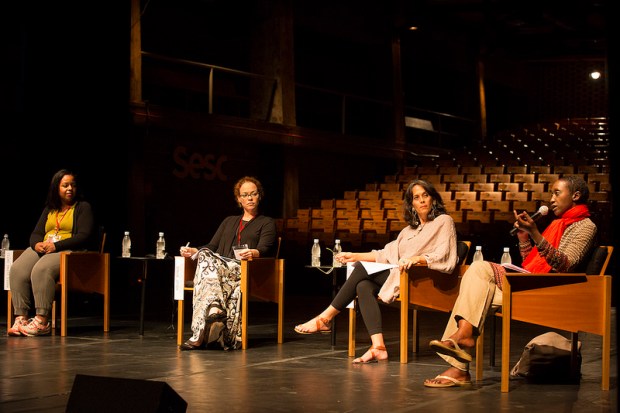
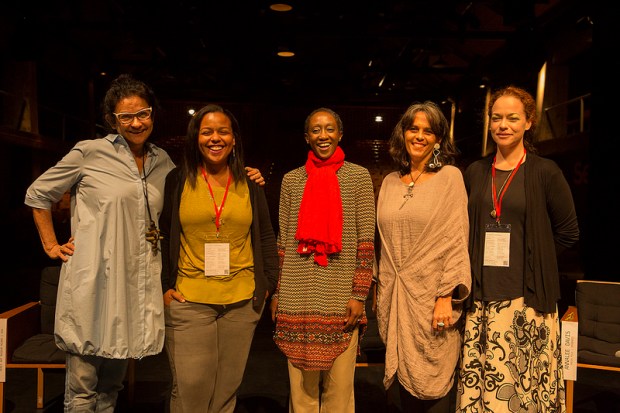
L-R: Solange Farkas (Director of Videobrasil), Maria Elena Ortiz (Assistant Curator at PAMM), N'Gone Fall (Founding member of GawLab), Annalee Davis (Founding Director of Fresh Milk) and Holly Bynoe (Director and Editor-in-Chief of ARC Magazine). All images courtesy of Videobrasil

L-R: Solange Farkas (Director of Videobrasil), Maria Elena Ortiz (Assistant Curator at PAMM), N’Gone Fall (Founding member of GawLab), Annalee Davis (Founding Director of Fresh Milk) and Holly Bynoe (Director and Editor-in-Chief of ARC Magazine). All images courtesy of Videobrasil

Earlier this year on a trip to São Paulo, ARC’s director and co-founder of Tilting Axis, Holly Bynoe, met with Solange and Thereza Farkas, Director and Program Director of Videobrasil, to speak about opportunities available at the 19th Contemporary Art Festival Sesc_Videobrasil scheduled to take place during the 5-10 of October. During that initial meeting, Solange expressed interest in opening up the public programming while also being acutely aware of the of the way in which the Caribbean is being positioned in the continuum and discourse around the Global South.

Solange Farkas

Solange Farkas

Conceived as a mid point meeting, Tilting Axis 1.5 acted as a discursive moment to continue circulating the collective’s core methodologies. Goals included addressing the Caribbean’s peripheral position within larger global art conversations, generating awareness and sensitizing cultural practitioners in the Global South to Tilting Axis.

With an audience of about 30 members, the intimate gathering took place on the 8th of October at Sesc_Pompeia’s Theatre. Solange welcomed the panelists and remarked “It is a great pleasure to be part of this promising encounter Tilting Axis is providing. The Caribbean, despite its global relevance as a tourist destination, has yet to gain recognition as an inexhaustible source of visual art to its full potential and production. There is a clear difficulty in overcoming the ocean that surrounds this archipelago and Tilting Axis has a fundamental role in the unification of the region by hosting meetings and discussions and thereby increasing worldwide interest in the artistic production of the Caribbean.”

N'Gone Fall

N’Gone Fall

The conversation was chaired by N’Gone Fall, independent curator and founder of GawLab (Senegal) who framed the conversation and the larger platform as moments to think about factors tied to the invisibility and visibility of the Caribbean in the larger art world. The panel comprised Annalee Davis (Fresh Milk), Holly Bynoe (ARC Inc.) and María Elena Ortiz (PAMM).

Annalee gave background to Fresh Milk’s interest in Tilting Axis, spoke to why and how Tilting Axis developed and presented an overview of the inaugural 2015 meeting which took place at Fresh Milk in Barbados. Davis made comparisons between the 1st Mercosul biennial – curated by Federico Morais 20 years ago with a mandate to rewrite “the history of Latin American art from a non-Eurocentric perspective”; the Habana Bienal that began as a vital event to place Cubans and other artists from the Global South on the world map and the São Paulo Biennial originating with a goal to establish that city as an international art centre.

Annalee Davis

Annalee Davis

She acknowledged the 19th Festival as another cry to the world from the Global South, as Tilting Axis is a collective shout out from the Caribbean to the world, creating visibility and awareness of contemporary visual arts practices from the region. These platforms redirect the tilt to more horizontal axes of discourse which facilitate our listening to the polyphonic voices across the many art worlds, challenging the notion of one centre and one voice. Tilting Axis is contributing to this global chorus.

Holly spoke to ARC’s interest in Tilting Axis, the outcomes of the gathering and gave a synopsis of the four clinics along with the platform’s goals. Opening with the promise of an ongoing commitment to transferring institutional knowledge, developing exhibitions and programming opportunities regionally and globally; the core organizations involved have entered into a collaboration that is expected to help accomplish multi tiered levels of sustainability and organic growth for the platform and its deliverables.

Holly Bynoe

Holly Bynoe

Highlighting Tilting Axis’ presence, Bynoe reiterated that it is not to eradicate but to alleviate, calm and decentralize certain pressures linked to creative production by giving creative bodies agency and a framework to reestablish connections with each other. The connections forged from the meeting become less formal and more organic, engendering corroborative actions that are negotiated without scrutiny and leading to a continuation of works that expand upon the industry; its momentum and emergence.

María Elena spoke about PAMM’s interest in participating in Tilting Axis, as well as hosting the upcoming event in Miami in February 2016. PAMM started collaborating with Tilting Axis in 2013 as an effort to reconsider Miami as part of the Caribbean. María Elena explained that at first glance this could be seen as problematic, however, Miami has a significant position within Caribbean communities as a cultural hub. She also described how the decision to host the event in Miami actually came from the group at the first meeting in 2015. María Elena gave an overview of the next iteration, which will continue exploring the main issues raised in the first iteration in Barbados, specifically in the areas of Exhibition and Programming; Education, and Artists’ Movement and Mobility.

Maria Elena Ortiz

Maria Elena Ortiz

For PAMM, it is extremely important to address the concern of the local Caribbean community, which will also be reflected in the upcoming event in 2016. Tilting Axis 2.0 will continue to explore notions raised in the first iteration and make connections with Miami as a pivot to the Caribbean. The name of the 2016 program, Caribbean Strategies, considers possible strategies in the identified areas that could be shared, questioned, or reinterpreted across a transnational Caribbean.

As a result of the TA 1.5 conversation at the Festival, strong interest has emanated from the South African based quarterly publication, ART AFRICA, who have already discussed the possibility of including Tilting Axis in their THAT ART FAIR programme for 2017. In addition, they have expressed interest in offering a partnership to Fresh Milk to participate in an exhibiting capacity. Furthermore, ART AFRICA are looking to extend their network of contributors, and have asked if Fresh Milk and ARC would be interested in contributing a Caribbean perspective to their publication.

Also in attendance was Sharjah Art Foundation President, Sheikha Hoor Al Qasini and Tumelo Mosaka, independent curator of projects such as Infinite Island, Brooklyn Museum (2007) along with Till Fellrath, co-founder of ART Reoriented, a multidisciplinary curatorial platform based in Munich and New York.

The panelists at TA 1.5

The panelists at TA 1.5

MOVING FORWARD

  • Tilting Axis 2 will be held at the Pérez Art Museum Miami from February 19-21 2015. PAMM and Cannonball have confirmed a partnership which includes two residencies during February. Trinidad-based Marsha Pearce – scholar, researcher, educator and emerging curator – along with London based Bahamian visual artist Blue Curry will spend four weeks at Cannonball.
  • Fresh Milk is deepening connections with the São Paulo office of the Goethe Institute who is interested in fostering a collaboration with Casa Tomada to create possibilities for exchange between Brazil and the Caribbean. To this end, discussion is under way to potentially partner in the 2016 iteration of the Transcoeanic Visual Exchange project to platform experimental film between Brazil, the Caribbean and Germany.
  • The National Art Gallery of the Cayman Islands (NGCI) has confirmed that they will host Tilting Axis in February 2017. Natalie Urquhart, the gallery director states: “By bringing together arts professionals from across the region, Tilting Axis has provided an unparalleled platform for collaboration and exchange, which has already translated into several important initiatives. We are looking forward to continuing the conversation at TA 2 at PAMM, reporting on outcomes that have arisen out of the initial meeting and expanding opportunities further under the Caribbean Strategies program.

The NGCI is then committed to hosting TA 3 in 2017, the focus of which will be determined by the 2016 gathering, and to help keep the momentum generated by Tilting Axis moving forward.”

  • Another outcome from Tilting Axis 1 which was platformed at the conversation included the Arts Mentorship Programme, a one-year trial to be run in a partnership between the Cultural Skills Unit of the British Council Scotland and independent curatorial project Mother Tongue, the Cent­re for Contemporary Arts Glasgow (CCA) and David Dale Gallery and Studios. The geographical remit of the programme covers the entire Caribbean, regardless of language, and regional partners will be sought to assist the delivery of the initiative. It has been developed out of exchanges between Scotland and the Caribbean in 2014/2015, and therefore aims to directly target areas of need raised during scoping visits and the first Tilting Axis conference. The project will be aimed at artists, curators and writers at all levels: those in education, recent graduates, emerging practitioners and artist-led spaces; to professional platforms, organisations and institutions.

In the first year, the mentorship programme will deliver the following pilot projects which will be used by the organisers to assess the impact of the first year’s activity, and as case studies to apply for further funding beyond the trial. This partnership will offer two shadow curatorial placements at the Centre for Contemporary Arts, Glasgow, working with curator Remco de Blaaij. Additionally, between 2 and 4 remunerated internships will be granted to students and recent graduates in Barbados through an open call to work on the production and delivery of the exhibition Rum Retort. Programming will also be developed, including but not limited to exhibitions with David Dale Gallery in Glasgow, Scotland.

The British Council, independent of the mentorship program, has also begun initial conversations around a research curatorial trip scheduled to take place in Glasgow, Leeds and London in November, creating various platforms and opportunities for promoting a better understanding of collaborative and exchange possibilities emerging out of Scotland. Several curators from the Caribbean, Brazil, Mexico; including Holly Bynoe, who is currently Chief Curator at the National Art Gallery of the Bahamas; have been invited to participate in this research trip.

Tilting Axis 2 will take place at the Pérez Art Museum Miami on the 19- 21st of February 2016.

TA_1point5_FB_FINAL

Read the Tilting Axis 1.5 report on the Tilting Axis website here.

Maj Hasager & Ask Kæreby – Week 1 Blog Post

Danish artists Maj Hasager and Ask Kæreby share a blog post about week one of their Fresh Milk residency, taking place during the month of November, 2015. This will be the artists’ first collaborative residency. It has begun with researching the island through publications, museum visits, talks and exploring the landscape, and will progress into public engagement and teaching components over the coming weeks. Read more below:

A week has passed since we arrived at this lovely place – Fresh Milk. It has been a week of ongoing conversations that have taken us through different trails of pasts and presents, and imagining possible futures. It is our first collaborative residency, and we are collecting sounds, photographing, digging through the archives and following traces in the history of the island. We will both do teaching as a part of our residency. Maj will explore notions of social practice together with fine arts students at Barbados Community College and Ask will conduct an experimental sound workshop every Thursday for the coming three weeks. We are both really excited to be here. For Ask it is his first visit to the Caribbean, and for me it is a return to where I stayed for quite a while in the late 90’s – more than 15 years later it is a very different meeting with the region. Like looking at a faded colour photograph of oneself and appreciating that time too is passing.

Our first day at Fresh Milk was a solid introduction to the Colleen Lewis reading room – as well as the joy of tapping into Annalee’s encyclopaedic memory that became increasingly activated as our conversation progressed. The result is now a pile of books on my desk in the studio. All of them are relevant for both of us, and create different entry points to the place and its layers of histories.

Fresh Milk is an unbelievable valuable and important resource for contemporary art, writing and sound. It functions as a critical platform for exchange of ideas, and the level of engagement from both Annalee and Katherine is highly motivating, as is the studio space – the perfect place to think and reflect. After an insanely busy year, it is indeed something we both are benefitting from and it allows us to explore different notions of our own individual praxes as well as working together, sketching for a new collaborative project. We can already conclude that our time here seems too short.

We have spent the first week of our stay following traces of written and official history by looking at what is represented by the different museums around the island that we have visited. When working in an unfamiliar setting we try to acquire at least a basic understanding of the place – while being fully aware that we experience with the gaze of an outsider. So this past week has been an attempt to scratch the surface and begin exploring the island by local buses – which until now has been a great starting point for conversation as well as eavesdropping on teenagers chatting during morning rush hour.

A few highlights from last week, which has been packed with visits to museums, site visits and research: A lecture by the historian Karl Watson titled “From Sugar to Tourism” on the shifting landscapes of the island, which gave a broad spectrum of information on post plantation Barbados – as well as the future influence of tourism. It was indeed food for thought thinking through the perhaps short-term strategies for tourism that might not benefit the island with any sort of sustainability. Another highlight was the beautiful Arlington House Museum in Speightstown where a very dedicated invigilator gave us a brilliant tour of the house – if you can forgive the overly interactive aspect of the museum, the displays offer a more critical reflection on the colonial past and the slave trade. Last but not least in terms of highlights:  Photographing and recording sound on the east and the west coast – offering two very different entry points and landscapes to explore.

_____________________________

DanishArtsFound_LOGO_CMYK

This residency is supported in part by the Danish Arts Foundation

Nadijah Robinson’s Residency – Week 4 Blog Post

Nadijah Robinson shares her final blog post about her residency with Fresh Milk, concluding with her thoughts on how history is written, told and understood, and the value held in the land and our own bodies  in remembering/passing on these stories. She also shares the impact of her presentation to the final year students in the BFA programme at Barbados Community College (BCC) in considering her goals as a socially engaged artist. Read more below:

wk4_1

My last week at Fresh Milk. I have been wrapping up my work in the studio, making connections, having conversations, getting souvenirs, seeing my Bajan family and seeing some last sights.

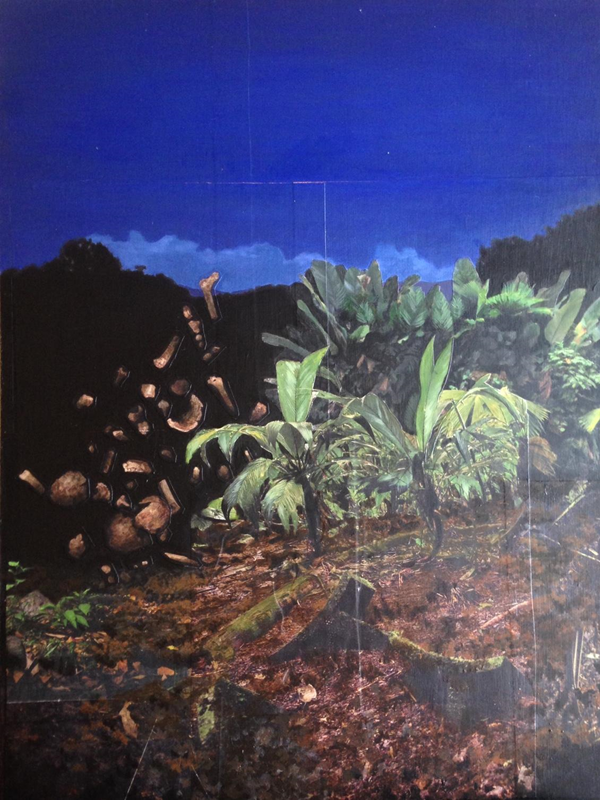
On my last morning in the studio, I finished the piece I’ve been working on, although it doesn’t have a title yet. I know now that it is about how the history that I want to recognize is not written in books, it is written in the earth, in the land and in our bodies and blood. It is most accessible in oral stories, by observing ourselves and the culture we create, and by intuitively knowing what we do.

I did my presentation to a 3rd year art class at BCC this week. I gave a talk and slideshow presentation on my history of community-engaged work. This is a collection of my work that sometimes approaches and is within the realm of ‘social practice art’, but is also peppered by work that is more appropriately called arts-based youth work. In preparing this presentation I realized how much my practice has been formed from a desire to do something with my artwork.

I remembered a moment of crisis in high school when I felt like I had to make the choice that would change the rest of my life and set me on a particular path – the middle and high school years in Canada felt full of these deciding moments. I felt I had to choose between being a professional artist and a teacher, more specifically whether to take grade 11 Art, or something more ‘academic’. These were two career paths I’d known for a long time that I’d wanted to pursue. At the time, becoming a teacher was a promising career in Toronto – there was a teacher shortage that would soon after become an incredible teacher surplus. The pay was decent, and it was basically the definition of job security. I had watched all of the terrible, misguided teacher-saviour films, and they had created in my mind a sensational image of what being a teacher could be –  a way to effect change in the world, locally. I wanted that, to be a vehicle of social change. But mostly I just wanted to make art, though this was not the wise career choice. There’s no money in art, and I didn’t want to be poor and struggling forever. Not only that, but I didn’t want to be preoccupied with the self-involved, decorative, wishy-washy activities that having an art career seemed to be all about. I wanted a way to make artwork that meant more than that one-dimensional caricature-like story I was presented. My younger self wanted to make art that was all about edgy stuff and politics and was ground-breaking and would one day make it into an Adbusters magazine. I wanted to make artwork that would infect people’s minds with possibilities of better things to come, and place a how-to handbook in their hands. I chose in the end to take grade 11 Art, because I had the genius realization that I could be an art teacher, and have an art career in my off time. I’m glad I did.

wk4_2

In doing this presentation more than 10 years later, I realized how I came to reconcile wanting to make art that does stuff for people. I’m still working on it, but I have been listing for myself a set of guiding principles as I go, the first of which was that I must know what I am trying to do with my work, who I’m doing it with (as opposed to for), and in what language (medium and vernacular) I would do it. Along the way I added things like prioritizing integrity, and supporting community-led projects and speaking with my own voice.

I feel very grateful to have had this experience at Fresh Milk, and it is significant that I did my residency here, in Barbados. Being able to reconnect with my family, with Bajan culture and with the history of this place, and having had the conversations that I have had this month has shifted how I see my own particular cultural makeup. The diaspora upon diaspora, the historical memory and living in North America, Toronto in particular. Some ideas have shifted and some have solidified, but they are complex things to reconcile and I feel as if I’ve just begun again.

wk4_3

_______________________________________

2014 OAC logo RGB JPG

This residency is supported by the Ontario Arts Council.

Transoceanic Visual Exchange and the Fresh Milk Team featured in Barbados Today

In her arts column ‘About Town, Across Country’ for the Barbados Today e-newspaper, Katrina Marshall recently shared two articles: one on the Transoceanic Visual Exchange (TVE) programme, and one focusing on what it means to be an artist-in-residence, speaking with Fresh Milk’s Katherine Kennedy about her work and residency experiences to explore the topic.

Thanks very much, Katrina, for taking an interest in the arts!

Barbados today TVE

To read the article on TVE, which appeared on pages 12-13 of the October 22 edition of Barbados Today, click here.

Barbados today Katherine article

To read the article about Katherine Kennedy and her thoughts on artist residencies, which appeared on pages 12-13 of the October 30 edition of Barbados Today, click here.