Saada Branker & Powys Dewhurst – Week 3 Blog Post

Fresh Milk resident artists, writer Saada Branker and filmmaker Powys Dewhurst, share more about their time spent in Barbados. For their third blog post, Saada writes a three-part reflection on artistry and education in the island, outlining the creativity, diversity and tenacity she and Powys have seen and engaged with while working on their  documentary memory project commemorating the 60th anniversary of Hurricane Janet. Read more below:

Education and for the finest at UWI. Roaming chickens remain camera shy.

Education for the finest at UWI. Roaming chickens remain camera shy.

Where Education Can Take You in Barbados

Before we dismiss art as a sidetrack, consider how creative classes have always grown their ideas by finding methods to execute, launch and celebrate their overarching concepts. Today through layered highways of social media, an ever-expanding audience is poised to tune in to the language and persuasion of the artist. In this three-part blog, I celebrate artistry and arts education in Barbados. As I learned during my third week in the Fresh Milk international residency programme, its producers are well positioned to express and represent to a shrinking world.

All traveling week 3 was made possible courtesy of Southern Rentals Barbados.

Part 1: Literacy begat Education

In the Cave Hill courtyard of the renowned University of the West Indies, chickens walk freely on campus alongside aspiring and established scholars. Each time I turned into paparazzi to capture a feathered creature doing its thing, I lost focus and was turned back to the task at hand: interviewing. Later packing up equipment, Charles Phillips, our assistant director, nonchalantly mentioned that he saw one rooster come out of a locker. “He just stepped out.” The jokes ensued about the free-roaming fowl having opportunity to better their education and go places.

At the root of our humour is a well-nurtured truth about Barbados and its heightened affinity for literacy and education.

On April 8th, 2011, Powys Dewhurst and I were in the audience after a Reel World premiere screening of Russell Watson’s feature film, “A Handful of Dirt” in Toronto. Watson, an acclaimed Bajan director, took a question and in that moment said something that stuck with me fast for four years. His reply got us thinking of slave rebellions in the Caribbean region. What did it mean to rebel against an inhumane system? How was it done? As context for the resistance that took shape throughout the tropical islands, Watson spoke of Jamaica having its Maroon history. Conversely, Barbados’ very distinct flat lands made the African slaves’ escape to mountains impossible. Still, as seen in today’s depiction of broken shackles around Bussa’s raised hands, the desire for emancipation burned during the late 18th and early 19th centuries. What Barbados ran with year after year to fight the suffocating weight of slavery was literacy, said Watson. By learning to read, our ancestors opened their world to education, namely to critical thinking and philosophic ponderings and ultimately an awakening about the human right to self-actualization and self-determination. That understanding was passed on to children.With that burgeoning awareness, they also opened themselves to the influences of art.

An emancipated Bussa symbolizes a full-bodied rebellion in Barbados

An emancipated Bussa symbolizes a full-bodied rebellion in Barbados. Photo credit: Powys Dewhurst

 Part 2: Education begat Art

I no longer see education as book smarts. In Canada, we have shifted noisily from embracing only hallowed halls of learning to running through open fields for art education or both. I experienced as well in some Bajan circles, a palpable openness to converse and learn about artists who build, create and produce.

When we stop to reflect, no matter where we are in the world, we can always count on artists to be found somewhere and everywhere. Expect artists to carry a message that puts your brain to work. Expect their minds to race above and beyond as they do that. Through their produced works, they dare audiences as much as they encourage them to be critical thinkers and join a forging movement that will exist whether or not you choose to travel alongside. Therefore, expect artists to dedicate precious time to help us imagine, expand our consciousness and sometimes consider solutions together. We’re talking gifted people, traditionally rendered invisible because they dared to be passionate about the non-scripted life, and would sit or dance or paint or build or produce or capture or write or sketch or sing or study or rehearse for long hours that stretched into months; their lives at a standstill, their work speaking loudly and their motivation contagious.

Taking time with my celebrated filmmaker Powys Dewhurst and acclaimed author Robert Sandiford

Taking time with my celebrated filmmaker Powys Dewhurst and acclaimed author Robert Sandiford

 Part 3: Art begat Art Education

I caught on to the support and the rallying calls from curators during my third week in Barbados. Through casual conversations with these facilitators, I’m learning about the promotion of Bajan artists and what it takes to help them get their work out and into the world. I learned from Annalee Davis, artist and founder of Fresh Milk Barbados, Robert Sandiford, co-founder of writer of ArtsEtc Barbados, Ebonnie Rowe, producer of Honey Jam in Toronto and Barbados and now Honey Jazz, and Beverly Smith-Hinkson, founder of Chattel House Books.

So, sitting and typing in the Fresh Milk artists’ platform, I found space and peace of mind to observe and ponder what I needed to say. There is no missing that the space was made for that very reason. On my third Monday in Barbados, as I worked in the studio researching and chasing interviews, I met illustrator Simone Asia, a former local resident at Fresh Milk. Her meticulous sketching evokes feelings worth exploring, and for a couple hours we shared and talked out finer points of how and why she creates. Our village indeed has gone global so I knew, gazing at her dimensional patterns, that I wouldn’t be the only one to appreciate her hand’s illustrations.

On a few occasions, Powys and I found our way into Chattel House bookstore to leaf through and purchase the works of Matthew Clarke, Omar Kennedy, Robert Sandiford and Karen Lord. Their commitment to literature, fantasy and art thrills us. Barbados indeed has its very own social generation of nerds, eloquent visionaries and ambitious pointy heads with a gift for illustration. We also turned the pages of stunning photography books like Barbados Chattel Houses by Henry Fraser and Bob Kiss (2011) which captured the richness of Barbados architecture and its accompanying history. With each visit, we chatted about these artists and historians with manager Russell and employee Jason. There was a consensus on how thisgrowth of talent in Barbados and the documented history can amplify Barbados on a world stage. Meanwhile, as we pontificated, children walked into the store and plucked items from the shelves. On the Chattel House couch they sat quietly, focused, and with book in hand, pored over pictures and words—their brains revving. Seeing them, I look forward to many more talented Bajans stepping out.

Thais Francis’ Residency – Week 4 Blog Post

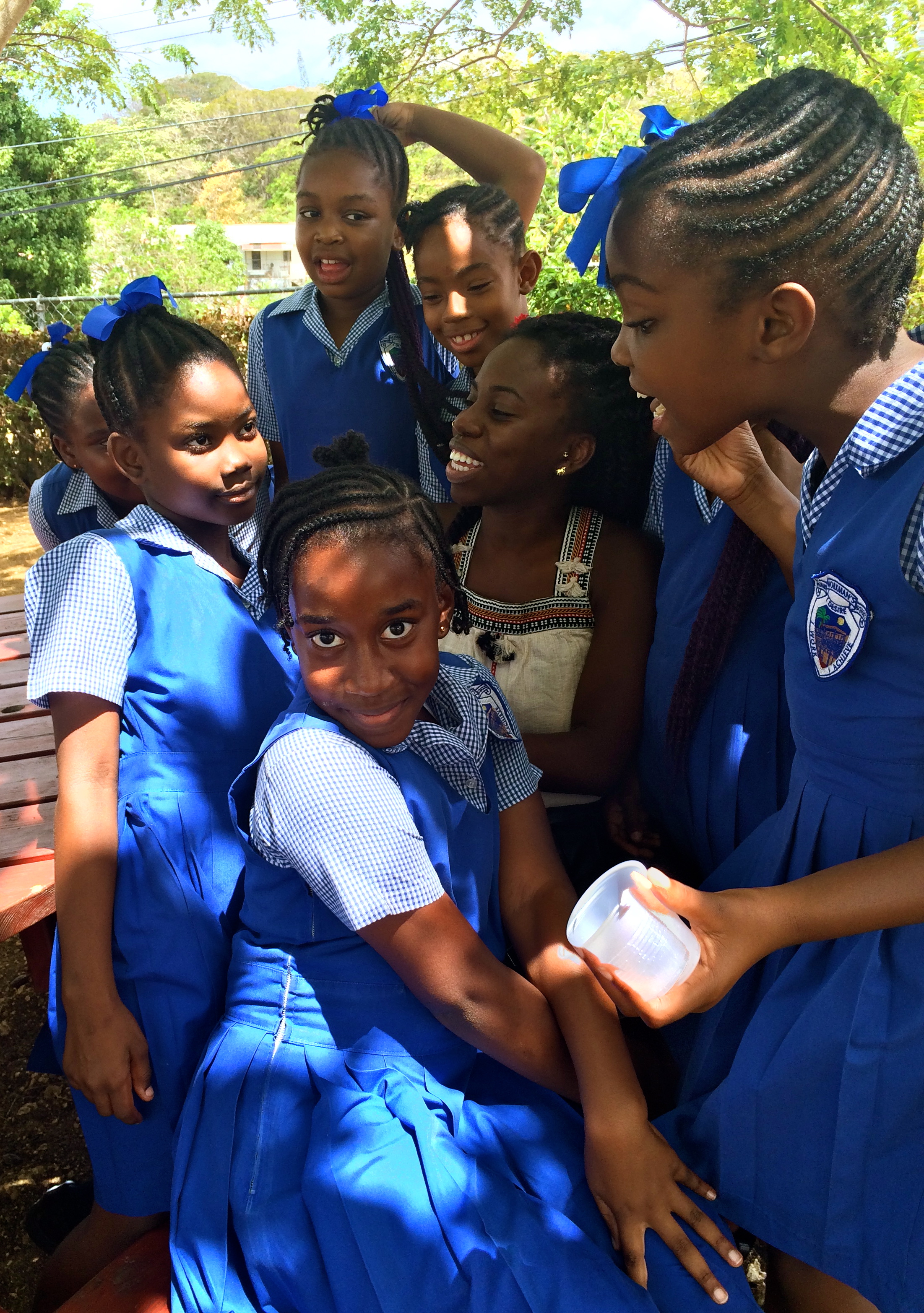
Thais Francis shares her fourth and final blog post about her recently completed Fresh Milk residency. Looking back on her time in Barbados, Thais is happy with the the focus that having a dedicated, peaceful working environment has afforded her, as well as the work she was able to do with the children at Workmans Primary School, overall leading to a very productive and inspiring residency period. Read more from Thais below:

IMG_0193

“I heard you on the radio, are you here in Barbados?”

When I saw those words, I felt sad – because the answer was no. I am no longer in Barbados, I am back in America, and maybe I missed my opportunity to sit with you and thank you. Thank you for opening my eyes to a world of Caribbean literature, for introducing me to the Orishas and for being a pioneer. Who would have thought my NYU professor from 5 years ago would remember me and even find my email address? Who would’ve known he’d be listening to the radio right at the moment when I came on? He was the person who taught me how to look at words through an Afro-Caribbean point of view, thus shaping the person I am becoming. Kamau Brathwaite great writer and Barbadian, thank you. The next time I’m in Barbados you will not find out through the radio.

IMG_3541

Had it not been for this residency, I would not have known my weaknesses. Have you ever had time to just sit and think? Sit under a tree, and read a book, or write in your journal, without any distractions? Thinking can be quite intense sometimes, but then it can be quite revelatory. You know how Stella went to Jamaica to get her groove back? It felt a little like that – thankfully I’m still young and I have not lost my groove, but I empathize with Stella. I got something in Barbados. I got the ability to fully see and carry on – even in the midst of not knowing. This is beginning to sound like a chapter from Eat Pray Love so I’ll be moving on with my point.

IMG_3396

I have 136 pages of a screenplay. It may be good or it may be bad but I DID IT. I sat down and wrote, even when I was bored I continued, even when I wanted to go to the beach – I did it (sometimes I couldn’t resist the beach though). 136 pages later, I’m ready to continue. Writing a screenplay and seeing that into fruition on a screen seems like a never-ending process, but there is a skeleton, and writing in the studio really helped. Working with the children helped too. I figured I should share my gift. It’s fun to write for your own projects, but even better when you’re able to show kids that art is fun. Playing is fun. Dressing up, saying your name loudly, bowing when your classmates clap, imagining worlds and storytelling is fun. Life should be fun. I hope they learned as much from me as I did from them. I salute teachers. I salute Mrs. Bradshaw and Ms. Gatsby the principal of Workman’s and Annalee and the Fresh Milk team for making the space so aesthetically inviting.

All in all, it was a great experience. My quarter life identity crisis issues have somewhat abated, and now I must proceed. I’ll let you know when the movie comes out. Maybe I’ll have a screening in Barbados. Okay?

Saada Branker & Powys Dewhurst – Week 2 Blog Post

Fresh Milk‘s current residents, writer Saada Branker and filmmaker Powys Dewhurst, share their second blog post about their experiences in Barbados. Despite going all out this week to gather information and stories for their documentary memory project about the effects of Hurricane Janet on the island, Saada takes the time to consider not only the power of individual accounts, but the importance of a broader context and the longer term results of the storm. Read more below:

Saada Branker and Edwin and Angus of Top Car Rentals.

Saada Branker and Edwin and Angus of Top Car Rentals.

It seems like self-inflicted cruelty to be picking up our pace in a place like Barbados. What has become the status quo in tightly-wound Toronto is almost ludicrous in sedate Walkers Terrace, St. George. Funny: I remember a friend once agreeing that navigating in Canada’s largest metropolitan city feels like being in a rat race. “But we’re not rats,” she added. Indeed.

Bad habits die hard, even in Barbados. To get what we need on Hurricane Janet, I’ve been going at a steady pace of chasing interviews, setting them up, helping to coordinate the team, interviewing, researching and writing. Of course, I’m not alone. Joining me is a wonderful team of Fresh Milk blog coordinators and chasers including my editorial assistant Natalie McGuire. ArtsEtc’s co-founder Robert Sandiford provides us advice and links to key people. Filmmaker Powys Dewhurst, assisted by our intern, Charles Phillips, does all the driving, courtesy of Top Car Rentals as and as of week three, Southern Rentals Barbados. The film duo also does the heavy lifting, setting up equipment, filming interviews, capturing additional visuals and packing up.

Truth is, to gather information about Hurricane Janet we need not just memories, but context. What was happening in Barbados in 1955? How were Barbadians living and how did they fare during the months of post-Janet recovery, especially as 20,000 people struggled to replace houses they lost to irreparable damage? What changed because of Janet?

To help us answer these questions and lead to further queries, we secured more extraordinary Barbadians. On Wednesday, Charles and Powys set off for a day of streeters in St. Phillip—essentially newsroom jargon for quick interviews on the road posing one or two questions. In a rum shop filled with friendly, card-playing patrons, they found what they needed. Thursday, Powys and I set out to meet Alvin Cummins, retired microbiologist, award-winning author and treasurer of the Barbados National Union of Fisherfolk Organizations (BARNUFO). Through him we learned of government-imposed changes to the fishing vessels after Hurricane Janet, and the socio-economic challenges families faced years later. Alvin was a wealth of information, just like his colleague Buddy Larrier the week before at Oistins. We learned what a Dry Dock is and that the world’s last remaining structure can be found nearby in Bridgetown & its Garrison area.

The strangest part of that day? A dynamic and loquacious photographer from Antigua named Craig Fernandez rolled up on us. In the course of a conversation, Powys eyed him carefully, thinking he saw a resemblance. It turned out he knew the artist’s father. To our surprise, Craig happily assisted us as 2nd camera for about three hours.

Friday morning was spent at the Nation News headquarters where we met with Harold Hoyte, co-founder of the national newspaper and Editor Emeritus. His interview will shine in our documentary. Complementing Harold’s talk was the Nation’s Editor-in-Chief Roy Morris. It was a seamless film shoot thanks to the staff, in particular, Sonia Marville-Carter. Her coordinating skills ensured our time went smoothly and efficiently.

We’re finding it hard to slow down. There’s something spectacular about learning of a shared moment from people with a comprehensive understanding of impact, whether they’re met on the road or in a newsroom. As each of these keen interview subjects point the team in a particular direction, we can’t help it; our excitement takes over and we find ourselves quickening our pace.

Sign-up for a sound workshop with upcoming resident artist Ask Kæreby

Danish composer and sound artist Ask Kæreby will be hosting a series of workshops around experimental ways of working with sound during his upcoming Fresh Milk residency in November, 2015.

Find out more about the programme below and email us at freshmilkbarbados@gmail.com to let us know if you are interested in attending, as space will be limited. More detailed information about the dates & times of the workshops will follow:  

sound flyer final

About the workshop:

What sounds are available for artistic expression and how can we approach them?

As a composer or musician it is very possible to take available instruments and their sounds for granted, as most have a heritage of hundreds of years, and many new are simply variations or emulations of earlier models. But what if we suspend “the usual suspects” for a while, and try to listen in a different way? What if we refrain from identifying a sound by its source, origin or processing, and instead try and describe what we hear by its own merits? If we open ourselves to the soundscape surrounding us, how can we appreciate this in a meaningful way, and can we communicate to others by means of our own soundscapes, composed or fabricated from field recordings?

In a number of workshops, we will focus on sound as a medium of intrinsic value and its own source of information. With inspiration from the World Soundscape Project from the 1970’s, we will begin an aural mapping of the environment, documenting the local soundscape via field recordings and discussing possible signature sounds or soundmarks. Using different types of transducers, we will investigate vibrations in different types of materials such as gasses, liquids and solids – thereby exploring different modes of perception and listening. These recordings will also function as the compositional base for experimental construction of sonic narratives, musical compounds or combinations thereof.

ask kaereby

Ask Kæreby

Artist Statement:

My artistic practice is interdisciplinary and research-based, involving experimental composition, sound design and electroacoustic music. I’m interested in the presentation of narratives by means of sound – not through traditional musical gestures, but using different approaches such as musique concrète or the futurists’ bruitism, thereby giving the listener a more subtle way of experiencing the essence of the work. By placing myself in the intersection between the known formats, I wish to challenge our ways of listening – to music (live as well as recorded), to our surroundings and to (sonic) art.

Since the days of Aristotle, narratives in art have been characterised by a “poetic” organising principle, which is both logically and aesthetically superior to the random historicity of factual events. The incorporation and processing of pieces of reality in the shape of sounds in forming an audible work, contains possibilities for combining and juxtaposing these two principles, which I find extremely interesting.

My projects begin with a longer period of research, where I collect factual and historical information and gather impressions and sounds from the area and/or subject. Particularly interesting ideological or technological methods may appear, and form the basis of my further compositional work.

Bio:

Ask Kæreby is a Danish composer. He studied music production in Copenhagen, earning a MMus degree from The Royal Danish Academy of Music.

Kæreby’s artistic practice is interdisciplinary and research-based, including elements of experimental composition, sound design and electroacoustic music. He is interested in the presentation of narratives by means of sound – not through traditional musical gestures, but using different approaches such as musique concrète or the futurists’ bruitism. Working in the intersection between known formats, Kæreby wishes to challenge our ways of listening – to music (live as well as recorded), to our surroundings and to (sonic) art.

He has been awarded grants in support of his work from The Danish Arts Foundation, Danish Musicians’ Union, Wilhelm Hansen Foundation, Familien Hede Nielsen Foundation, Dansk Artist Association, Ellen & Erik Valdemar Jensen Music Grant, Anders Månsson & wife Memorial Grant and Karen Margrethe Torp-Pedersen & husband Foundation.

Saada Branker & Powys Dewhurst – Week 1 Blog Post

Canada-based couple Saada Branker and Powys Dewhurst, a writer and filmmaker respectively, share their first blog post about their Fresh Milk residency. Both having strong ties to Barbados, Saada and Powys are in the island embarking on a project very close to their hearts and heritage: a documentary memory project commemorating the 60th anniversary of Hurricane Janet. Read more below about their first week of collecting data and interviews, and how physically being in the space has brought home the reality of Janet’s impact on the island and its people:

It was perhaps not by accident but by divine design that we arrived in Barbados on June 1st, the official start of the 2015 Hurricane season. Quite simply, Powys and I are hunting Hurricane Janet, although she is long gone. We resurrect her memory with each question posed to Bajans as they go about their daily business.

We got straight to it as we exited Grantley Adams International Airport. Our baggage handler told us she was born in 1956, one year after Hurricane Janet hit the island, but she grew up hearing of it from people every hurricane season. Edwin Edey from Top Car Rentals Barbados awaited us with a pristine vehicle, courtesy of this efficient family-run business. After a conscientious explanation of our contract, rules of the road and features of the van, Edwin described his memories of the terrain being levelled by Janet’s violent winds.

At that moment, I was hit by the realness of what Powys and I are setting out to achieve. Why it was sobering, I’m not sure. Barbados is not new to either of us. Powys grew from a precocious child into a curious teen here. I visited my parents’ birthplace for my third birthday, and I returned as an adult a few times. This media project offers us a new discovery of Barbados, guided from our elders’ lips to our ears. As in all oral traditions, there’s no greater honour than to receive such memories and hold them for sharing.  Maybe that moment of truth is what I tapped into.

Driveway to the Fresh Milk residency flat in St. George

Driveway to the Fresh Milk residency flat in St. George

Edwin graciously offered to drive ahead to show us the way to Fresh Milk. Thankful, we followed his car and looked about at our surroundings with new eyes. Where we saw foliage, infrastructure, industry and farmland, we tried to imagine 60 years earlier with bent trees, debris swirling overhead and houses battered by winds travelling upwards of 111mph. I must say, it wasn’t easy.  I was distracted. St. George was my parents’ stomping grounds when they were children.  Because I’m a sit-put condo dweller, I was struck by the steady movement of people by foot and car, the expanse of farmland and just how picturesque the Fresh Milk Art Platform really is. My inspiration to write took over.

On our third day here, with the help of Annalee Davis, Fresh Milk’s director and founder, we met with Charles Phillips, a talented photographer and entrepreneur behind Barbados-based Monochrome Media. He’s now our assistant director and 2nd camera for our film shoots.  The next day, with Charles, we were able to drive to the Barbados Museum & Historical Society located in the area of Bridgetown & its Garrison. Off camera, Assistant Curator Miguel Pena told us about the founding of the Society in 1933 as he led us to their library. There we read about the history of hurricanes in Barbados. Day 5 took us to the island’s south coast for a crucial interview in Oistins. What we learned grounded us. On Sunday, day 6, we travelled with our flatmate Thais Francis to Bathsheba on the eastern side of the country in St. Joseph.  I’m  thrilled because we’re seeing context; spaces in towns and villages where people on the move spill onto roads or simply catch a cool breeze on a corner and smart conversation with friends—many of them waving as we passed. Their gestures confirming, “I’m here and I see you.”

In no other country have I felt so welcomed by people who don’t know me. Indeed, 60 years ago Hurricane Janet killed Barbadians, Grenadians and days later Mexicans, carving a path of extensive environmental devastation. Remarkably, that same disaster speaks volumes about the people who lived through it and how they’re ready and willing to tell us about this defining moment.