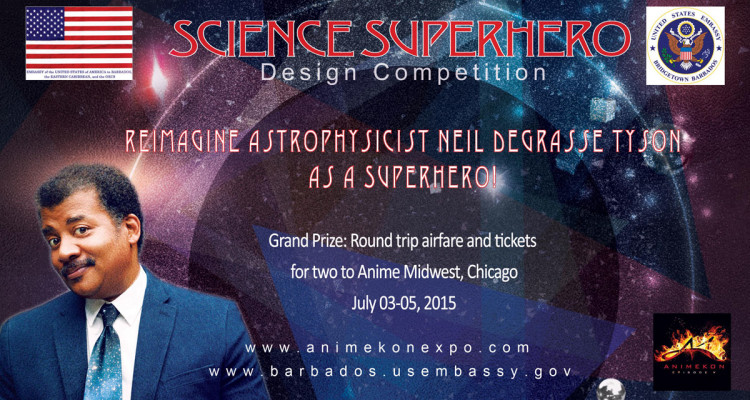
Design Neil deGrasse Tyson as a Superhero!

Neil deGrasse Tyson Competition

One of the most recognizable American scientists of the modern age, Neil deGrasse Tyson, has challenged and inspired people all over the world through his work as an astrophysicist, author, and science communicator.  Since he has made so many invaluable contributions to science, many think of him as the SUPERSTAR of science!

In the spirit of this year’s AnimeKon, the U.S. Embassy to Barbados, the Eastern Caribbean, the OECS invites you to create eye-catching, original artwork reimagining Neil deGrasse Tyson as a SUPERHERO for a chance to win roundtrip airfare for two to Chicago, Illinois and tickets for two to attend the 2015 Anime Midwest convention July 3-5 2015 at the Hyatt Regency O’Hare & Convention Center.

The winner will be announced on November 20, 2014 during Neil deGrasse Tyson’s first public event in Barbados, and admission is free!

Review the competition rules here and submit your entry by November 6th.

OPEN CALL – 19th Contemporary Art Festival Sesc_Videobrasil

Associação Cultural Videobrasil and Sesc São Paulo are calling upon artists interested in taking part in the 19th edition of the Contemporary Art Festival Sesc_Videobrasil, due from October 6 to December 6, 2015 at Sesc Pompeia, in São Paulo, Brazil. Entries will be accepted from September 15 to November 16, 2014.
Open Call

19th Contemporary Art Festival Sesc_Videobrasil OPEN CALL

 The Contemporary Art Festival Sesc_Videobrasil has become established over the years as a diverse, multiple framework designed to spread, foster and reflect on art production from the “global South”, understood as Latin America, the Caribbean, Africa, the Middle East, Oceania, parts of Europe and Asia.Significant geopolitical changes are underway, radically resizing the notions of North and South. Nonetheless, the need persists to work for art and culture in areas that are yet to invent new forms of circulation and visibility.

In its 19th edition, the Festival aligns its curated sections with the South, rather than its competitive show only, as it did in the past. The entire program is therefore oriented towards the South and its myriad issues. These issues – which provide inspiration and parameters for the selection of artworks and projects for the Festival – concern the diasporas, hybrid identities, travel and migration flows, personal narratives, isolation, the social fabric and insularity

For the first time ever, the call for submissions comprises two separate open calls: one for artworks and another for projects, to be developed under the oversight of curators and with backing from the Festival; both the artworks and the projects are to be featured in the upcoming edition of the Festival. Artworks and projects will be accepted in all supports, artistic expressions and techniques, by artists either born or resident in the Festival’s target areas for over five years. Each artist may submit up to three (03) artworks and/or one (01) project, in keeping with the terms set forth in the open calls available on the website as of the opening date for entry.

The Curatorial Committee will select 4 (four) projects for production of artworks. Each project will receive financial support of up to R$ 30,000 (thirty thousand reais) and will be overseen by one of the curators until its presentation at the Festival.

In this edition, the Curatorial Committee is formed by Solange Farkas and by invited curators Bernardo de Souza, Bitu Cassunde, João Laia and Júlia Rebouças.

Based on the Award Jury’s selection (to be announced in 2015), the Festival will grant 1 (one) cash prize of R$ 75,000 (seventy-five thousand reais) and 9 (nine) two-month artist residency prizes  to be undertaken in Videobrasil Residency Network’s partner organizations around the world. Prizes do not apply to the projects produced by the Festival.

As a strategy of publicizing the selected artworks and spreading knowledge about the artists’ creative processes, the Festival will showcase the works via Associação’s online research tool PLATFORM:VB; publications; and documentary films and interviews produced for VB Channel.

Aiming to consolidate an active network of exchange that contributes to the insertion of the selected artists on the contemporary artistic and cultural circuit, the 19th edition of the Festival will also promote Public Programs activities, with meetings between artists, curators, critics, researchers, delegates from different organizations and residency sponsors.

Carefully read both calls for entries prior to your application on Videobrasil’s website

More on the Festival

In addition to exhibiting artworks and projects by shortlisted and guest artists, the Contemporary Art Festival Sesc_Videobrasil offers artist residencies, public programs, educational actions and publication launches.

In a bid to publicize the productions of shortlisted artists, the Festival also conducts actions to make their work available in its digital research platforms, books, websites, social media, as well as documentaries and TV programs produced by the organization. The artists also participate in meetings and debates that bring together curators, critics, researchers and delegates from art institutions and artist residencies to reflect on and discuss pressing issues in contemporary art and culture.

The Festival also awards a cash prize and nine artist residency prizes to be undertaken at Videobrasil Residency Network partner organizations around the world. All of the winners are given trophies designed for each edition by artists such as Tunga, Rosângela Rennó, Erika Verzutti, Carmela Gross, Luiz Zerbini, Raquel Garbelotti, among others.
Cherise Ward is now at Falmouth University, England

Artwork by Cheris Ward

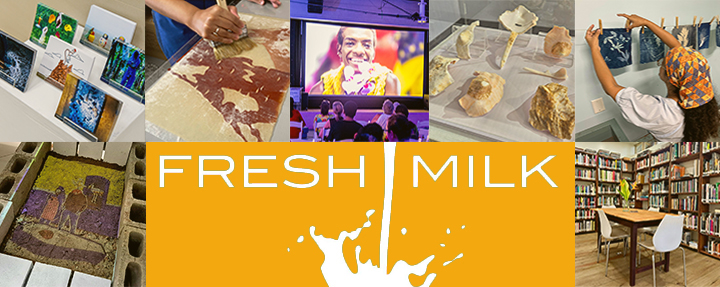
In May 2014, Cherise Ward undertook a residency at Fresh Milk for a month developing her illustrations and puppet making. We are pleased to share the good news that Cherise has just begun a postgraduate program at Falmouth University in England where she will spend the next year in their MA Illustration program. Read more below from Cherise:

The Falmouth School of Art Post graduate Centre
I made the decision to study MA Illustration: Authorial Practice at Falmouth University because I wanted a different experience than that of studying in New York City, which was where I got my undergraduate degree at the School of Visual Arts in Manhattan. Falmouth university is located in Cornwall, England and I am attracted to the diverse, one year, Illustration programme. This is my first time in England, and I’m looking forward to doing a lot of exploring and experimenting, expanding on ideas I developed during my residency at Fresh Milk, as well as new ideas inspired by this new environment. So far, I have experienced orientation trips to Eden Project as well as St.Ives, explored the beautiful little shops in Falmouth town and seen the beach on both a clear day and a heavily foggy day. I’m excited to get started and for what this coming year will bring.

Telling our Stories: Achille Brice & Eka Christa Assam

On September 3, 2014, former Akademie Schloss Solitude resident Achille Brice and fellow filmmaker Eka Christa Assam presented the German premiere of three film shorts – I.C.U., I-BEMSI and Beleh – at Generationshaus, Stuttgart. Barbadian artist and writer Katherine Kennedy, who is currently in residence at the Akademie acting as a correspondent between the Caribbean and the community here, spoke with them after the screening. The conversation provided an opportunity to discuss not only the works themselves, but the larger context in which they function in Cameroonian society. Through a series of questions, observations and personal anecdotes, cultural exchanges occurred, emphasizing the importance of perspective in both the telling and appreciation of a story.

Read the interview originally conducted for the Akademie Schloss Solitude Blog below:

The German premiere of I.C.U., I-BEMSI and Beleh. Premiere pictures courtesy of Eka Christa Assam.

The German premiere of I.C.U., I-BEMSI and Beleh. Premiere pictures courtesy of Eka Christa Assam.

Katherine Kennedy: Can you begin by telling me about your background in acting/filmmaking, and the context you are working out of in Cameroon; is there already an industry you are situating yourself in, or is it now emerging?

Eka Christa Assam: I actually studied accounting after high school, but I always wanted to act. At some point I dropped out, and after a year or two I got my first movie role in 2006. After being in a couple of films, I realized I wasn’t interested in the kind of scripts that came my way. In Cameroon, the film industry is still trying to find its feet, especially the English speaking section. Many filmmakers try to copy what Nollywood – the Nigerian film industry – is doing, which is mostly home videos for entertainment that don’t follow cinematic techniques, and I wanted more from the genre. I felt that film was tool we could use to address some of the issues we are facing in our country.

Eka Christa Assam

Eka Christa Assam

After a while I tried writing and directing my first short – but that didn’t even make it out of post. It was very hard because I hadn’t been to film school, I had no experience. I tried to read up on it but I don’t think I was quite prepared yet. I tried to get books on filmmaking, looked for information online and studied lots of Western films. Then I met Achille, who had been here at Akademie Schloss Solitude, and he was kind of like a mentor. He gave me pointers and sources for material, and he helped me with the second short, Doormat, which was 6 minutes long. With that piece I got accepted into the Durban Talent Campus 2012.

The second project we worked on was Beleh, which has been doing really well. It’s been screened at 12 festivals to date and won best short film at the ZAFAA African Film Academy Awards in London in 2013 and got a jury mention at the Africa International Film Festival (AFRIFF) in Nigeria. It’s a slow process, but it’s picking up – the more you do, the more you improve, and because we have no formal training we learn on the job. It’s a bit of a struggle, but now that our work is getting out there and we’re getting opportunities to interact with other artists, we’re learning from them, getting inspired by their work, and approaching our own work from a different perspective.

Achille Brice

Achille Brice

Achille Brice: In terms of coming into the industry, I wasn’t even sure I wanted to be a film artist at first. I started as more of a recording artist and I was editing pictures for fun part time. A Cameroonian director had seen some of my work, and approached me in 2003 to suggest I try my hand at video editing. The first movie I ever edited was feature length; it was chaotic, but it was an amazing experience and ever since then I have been doing a lot of homework, trying to gain experience. I was lucky to be selected for the Durban Talent Campus in 2008, and in the same year selected for the Berlinale Talent Campus in Germany, so I think those were turning points in my artistic career. I got to meet professionals that have been in the industry for a long time, network and share ideas. I think that was a source of motivation.

Being able to manipulate scenarios, in a sense giving meaning to nothing, is what brought me to the industry. As Eka said, I discovered it was a platform where I could pick out relevant topics, and use video to break a barrier that other genres cannot really cross in the same way. I would say the artistic scene in Cameroon, especially in film, is slow because there are no real film institutions. If you want to become an artist you have to take the initiative in educating yourself.

ICU Poster big

KK: Given that the industry is still in its latent phases, did that lead to the founding of BinAm Studios? What are some of the obstacles you’ve had to overcome?

AB: There is a problem with movie financing because a lot of investors don’t want to put their money into a sector where nobody has had formal training, but I think it’s a necessary risk to invest in and encourage talent. BinAm Studios was created as a platform to celebrate our own, because the general population of Cameroon tends to embrace foreign products. Sometimes when we do movies, people say that we’re copying Nigeria, but we’re trying to tell our own stories. It’s a gradual process; first we have to prove our worth, and then we can use this platform to showcase ourselves so that Cameroonians and those living in the diaspora know that things like this can happen in our own home. I founded BinAm Studios to cultivate this field while exposing our best. We have amazing actors, directors and producers who don’t get recognition because people think moviemaking is just a part time thing, but for me moviemaking is my saviour. It’s where I found my home.

ECA: Film is more than a hobby – it’s a passion and a profession, and you have to find that balance. Too many people do it for the wrong reasons. They may not even be finished editing the first draft, and they’re already starting on the promotion because they want their friends to know they will be on camera. They’re in a hurry to get it out there – but why are they doing it? The reason determines how well it is done. I feel that, as much talent as we have – and there are so many talented Cameroonians – once your attitude gets tainted, your whole art will crumble. And that is one of the biggest problems in our industry. We don’t have a market for our films yet, so the challenge is for us to be able to find our own voice and style, and make the public believe in our ability to present unique content.
Continue reading

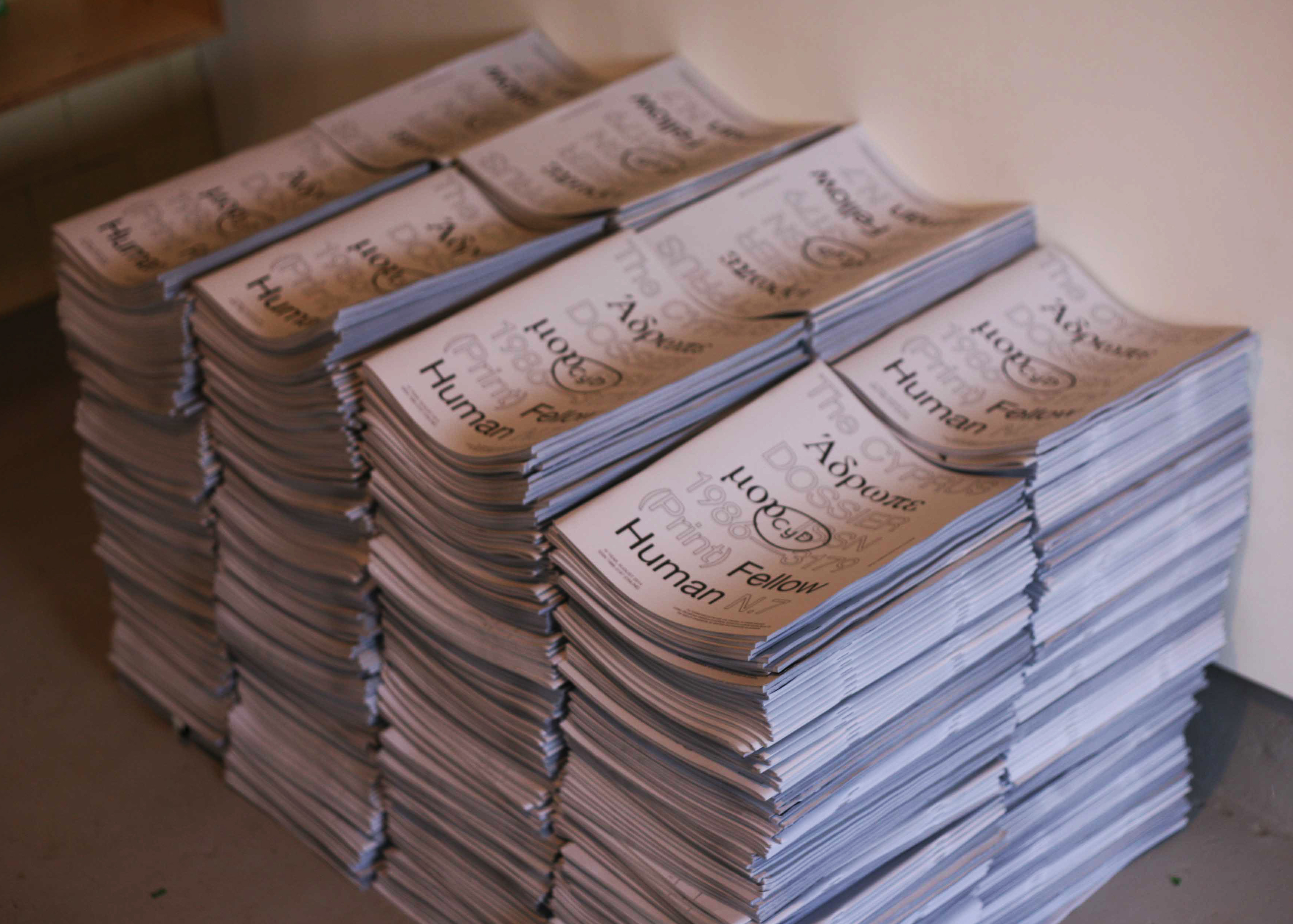
Article featured in the Cyprus Dossier: Notions of common/wealth versus single/wealth

The 7th edition of the Cyprus Dossier, launched this summer during the International Artist Initiated project hosted by the David Dale Gallery in Glasgow, Scotland, featured an article titled ‘Notions of common/wealth versus single/wealth‘ written by Fresh Milk‘s founding director Annalee Davis. Read the piece below:

CD crop

“Global art is not only polycentric as a practice, but also demands a polyphonic discourse. Art history has divided the world, whereas the global age tends to restore unity on another level. Not only is the game different: it is also open to new participants who speak in many tongues and who differ in how they conceive of art in a local perspective. We are watching a new mapping of art worlds in the plural which claim geographic and cultural difference.”[1]

The Fresh Milk Art Platform Inc., founded in 2011, is located on a dairy farm on the island of Barbados in the Southern Caribbean. We are one of several artist-led initiatives continually emerging across the archipelago supporting contemporary art production and the shaping of critical communities in the region. The local contexts these Caribbean artist networks respond to is the lack of formal institutions to meet artists’ needs, such as a national art gallery or a museum of contemporary art with a mandate to support the production, discussion and visibility of contemporary practice.

Artists in the region are functioning in an arena with relatively small local audiences, underdeveloped primary art markets and, in most cases, non-existent secondary markets for contemporary art works with very few spaces to exhibit. A challenge this poses is that much of the artwork produced in the region is exhibited, appreciated and valued outside of the region where more developed creative environments function, creating a gap between artists and their domestic audiences. Artist-led initiatives have been working to bridge this gap by creating opportunities for creatives to engage with local audiences.

Fresh Milk responds by (i) offering residencies for local artists to produce work and nurture critical thinking, (ii) expanding the reading room to acquire material focusing on contemporary practice from within the region and around the world, not available anywhere else on the island, (iii) activating the reading material through establishing mentoring opportunities for young people who write critical reviews of the book collection shared through the Tumblr page – Fresh Milk Books – The books that make us scream!, and (iv) staging public events providing local audiences and artists moments to engage with each other, along with other activities.

CD1

While recognizing the importance of nurturing the local environment, Fresh Milk is equally committed to participating in larger and more diverse conversations regionally. Common obstacles rippling throughout the region’s creative sectors act as unifiers, giving rise to geographical connections among artists across the Caribbean who share in these frustrations and resulting in the formation of many of these artist-led initiatives and collaborations.

Fresh Milk’s online interactive mapping project reconfirms our regional identity and functions as a transnational exercise demonstrating the presence of a myriad of arts entities across the Caribbean from the nineteenth century till now – refuting the fact that we are a divided space as determined by former colonizers who used dominant languages to separate the region linguistically. Consolidating regional art spaces into one, the readily accessible online map also acts as a crucial educational and research tool for locating historical and current data about Caribbean art, broadening both local and international knowledge, awareness and collaboration. Mapping becomes an act of resistance as we become our own cartographers, insisting on connection rather than division and relationship as opposed to discord. The map also resists the notion that there is a central and singular art world of which we are peripheral.

While it maybe true that, as Amanda Coulson wrote in the Frieze April issue, ‘The idea that anything intellectual happens here is anathema to the brand we have projected to the outside world’,[2] this map opposes the reductive way in which the Caribbean has been branded repeatedly as an exotic playground for people from elsewhere.

Fresh Milk has worked with partners in the region to establish a regional residency project called Caribbean Linked.[3] This project brings artists throughout the region to make and exhibit art, engage in critical dialogue and build relationships, while using the arts to foster a more unified Caribbean.

As our relationships spread beyond the insular Caribbean, our programming expands to reflect the shifting dynamics of our engagements. Nurturing our core foundation in the Caribbean equips us to build robust, meaningful connections internationally – not seeking validation, but rather mutually enriching cultural exchanges. Fresh Milk is continually fostering critical conversations with entities throughout the Caribbean, in the Global South and traversing the North/South axis of the world to holistically realize a healthy cultural ecosystem.
Continue reading