Art historian and writer Jessica Taylor reviews Fresh Milk’s last event, FRESH MILK XIV, which took place March 20, 2014 at The Milking Parlour Studio.
Photographs by Dondré Trotman.
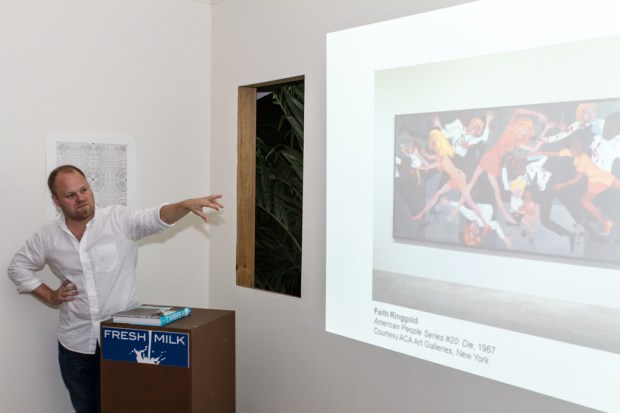
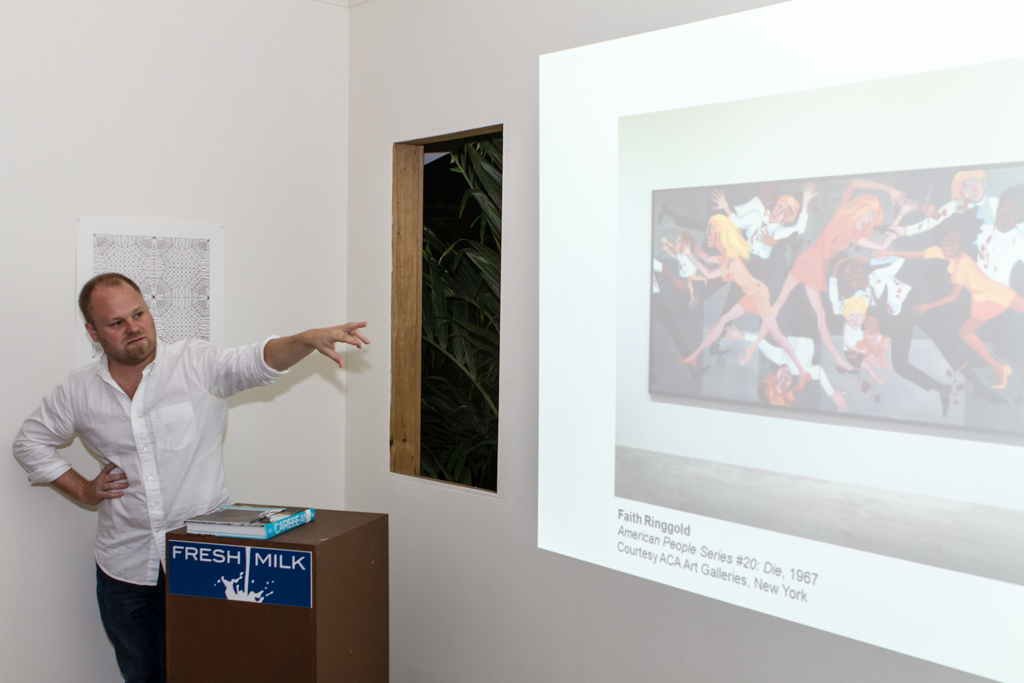
Chief curator at the Pérez Art Museum Miami, Tobias Ostrander, giving his presentation. Photo by Dondré Trotman.
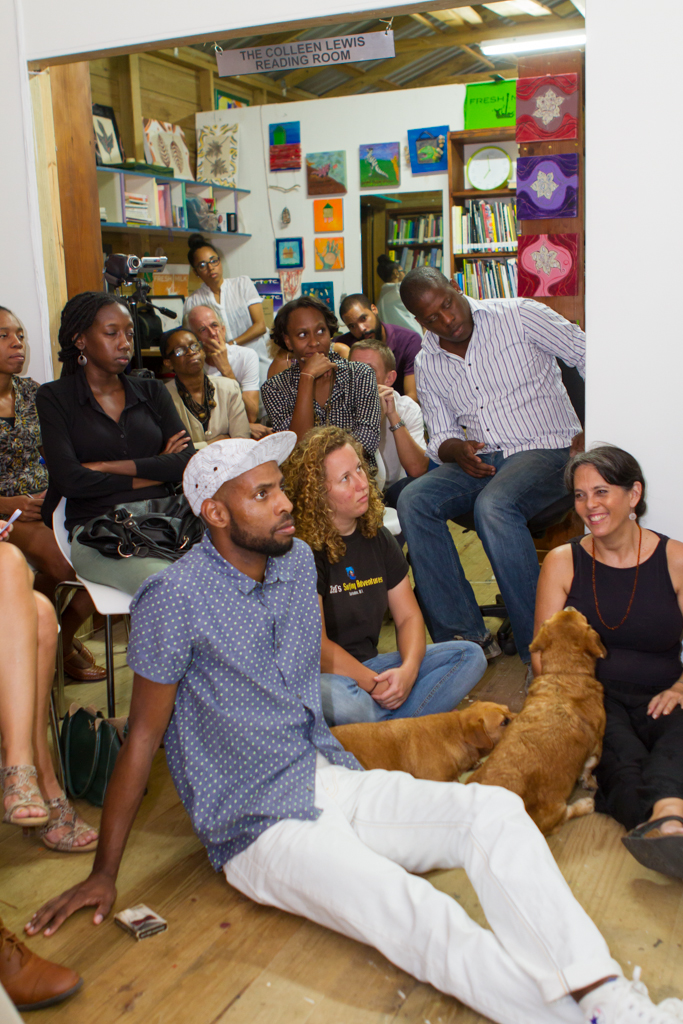
The inaugural event held at the Fresh Milk Art Platform for the year 2014 brought together two interesting discussions concerning the production and exhibition of artworks within a global context. The first of these took up the role that artists’ residencies play as valuable sites of artistic growth and production, but also as sites that encourage cultural mobility and the negotiation of difference, where artists are able to freely adapt to new spaces and perspectives. These talks were conducted by three local artists – Mark King, Nick Whittle and Versia Harris – who have participated in multiple residencies within the region and internationally. This was followed by a presentation from the Chief Curator at the Pérez Art Museum in Miami, Tobias Ostrander, who explored the notion of a new regional museum. Reinforcing the emphasis that Fresh Milk places on the importance of cross-cultural collaboration, the speakers at FRESH MILK XIV provided audience members with an expanded view of Caribbean regionalism, intending to provoke greater consideration of the need to work across geographical boundaries in order to develop relationships with other institutions across the globe.
For Barbadian and British artist Nick Whittle, the problem with residencies is that eventually they come to an end. This notion of the artist residency as a safe space in which to experiment, explore, develop and even make mistakes resounded throughout the presentations given by the three speakers. For artists, a residency is an opportunity to produce work in a space away from their usual environment and obligations, often accompanied by other artists, and thus creates a community of reciprocity. Since there is not one specific model, residencies offer different environments and different creative frameworks.
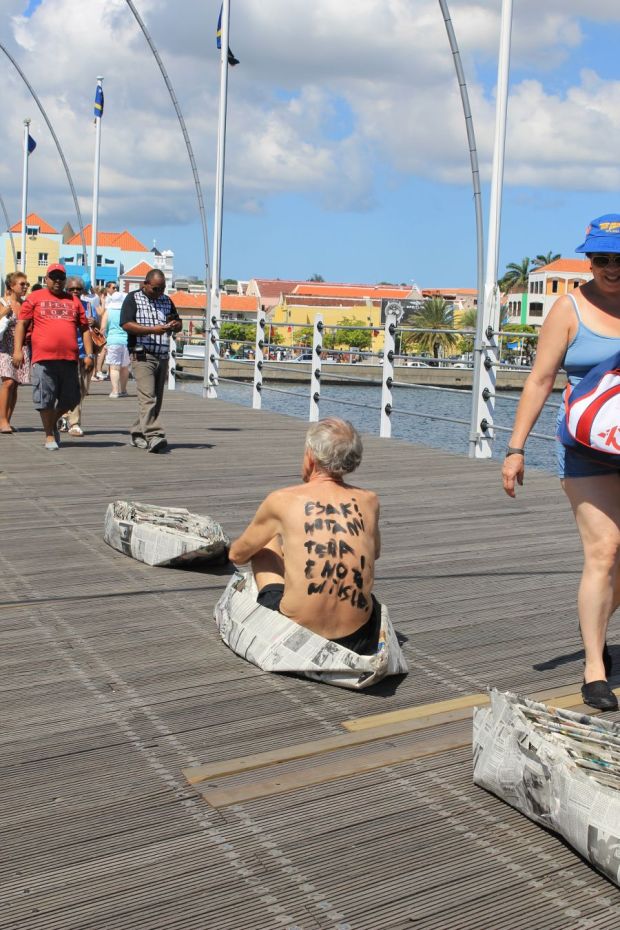
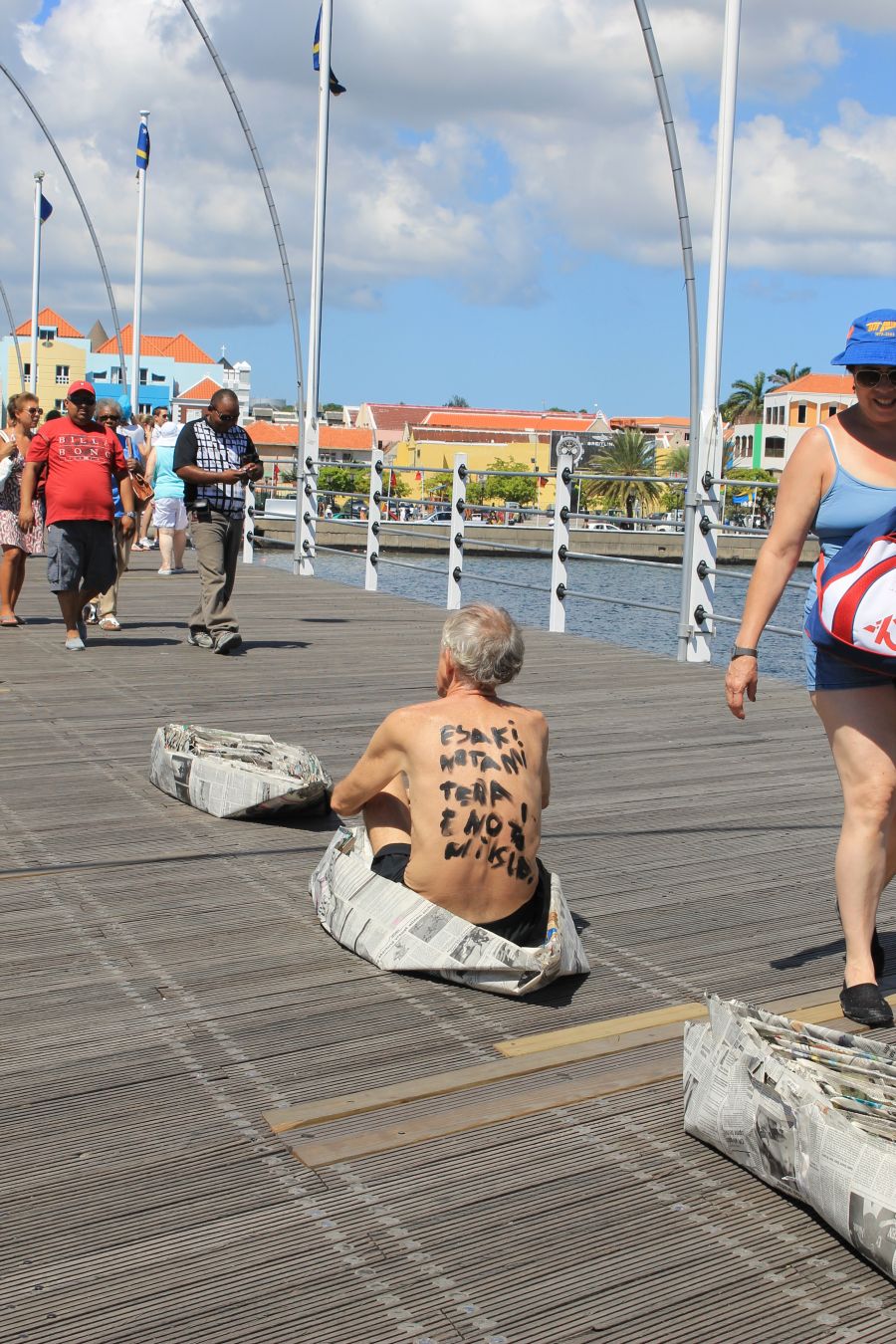
Nick Whittle, Queen Emma Bridge, Curacao, 2013
Nick recently attended a residency at the Instituto Buena Bista (IBB) in Curaçao. The language barrier that Nick experienced inspired him to take up the issue of exclusion in his works, which acquired the form of nesting boats made from large sheets of Dutch newspaper. With the words “this is not my land, not my island” written on his back, Nick staged a live performance in Curaçao in which he sat in a long newspaper boat on a bridge, forcing viewers to consider what his presence in that context meant historically and geographically. Subsequently, Nick has produced a short film with his daughter, artist Alberta Whittle, extending these themes of exclusion and belonging, presence and absence, forced encounters and cultural dislocations.

Versia Harris presenting at FRESH MILK XIV – Photo by Dondré Trotman.

Versia Harris giving her presentation. Photo by Dondré Trotman.
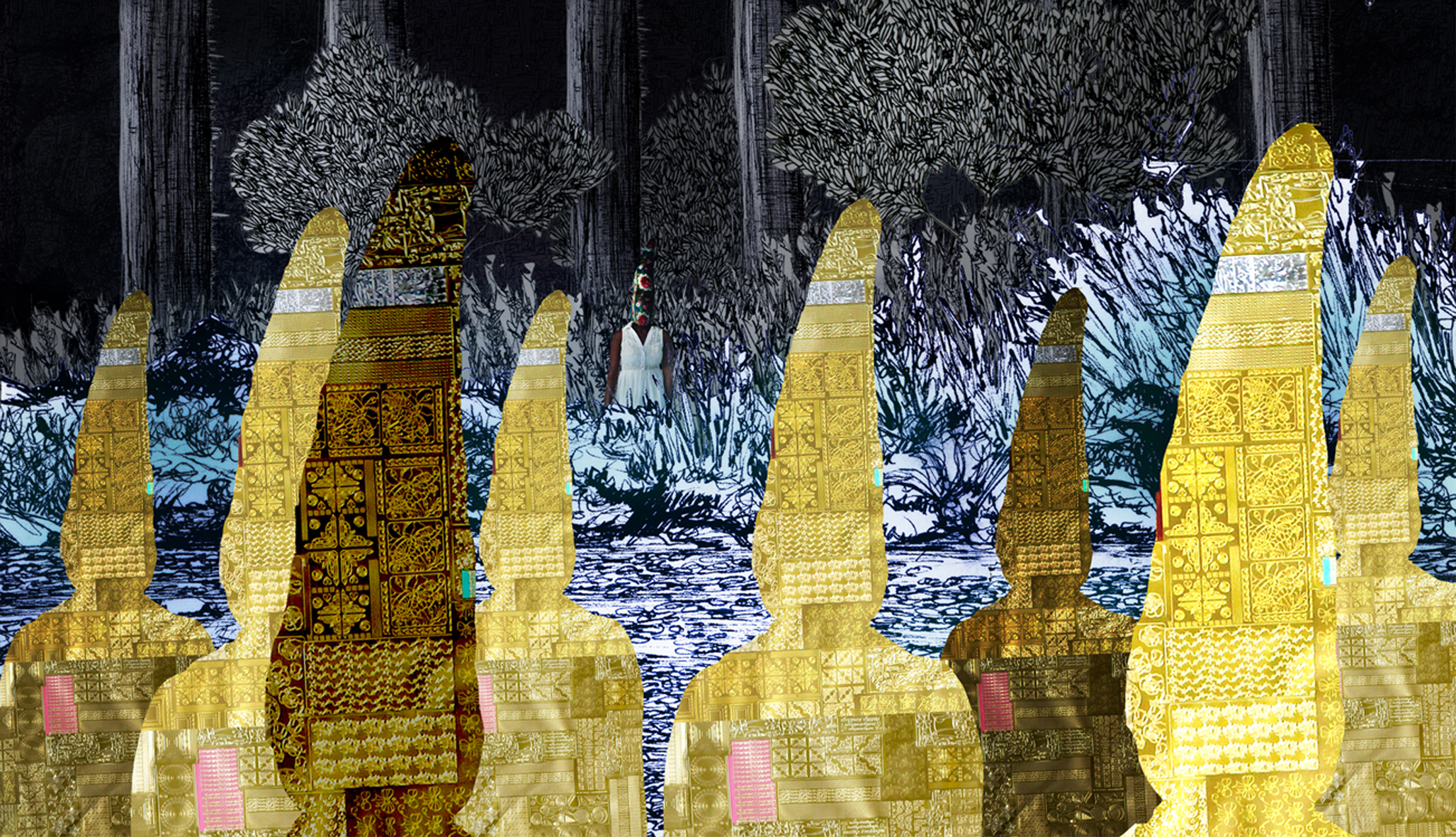
Versia Harris, a Barbadian artist, was able to trace both the transformation of her artistic style and the development of her confidence towards her production process through her experiences at four artist residencies. Beginning at Fresh Milk, she saw this opportunity as a test run for her first international residency at the Vermont Studio Center, where her intention was to focus on printmaking because of the facilities available at the Center. By the time Versia finished her next residency at the IBB in Curaçao, her work had taken a fascinating turn, experimenting with the incorporation of photographs and live footage into her animations.

Versia Harris, Fantasy Land Seperation, 2013
In Trinidad, under the guidance of Christopher Cozier, co-director of Alice Yard, Versia began to revise pervious animation projects, and through the process of re-editing was able to produce a multi-screen installation on the exterior walls of the Alice Yard building. This creation of a strong, new work from fragments of older works was an impressive manifestation of Versia’s development as an artist during her time at the four residencies, and stands as a testament to the importance of reflecting on progress over time, and anticipating what is to come from this young artist.

Mark King giving his presentation. Photo by Dondré Trotman.
While Versia’s development was first and foremost aesthetic and stylistic, artist Mark King’s development was intrinsically based in the theory behind his works. Although trained in photography, Mark felt that the medium was limited in its ability to communicate the issues that he wanted to address. While attending residencies at Alice Yard, Fresh Milk and Ateliers ’89 in Aruba, Mark used the mediums of photography, drawing, installation, sculpture and collage to respond to what was happening around him. Inspired by geometric forms and the practice of origami, Mark has created a series of beautiful and complex line arrangements on paper that are the result of algorithms made from books on the 2009 economic crash, overall banking history and culture, memoirs, autobiographies, and financial industry related news articles.

Work by Mark King from the CABTW series, (2013 – ongoing) exhibited at FRESH MILK XIV. Photo by Dondré Trotman.
Underlying these intricate and delicate designs is a strong criticism of the CEOs who were responsible for the financial crisis, and he recognizes an interesting connection between the uncertainty of the shape that the algorithms take when converted into the vectors that make up his work and the uncertainty of the stock market. In this series, and in his installations in Aruba, Mark has altered familiar structures in ways that enabled him to respond to social norms in coded and often satirical ways, free from the restrictions of one specific medium.

Chief curator at the Pérez Art Museum Miami, Tobias Ostrander, giving his presentation. Photo by Dondré Trotman.
The value of attending multiple artists’ residencies as part of a larger process of artistic development comes from the global reality of our contemporary art world. Residencies, both regional and international, should be seen as part of a wider network of institutions that stands to connect artists and foster cultural exchange. This dialogue was continued by Tobias Ostrander, who spoke of his work as chief curator at the Pérez Art Museum Miami, which opened December 2013 in a new building designed by Herzog & de Mueron. Given that Miami functions as a transitory space between North, South and Central America and the Caribbean, the addition of this large-scale museum to a quickly maturing city, previously best known for the temporary art fair Art Basel, positions Miami as an interesting space in which to explore the possibility for a long-term relationship between the Pérez Art Museum and Caribbean art institutions.
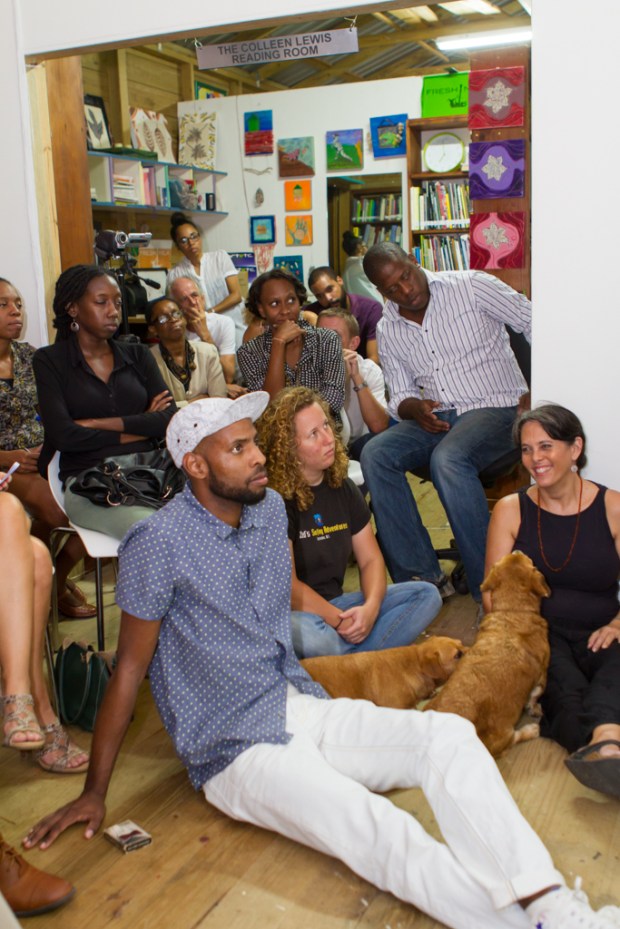
Speaking of a larger project of “strategic regionalism,” intended to increase the dialogue between these regions over time, Tobias emphasized the importance of seeing this a process of resolution, rather than a quick solution to the lack of visibility that Caribbean artists experience. Recognizing the curatorial issues inherent in exhibitions like Caribbean: Crossroads of the World, which will be shown at the Pérez Art Museum this year on a smaller scale than was shown in New York in 2012, Tobias positions this exhibition as a potential starting-point for dealing with these issues, and the first stage in a greater project of collaboration.
Underlying the discussion was a distinct frustration that ultimately exhibitions, like residencies, are temporary. The challenge that we face now is how to extend the wider horizons afforded by these events to effect meaningful change to the infrastructure within which Caribbean artists work on a daily basis.

Work by Mark King from the CABTW series, (2013 – ongoing) exhibited at FRESH MILK XIV. Photo by Dondré Trotman.
_________________________________________________
About Jessica Taylor:
Jessica Taylor
Jessica Taylor recently graduated from McGill University with an undergraduate degree in Art History and Philosophy and hopes to begin a graduate degree in Curatorial Studies in 2014. Her focus is contemporary Caribbean art.










 fresh milk barbados