Maj Hasager & Ask Kæreby – Week 2 Blog Post

Fresh Milk resident artists Maj Hasager and Ask Kæreby share the second blog post about their time in Barbados, outlining their busy week that saw them continuing to learn about the island through research in the Barbados National Archives and by traversing the physical landscape. Both artists also began their community outreach, which included Maj’s first session with BFA students at Barbados Community College and day one of Ask’s experimental sound workshops being held at Fresh Milk. Read more below:

The blessed rain pours down massively. After a dry wet season the plants, trees and animals feel energized and revitalized. Monday is spent in the studio and the rain creates a perfect soundscape on the metal roof, where the sound is intensifying and suddenly loosens its loud grip to make the wind and the surrounding sounds audible. The studio is quiet and we are planning the South Coast trip later in the week. Our plan is to see the majority of the island by local buses and it demands a bit of logistics, good walking shoes and some determination to make this happen – as time is a luxury that many visitors to the island seem short of. Insisting on taking our time is indeed in stark contrast to the past year of activities, and it is highly appreciated.

Annalee is waiting in her car outside the apartment – I (Maj) can hear her beeping and grab my things before closing the door behind me. We move down the hill towards Barbados Community College (BCC) where half an hour later I will give a lecture on my work to a group of students from the fine arts department. Hours later, I am enriched by the level of conversation and questions raised amongst the students, and I can’t wait for the next session where we will go more in depth in terms of a close reading of a text, and thinking through social practice together. As we are leaving the BCC, Annalee takes me to the top of the campus to show me an old derelict building – despite it falling apart you can sense the grandeur of the structure. She tells me that it is a former sugar plantation house and it sits fairly dislocated or perhaps amputated at the edge of campus. Here the generic campus buildings seem to be rejecting a contested past, and the neglect of the house (or perhaps its symbolic meaning of colonial power) seems to be a way to suppress a past by letting it dissolve slowly by time. Though perhaps forgetting, as Annalee mentions, that the first black Chief Justice on the island Sir Conrad Reeves lived in this house too.

History spills out of wooden drawers in the chilled archival hall of the Barbados National Archives where we arrive Wednesday morning. We are slowly chewing our way through archival documents – via neatly organized index cards in perfectly fitted drawers tracing migration movements after the emancipation in the 1830’s – in particular looking at the massive exodus of young Barbadian men leaving for work in Panama either constructing the railway or later digging the Panama Canal. We are following the trail of the “Panama money”, the encouragement – and later restriction ­– of migration, the riots in 1937 and the formation of trade unions. One thing leads to the next as the hours vanish in the archive. The archive itself is somehow stuck in the past, and the sounds of heavy books being dropped on tables echo in the vast space. At 4 pm the archive is slowly shutting down, and we leave the air-conditioned hall with a chill. Outside the archive at 4 pm on the dot, the art historian Therese Hadchity picks us up. She left Denmark 25 years ago, and we spend hours over coffee discussing contemporary art in the Caribbean, social practice and the potential pitfalls of this type of practice – to mention a few of the many topics covered over three hours in good company – definitely a conversation to be continued.

Thursday morning begins with some more work on the hydrophone (underwater microphone) – Ask is still attempting to secure the cable so water is kept out when immersed. Thanks to the Colleen Lewis Soldering Iron, Annalee’s extended family and local hardware and music stores, an improvised solution begins to materialise. The plan is to test it over the weekend when we are walking along the South Coast. Thursday is also the first session of the sound workshop that Ask is teaching. Six people turn up at Fresh Milk for the first dose of soundscape recording and composition – some have a bit of a shell shock. It is a rocky ride through Musique concrète, Pierre Schaeffer, soundscape, acoustic ecology, Murray Schafer and the physics and technology behind it all. As the dust settles, questions arise and a most interesting debate takes form – I am very much looking forward to the continuation.

We head out early Friday morning, and as we leave the apartment at dawn, Annalee’s lovely father offers us a ride to St. Lawrence Gap at the South Coast, and thereby cuts our journey shorter by an hour or more. St. Lawrence Gap is the first place where we immerse the hydrophone fully in seawater, and thank goodness it is water proof despite its very homemade look. Maj has volunteered to be the assistant in the sea (what a dreadful task) and Ask is at shore with the recorder and headphones. Suddenly sounds of sand on the sea bottom are coming through and it is very exciting. The recordings continue throughout the weekend in different locations and both in the Caribbean Sea and Atlantic Ocean.

We end the weekend trip at the Good Life Café near Accra Beach, where we meet the multitalented artist Mark King, who quickly turns out to be a stimulating conversation on both art and global politics.

_____________________________

DanishArtsFound_LOGO_CMYK

This residency is supported in part by the Danish Arts Foundation

Sign-up for a sound workshop with upcoming resident artist Ask Kæreby

Danish composer and sound artist Ask Kæreby will be hosting a series of workshops around experimental ways of working with sound during his upcoming Fresh Milk residency in November, 2015.

Find out more about the programme below and email us at freshmilkbarbados@gmail.com to let us know if you are interested in attending, as space will be limited. More detailed information about the dates & times of the workshops will follow:  

sound flyer final

About the workshop:

What sounds are available for artistic expression and how can we approach them?

As a composer or musician it is very possible to take available instruments and their sounds for granted, as most have a heritage of hundreds of years, and many new are simply variations or emulations of earlier models. But what if we suspend “the usual suspects” for a while, and try to listen in a different way? What if we refrain from identifying a sound by its source, origin or processing, and instead try and describe what we hear by its own merits? If we open ourselves to the soundscape surrounding us, how can we appreciate this in a meaningful way, and can we communicate to others by means of our own soundscapes, composed or fabricated from field recordings?

In a number of workshops, we will focus on sound as a medium of intrinsic value and its own source of information. With inspiration from the World Soundscape Project from the 1970’s, we will begin an aural mapping of the environment, documenting the local soundscape via field recordings and discussing possible signature sounds or soundmarks. Using different types of transducers, we will investigate vibrations in different types of materials such as gasses, liquids and solids – thereby exploring different modes of perception and listening. These recordings will also function as the compositional base for experimental construction of sonic narratives, musical compounds or combinations thereof.

ask kaereby

Ask Kæreby

Artist Statement:

My artistic practice is interdisciplinary and research-based, involving experimental composition, sound design and electroacoustic music. I’m interested in the presentation of narratives by means of sound – not through traditional musical gestures, but using different approaches such as musique concrète or the futurists’ bruitism, thereby giving the listener a more subtle way of experiencing the essence of the work. By placing myself in the intersection between the known formats, I wish to challenge our ways of listening – to music (live as well as recorded), to our surroundings and to (sonic) art.

Since the days of Aristotle, narratives in art have been characterised by a “poetic” organising principle, which is both logically and aesthetically superior to the random historicity of factual events. The incorporation and processing of pieces of reality in the shape of sounds in forming an audible work, contains possibilities for combining and juxtaposing these two principles, which I find extremely interesting.

My projects begin with a longer period of research, where I collect factual and historical information and gather impressions and sounds from the area and/or subject. Particularly interesting ideological or technological methods may appear, and form the basis of my further compositional work.

Bio:

Ask Kæreby is a Danish composer. He studied music production in Copenhagen, earning a MMus degree from The Royal Danish Academy of Music.

Kæreby’s artistic practice is interdisciplinary and research-based, including elements of experimental composition, sound design and electroacoustic music. He is interested in the presentation of narratives by means of sound – not through traditional musical gestures, but using different approaches such as musique concrète or the futurists’ bruitism. Working in the intersection between known formats, Kæreby wishes to challenge our ways of listening – to music (live as well as recorded), to our surroundings and to (sonic) art.

He has been awarded grants in support of his work from The Danish Arts Foundation, Danish Musicians’ Union, Wilhelm Hansen Foundation, Familien Hede Nielsen Foundation, Dansk Artist Association, Ellen & Erik Valdemar Jensen Music Grant, Anders Månsson & wife Memorial Grant and Karen Margrethe Torp-Pedersen & husband Foundation.

Thais Francis’ Residency – Week 1 Blog Post

Trinidad-born, Brooklyn based multi-disciplinary performance artist and writer, and current artist in the Fresh Milk International Residency Programme, Thais Francis reflects on the first week in Barbados. She writes about her hesitation to confront her “quarter life identity issues” with a group of eager students from Workmans Primary School. After an eventful time with the children, she focuses on the challenges and rewards of writing her first feature screenplay. Read more below:

IMG_2194

“You look like my auntie!”

“I look like your aunt?”

“I like how you does say Auntie…say it again?”

“Ummm…aunt?”

“Where you from?”

Their names are Nyesha and Ramaya- one is bedecked in her brownie outfit, the other wears her school uniform topped with three plaits and ribbons. Nyesha thinks I look like her aunt, and Ramaya has picked up on my accent. She asks me the question that I dread answering. What do I tell her? Do I go into a spiel about emigrating from Trinidad…or do I just say Maryland? My brain goes into overdrive and my “quarter life identity issues” resurface. More classmates join them, and all stare at me expectantly. Innocently invasive brown eyes filled with questions and excitement. They are reminders of the beauty of being 9 years old.

“I live in America”.

They are satisfied with my response. We then all walk over to the open field.

When I first saw the students at Workman’s Primary school, I was elated. The ribbons, uniforms, brown skin-all images of a past life tucked away in the folds of mind. However, it wasn’t hard to remember and transform with them. With Ms. Bradshaw’s class of 17 students I found myself using theater, music and dance to add more color to the kaleidoscope of their lives. We used our bodies to mime and form shapes that were parts of speech; we became a human orchestra, and created a dance to work on focus and memory. They referred to me as “ma’am”. After the class, I thought about that. “What is a ma’am and how did I become one?”

In other news, here in Barbados, I have learned how to light a stove, with a match. Like, I can strike a match and light a stove. I’ll be sure to show my granny this new skill when I visit- she’ll be impressed.

IMG_2239

However, the main reason I am here is to work on my first feature screenplay. It’s actually weird, and frustrating, but sometimes cool, sometimes I like what I’m saying…most times I don’t. Mostly I’m excited to complete it, and then have people read it and rip it to shreds in a few weeks. I’m still figuring out what I’m saying- but I’m really into it the overarching idea, and the realness of the characters. I’m at page 78, luckily I worked on this A LOT in Trinidad and Abu Dhabi a few months ago-so I’m really happy I’m not starting from scratch. It makes this process less overwhelming.

Review of ‘The Art of the Essay/The Essay on Art’ Workshop – Part 1 & 2

As part of his residency at Fresh Milk, Toronto based, Trinidadian-Bahamian writer Christian Campbell hosted a workshop titled The Art of the Essay/The Essay on Art on December 6 & 13, 2014. The two days focused on critical essays on art, not only as a form of criticism but also looking at the essay as an art form in itself. Fresh Milk Books team leader Kwame Slusher shares a two part review of the workshop below:

tumblr_inline_ngf3k1W8Ba1sdx8um

Part 1

The word origami means folding paper. For it to be authentic the paper folder is expected to create a paper sculpture without cutting, gluing or marking the paper in any way. Despite these restrictions, the possibilities of paper sculptures from a simple flat piece of paper are inexhaustible.

On Saturday December 6th, the Fresh Milk Art Platform hosted the first half of a two day workshop titled, ‘The Art of the Essay/The Essay on Art’. Led by the Toronto based, Trinidadian-Bahamian poet and cultural critic, Christian Campbell, the workshop was geared toward encouraging us, as artists and writers, to rethink and reexamine our idea of the essay. Campbell demonstrated to us that, like a flat piece of paper, the essay can also take many different forms.

In our first activity we were challenged to analyze an elegiac essay titled Etta James: Her Lonely Sound by Hilton Als. We looked at how his piece deviated from the traditional form of the essay while simultaneously maintaining an analytical authority—how Als expertly weaves the personal with the analytical.

After that, we watched Janis Joplin’s very dark rendition of Summertime on YouTube, and wrote a paragraph long response, bearing in mind the techniques used in Hilton Als’s essay. When we were finished we all read our responses aloud, and Campbell critiqued them. Some of us he encouraged to put more of ourselves in the essay and others to be a little more analytical, but on a whole it was clear that we all were beginning to understand the potential elasticity of the form.

At the end of the session Campbell passed out printed copies of Elizabeth Bishop’s ‘The Map’ to be read for the next session, which will be held on Saturday December 13th, from 10 to 12. As we packed notebooks and pens or pencils away, Fresh Milk Director Annalee Davis served slices of cake/pudding, while we were locked in lively discussion on what it means to be a “…millennial in the Caribbean right now”, and the inexhaustible shapes in which we can sculpt the space/s around us.

Jean-Michel Basquiat, Self-Portrait, 1982

Jean-Michel Basquiat, Self-Portrait, 1982

Part 2

In a recent interview, a Guyanese art student at the Barbados Community College said that she was given an assignment where she had to do an abstract self portrait of herself. She decided to focus on her origins, and the result was an overhead topographical map of Guyana. She wanted the art work to show a landscape with all of the bumps, hills and groves that correlate with the complexity of a person’s emotional layers.

The second and final session of The Art of the Essay/The Essay on Art was really about creating maps. Like the art student, we were challenged to move away from the established contours and chart emotive and critical pathways with our writing. Christian challenged us to navigate our own ways through perilous territory—ourselves.

The first thing we did was to review the reading assignment that we were given from the previous week, The Map by Elizabeth Bishop. After a not too close reading of Bishop’s poem, Christian brought up a map of Barbados on his Mac and asked us respond to it, keeping the poem in mind. The result was the charting of emotional territory as we found unique ways of connecting with the familiar landscape; from immediately coherent political statements to abstract, but poignant, word associations.

After that we looked at another reading assignment that we got during the week via email. It was an essay called Never Trust a Big Butt with a Smile by Greg Tate, which explored implications of the phrase ‘Black Comedy’ amongst other things. What was immediately apparent, even before the subject matter of the article became clear, was Tate’s use of colloquialisms. After discussing the reading, we were encouraged to make a list of all the colloquial words and phrases we could think of within a given amount of time.

Next, Christian brought up the image of Jean Michel Basquiat’s Self-Portrait on his Mac and challenged us to respond to it using some of the same colloquialisms that we had written down, or any others that we could think of during the free writing exercise. This proved problematic, because the use of dialect and colloquialisms seemed to peel away the seriousness of our responses to Basquiat’s work. We had mapped ourselves into awkward territory and tried to laugh it off. This exercise really forced us consider our relationship with standard English and dialect, and the existing linguistic hierarchy that privileges the former over the latter, ultimately considering our own identities.

There is always that fear of transgressing an existing border, but the workshop showed us that we need to untangle ourselves from preexisting imaginary lines. We need to toss our compasses, and form our own Keys and Legends, and really try to chart our own personal geographies.

Cherise Ward ‘My Time’ Residency – Puppet Building Workshop

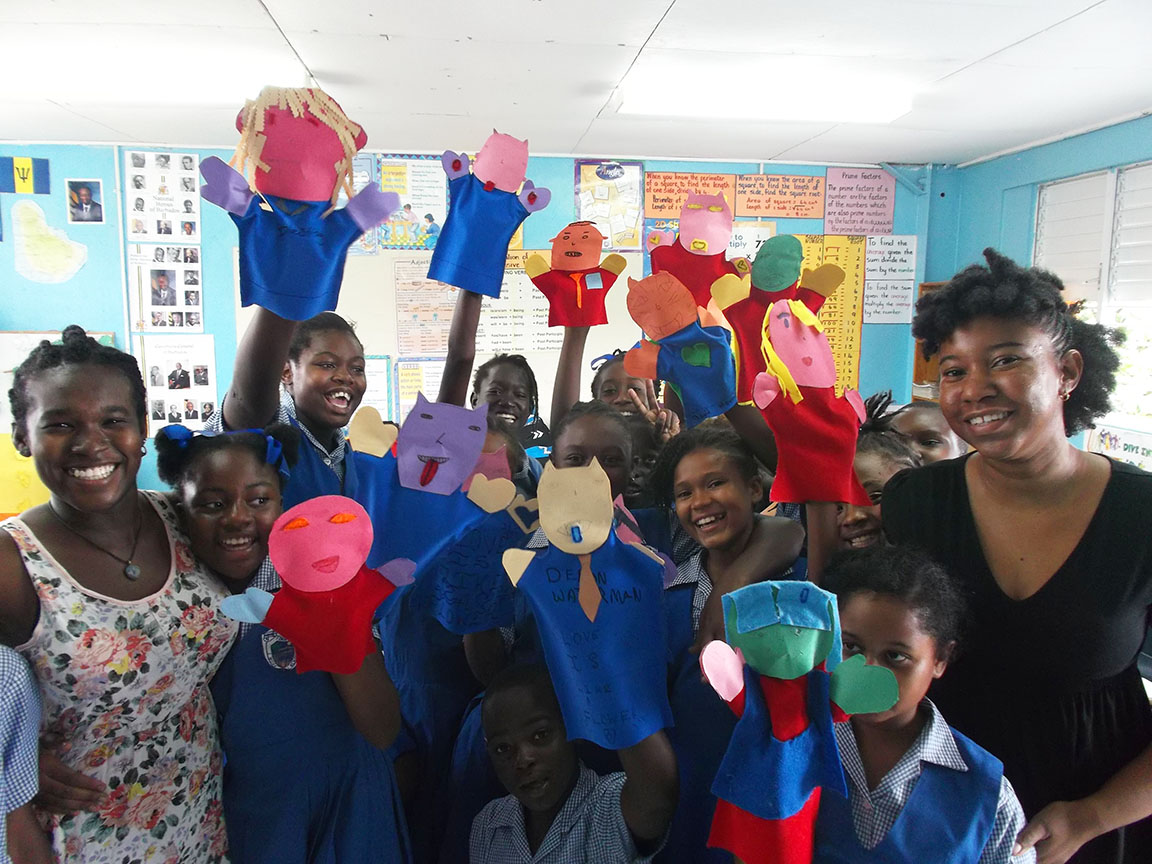
PuppetWrkshp16For my community outreach for the residency, I decided to do a 3 hour Puppet Building Workshop with students from Workmans Primary. The students were from both Class 3 and Class 4.

As part of my preparation, I made a test puppet. I wanted it to be a simple hand puppet that I thought the students would be able to make themselves. I used fabric, felt and construction paper.

On the day of the workshop, I had the assistance of Fresh Milk volunteers Versia and Ronald, and they were a great help.

I started by teaching the students about 3 different types of puppets, and doing a brief demonstration of how they worked using puppets I have made. They took notes, and were interested in trying to operate the puppets themselves. Then we got started making their hand puppets.

The students cut out their templates for the glove part of the puppet, and traced them onto the fabric, and we helped them cut and glue the fabric. They drew the designs for their puppets, and then cut the shapes for the heads and hands, and decorated them using felt, paper, and crayons.

The workshop was really well received. The students were enthusiastic, and excited about the puppets, and we had a great time. Thanks to Versia and Ronald for their help as well as Annalee and the teachers at Workmans Primary.

Follow Cherise on Tumblr for updates on her residency & practice.