Brass Tacks: A Workshop on the Nuts & Bolts of Building a Writing Life by Naomi Jackson

Brass Tacks: A Workshop on the Nuts & Bolts of Building a Writing Life is an afternoon session which will be hosted by writer Naomi Jackson at Fresh Milk on Saturday, July 16, 2016 from 2-5 pm. Naomi will lead participants in conversations and activities designed to help refine their writing goals, support the creation of productive and satisfying writing lives and address the commercial aspects of breaking into the business.

Brass Tacks_Naomi Jackson Flyer

Some topics to be addressed include:

✔ Setting and achieving goals for your writing
✔ Developing writing routines
✔ Preparing writing submissions (i.e., drafting query letters)
✔ Approaching potential editors, agents, and/or publishers
✔ Building a community of support and trusted readers to advance your work

To register, please send a letter of interest to freshmilkbarbados@gmail.com. This one-page statement must outline your current writing projects, your short and long term writing goals, and why you wish to participate in this programme.

There will be an attendance fee of $15.00 BBD, and spaces will be limited to 12 participants.

________________

About Naomi:
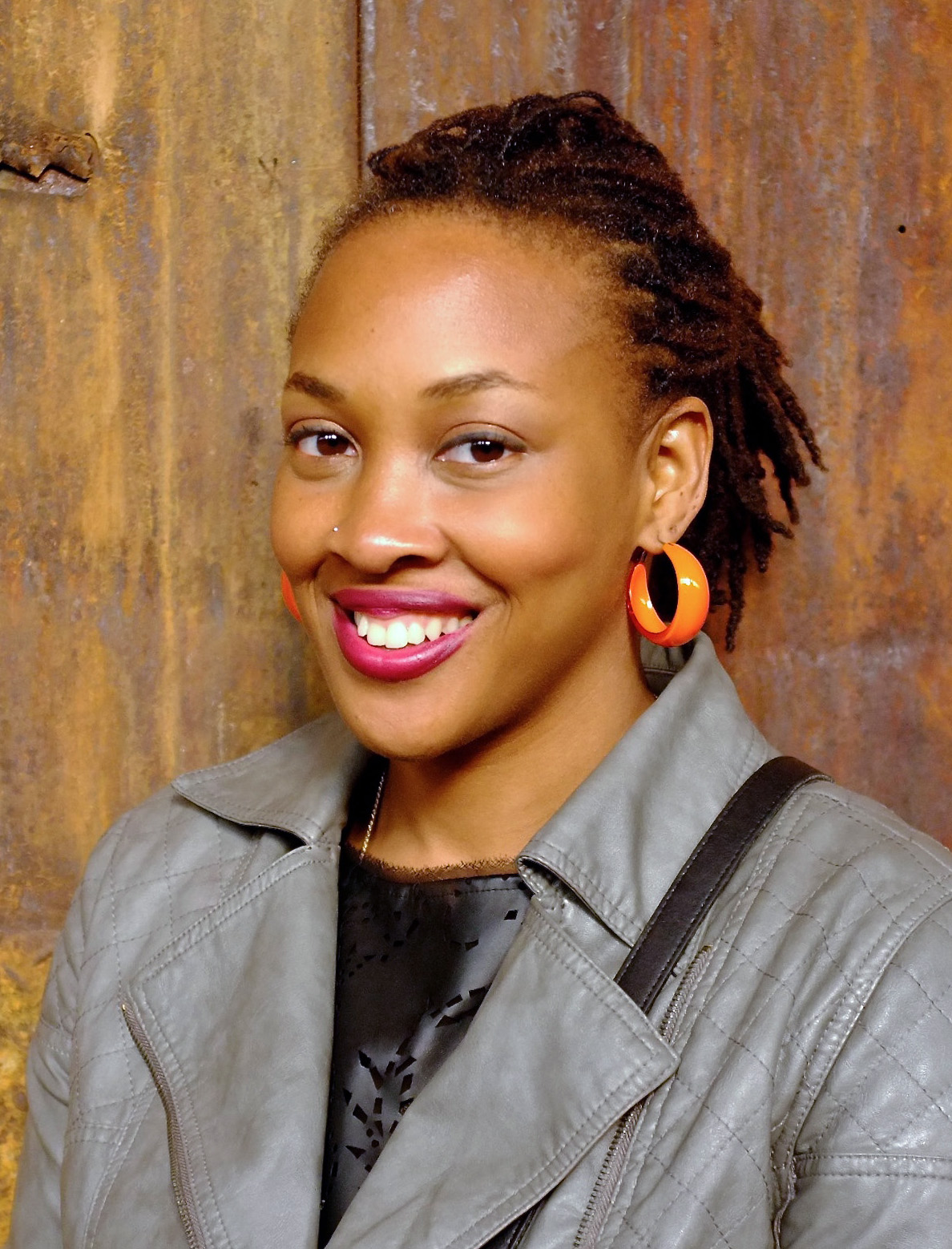
n.jackson_headshot

Photo credit: Lola Flash

Naomi Jackson is author of The Star Side of Bird Hill, published by Penguin Press in June 2015. The Star Side of Bird Hill was nominated for an NAACP Image Award and longlisted for the National Book Critics Circle’s John Leonard Prize as well as the Center for Fiction’s First Novel Prize. It was also selected for the American Booksellers Association’s Indies Introduce and Indies Next List programs. The book has been reviewed in The New York Times, The New Yorker, Kirkus Reviews, NPR.org and Entertainment Weekly, which called Star Side “a gem of a book.” Publishers Weekly named Jackson a Fall 2015 Writer to Watch.

Jackson studied fiction at the Iowa Writers’ Workshop. She traveled to South Africa on a Fulbright scholarship, where she received an M.A. in Creative Writing from the University of Cape Town. A graduate of Williams College, her work has appeared in literary journals and magazines in the United States and abroad. She is the recipient of residencies and fellowships from the Kelly Writers House, Hedgebrook, Vermont Studio Center, and the Camargo Foundation.

Jackson has taught at the University of Iowa, University of Pennsylvania, and The City College of New York. She is a Visiting Assistant Professor of Creative Writing at Oberlin College for spring 2016 and will be Visiting Writer at Amherst College beginning in fall 2016. Jackson was born and raised in Brooklyn by West Indian parents.

Alex Kelly’s Residency – Week 3 Blog Post

Trinbagonian artist Alex Kelly shares a third blog post about his Fresh Milk residency, which took place earlier this year in March. Looking at his last night in Barbados, spent liming with some of the people he encountered while in the island, Alex reflects on some of the collective aspects of the Caribbean experience he has noticed, and the fine line between comforting familiarity and complacency around regional issues. Read more below:

It’s the last lime before I leave Barbados. I’m having a chat with my Bahamian flatmate and her friend, a fellow Bahamian who’s lived in Barbados since she was a child. There is a bowl of chips and two bowls of dip on the coffee table in front of us. A fly lands on one of the chips and begins to survey the bowl. We continue having our conversation.

Someone gets up and, paying no attention to the fly, takes a chip out of the bowl, scoops up some dip and returns to their seat to enjoy. The fly has of course exited the conversation at this point, but that just happened, and we all let it. In that moment, I once again felt strangely at home in Barbados.

It’s not that we’re particularly fond of flies in TT, in fact I’m sure that the average person, including myself on another day, would have hastily gotten rid of the fly before it could ever desecrate the surface of a single chip; we love we belly. But there was something so unpretentious and confident about the imagined Caribbean that I learned to appreciate, and while on an average day I feel that I am constantly surrounded by actors playing out a role or as Chang might have said, artists more interested in their title than in the work, in that moment I saw an image of that Caribbean. No one pretended to be offended by the presence of that fly.

I am aware that this is an odd and, perhaps for some, off putting example, but I went to Barbados hoping to find a way that my own Caribbean experience could connect to others. I found it yet again in those moments. In that interaction, I was reminded of all the tension that I experience in my work; a practice that examines a way of life that is deeply troublesome and often dangerous, but one that is full of little subversions that make life so much more beautifully subtle and complex.

The frightening question that I am now comforted by, after having been reminded that it is our breaking of the rules that often makes life so nice, is how does a people manage to keep their beautiful conversation going, with that fly still in the bowl, and yet avoid all of the horrors associated with its kind. I believe that we can find a better way, but I’m not sure that I ever want that way to include fussing over a bowl of imported chips. What doh kill does fatten.

________________________

Tridium

This residency is supported by Tridium Caribbean Limited

Sonia Farmer’s Residency – Week 4 Blog Post

Bahamian artist and writer Sonia Farmer shares her fourth and final blog post about her residency at Fresh Milk, which took place during March. Continuing her creative journey after the residency – which marked the beginning of a series of new adventures, including a recent workshop hosted by San Diego Book Arts – Sonia looks back on her time in Barbados, realizing that the ideas planted here will continue to grow organically; not tied to a physical space, but to an ongoing process of discovery and dismantling of experiences. Read more here:

1

Just as my time flew by in Barbados, so has the time on my journey post-Barbados. Being my first residency, I was not sure what to expect, but I did believe I had a lot of time at my disposal…which wasn’t entirely true. That is the lesson I’ll carry to any future residencies: you don’t have all the time you think you do while you are there. But—at least in this instance—the piece doesn’t exactly have to live within the confines of the residency itself.

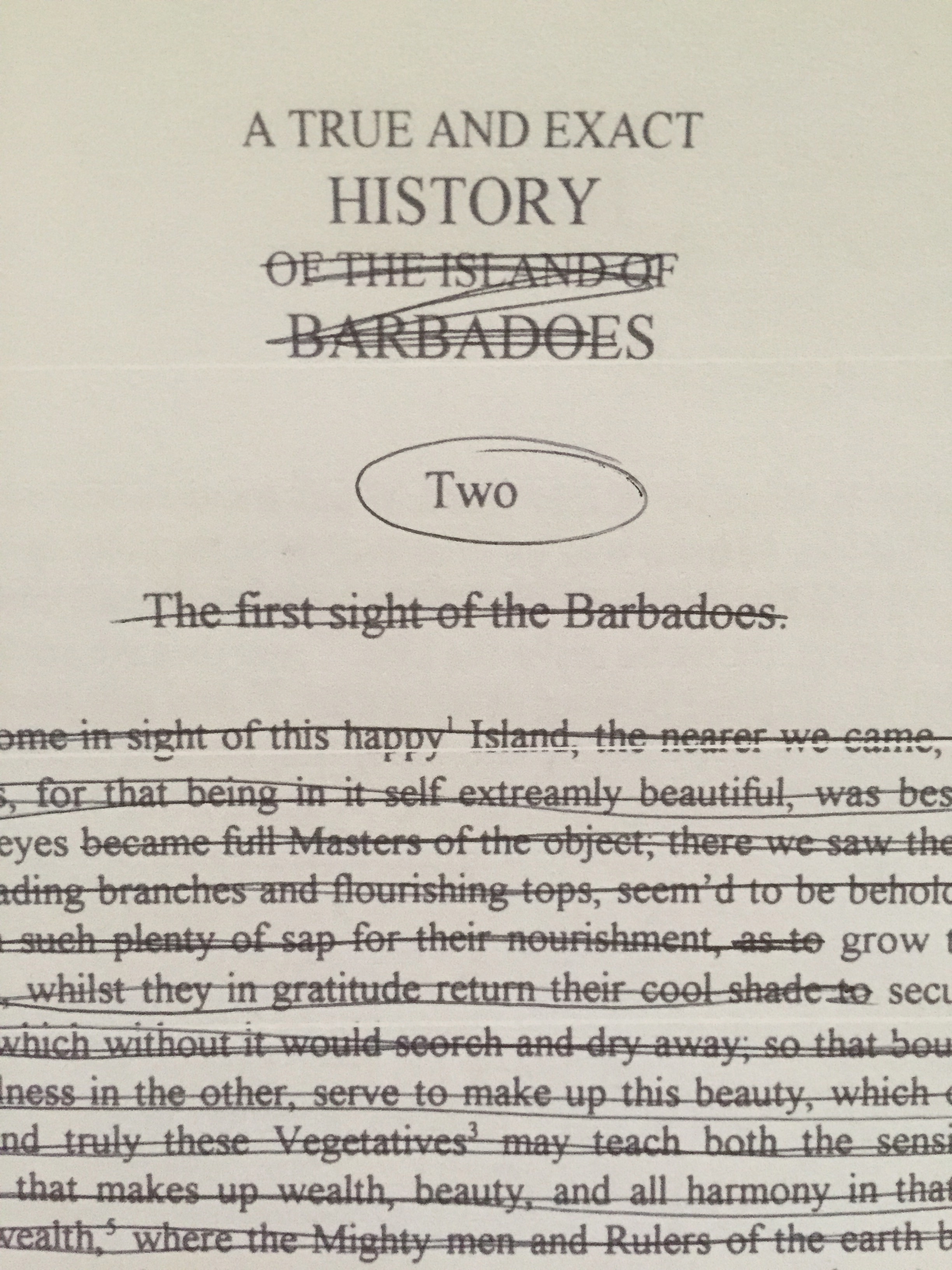
I am barely halfway through my erasure project of Ligon’s A True and Exact History of the Island of Barbadoes. I harbored some anxiety about finishing the entire erasure within the environment of its origin, but I also knew the desire was unrealistic, given my major commitment to teach a four part workshop during my time there, which took up half of my studio time overall.

But this desire to start and finish the text within Barbados was unrealistic in another way too, which has been revealed to me as I continue to visit the text on trains and buses moving through landscapes just as unknown to me as the island: the poem I am culling from this text so concerned with establishing a sense of place in fact removes that recognizable place. Or perhaps, more accurately, its underlying anxiety to locate place drives an obsessive challenge to interrogate that very idea, dismantling it not necessarily for reconstruction but rather for dismantling’s sake, the very unsettling result the actual desired result:

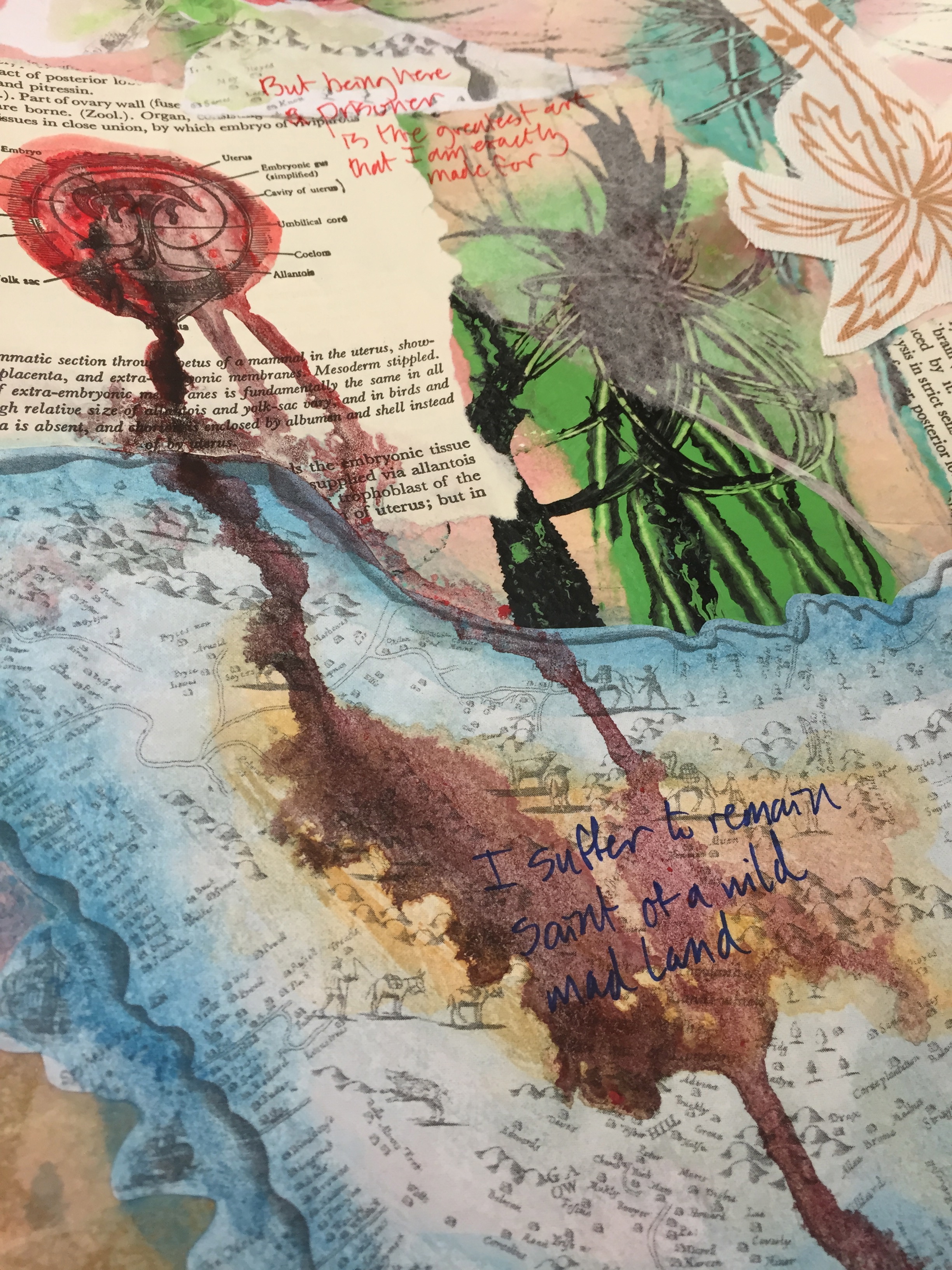
“But being here a prisoner
is the greatest art
that I am exactly made for”

There is a loose narrative, a voice that belongs sometimes to a traveller, sometimes with a companion, and other times belongs to a collective. Place, time and body collapse and expand, melt away and come into focus, but remain always in an abstract, deconstructed and unsettled state. I’m enjoying the little insights this provides into our historical foundation and current realities in the Caribbean space. It makes me think about what I said it week one, that visiting other Caribbean spaces is like an exercise in magical realism—this text is the written experience of that feeling, a constant rush of déjà vu.

I think it is appropriate to continue this exploration as I myself remain an explorer for these next few months, finding refuge in the strange but also exciting nature of this act even outside of the Caribbean. Because I’m still captivated by this idea, the in-progress poem and its imagery became my subject during a three day workshop in San Diego, ‘Sketch Book Stitch’, taught by Cas Holmes and hosted by San Diego Book Arts.

Less about creating a finished product and more about encouraging experimentation, the class helped to break open my obsessions with Ligon’s text and the themes I’m exploring in the erasure. I brought together decorative papers, found imagery, maps, and Ligon’s own drawings to create mixed media collages that respond to the poem. Just like the poem, these pieces are in no way finished, but they have allowed me to keep dig deeper into this project began at Fresh Milk. I think I’m gaining clarity on another theme that interests me while I deconstruct this text and also visit other spaces, which is how violence plays into the physical and social formation of landscape, and how violence inflicted upon one ties into the other. That definitely came out in the imagery, and I’m still turning it over in my head. We will have to see how it plays out.

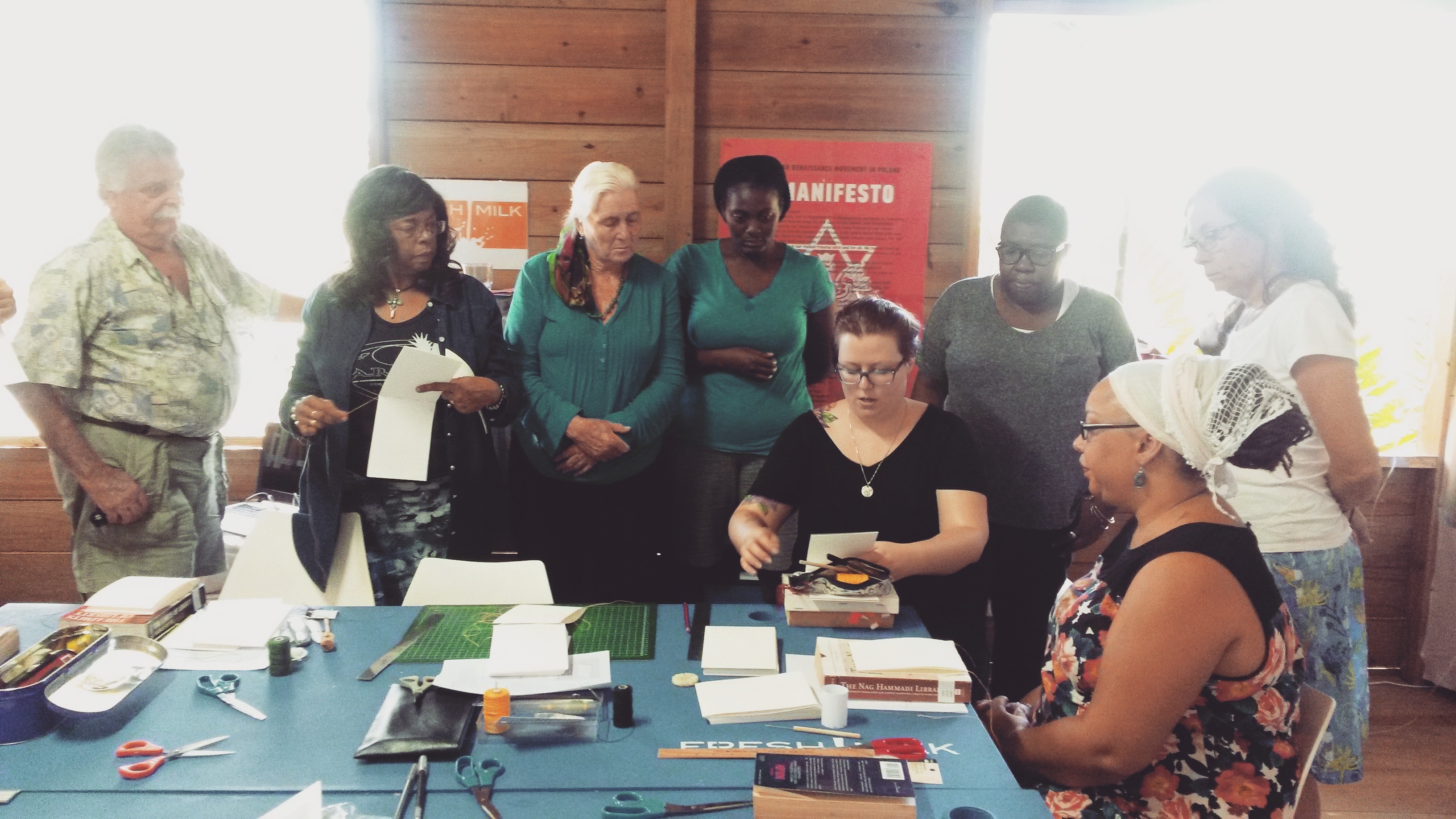
I’d like to take this last opportunity to thank Fresh Milk for such a life changing experience. This residency has helped me tap back into my creativity with confidence and playfulness. I have been so fortunate to meet some incredible creative thinkers while there and also light a fire for book arts through my class. After our last class together, many of my students seemed pleased with the course. They walked away with many book structures to explore through their own creative practices, and we left three collaborative books in the Colleen Lewis Reading Room as a tribute to our time together. I’m so proud of them and I hope they continue to explore the craft! Thank you, Fresh Milk, for giving me the opportunity to teach again.

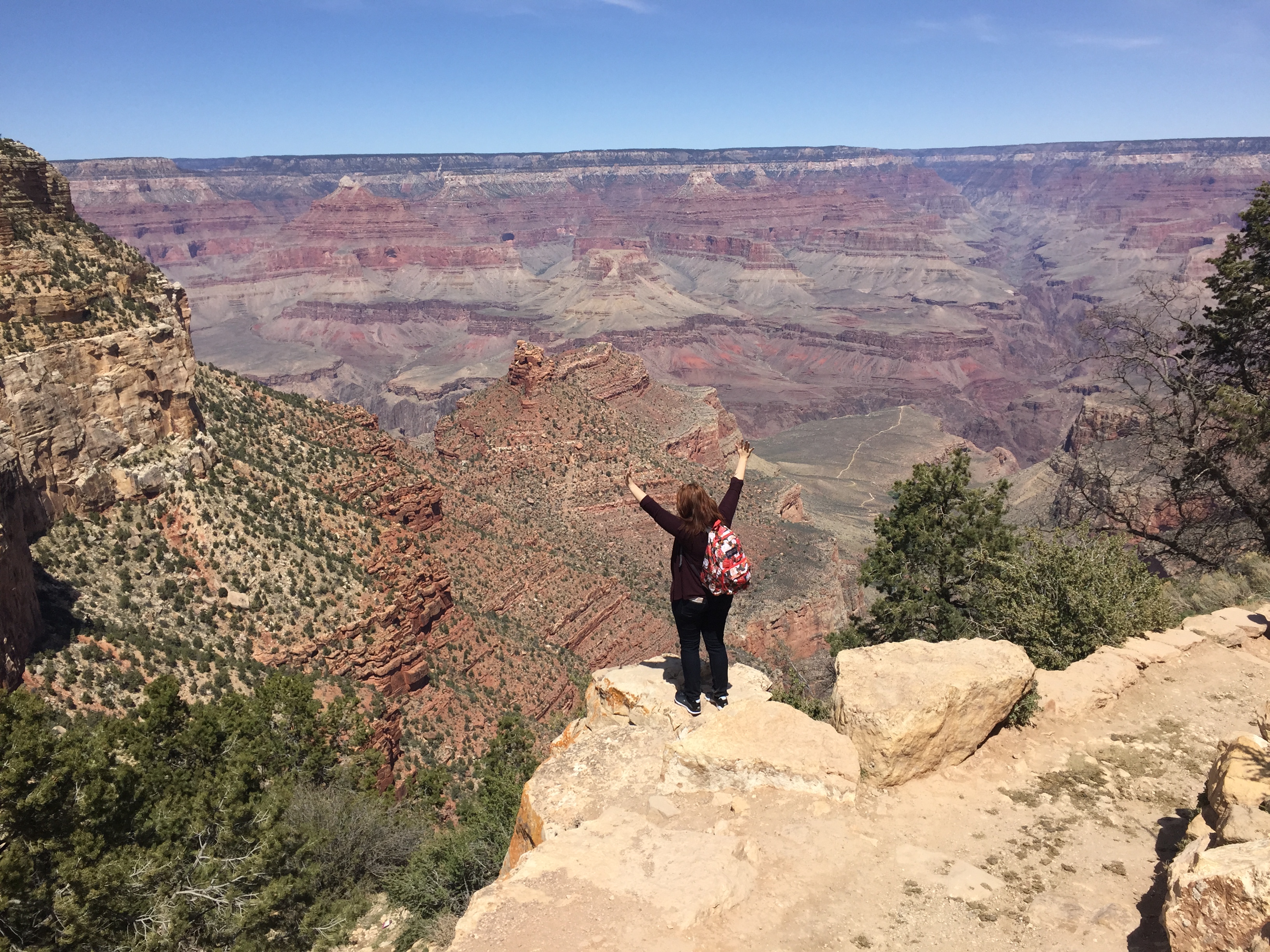
I’m at a rare rest moment in a months-long nomadic journey, but soon I’ll pack my bag and head to the next city on a train or bus, discovering new landscapes and their strange histories, carrying the voice of the narrator inside of me:

“I suffer to remain

Saint of a wild
mad land”

16

Sonia Farmer’s Residency – Week 3 Blog Post

Sonia Farmer writes about her third week in residence at Fresh Milk. Continuing her erasure poetry project using the text ‘A True and Exact History of the Island of Barbadoes’ by Richard Ligon while conducting her own exploration of the island, she contemplates the loaded act of ‘discovery’ and the implications it carries. She also shares the outcome of the challenging but successful third week of her book-binding workshop ‘The Art of the Book‘, which saw the students begin to create their own hardcover notebooks and leather journals. Read more here: 

1

Lives in and out of the studio are converging in interesting ways given my chosen project. I’m still working my way through an erasure of A True and Exact History of the Island of Barbadoes by Richard Ligon, but also discovering more of the island myself. The week began with thrilling visits to Harrison’s Cave, Hunte’s Gardens, and Bathsheba, all self navigated with a car rental rather than a pre-arranged tour. We became dreadfully lost on the way to the cave, got soaked in one of those short-lived island downpours in the gardens, and found our recommended lunch place closed due to construction with dangerously low blood sugar levels—but we could say we had a pretty fantastic adventure. Similarly, I’m reconnecting with a Bahamian friend who lives here in Barbados. When she asks what I would like to do around the island, I answer, “Anything.” I’m hungry to see and do it all.

These moments bring out the romantic in me, even though I know all too well the often-frustrating realities of island living and rolling stone travel. But just as I felt during our Week One island tour, exploring a new space is a thing of wonder and an entirely individual experience, something that I am trying to honor and witness in my personal journey as well as my creative practice. I want to be an explorer, not only of physical space, but emotional space too—to study how we meet new experiences with both head and heart.

Is discovery the endgame? Discovery is a problematic word for me, but one that I have been turning over in my head as I think about what it means to write “a true and exact history” of anything: the weighty privilege of it, the naiveté, the narcissism, the violence, all inherent in that word as we have learned it, especially in the Caribbean. We all know the story: In 1492, Columbus sailed the ocean blue. Good for him. Not so great for others. Because we know that no place can be “discovered” that has already existed in the minds and hearts of others. What maybe can be discovered is something entirely individual and emotional, found on an inward journey while on the outward journey, and that discovery is completely personal. The “true and exact history” of the world as we have learned it is a myth. I don’t think discovery is an endgame here. Exploration and deconstruction, perhaps.

Because when I revisit this historical text by Richard Ligon, a man who, by his privilege, has found a spot in this island’s history, I am interested in deconstructing and reconstructing through the act of exploration. I’m drawn to finding a new narrative within the existing narrative, one that touches upon emotional landscape. And one that honors the fact that if I had approached the text on any other given year, or day, or hour, I could pick up on a completely different set of words and perspective. And that would be true for any other person I hand the text over to.

So I don’t want to think about the history of discovery, I want to think about the discovery of history. I want to think about the act of exploring. I want to explore what we carry and what we choose to include vs. what we overlook and what we choose to leave out. I want to think about the fragility of the moment in the process of choosing one story over the other, and why we are drawn to that. I want to think about making space and leaving room. I want to think about the stories we tell ourselves when we only have one version of history to work from, and how we can still find power and wonder and self-discovery in that. Or not. I have my own set of privileges guiding my through the process behind this project. So overall, I want to keep it personal, because there is no true and exact history.

10

Meanwhile, setting aside the 24 hours I thought I was coming down with a flu but somehow gained strength from a fantastically indulgent meal at Chefette, my students crushed week three of our workshop when they sewed their first multi-signature text blocks to create two different blank notebooks. One will be an exposed-stitch hardcover, while the other will be cased into leather for a travel-notebook. As usual, I was completely too ambitious within my given time-frame, even though we extended the class by an hour. Luckily, week 4 is a catch-up class as well as a fun final class, so we will case in our notebooks, revisit a group project, and then make some quick fun book structures. Also luckily, they all had a blast even though I know it was a very challenging class and I couldn’t split myself into three people to assist everyone, but they passed with flying colors. I’m so proud of them!

Alex Kelly’s Residency – Week 2 Blog Post

Fresh Milk resident artist Alex Kelly shares some reflections from his second week in Barbados. In looking at some of the connections and common threads he has noticed in the region, he has revisited his use of a shipping pallet as a symbol of our reliance on imported goods. He has also been looking at the similarities and issues within the Caribbean’s educational systems, and the importance of encouraging critical thinking to avoid perpetuating unproductive cycles of action and thought. Read more here:

Image (3)

I’ve discovered for the second time how a change of environment can help to refocus my thoughts about work and about the space that I am discussing. I suppose the conscious act of applying for and participating in a residency is a way of surrendering myself to possibility. I become more in tune to the elements that potentially connect to define Caribbean people and their environment.

Within the boundaries of this particular space, where you can find water from Jamaica, films from the USA, dried seasonings from Puerto Rico and I shop in a supermarket chain from Trinidad and Tobago, the wooden shipping pallet that I had been working with since last August becomes significant yet again. It is a symbol of dependence on imported goods and cultural influences. In a moment of economic and political uncertainty, the lack of self reliance suggested by the pallet is noteworthy. It is quite striking that this symbol would be the one to connect my practice in three separate Caribbean territories.

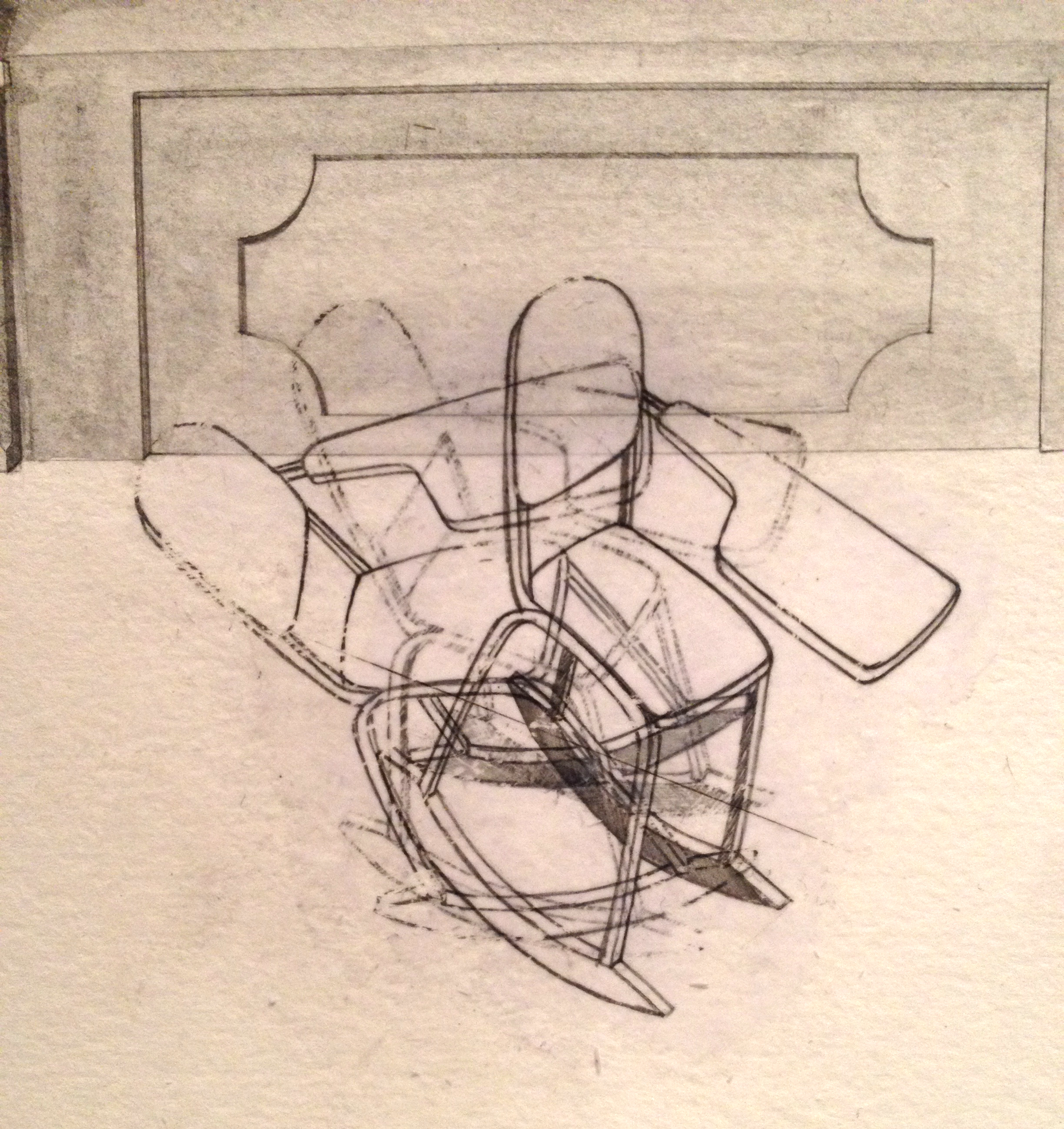
What has also struck me as significant is the shared education system and the role it plays in shaping the kind of citizens that individuals become. A conversation I recently had has  reminded me that the education systems of many Anglophone Caribbean islands are ultimately geared towards the same goal. So that each of the countries are equally influenced by a curriculum that was not designed to foster critical and creative thought or to nurture citizens capable of shaping the kind of environment that they desire. We are sitting in a rocking chair, moving vigorously back and forth, but making no progress. It begs the question, what effect might decades of this kind of action have on a people and their culture.

chair

Still, in spite of these and other similarities I have discovered, I find that my work represents a reality of life that seems frightfully specific to Trinidad and Tobago. In questioning how this work might be relevant in a wider Caribbean context I can only hope that a possible answer is, that it acts as an account of how we made it to where we are and as such provides a means by which other territories might avoid such a fate.

________________________

Tridium

This residency is supported by Tridium Caribbean Limited