Reading Pictures: What We Think About When We Look at Art – #CCF

Reading Pictures: What We Think About When We Look at Art by Alberto Manguel

The first time I stepped into an art gallery I was lost. I didn’t know how to engage with the the works that were mounted and framed on the walls. I didn’t know how to read or find a narrative in the beautiful, sometimes disturbing pictures that I was seeing. Manguel’s book Reading Pictures: What We think About When Look At Art is not a how to book, it makes no pretentious claims about what the reader should have achieved after closing the back cover, instead what his book offers are few examples of how certain art works can be interpreted based on common understandings, iconography or image writing.

The above excerpt is from Kwame Slusher’s review of Reading Pictures: What We Think When We Look at Art by Alberto Manguelthis week’s addition to the Fresh Milk Books Tumblr – the online space inviting interaction with our collection in the Colleen Lewis Reading Room.

For new Critical. Creative. Fresh reviews every week, look out for our #CCF Weekly posts and see the great material we have available at Fresh Milk!

»Redefining Practice« Reflections with Maj Hasager

During her ongoing residency at Akademie Schloss Solitude, Katherine Kennedy – current fellow in the ResSupport programme supported by Res Artis, representing the Fresh Milk Art Platform at the Akademie – had a conversation with Danish artist and Solitude fellow Maj Hasager reflecting on integrated & socially aware ways of looking at artistic practice. Read the article, originally published on the Akademie Schloss Solitude Blog, below:
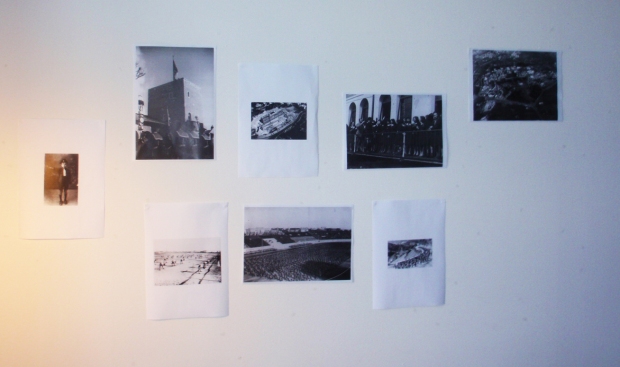
Maj's studio at Akademie Schloss Solitude.

Maj’s studio at Akademie Schloss Solitude.

When we speak about art, we often use the word »practice« as a multipurpose term to cover the thinking, the making, the product…all the processes that build towards something such as an exhibition or a clearly defined project. But what about the moments that occur in between, not necessarily linked to a finished piece? Where do ‘non artistic’ tasks fall in the realm of this all encompassing »practice«, and how do our actions influence or become part of our artistic work? These questions led to a discussion between Katherine Kennedy and Maj Hasager, both fellows at Akademie Schloss Solitude. Read more about their talk below:

I began my exchange with Maj by introducing the Fresh Milk Art Platform, a Barbadian cultural arts centre and residency programme, and ARC Magazine of contemporary Caribbean art, the two spaces I work for; speaking about these organizations has become almost second nature to me.

It was when Maj asked about my own art »practice« that I suddenly felt unsure…I wondered, as I showed her my artist website, is this reaction backwards? The balance between making work and my other roles is something I continue to struggle with, and there are a number of doubts that arise when I confront it; am I still an artist? Will I produce work again? Have I given up my »practice«? I’m not unique in these crises…these are common questions faced by many artists whose lives teeter between other jobs and responsibilities.
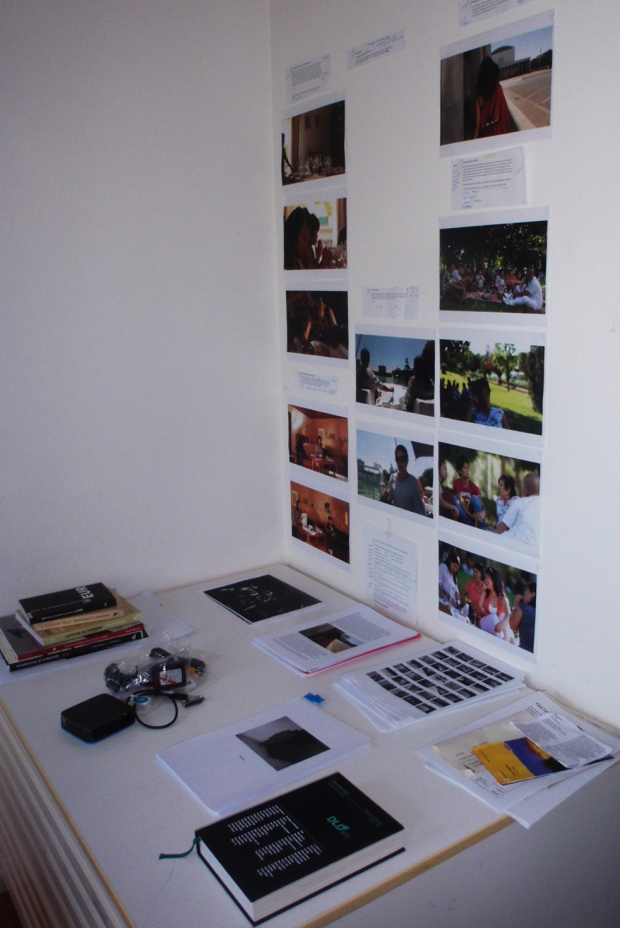
Maj's studio at Akademie Schloss Solitude.

Maj’s studio at Akademie Schloss Solitude.

Maj and I spoke about these anxieties, which had interesting associations to the MA programme she leads at Malmö Art Academy, Sweden, called Critical & Pedagogical Studies. This degree crosses the supposed boundaries between art, theory and pedagogy, framing relationships between production, teaching, administration and curatorship as »integrated practice« rather than distinct disciplines. While the stretch between one actual creation to the next may be long, that doesn’t negate the importance of what happens in those gaps, or the larger impact of knowledge transfer to personal and public creative growth.

I could already see how the importance of circulating information and operating in intermediary ways was applicable to the work of Fresh Milk and ARC; the foundations we are trying to lay for contemporary art in the Caribbean can very much be read as »social practice«, and affect the wider context I work within, along with my individual outlook. We spoke about whether there was a chance to marry this social »practice« with my visual one; the interconnectivity of art and life means that things are rarely as separate or stagnant as they may seem, and dormant seeds of production may just need the opportunity to flourish. We were both in agreement that Solitude can be considered fertile soil, with the freedom afforded to map out and nourish these connections.
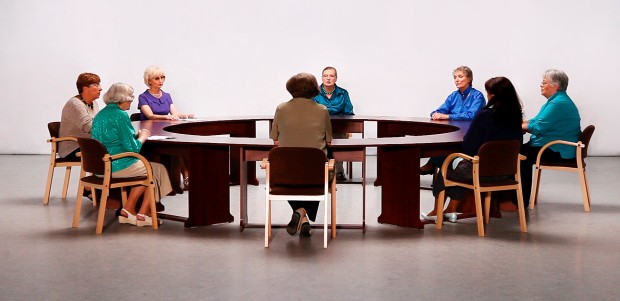
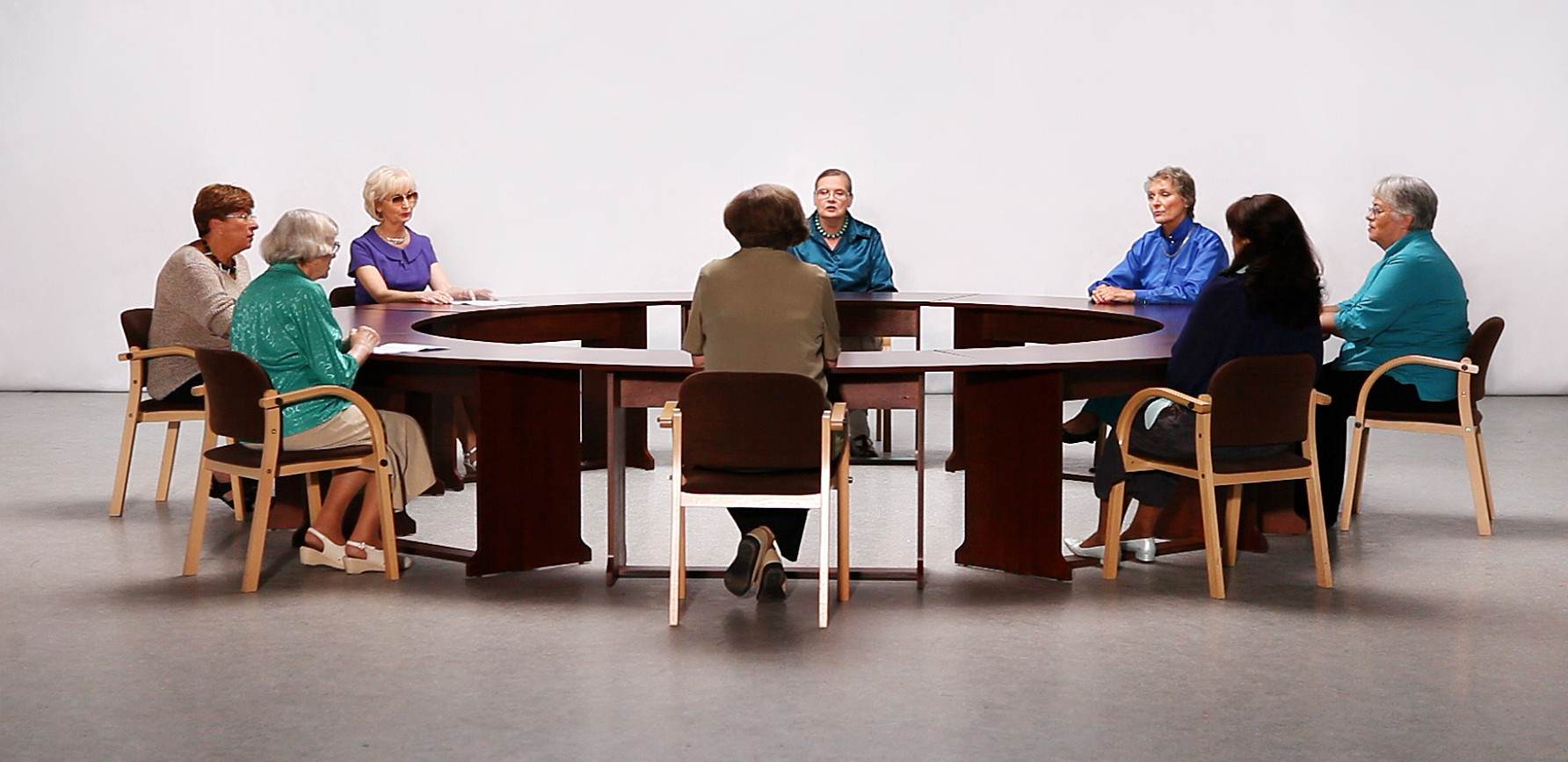
Maj Hasager, Decembers – performing a past, 2013. Courtesy of the artist.

Maj Hasager, Decembers – performing a past, 2013. Courtesy of the artist.

Maj’s personal »practice« also exemplifies hybridity. In addition to her academic pursuits, she negotiates delineations between history/lived reality; archive/interpretation; geopolitical North/South; utopia/dystopia. She took me through some of her multimedia work, which is heavily driven by communities and their geographical and socio-political positions in the environments they inhabit. Displacement is a common theme in her »practice«; she has conducted socially charged projects where she speaks and works with immigrant or underrepresented populations, such as the Filipino community in Italy, or documenting the perspective of Polish women during the solidarity movements of the 70s and 80s. The space she explores is a limbo of sorts; neither dwelling explicitly on the past nor idolizing the future, but the somehow honing in on the forgotten present, and how these communities function – or »practice« – in daily life, which inherently retains the weight of history and the possibility of tomorrow.

Relational »practice« is the core of her work, taking into account and being organically informed the multiple cultures she encounters. The drastically different points of view between herself and the societies she engages are not lost on her; she acknowledges that she is coming from a position of privilege, and does not try to overshadow the voice of the community. As a citizen of an island that is often defined from the outside rather than within, I appreciated this concession, and the genuine interest Maj takes in authenticity when treading this fine, complex line. For example, in her work Decembers – performing a past, 2013 there is no translation from Polish of the exchange between women of a certain generation sharing their stories – this is not done to exclude viewers, but to allow them to enter the moment and feel the dynamic without being distracted by divisive constructs such as language:

Spilled in the language’s veins
A militant regards
When will words be
A tool for something other

– Thom Donovan
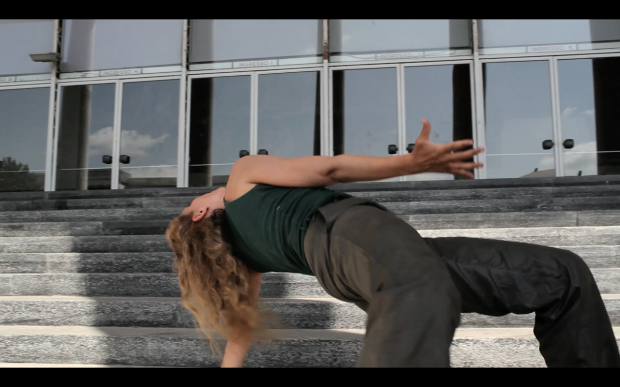
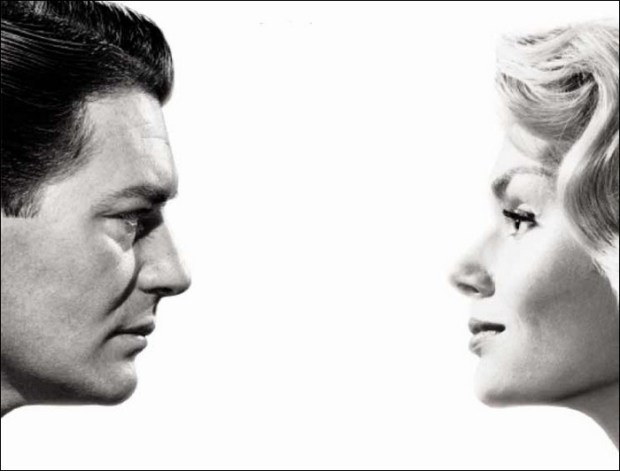
Film still: Contemporary dancer Maria Concetta Borgese in ‘Bifurcating Futures’, directed by Maj Hasager.

Film still: Contemporary dancer Maria Concetta Borgese in ‘Bifurcating Futures’, directed by Maj Hasager.

This excerpt is taken from a poem by American poet Thom Donovan, whose work Maj used in a recent project that she directed and was editing while at Solitude. A departure from the usual way in which she works, the piece titled Bifurcating Futures is more abstract; it features a performance by a contemporary dancer interspersed with moving shots of an empty city and stanzas from Donovan’s poem, all overlaid with a haunting track of urban sounds, warped into a futuristic, ominous refrain that echoes the dystopic landscape. The dancer, deliberately chosen for the experience and maturity her body brought to the role, performs a series of gestures in the space, always inaudible but never truly silent. The piece straddles new media and documentary filmmaking, challenging Maj’s usual »practice«, but still referencing themes such as feminism, futurism and creating a platform for the unheard.

What remained with me after our meeting is that we have the artistic license to define »practice« as we see fit; we can use residencies as creative incubators for our work, but »practice« comes from lived experience. Even if not specifically deemed »social practice«, it still absorbs our thoughts, actions and interactions with others, and in the end, cannot be predicted, relegated or compartmentalized – only manifested, one way or another, in the direction we channel it.

Read the original article on the Akademie Schloss Solitude Blog here.
Slaying the Mermaid: Women and the Culture of Sacrifice #CCF

To be honest, the book felt personal. I could relate to my grandmother’s and mother’s continued self-sacrifice, but it also didn’t challenge the statement I’m about to share at the start of this essay.
After making the misguided statement that “Men are better leaders than women,” and having to defend myself in a series of debates that followed, I was pressured into reading a book on feminism so I could ‘get my mind right’. So I selected the one that caught my attention—Stephanie Golden’s Slaying the Mermaid: Women and the Culture of Sacrifice…

It may have been the wrong choice.

The above excerpt is from Ronald Williams’ review of Slaying the Mermaid: Women and the Culture of Sacrifice by Stephanie Goldenthis week’s addition to the Fresh Milk Books Tumblr – the online space inviting interaction with our collection in the Colleen Lewis Reading Room.

For new Critical. Creative. Fresh reviews every week, look out for our #CCF Weekly posts and see the great material we have available at Fresh Milk!

New Books in the CLRR!

We are pleased to announce that the full suite of books donated to the Colleen Lewis Reading Room by Jessica Bensley, Clyde Cave, Winston Edghill and Leslie Taylor have all arrived.

IMG_20141002_201517

Included in the delicious suite are the following:

Caribbean Political Thought: (i) Theories of the Post-Colonial State and (ii) the Colonial State to Caribbean Internationalisms and, (iii) Caribbean Cultural Thought: From Plantation to Diaspora – edited by Aaron Kamugisha and Yanique Hume – both lecturers in Cultural Studies at the University of the West Indies.

Global Studies: Mapping Contemporary Art and Culture edited by Hans Belting, Jacob Birken, Andrea Buddensieg and Peter Wiebel. This is the third volume in a series that is part of the “GAM – Global Art and the Museum” project, providing an overview of the institutional and ideological landscape of contemporary art and culture in a global context.

The Image of the Black in Western Art – The Twentieth Century: The Impact of Africa. V Part 1, edited by David Bindman and Henry Louis Gates, Jr. looks at the history of the representation of people of African descent.

The CLRR is open by appointment on Tuesday and Thursday. Please contact us at freshmilkbarbados@gmail.com to set up a time to visit the CLRR.

Thank you to the donors.

Article featured in the Cyprus Dossier: Notions of common/wealth versus single/wealth

The 7th edition of the Cyprus Dossier, launched this summer during the International Artist Initiated project hosted by the David Dale Gallery in Glasgow, Scotland, featured an article titled ‘Notions of common/wealth versus single/wealth‘ written by Fresh Milk‘s founding director Annalee Davis. Read the piece below:

CD crop

“Global art is not only polycentric as a practice, but also demands a polyphonic discourse. Art history has divided the world, whereas the global age tends to restore unity on another level. Not only is the game different: it is also open to new participants who speak in many tongues and who differ in how they conceive of art in a local perspective. We are watching a new mapping of art worlds in the plural which claim geographic and cultural difference.”[1]

The Fresh Milk Art Platform Inc., founded in 2011, is located on a dairy farm on the island of Barbados in the Southern Caribbean. We are one of several artist-led initiatives continually emerging across the archipelago supporting contemporary art production and the shaping of critical communities in the region. The local contexts these Caribbean artist networks respond to is the lack of formal institutions to meet artists’ needs, such as a national art gallery or a museum of contemporary art with a mandate to support the production, discussion and visibility of contemporary practice.

Artists in the region are functioning in an arena with relatively small local audiences, underdeveloped primary art markets and, in most cases, non-existent secondary markets for contemporary art works with very few spaces to exhibit. A challenge this poses is that much of the artwork produced in the region is exhibited, appreciated and valued outside of the region where more developed creative environments function, creating a gap between artists and their domestic audiences. Artist-led initiatives have been working to bridge this gap by creating opportunities for creatives to engage with local audiences.

Fresh Milk responds by (i) offering residencies for local artists to produce work and nurture critical thinking, (ii) expanding the reading room to acquire material focusing on contemporary practice from within the region and around the world, not available anywhere else on the island, (iii) activating the reading material through establishing mentoring opportunities for young people who write critical reviews of the book collection shared through the Tumblr page – Fresh Milk Books – The books that make us scream!, and (iv) staging public events providing local audiences and artists moments to engage with each other, along with other activities.

CD1

While recognizing the importance of nurturing the local environment, Fresh Milk is equally committed to participating in larger and more diverse conversations regionally. Common obstacles rippling throughout the region’s creative sectors act as unifiers, giving rise to geographical connections among artists across the Caribbean who share in these frustrations and resulting in the formation of many of these artist-led initiatives and collaborations.

Fresh Milk’s online interactive mapping project reconfirms our regional identity and functions as a transnational exercise demonstrating the presence of a myriad of arts entities across the Caribbean from the nineteenth century till now – refuting the fact that we are a divided space as determined by former colonizers who used dominant languages to separate the region linguistically. Consolidating regional art spaces into one, the readily accessible online map also acts as a crucial educational and research tool for locating historical and current data about Caribbean art, broadening both local and international knowledge, awareness and collaboration. Mapping becomes an act of resistance as we become our own cartographers, insisting on connection rather than division and relationship as opposed to discord. The map also resists the notion that there is a central and singular art world of which we are peripheral.

While it maybe true that, as Amanda Coulson wrote in the Frieze April issue, ‘The idea that anything intellectual happens here is anathema to the brand we have projected to the outside world’,[2] this map opposes the reductive way in which the Caribbean has been branded repeatedly as an exotic playground for people from elsewhere.

Fresh Milk has worked with partners in the region to establish a regional residency project called Caribbean Linked.[3] This project brings artists throughout the region to make and exhibit art, engage in critical dialogue and build relationships, while using the arts to foster a more unified Caribbean.

As our relationships spread beyond the insular Caribbean, our programming expands to reflect the shifting dynamics of our engagements. Nurturing our core foundation in the Caribbean equips us to build robust, meaningful connections internationally – not seeking validation, but rather mutually enriching cultural exchanges. Fresh Milk is continually fostering critical conversations with entities throughout the Caribbean, in the Global South and traversing the North/South axis of the world to holistically realize a healthy cultural ecosystem.
Continue reading