Marianne Keating – First Blog Post

Irish artist Marianne Keating shares her first blog post about her Fresh Milk residency. During her time in Barbados, Marianne’s focus will be  on the migration of indentured labourers from Ireland, England, Scotland and Wales who arrived in the island in the seventeenth century. She intends to explore this complex history both through the physical and social landscape of the country, beginning by conducting site visits and reflecting on the journeys of those who have long since traversed this space. Read more below:
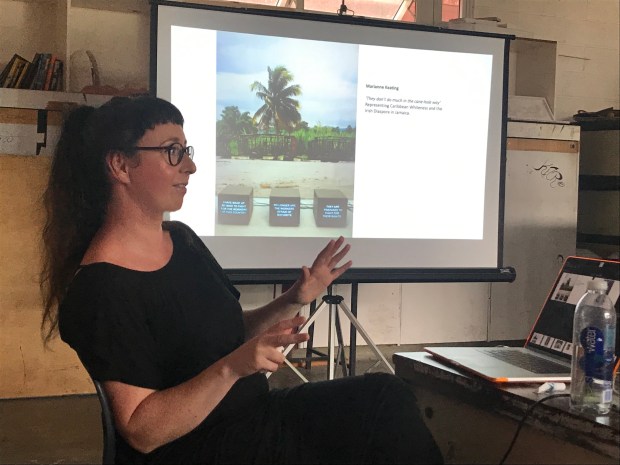
Marianne Keating presenting to the students at Barbados Community College

During the last six years, I have spent my time as a practice-based researcher exploring and tracing the multiple trajectories of the migration of the Irish to Jamaica during Ireland’s colonial rule by Britain. My beginning point in the complex histories of Irish emigration to the Caribbean is the movement of Irish indentured labourers from Ireland to Jamaica beginning in 1835 until its abrupt end in 1842, and their resulting legacies in contemporary Jamaica.

My practice-based research combines many hours spent in national archives, libraries, onsite research, interviews and location shooting before combining all these research methods in my studio, where my multi-disciplinary outputs include a series of video pieces and written accounts. My research has now expanded to include the Irish diaspora in Barbados – bringing me back once again to the beginning –with a new direction in my research in an unknown land, surrounded by a new landscape, history, culture and people.

Although my research subject is the same, there are vast differences in all aspects between the Irish migration to Jamaica and Irish migration to Barbados of which I am still attempting to wade through and come to grips with during my first few weeks of onsite research.

To Begin
LAND – Ireland, Jamaica and Barbados

“By land is meant not merely land in the strict sense of the word, but the whole of the materials and forces which nature gives freely for man’s aid in land, water, in air and light and heat.” – Alfred Marshall.

I have always been fascinated by the geology of land, how the soil under our feet has been formed, who has passed this way before and the frequency of such movement. I think of our homogeneous desire to follow the same, well-worn path and manoeuvre inside the marks created in the landscape by those who have come before. These lie in stark contrast to the rawness of other areas, where few now walk allowing the natural world to continue ownership or reclaim the land back to its original form; removing all traces of life that passed through before.
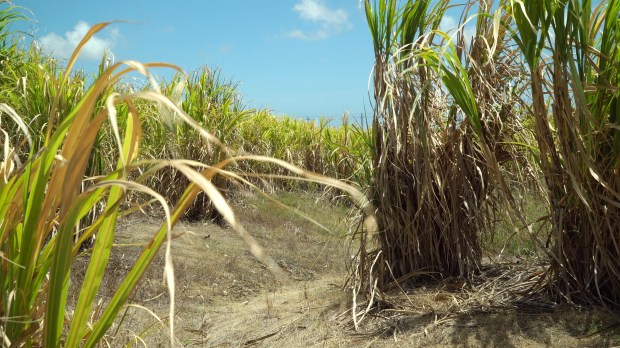
Path of migration within a cane field, St. George, Barbados

As economist Alfred Marshall discusses, the word ‘land’ refers to not just the soil beneath our feet, but instead encompasses all of nature’s resources including the minerals underneath the soil and the trees above. “The term ‘land’ thus embraces all that nature has created on the earth, above the earth, and below the earth’s surface.”

Land holds the memories of past lives. The coral and limestone sediment on which we stand embeds what has come before and consumes the archives of past experiences, leaving us with few traces with many details never to be recovered. We trail through all manners of the past archaeology, anthropology and sociology to attempt to reconstruct the narrative, but often the land holds onto more traces than it reveals.

I think of the importance of our place in the landscape, and its gradual erosion by the constant migration of people over thousands of years, crossing the land back and forth on daily journeys and the eroding and erasure of the ground by natural or human-made means. It highlights the experience of all who have emigrated and continue to migrate from one country to another whether by choice, necessity or force. The formation of land over millions of years is a culmination of its coral and limestone structure and the inedible marks left in the soil by those that have passed through.

Many conflicts have been fought, whether on global or localised scales, over the ownership of land. But as Mason Gaffney discusses in his essay Land as a Distinctive Factor of Production, we are all only present for a time before the land is handed down over and over again, recycled as the limit of land is determined; its value may change due to circumstances, but its supply is finite. “Land is reusable. All the land we have is second-hand, most of it previously owned. Our descendants, in turn, will have nothing but our hand-me-downs. As there is never any new supply, the old is recycled periodically, and will be in perpetuity, without changing form or location.”

The importance and weight of land can never be diminished, and people’s connection to the land is universal. As each new generation is born, their attachment to the land continues, both of the lands of their birth and of that of their ancestors.

There are many points of connection between the three countries of my research through which I trace the migration of the Irish to Jamaica and Barbados. They all have the collective experience of being island states, their connection by the Atlantic Ocean and their colonisation by Britain till the 20th Century. This is not where these connections end, but it is instead the starting point for my exploration in Barbados.

To look at the lands of Ireland, Jamaica and Barbados, there are vast physical differences. Barbados, the eastern-most Caribbean island, was created by the collision of the Atlantic crustal and Caribbean plates, along with a volcanic eruption. It comprises low-slung terraced plains, separated by rolling hills, with eighty-five percent of the island’s surface consisting of coralline limestone. The island is small in comparison to the others, measuring 23km at its widest point, 34km long and a small surface area of 430 square km, with Mount Hillaby – the highest point on the island – at 340 meters above sea level.

Barbados is geologically unique, being two land masses that merged over the years with the deep ravine visible across the island. The distance by sea between Ireland and Barbados is approximately 6,357km, and I am imagining time spent by the Irish on their migratory path travelling across the Atlantic Ocean, knowing there was little chance of returning to the soil of their birth.

________________

This residency is supported by the Arts Council of Ireland

Change of Date – Tilting Axis 5: ‘Beyond Trends: Decolonisation and Art Criticism’

Due to transit schedules raised during a site visit to Guadeloupe, the Tilting Axis committee has decided to move the meeting up by one day.

Tilting Axis 5: ‘Beyond Trends: Decolonisation and Art Criticism’ will now take place from May 29-31st, 2019. Attendees are asked to be in Guadeloupe from May 28th, leaving on June 1st/2nd. On June 1st we will have an optional tour day across various cultural sites.

The RSVP date has also been moved to April 1st. We are very much looking forward to seeing you there and sharing the full programme with you soon!

Open Call: Transoceanic Visual Exchange 2019

The Fresh Milk Art Platform (Barbados), China Residencies (NY and China), The Barbados Museum and Historical Society, I: project space (Beijing) and Alice Yard (Trinidad & Tobago) are pleased to welcome submissions of recent film and video works – screenings, installations, new media and expanded cinema – by contemporary artists, to be included in the third edition of Transoceanic Visual Exchange (TVE), a series of programmes taking place this year between Barbados, China and Trinidad & Tobago. Submitted works must have been completed in the last five years and must be made by artists practicing in the Caribbean, China and their diasporas.

TVE will be a collection of recent artists’ films and videos from each region. However, the final shape and content of the programme will be informed by a community curatorial process, which aims to involve and promote discussion within the wider arts communities of each participating initiative.

Working between the Caribbean, China and their diasporas, TVE aims to negotiate the in-between space of our cultural communities outside of traditional geo-political zones of encounter and trade. TVE intends to build relations and open up greater pathways of visibility, discourse and knowledge production between the regional art spaces and their communities.

Submission Requirements:

  • Must be work from artists practicing in the Caribbean, China  and their diasporas;
  • Must be work that has been completed/made in the last five years;
  • Can be films of any length (shorts, experimental, features and video artworks);
  • Can be in any language (films originally produced in regional languages are welcome);
  • Multiple submissions are welcome;
  • Must be accompanied by a description of the work (500 words max), a bio (200 words max) and details of any technical requirements i.e. audio, installation, equipment required, preferred setting etc.;
  • Works must be in the form of mp4 files no larger than 100MB, or private Vimeo / Youtube links (please provide passwords);
  • Works must not have been submitted to previous editions of TVE;
  • Please specify whether your submitted works have permission to be exhibited on an online space.

Deadline for submissions: 28th June 2019

The online submission form can be found here.

Please direct any queries about Caribbean submissions to: tveproject.caribbean@gmail.com
Please direct any queries about China submissions to: nihao@chinaresidencies.com

For more information on TVE and its first two iterations, visit the TVE website.

____________________________

About the TVE 2019 Partners:

Fresh Milk

Fresh Milk is an artist-led, non-profit organisation founded in 2011 and based in Barbados. It is a platform which supports excellence in the visual arts through residencies and programmes that provide Caribbean artists with opportunities for development, fostering a thriving art community.

Fresh Milk offers professional support to artists from the Caribbean and further afield and seeks to stimulate critical thinking in contemporary visual art. Its goal is to nurture artists, raise regional awareness about contemporary arts and provide Caribbean artists with opportunities for growth, excellence and success.

Website: freshmilkbarbados.com
Facebook, Instagram and YouTube: FreshMilkBarbados
Twitter: FreshMilkBdos

China Residencies

China Residencies is an online and New-York based nonprofit founded in 2013 by Crystal Ruth Bell & Kira Simon-Kennedy. Since then, China Residencies supported over 50 artists and collective projects in mainland China and Hong Kong. China Residencies supports a network of over 40 different residency programs through openly accessible website, and supports the next generation of artists, activists, and arts administrators through fellowships, exchanges, and fiscal sponsorship.

“We believe diplomacy shouldn’t just be left up to politicians. Artists are cultural and social changemakers, and, in a world where people sometimes forget to listen to and learn from one another, we are passionate about creating opportunities for artists to bring a broader cultural understanding into their work and communities.”

Website: chinaresidencies.com
Facebook: chinaresidencies
Twitter: chinaresidency
Instagram: china_residencies

The Barbados Museum and Historical Society

The Barbados Museum and Historical Society (BMHS) is a non-profit, non-governmental organization with a membership of over 1,000 individuals and companies. A fourteen-member Council and the Director are responsible for its policies and operation. Nine council members are elected annually from the membership of the BMHS; the remaining five are appointed by Government.

The mandate of the Barbados Museum and Historical Society is: To collect, document and conserve evidence of Barbados cultural, historical and environmental heritage; and to interpret and present this evidence for all sectors of society.

Website: barbmuse.org.bb
Facebook, Twitter and Instagram: BarbadosMuseum

I: project space

I: project space is an augmentation of what a contemporary art institution can be, by using the freedom that comes along with running an independent practice. The space is located in the old Hutong area of Beijing and is combining an exhibition space with a residency studio for visiting artists from China and abroad. Taking its location in the center of Beijing but outside the art districts as a premise, I: project space engages in bringing an interaction with art back into the daily life.

Collaborating with local and international cultural producers, I: project space is constantly building networks with like-minded spaces all over the world to share information and to expand the impact of the independent art scene. Dedicated to build support structures for artists and open possibilities for long-term dialogues between artistic, curatorial, research and other modes of knowledge production.

Exchange and dialogue should not become empty phrases, but have to be implemented into actions. The programming of the space is framing the residency and exhibitions with an ongoing discourse about current questions on contemporary art.

I: project space aims to encourage innovative and investigative approaches, crossing borders between different creative disciplines, cultural identities, geographical locations, political economies, crafts and new technologies. By placing emphasis on the open dialogues, I: project space looks to foster experimentation, collaboration and interdisciplinary exchange.

Website: yi-projectspace.org
Facebook and Instagram: Iprojectspace

Alice Yard

Alice Yard is the backyard space of the house at 80 Roberts Street, Woodbrook, Port of Spain. This was once the house of Sean Leonard’s great-grandmother. Four generations of children played and imagined in this yard, and now we continue this tradition. Alice Yard is a space for creative experiment, collaboration, and improvisation.

Alice Yard is administered and curated by architect Sean Leonard, artist Christopher Cozier, and writer and editor Nicholas Laughlin, with the help of a growing network of creative collaborators. Alice Yard is a non-profit organisation incorporated under the laws of Trinidad and Tobago.

Since 2008, Alice Yard has run a residency programme hosting artists, curators, and other creative practitioners.

Website: aliceyard.blogspot.com
Facebook & Twitter: aliceyard
Instagram: aliceyardinsta

Fresh Milk Welcomes Marianne Keating to the Platform

Fresh Milk is pleased to welcome Irish artist Marianne Keating to the platform between March 11th – April 18th, 2019.

Landlessness, 2 Channel Video Installation, StudioRCA, London 2017.

Residency Statement:

Harnessing post-colonial and archival theory to analyse the migration of the Irish diaspora to the Caribbean during Ireland’s colonial rule by Britain, my research focuses its attention on the complex histories of the movement of Irish indentured labourers from Ireland to the Caribbean.

My focus in Barbados addresses the subaltern ‘poor whites’ community on the East Coast of the island, who are believed to be direct descendants of indentured labourers from Ireland, England, Scotland and Wales who arrived in the seventeenth century, although through creolisation their direct origins can no longer be determined. During my residency at Fresh Milk, I aim to visit and document regions related to this community in the villages of the parish of St John where the ‘poor whites’ still live today and other sites of importance including the “vanishing villages” of Irish Town and Below Cliff. The analyses of this material and sites are fundamental to my research and development of my practice-based output, which involves the gathering of oral histories through interviews, film footage, research and documentation.

Excavating the official government documents at the Irish, English, Jamaican and the Bajan National Archives, alongside on-site investigation of other remaining visual and material traces, and through new oral histories, I begin to reconstruct this history.  Accumulating these disregarded and overlooked traces of different histories, I seek to insert a series of previously muted or silent voices into the archive and to give them presence through my practice-based work as an artist-researcher.

Situating my practice within the historiographic turn in contemporary art discourse and in relation to the Archive, notably through the examination of unrecorded, private and disregarded histories, my multi-disciplinary approach to the research, the archival record and the archival image questions the legitimacy of the archive and falsification within the recorded image and text. My research involves the gathering of oral histories through interviews, film footage, analysis, documentation and re-documentation. Through my research and the study of archival theory, I wish to challenge the definitions and meanings of the archive itself. By recovering photographic and textual traces, which had been consigned to disappear within the archive, I question what the archive remembers and what it forgets; for whom and for what purpose. By investigating collective, social and individual memory through a series of video interviews, I accumulate accounts and memories of a particular time and consider how they have been affected by the passage of time. My engagement with archival and personal accounts and embodied memories positions my research as anti-monumental, counterpoising monumental official state histories, and developing strategies to address excluded narratives, enabling previously muted voices to inform a counter-narrative assembled through creative practice, exhibition and written accounts.

About Marianne Keating:

Marianne Keating graduated with an MA from the Royal College of Art, London, and a BA from Limerick School of Art and Design, Ireland. She has exhibited extensively including exhibitions in London, Paris, New York, Melbourne and Shanghai. She is currently preparing for upcoming solo shows for the Crawford Art Gallery, Cork, Ireland and Rampa Gallery, Porto, Portugal. Recent group shows include New Contemporaries, South London Gallery and as part of the Liverpool Biennial; Arrivants: Art and Migration in the Anglophone Caribbean, Barbados Museum and Historical Society, Bridgetown, Barbados and Between Us And, Embassy Gallery, Edinburgh, Scotland (2018). 

Tilting Axis Collections and Commissioning Fellowship 2019

The Tilting Axis Fellowship is a direct outcome of the Tilting Axis meetings in 2015 at Fresh Milk in Barbados, in 2016 at the Pérez Art Museum Miami and in 2017 at The National Gallery of the Cayman Islands. For its 2019 iteration, Scotland based cultural partners including the Glasgow School of Art, The School of Art History at the University of St Andrews, CCA Glasgow, LUX Scotland, Hospitalfield and curatorial duo Mother Tongue have come together to offer support for a research fellowship to Scotland for an emerging contemporary art practitioner living and working in the Caribbean to share knowledge about current approaches towards commissioning and collecting in the arts.

For Whom?

Curators, researchers, artists, or cultural producers based in the Caribbean region who want to make new links in Scotland and have a keen interest in developing their curatorial practice. Applicants must have a working knowledge of English.

Goals

  • Develop, stimulate, support, and visualise curatorial and artistic realities coming from the Caribbean region;
  • Facilitate face-to-face communication in Scotland;
  • Offer free and open access to knowledge and practices;
  • Provide a stable platform for professional experiences;
  • Produce critical knowledge on educational tools as well as visual culture;
  • Focus on emerging practices;
  • Utilise the existing Tilting Axis network;
  • Offer practical support for the duration of the research trip in Scotland.

This Fellowship opportunity focuses on the development of pragmatic and critical curatorial and artistic practice hailing from the Caribbean region, and is research and practice-led, and mentor-based. The fellow will be invited to Scotland for up to one month from 1 October 2019 to undertake a period of open-ended research and development. Artists or curators may apply to undertake research for a mode of curatorial practice. The Fellowship is focused on alternative forms of Collections and Commissioning, in collaboration with partners across Scotland whose work focuses on various forms of collecting, archiving or supporting the development of artworks.

Within the Tilting Axis annual convenings, complexities of mobility, the politics of archiving, access and privilege, decolonisation, institutionalism, curatorial knowledge, pragmatics, and social realities have surfaced as keywords of urgency within Caribbean cultural ecosystems. We seek proposals that engage with the unique visual culture available in the Caribbean and what might be learned from its unexpected and innovative approaches. The Fellowship has an open-ended outcome, offering support for critical development of curatorial or artistic practice while giving a practical base within partner organisations to research different methodologies and institutional approaches.

Drawing on the specifics of the Caribbean region through processes of decolonisation, race, mobility, access and privilege and digitalisation, your proposal might approach actively how people live and work, and especially how contemporary art takes a responsibility to reflect and act on it. What are fears as well as potentials in these current times? Within such a complex geography, what are the challenges? What are the interventions? The Fellowship might support and expand these conversations on a mutual basis.

More information about each organisation’s core interests can be found below. It is expected that the Fellow will focus on a period of research with each organisation to mutually address some of these questions across the month-long residency.

The fellow will receive a fee of £1500 and a per diem to cover expenses and living costs whilst in Scotland. All travel and accommodation costs will be covered by the host partners. An itinerary of travel, meetings and public events will be arranged in collaboration with the successful applicant and partners, prior to the fellow’s arrival. The budget will be managed by the partners, and includes a winter clothing allowances of £300. The Fellow is also expected to participate in a public event or lectures in two or three Scottish locations, to share their knowledge, context and practice.

A contribution to the public blogs of British Council and CCA Glasgow as well as the Tilting Axis website will be required along with a final report on the Fellowship. Tilting Axis partners will work towards funding additional funds for the fellow to attend Tilting Axis 6, (location tbc) where the fellow can present on their experience.

Application

Applicants for the Fellowship are invited to develop an independent proposal outlining a clear interest in the issues and organisations highlighted. The proposal should be content driven and can be based on already existing research or offer new projects. The fellow is not expected to produce an outcome or finished artwork but will be expected to speak publicly about their ongoing research or interests whilst in Scotland.

Departing from a curatorial or artistic ambition, we expect to see a statement of intent of maximum 1000 words. This statement should explain the fellow’s research focus, respond directly to the keywords and thematics raised in the call out, and highlight reasons for visiting Scotland and/or the partner organisations. A separate artist/curatorial statement can also be supplied. Please also include a CV and two references, and an indication of availability from early October 2019.

The application should be submitted via e-mail to: Ainslie Roddick, CCA Glasgow Curator: ainslie@cca-glasgow.com.

The deadline for submission is 15 April 2019.

For more information on the fellowship and the partners, visit the Tilting Axis website here.