Matthew ‘Kupakwashe’ Murrell’s Emerging Director Residency – Week 3 Blog Post

Matthew ‘Kupakwashe’ Murrell writes about the third week of his Emerging Directors Residency, a collaboration between Fresh Milk and the National Cultural Foundation (NCF). Having extended his time at Fresh Milk to continue his research and exploration around the play ‘Shakespeare’s Nigga’, Matthew had the opportunity to meet with Dr. Sean Benson, a professor at University of Dubuque, USA who specializes in Shakespeare and is currently on a Fulbright Scholarship at the University of the West Indies, Cave Hill Campus, Barbados. Read more about their thought provoking discussion below:

img_20160920_110405

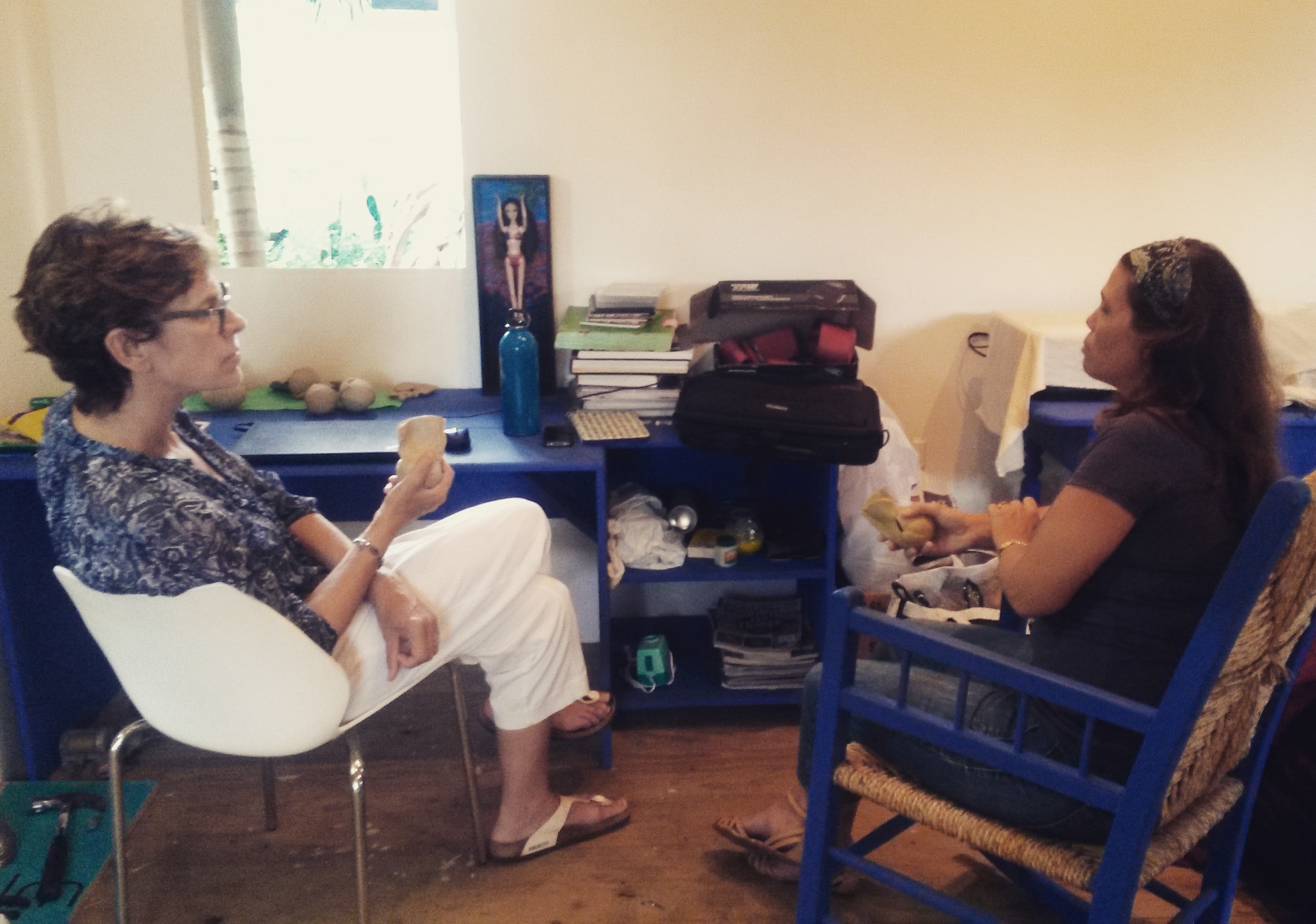
Dr. Sean Benson in conversation with Matthew ‘Kupakwashe’ Murrell

Greetings.

This week was a short week, but this post won’t be short; though short, it was still relatively impactful.

On Tuesday, I had the pleasure of meeting and conversing with Dr. Sean Benson, a US professor specializing in Shakespeare. We had quite an extensive and enlightening conversation. I had my questions ready to discover some truths about Shakespeare, but the conversation didn’t go as I’d imagined. We’ve both discovered Shakespeare’s impact on the US is not necessarily as deep and as complex as it is in the West Indies. Within my research, I wanted to uncover Shakespeare’s invasive legacy onto the Caribbean space as a tool of socio-political, race related, educational and literary oppression. Many of these things Sean didn’t know, but totally understood how it could be so, being as we both agreed that after the Bible, the next series of literary oppression to the enslaved Africans and free Africans would be the works of Shakespeare. Shakespeare in the US, is not Shakespeare in the West Indies. As Sean stated, Shakespeare isn’t putting anyone on the back burner in America, as America has been more diverse in its literary scene. Many American and non-American writers dominate their spaces, with Tennessee Williams, Langston Hughes and even Samuel Beckett having their dedicated audiences, and even festivals in their names. Whereas on this island, every year in Holder’s Season, Shakespeare is met with bourgeoisie audiences, expensive tickets and a class privilege one must hold; let’s not forget Gale Theatre as well and their Shakesperian contribution.

In our society, for many years, to know and understand Shakespeare, his ‘classics’, sonnets and the iambic pentameter, showed your level of intelligence and social status, or potential for these things. Sean also mentioned that his UWI students (who he believes are being overworked!) come into the classroom knowing more about Shakespeare, almost twice as much as his American students! Yet, though he himself says he’s a fan of Derek Walcott, can’t say the same for his Caribbean students. I introduced my new buddy to the works of some of my favourite Caribbean playwrights and poets, Kamau Brathwaite, Denis Scott and Earl John, to have a feel for some awesome Caribbean classics.

Sean and I also delved into the Moor characters, Aaron and Othello, and this is where I learned a lot and discovered some greatness to employ in Shakespeare’s Nigga. Sean gave me a basic timeline for Aaron, from Titus Andronicus being the first mention of a Moor in Shakespeare’s earliest works. Though the writing of the play and staging of it were two different times, it was staged before slavery ever started. Interestingly enough, Aaron is a slave that carries out deadly deeds in the name of the crown and persecuted for it. My question was, how would Shakespeare have met with Moors at that time? Apparently, Mr. Shakespeare would’ve befriended a Moor living in the UK and, as writers do,  felt compelled to understand his friend’s culture and write about it, as a challenge to himself. Sean also believes that Othello is an evolved character based on Aaron, basically a Moor going from slavery to being a free man, with Othello being written much later in Shakespeare’s life. I found it interesting that Shakespeare in his time would’ve been seen as a very progressive writer, who wrote for the unspoken for, defied the traditional way of writing and gave not only a black man a voice, but women a more powerful voice at the time. It’s interesting to see how a meager living playwright could centuries later be considered the ‘pinnacle’ of literary greatness. (Something to aspire to! Hmmm). Also funny, when same said meager playwright, whose profession was seen as lower than low, centuries later is heralded by the bourgeoisie. When Othello was staged, Sean informed me, that it was the most hated of Shakespeare’s plays for many reasons.

  1. At the time, the Aristole way of playmaking was to write about Kings and Queens, and though army generals might seem noble, it’s not noble enough! (Noble Othello! – or not so much)
  2. How dare you, Shakespeare, write a play about a black man! Especially when at the time you wrote that play, Europe was about to embark on the biggest economic plan the world has ever seen! SLAVERY!!!
  3. And then you had the audacity, the unmitigated gall to give that…that…Moor the title of the play…Othello!
  4. And he’s married to a white woman??? And you expect this play to be released under the queen’s patronage? A black man with a white wife??? You are inciting interracial coupling, do you know what that means!? God what next? Gay marriage!?
denzel

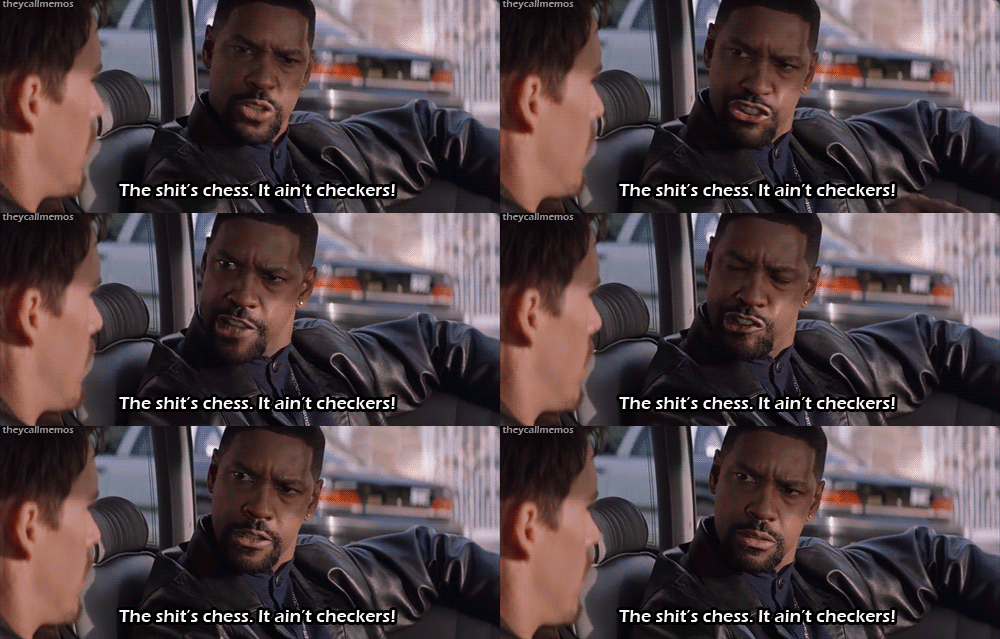
Denzel Washington in ‘Training Day’ (2001), directed by Antoine Fuqua

I had no idea Shakespeare could’ve been seen as progressive; kinda made me respect that man just a little. Maybe it’s his followers who irk me a bit (sounding a lot like John Lennon here). To think that Shakespeare wrote a play like this of such political magnitude at a time where he could’ve easily lost what little he had, was quite brave. What fascinated me more, was the progression of Aaron to Othello. Aaron, an angry and enslaved Moor, was desperate for freedom and basically would do anything at any cost for this freedom. Aaron would’ve faced blatant racism to its highest degree, physical and mental, causing his actions to seem evil though understandable – he’s treated like an animal and will lash out like one. Now with Othello, a successful and progressive Moor, he speaks the language, walks in their spine and adheres to their rules, yet he is not an equal. He too faces the racism and jealousy of white men who feel that, because of their skin colour, they deserve more than Othello. Othello, I think, has a deep internal struggle which I see a lot of black men today face, where to prove success is to embody the oppressor while still being oppressed. This type of black man is caught between the field of Aarons, questioning his blackness or his contribution to the struggle, versus fighting the system from within, almost assimilating to become part of it, and although having proven himself worthy of all praise, is never good enough due to the ‘curse of skin pigmentation ’.
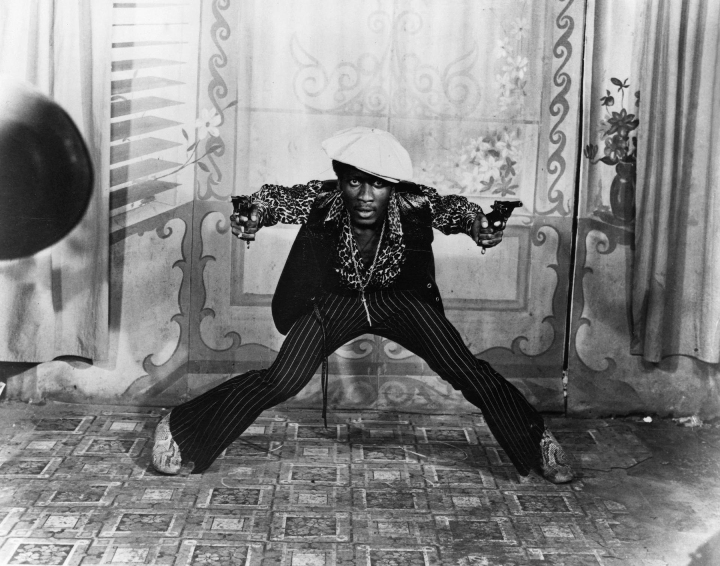
Still shot from 'The Harder They Come' (1973), directed by Perry Henzell

Still shot from ‘The Harder They Come’ (1973), directed by Perry Henzell

Not only in Shakespeare’s Nigga, but in many contemporary forms of Othello, we’ve seen this struggle of black masculinity challenged, and conversation has been generated around successful black men marrying white women as a way to boost to their social standing. I think we’ve had more stories understanding the Aarons of the world, the plight of the disadvantaged black man in an oppressive state (even I have my plays about them), but Othello is quite interesting to dissect. Often times, we praise the Aarons: we filled the seats for Roots in the 70s, Django Unchained had many people talking, Birth of a Nation is coming out soon, and most if not all Caribbean nations have a statue built of their emancipation hero. Then there are the unsung Aarons, ones not quite heroes, but tragic black heroes who in our contemporary adaptations face harsh penalties like Jimmy Cliff in The Harder they Come or even the portrayal of Easy E in Straight Outta Compton.  We don’t always like these images, these harsh, broody and hateful images of black men. Men whose faces are hardened by the life they were systematically placed in. We feel these images are destructive, demonstrative of an already disenfranchised community. When the art is reflecting the images we see, we panic that it can and possibly encourage more Aarons without a cause, almost seemingly forgetting the point of the existence of that Aaron. We just see the gratuitous violence, the tattoos, misogyny, the drugs and the love of a deadly lifestyle; then we want to see more Othellos.

“…I am a fucking black man
Hole in my head
Brains in my belly…”

– Kamau Brathwaite

Sarah and Thomas DuBois from 'The Boondocks'

Sarah and Thomas DuBois from ‘The Boondocks’ (2005-2014)

What about the images we give the Othellos? First image that came to my mind was Thomas DuBois of the Boondocks. Middle class black man, highly educated and great job. These Othello images can’t seem to just get it together, with people often questioning their blackness (How real is you, Nigga!). He doesn’t want to be labelled as an Aaron of the world, but he understands the Aaron. He still has to do his job, even if that means placing Aarons in trouble. He could easily be very well hated and loved for the same reasons. He’s successful, he’s over diplomatic, he wants to please his people but he wants to keep his status and gain power. He can’t really balance both; if he wants to please his people, he could risk his status, putting him back in a position where he can’t do much as before. If he pleases his superiors, he’s a ‘sellout’ an ‘uncle tom’ and a ‘coon’, and essentially ‘forgot where he came from’.

We know these Othellos. They’re professors at our Universities, they govern our countries and become knighted, they eloquently speak for the misleading media houses, the doctors, lawyers, the academics. We praised them when they fought on our behalf, but somewhere down the line they became ‘sellouts’, they’ve lived long enough to see themselves become what they once hated. A friend of mine from South Africa, she shook me to core once when she told me she has no love for Nelson Mandela. I know many black people who are dissatisfied with Barack Obama not addressing gun laws (or even pardoning Marcus Garvey!). How many disparaging statements we’ve heard about Sir Hilary Beckles. Our preferred Othellos usually have tragic moments before we could see them evolve into characters we no longer recognise; basically they die in climax of their revolutionary stance. Those Othellos are like Walter Rodney, Dr. Martin Luther King Jr. Some have slow deaths into obscurity due to whatever reason like Marcus Garvey, Clement Payne. These Othellos ultimately want peace, not justice. He might even say words like ‘assimilation’, ‘adapt’, his version of equality might not match yours. He wants Progression without Aggression, but sadly it can’t always happen, so they opt for the life better suited. They want their status, respect and a comfy home. Their partners may play the part of submissive wife, preferably in the categories of white, light skinned or racially ambiguous. Even if she’s black, she has to be highly educated but submissive, she doesn’t have to work either, and please, not the angry Angela Davis/Cole type! Why the change? He can’t take it anymore, he’s done enough for you ‘ungrateful negroes!’ If he can do it, you all can do it! He no longer believes there is a system because he’s cracked the system and become successful, so there is no racism!

…my people? They don’t need me.
They got legs and arms of their own…

– ‘Dutchman’ – Amiri Baraka

He’s worn, tired and frustrated with black people not working hard enough. He believes that after either affirmative action or 50 years of Independence, black people should know how to better themselves. He also feels disrespected by black people for not giving him the credit he deserves for his contributions. He’s done so much and received so little, all he gets is black people wanting more and more from him. He is now a miserable and cantankerous old man. Oftentimes, he’d write in the newspaper or be on the radio having an opinion no one cares about. He no longer cares to discuss race or race relations because it’s tiring. He’s more #AllLivesMatter than he is #BlackLivesMatter. Internally he still cares for black people, but he doesn’t think they care about him anymore. They’ve scrutinized every move he’s made. Disregarded his contributions. He’s self-loathing. He remembers so many times he’s wanted to be seen as more than just black, that he’s colour blind. Blind to the world, and blind to the struggle…blind to himself.

…We Cannot All be Masters,
nor All Masters Cannot Truly be Followed…

– Othello

What a life to live.

Anyway, much more to learn and grow. I’d like to thank Dr. Sean Benson for a great conversation and learning experience. So much more to learn about the Aarons and Othellos of this world, and the rest of us Moors in between trying to find a balance and conquer these dated notions of black masculinity. Until next time…

– Kupa

___________________
ncf mark rgb2This project is a collaborative initiative, funded by the NCF Barbados
Leann Edghill’s Residency – Week 2 & 3 Blog Post

Barbadian artist Leann Edghill blogs about the second and third weeks of her Fresh Milk residency. These two weeks have seen an increase in Leann’s studio hours and level of productivity, with studio visits from art historian and curator Dr. Allison Thompson and visual artist Ewan Atkinson helping her to think more about her concepts, and encouraging her to consider pushing her boundaries to move out of her comfort zone. This residency is generously supported by the Central Bank of Barbados. Read more here:

14341489_1690829591238488_279418763_n-1

My second and third weeks on the farm were very productive. I managed to start creating my first piece of artwork, and getting into the process of painting has been delightful. At first, I was off to a rough start, trying to figure out the composition of the piece, but I had a little help from Katherine Kennedy, Fresh Milk’s Communications & Operations Manager, and also my friend Shomari Harrison, who visited me on the platform for a week.

I spent a lot of my time painting in the spacious Colleen Lewis Reading Room, as well as having interesting discussions regarding the different activities that go on here at Fresh Milk and gaining some insight into how the space operates. I also extended my studio hours this week, giving myself time to dig deeper into the development of my work; more ideas keep coming to mind, and I can’t seem to get all of them on paper!

After being at Fresh Milk these past few weeks, and having studio visits with art historian and curator Dr. Allison Thompson and visual artist Ewan Atkinson, both of whom I knew from their roles at Barbados Community College, I am realizing the importance of taking several different approaches to my work and process. Being here has really made me challenge my thoughts and relationship with Barbie, which has been somewhat love-hate for many years. In a way, she is one of my best friends; we have been through a lot together (feminist backlash, issues around careers, family, friends etc.). We did everything together – or was that what Mattel wanted me to believe? Being here has allowed me to consider the doll’s status as an icon, and to reevaluate my connection to Barbie and the corporate powerhouse behind her.

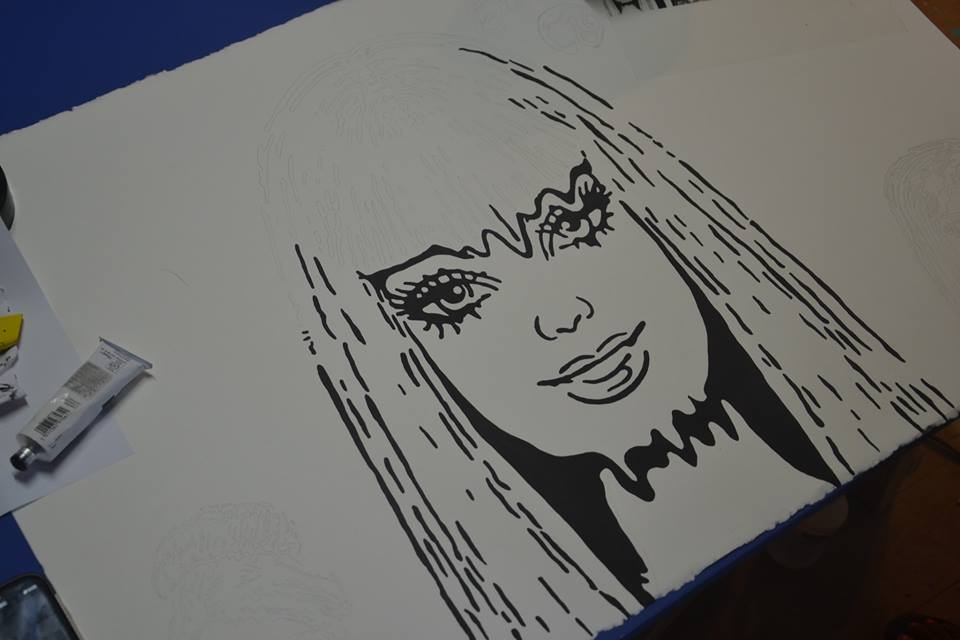
Even though this icon has had major backlash for over fifty years, she still remains an idol to many young girls. I started to illustrate Barbie through simplistic line paintings. Using a minimal colour scheme, I created a different side of her, shifting the focus from just her beauty. I have an obsession with Barbie’s blue eyes and the way that her artificial stare captivates many, including me. I am playing with the contradictory ways her eyes can be read, ranging from innocent to sinister.

14341554_1690811264573654_2046703727_n

By creating melting patterns and distortion on Barbie, I want to question her classic features, and why it is that Mattel has kept this reoccurring imagery to the present day. Although Mattel has shifted with the times to some extent while keeping up with Barbie’s appearance, they have managed to always maintain those baby blue eyes. As I dig deeper into her construction, I realize that my fondness for her compels me to keep her signature look intact, even when attempting to distort her to reveal a different side to her image. It is this nostalgia that prevents me from disfiguring the actual doll; even destroying her as a painting is hard. Perhaps this is an area in which I need to challenge myself personally and artistically, considering the depth of this connection and what might happen if I sever it.

_____________________

CBB Logo White & Black TextThis residency is sponsored by the Central Bank of Barbados

Raquel Marshall’s Residency – Week 3 Blog Post

Barbadian visual artist Raquel Marshall blogs about the third week of her Fresh Milk residency, describing it as her best week yet. Studio visits from ceramicist Juliana Inniss, art historian and curator Dr. Allison Thompson and visual artist Ewan Atkinson provided Raquel with valuable feedback, and the realization of one of her concepts has also been a source of  excitement and encouragement as she enters her final week. This residency is generously supported by the Central Bank of Barbados. Read more here:

20160921_133248

This week was the most fulfilling week thus far.

Moving forward in building and developing the concepts I’ve been working with, I continue to enjoy creating, molding and shaping the clay vessels for the installation. I am reconsidering the amount to produce and how they will actually hang; whether above my head like a ceiling or at different heights where the viewer becomes more of a participant in the piece, walking in, through and around the work. I am leaning towards the latter.

Dr. Allison Thompson having a studio visit with Raquel Marshall

Dr. Allison Thompson having a studio visit with Raquel Marshall

After having a studio visit with Art historian, Author and Head of the Division of Fine Arts at The Barbados Community College, Dr. Allison Thompson, I was challenged to explore the fragility of the work more, which is an aspect we both find intriguing. Since then, I have been more daring and have started pressing the clay between my fingers to create paper thin sides. The vessels are very brittle now, and I am holding them like I would a premature baby as I do the finishing touches. And yet even with the desire to be gentle, I have thrown caution to the wind as I expect some may crack and some may even break and may need repairing after firing. Now, I am excited to see the results and I actually WANT some to break!

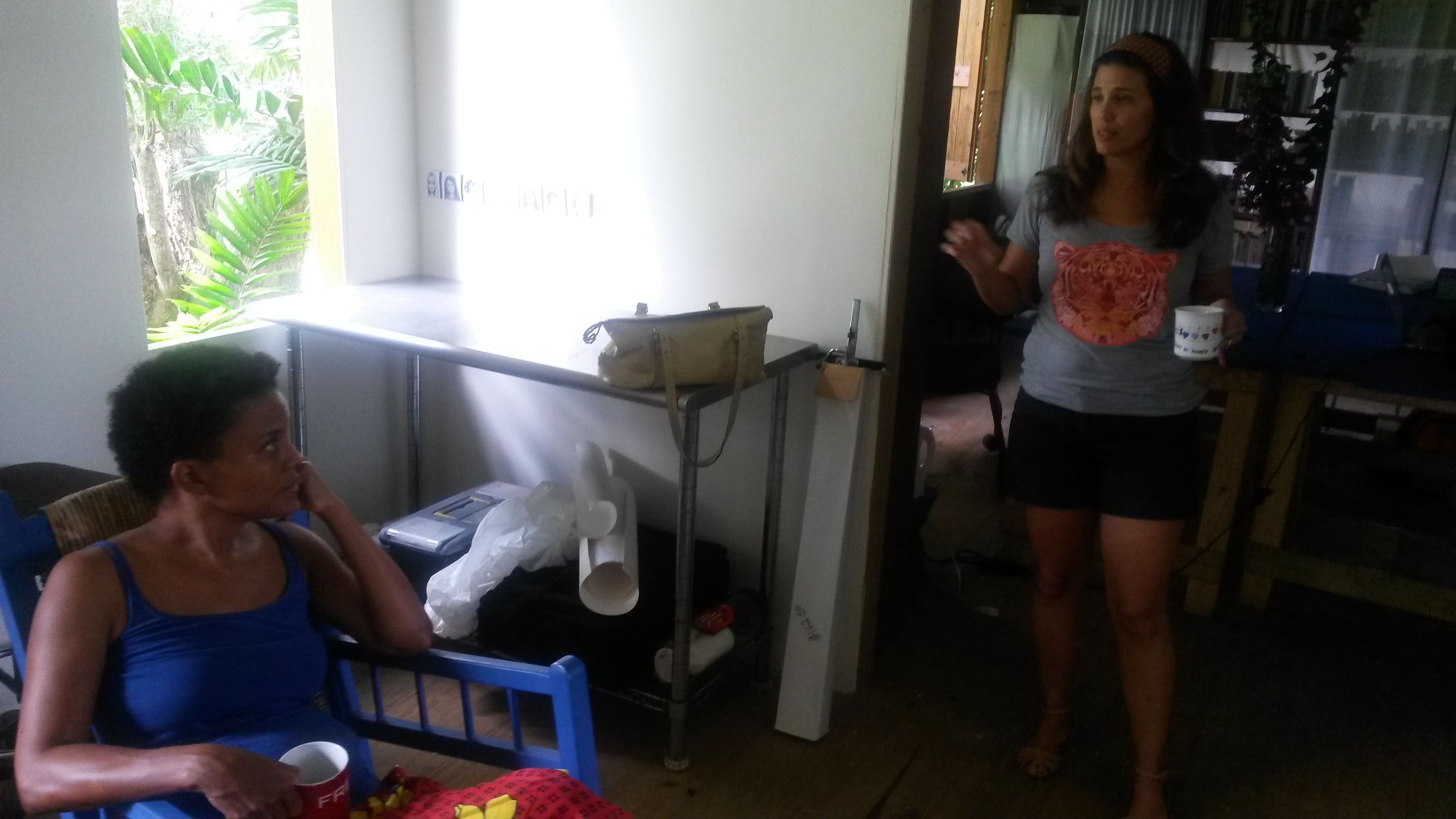
Raquel Marshall in conversation with Juliana Inniss

Raquel Marshall in conversation with Juliana Inniss

I am very grateful to Julianna Innis, an amazing ceramicist, who also came to visit me this week as I requested. I wanted to show her the ceramics and get her feedback. I had recently done a Raku Firing workshop with her and Joanne Johnson at The Barn Art Centre, and I wanted to incorporate what I learned into my ceramic installation. She has agreed to assist me.

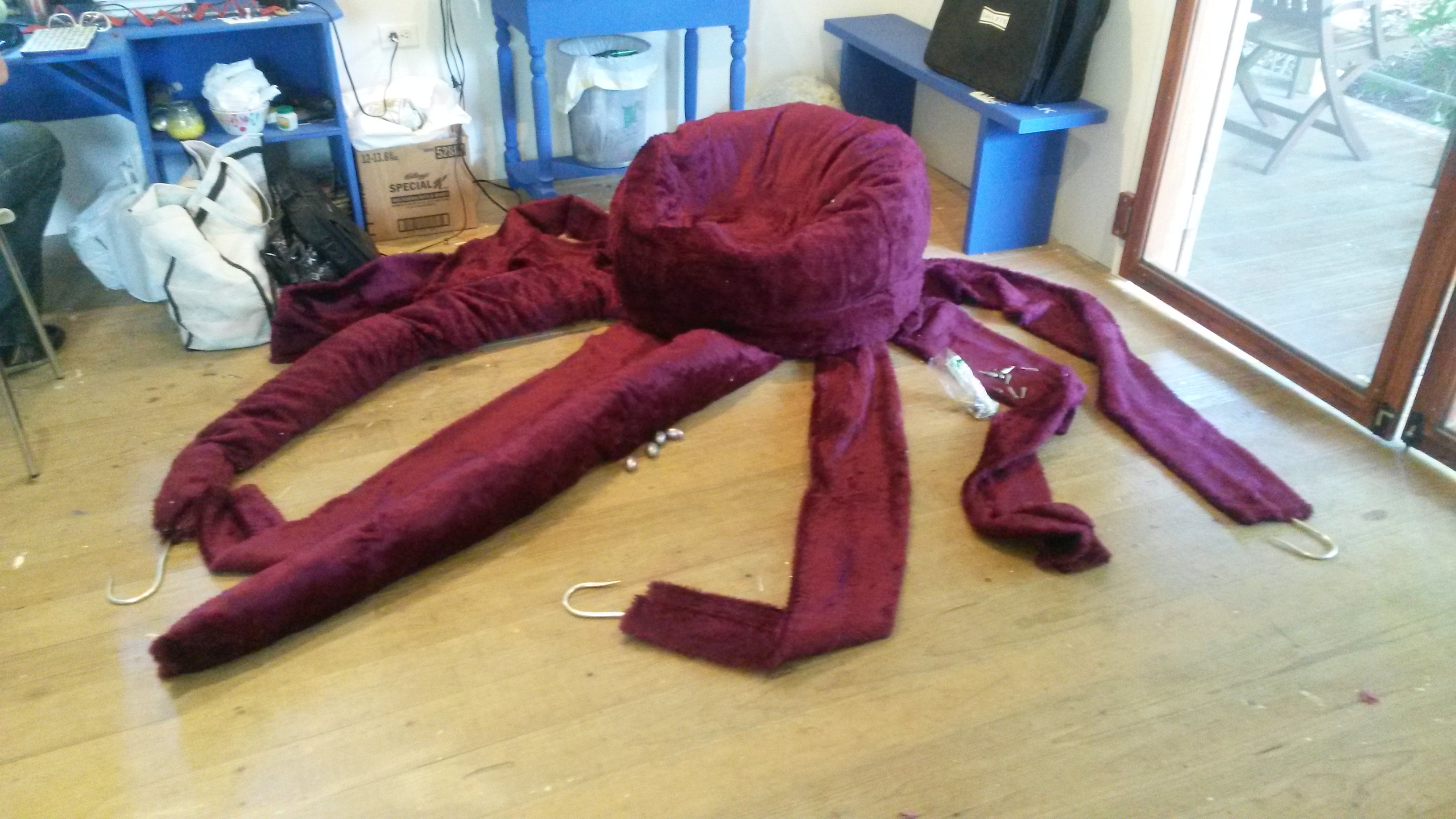
I also made some progress on another concept. It consists of two large 3-Dimensional pieces using bean bags. One of these bean bags once sat in my living room, where the idea was first conceived. This bean bag provided a comfortable place to relax and read, watch TV e.t.c. It got me thinking that when a person is in such a comfortable spot, it becomes hard to move out. I want to reflect the Caribbean’s relaxed way of life (which is one of the reasons I love it here), but from a different perspective – one which challenges the “no worries, man” attitude which can lead to the neglect of some very important issues – like our complacency towards alcohol consumption. I think of the traditional travel posters which promote the Caribbean with a collection of images such as a beach chair, umbrella, beach and a potent drink, for example. Very inviting not only to tourists but also to locals. Nothing is wrong with this in itself, but my concern about our culture is that at most events, whether be it a dinner, a beach picnic, painting class, a sport or even a child’s birthday party, alcohol is not only available but it is expected.

20160927_115841

The bean bag I decided to work on first is large, fluffy, wine coloured, and subliminally calls you to curl in. Extending from beneath are eight octopus-like tentacles adorned with hooks and weights and whatever else I can think to put on them. Should you stay there too long, a tentacle may just grab you, making it even more difficult to get out. Statistics have shown that people who are more susceptible to alcohol abuse as they age are those who start at young ages, those who grow up watching their parents drink or have alcoholism in their family history. I have only just attached these tentacles, and I am loving everything about the work so far; have you ever had a vision in your head, and when it comes to fruition and fulfils everything you expected it to be, you just want to dance? Well, I had to pelt a little waist in excitement.

One of the most challenging aspects of the residency for me has been writing this blog. Writing about my work in terms of context and process is something I have not done in a very long time. I have found the exercise has helped to bring focus and better prepares me to talk about the work. I realised this when I met with Dr. Thompson and Ewan Atkinson; I had requested Atkinson for a studio visit with me as I trust his aesthetic critique, and I know he isn’t going to sugar coat any of his responses.  I found myself more sure of my ideas and more clear in my explanation of the works’ development. I may just start my own blog before the end of the month.

I also discovered Theaster Gates this week. I was amazed that he had done a whole series with fire hoses. It reminded me very much of the seat belts that I have been using.

Leann and I are currently trying to decide what our community involvement will be. This is a welcomed requirement of the residency. We have decided that we would do something together at a local school close by, but when and what is still to be determined.

_____________________

CBB Logo White & Black TextThis residency is sponsored by the Central Bank of Barbados

Nicole Smythe-Johnson announced as curator for the Tilting Axis Curatorial Fellowship 2016

Kingston-based curator Nicole Smythe-Johnson has been selected for this year’s Tilting Axis curatorial fellowship. Smythe-Johnson is a writer and independent curator, who has written for ARC magazine, Miami Rail, Flash Art, Jamaica Journal and a number of other local and international publications. She is currently Assistant Curator on an upcoming exhibition of the work of Jamaican painter John Dunkley at the Perez Art Museum in Miami. She is also working on an Institute of Jamaica publication looking at Jamaica’s National Collection.

Congratulations, Nicole!

nicole

The curatorial fellowship is a direct outcome of the Tilting Axis meetings in 2015 at Fresh Milk in Barbados and in 2016 at the Pérez Art Museum Miami. Scotland based cultural partners CCA Glasgow, David Dale Gallery, Hospitalfield and curatorial collective Mother Tongue produced a structural long-term fellowship for an emerging contemporary art practitioner living and working in the Caribbean.

This new fellowship opportunity focuses on the development of pragmatic and critical curatorial development hailing from the Caribbean region, and is research and practice-led, and mentor-based. Designed as a year-long programme between the Caribbean region and Scotland, it offers support for critical development of curatorial practice and gives a practical base in the partner institutions with visits to Scotland and throughout the Caribbean.

During the fellowship, Nicole Smythe-Johnson will travel to Scotland in November, and will also undertake research visits to Suriname, Barbados, Cuba and Grenada. Smythe-Johnson said: “I am very excited about the fellowship. I attended the Tilting Axis conference this year in Miami and really savoured the opportunity to meet other arts professionals and hear about other institutions in the Caribbean region. I love my island, but island life can be isolating and there is a real temptation toward the insular. This fellowship then, is the perfect opportunity to build on the connections I made at TA 2016, and get some answers to the questions that came out of that experience. I can’t wait to jump in with both feet, starting with Glasgow.”

David Codling, Director of Arts for the Americas, British Council said: “In so many ways which are often overlooked, the Caribbean is the epicentre of the Americas: for better or worse Europe’s involvement with what it called the “New World” began in the Caribbean and for many European countries, including the four nations of the UK, our relationship with the Caribbean is deep, intense and complex. The British Council is proud to support and to be associated with the Tilting Axis Curatorial Fellowship which offers an opportunity to explore and understand that relationship and to promote new conversations.”

Holly Bynoe, co-founder, Tilting Axis said: “In keeping with the notion of tilting the axis which refers to the re-focusing of our gaze and harnessing our collective power to make the visual arts sector more sustainable in ways that resonate with our lived realities in the Caribbean, the introduction of the Tilting Axis Curatorial Fellowship is one example of how this might happen. Tilting Axis 2: Caribbean Strategies made significant strides in its aims to fortify networks and extend the reach of the arts throughout the Caribbean, with its partners in the Global North. I am delighted that the inaugural fellow is Nicole Smythe-Johnson and eagerly anticipate what will come of her research across the Dutch, Spanish, and Anglophone Caribbean, concluding in what I am sure will be a rich and stimulating experience in Scotland.”

The fellowship is in partnership with CCA Glasgow, David Dale Gallery and Studios, Hospitalfield, Mother Tongue and Tilting Axis. Supported by the British Council.

For more information, images or interviews, please contact Julie Cathcart, Communications ManagerCCA – julie@cca-glasgow.com / 0141 352 4911.

tilting-axis-logo

About Nicole Smythe-Johnson:

Nicole Smythe-Johnson is a writer and independent curator, living in Kingston, Jamaica. She has written for ARC magazine, Miami Rail, Flash Art, Jamaica Journal and a number of other local and international publications. She is currently Assistant Curator on an upcoming exhibition of the work of Jamaican painter John Dunkley at the Perez Art Museum in Miami. She is also working on an Institute of Jamaica publication looking at Jamaica’s National Collection.

About CCA:

The Centre for Contemporary Arts is Glasgow’s hub for the arts. The building is steeped in history and the organisation has played a key role in the cultural life of the city for decades. CCA’s year-round programme includes cutting-edge exhibitions, film, music, literature, spoken word, festivals, Gaelic language events and performance. CCA also provides residencies for artists in the on-site Creative Lab space, as well as working internationally on residencies with Palestine, the Caribbean and Quebec. CCA curates six major exhibitions a year, presenting national and international contemporary artists, and is home to Intermedia Gallery showcasing emerging artists.

About Hospitalfield:

Dedicated to contemporary art and ideas, Hospitalfield is a place to work, study, learn, visit and enjoy. Hospitalfield is an artist’s house in Arbroath, on the east coast of Scotland, with a captivating cultural and social history that spans many hundreds of years. The contemporary arts programme is anchored in the visual art yet encourages interdisciplinarity, supporting the production of new work and providing space for debate and learning through residencies, a summer school and four public projects with new commissions each year. The organisation maintains strong national and international working partnerships with the aim of making Hospitalfield a meeting place and cultural catalyst in the working lives of artists, students and creative professionals in Scotland and far beyond.

About Mother Tongue:

Mother Tongue is a research-led, independent curatorial practice formed by Tiffany Boyle and Jessica Carden. Since 2009, they have produced exhibitions, screening programmes, discursive events, essays and texts, working in partnership with galleries, museums, festivals, and publishers. Mother Tongue’s practice in exhibition-making intersects with research interests – including, but not limited to – post-colonialism, language, translation, heritage, identities, indigenousness, migration, and movement. They are currently researching the presence, work and exhibition histories of artists of colour in Scotland, working towards a future ‘AfroScots’ exhibition project.

About Tilting Axis:

Tilting Axis is a roving project conceptualised by ARC Magazine and the Fresh Milk Art Platform Inc. The first iteration was hosted at Fresh Milk in Barbados in February 2015 under the banner Tilting Axis: Within and Beyond the Caribbean | Shifting Models of Sustainability and Connectivity. Tilting Axis 2.0 was hosted by the Pérez Art Museum Miami in February 2016. This meeting explored the current state of cultural work in the Caribbean, and aimed to fortify networks, increase administrative and programming capacities, as well as transfer knowledge and funding opportunities to those working in the region. The Tilting Axis Emerging Curatorial Fellowship developed out of the second iteration and the next edition of the meeting is slated to take place in April 2017, hosted by the National Gallery of the Cayman Islands (NGCI).

About The British Council:

The British Council is the United Kingdom’s international organisation for cultural relations. The British Council creates international opportunities for the people of the UK and other countries and builds trust between them worldwide. We call this cultural relations. We build trust and understanding for the UK to create a safer and more prosperous world. In terms of our reach and impact, we are the world’s leading cultural relations organisation. Cultural relations is a component of international relations which focuses on developing people-to-people links and complements government-to-people and government-to-government contact. We use English, Arts, and Education and Society – the best of the UK’s great cultural assets – to bring people together and to attract partners to working with the UK. The British Council has over 7,000 staff working in 191 offices in 110 countries and territories.

Raquel Marshall’s Residency – Week 2 Blog Post

Barbadian visual artist Raquel Marshall writes about the second week of her Fresh Milk residency. This week, Raquel gives us some more insight into her impetus behind applying for the residency, and how her personal experiences with those who have suffered with alcoholism as well as research into the subject feed into the body of work she is creating while at Fresh Milk. This residency is generously supported by the Central Bank of Barbados. Read more here:

I have been working on a few different concepts this week. Here is a look at two of them.

The clay sculptures for the installation I imagined are coming along nicely. Each piece is its own unique vessel, and none are premeditated. Their shapes are quite fluid and remind me of sea life. I wanted to add texture to some of them and decided to go with coral and shell patterns. In trying to approach the subject of denial, it is my intention for these pieces to convey weight, time, care and an element of ‘what is hidden’ within the work. There is nothing I love more in the creative process than to start with a vague idea, be sensitive to the medium and observe the work evolve on its own.  I have about 80-100 to make!!

I was inspired to do this piece after having to face a difficult time in my life, which pushed me to apply for this residency.  In 2012, I lost my father to suicide due to a lifetime of alcohol abuse. It’s been 4 years (even though it feels like only 4 days at times) of numbness, questions and deep reflection; a time of cocooning and rebirth. The entire experience has inspired me to explore more about alcoholism (drug abuse), especially as it relates to our local (perhaps even regional) culture.

I am grateful to The Substance Abuse Foundation which is a place of healing for addicts because they have been very supportive in helping me find some statistics. Thanks to Larry Mayers and Bernard Pooler.  I also had the privilege recently to sit with Kurlyne Alleyne and hear how she uses art as therapy with the patients there. I have such high respect for this organization and the people who work there.  I feel proud of those who have walked through their doors to find healing as it is a very brave and honest act, and shows a tremendous strength and love of self.

In my efforts to gather some information I created a little anonymous survey. If you are a Barbadian please fill it out. Thanks to all of you who have taken the time so far. I hope to use the sentiments and statistics for future work.

fullsizerender

I truly believe that love saves lives, and this brings me to the next concept I have been working on.  According to Barbados Free Press in an article written in 2010,  the number of car accidents reported was estimated at 240% higher than the UK, and in 2015 Barbados Today also reported that there was a rise in road fatalities from the year before. Police say drunk-driving and speeding are among the leading causes of accidents. Anesta Henry’s report expresses my personal sentiments through the statements of Richard Cox, the public relations officer of the Barbados Road Safety Association, and Ronald Stanford, Assistant Superintendent.

I have been challenging myself as to whether or not I am being loving and responsible when I watch someone who has spent a night drinking get into their car and drive away? For those of you who don’t know, we don’t have safety laws to prevent people from drinking and driving, we don’t even have breathalyser tests. I have watched many leave the “partay” even with their “one fuh de road” in hand (what a terminology!) and said nothing – I just prayed they made it home safely. Seat belts are required now, and I wanted to incorporate one in a piece as they have been proven to save some lives. I cut the belt into hearts in the way children try to make patterns with folded paper. It was all experimental. The cutting caused the belt to fray, and I found myself drawn to the very tactile and now fragile properties of this new object. I want to do another one. I hope that my work creates dialogue that promotes change.

I took some time this week to walk the grounds here at Fresh Milk. I took in the scenery and calmed my thoughts. Discovering new places and new things always brings out our inner child, so even though there is seriousness in thought, playfulness is never far from reach. My imagination was sparked…I discovered an intimidating snake-like creature with many arrow-shaped heads, a wondrous tree with many rooms, and a troll under a “bridge”. And had a stare down with a cow.

_____________________

CBB Logo White & Black TextThis residency is sponsored by the Central Bank of Barbados