
Please introduce yourself, tell us a little bit about where in the region you are based, and share some of the major ideas and themes you engage with in your practice.
My name is Dominique Hunter and I’m a multi-disciplinary artist from Guyana. I have multiple ongoing series of works with some of the major themes including migration, mental health, representations of black women’s body in historical and contemporary print media, as well as the advertising and tourism industries’ complicity in how centuries-old stereotypes continue to be perpetuated today.


You’ve been interested in translating your painting and collage ideas into three dimensions and in experimenting with silver, copper, and brass. Can you speak about these technical inquiries, what you’ve been surprised by and the challenges with these investigations since receiving the TENDER grant?
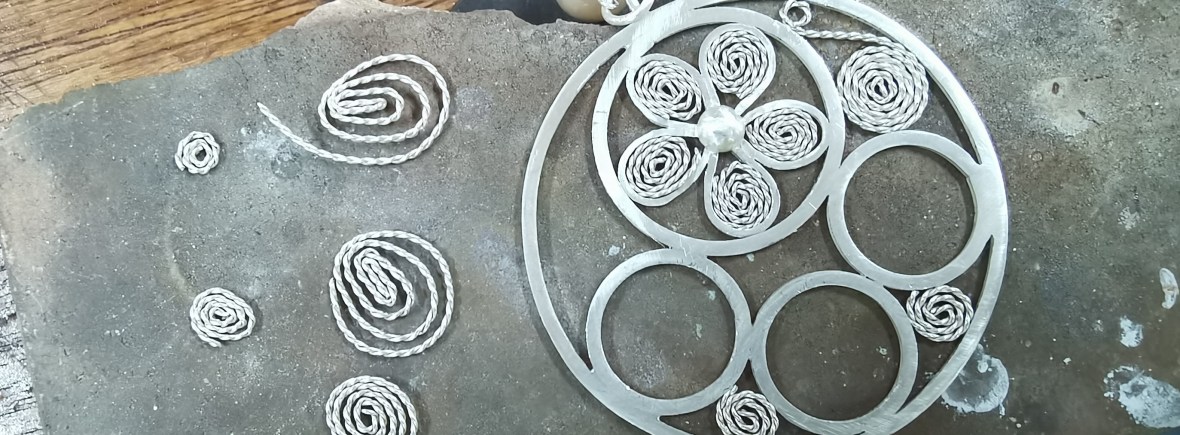
Now that I’ve more or less defined the conceptual framework for those ongoing series of works, I’m interested in how those themes and concepts would translate in the round, particularly using various metals. I think I’m drawn to this particular material because of both its history as well as its permanence. There’s also the layer of difficulty to consider when working with metals and wrangling them into the desired form or shape. Metalsmithing is also a very slow and labor-intensive series of processes that forces you to slow down (and sometimes start over, especially as a learner), even when your mind is racing with different ideas. Over time I’ve had to learn to adjust my approach to this new medium or risk frustration since it doesn’t have the same kind of immediacy that collaging can oftentimes have.
In the past, I’ve produced a number of sculptures and installations, so this leap into the “round” is not entirely new to me. But truthfully, since receiving the grant I have not been able to get the dedicated studio time I would need to carry out further experiments because my situation at work has changed quite significantly. I’m in a much more senior administrative position, which means that I have even less time and energy to focus on my own practice. I’ve still been able to produce work in spite of this new development, albeit at a much slower pace. Almost two years since I first started metalsmithing, I’m still learning different techniques and still eager to apply what I’ve learnt to my creative practice.


In addition to initiatives like TENDER, what other kinds of support or programming geared towards the needs of contemporary creative practitioners would you like to see implemented in the Caribbean?
I think an initiative like TENDER is great because it provides a more accessible form of financial support to creatives in the region who might otherwise have a hard time receiving that overseas. However, I think dedicated time to work in a studio, whether through an individual or group residency, is another incredibly important form of support. Many artists have difficulty carving out time to make work because of other commitments that allow them to live as an artist in the region. This is something I also struggle with now as someone who has gone from being an art educator to also performing duties as Director of Studies at the E.R. Burrowes School of Art, all while trying to balance my own creative practice. In the past I’ve benefited from two fully funded residencies (one of which was Caribbean Linked IV in Aruba) and they both played an instrumental role in the trajectory of my career, and the relationships I’ve been able to nurture since. I’d like to see more residency opportunities for creatives in the region because I’ve experienced firsthand just how transformative they are in our community.
 fresh milk barbados