
Please introduce yourself, tell us a little bit about where in the region you are based, and share some of the major ideas and themes you engage with in your practice.
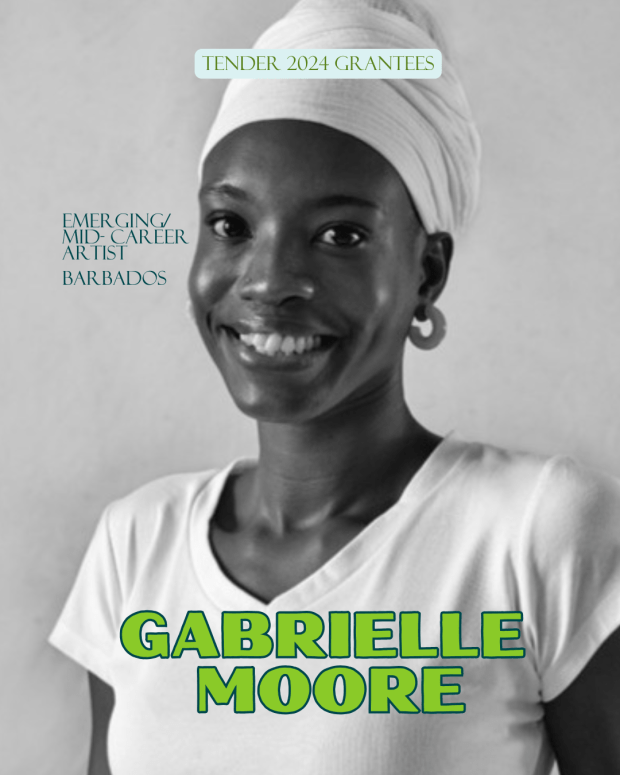
My name is Gabrielle Moore, and I’m a multidisciplinary artist based in Barbados. My work explores the relationship between the mind, body, and environment, and how that interaction is shaped by historical, social, and political realities. I’m interested in how these external influences shape not only our physical spaces but also our internal landscapes. The thoughts we have, our beliefs, and perceptions of ourselves and others.
My work often centers on Caribbean identity, memory, and the lingering effects of colonial trauma. I am motivated by a desire to make visible any inequalities and contradictions that are hidden beneath the surface, especially those that stem from the legacy of slavery and systems of exploitation. I want to heal, reclaim, and reimage paradise — not as an illusion— but as something we deconstruct, build and restore through truth-telling, connection, and art.
Visually, my practice is about balance: between softness and tension; clarity and distortion; beauty and discomfort. I use sculptural textures and painting techniques to explore these dualities, while creating works that feel both intimate and expansive. I want to present as they have been framed historically but also challenging and expanding those narratives ,to reflect the resilience, depth and complexity of our lived experiences.


How has the development of your studio space and access to resources impacted your art practice since receiving a TENDER grant, and can you also speak about how your interest in paradise, mental health and Caribbean history is continuing to evolve in your work as a result of your ongoing research and material exploration?
Since receiving the TENDER grant I’ve been gradually developing a more defined studio practice, both mentally and physically. I started by transforming a garage into a studio space: clearing out distractions and bringing in what I needed to focus on my art. It’s still a work in progress, but having a dedicated space has made a huge difference. I can experiment, make a mess, reflect, and go back to ideas without interruption.
The funding also helped me to purchase tools and materials to explore more three dimensional and layered ways of working. This has deepened how I approach texture, surface and scale, especially as I work between sculpture and painting. One of the biggest changes has been how I think about my themes. My ongoing interest in paradise, mental health and Caribbean history has grown. I no longer see them as separate ideas but as interwoven. Paradise is not just a place but a feeling we’re all trying to get back to, a space of clarity, safety or wholeness.
The TENDER grant has strengthened my desire to interrogate not only Caribbean history, but also the broader global systems that perpetuate inequality. My work continues to evolve in response to these questions, balancing the paradise that is often sold with the truths that are often silenced. This grant has played a foundational role in that shift. It helped me move beyond survival-mode of creativity and into a phase of more intentional research, development, and experimentation. That support is now manifesting in a new, more grounded phase of my artistic journey.


In addition to initiatives like TENDER, what other kinds of support or programming geared towards the needs of contemporary creative practitioners would you like to see implemented in the Caribbean?
Grants like TENDER are incredibly impactful, but I think there’s still a great need for more sustainable, long-term support for Caribbean artists. I would love to see more artist residencies and mentorship programs tailored to our unique cultural and regional contexts.
I also believe in the importance of flexible studio and exhibition spaces where artists can take risks and show work that may not be commercially driven.
Another major gap is access to professional development. Workshops in grant writing, archiving, installation, and international networking could empower artists to manage their careers better. Similarly, exchange programs, whether digital or physical, could foster much-needed dialogue and solidarity between artists across the Caribbean and the world in general.
What’s most important is that these programs are built in collaboration with artists and led by people who understand the lived experience of creating within and beyond the Caribbean.
 fresh milk barbados