Please introduce yourself, tell us a little bit about where in the region you are based, and share some of the major ideas and themes you engage with in your practice.
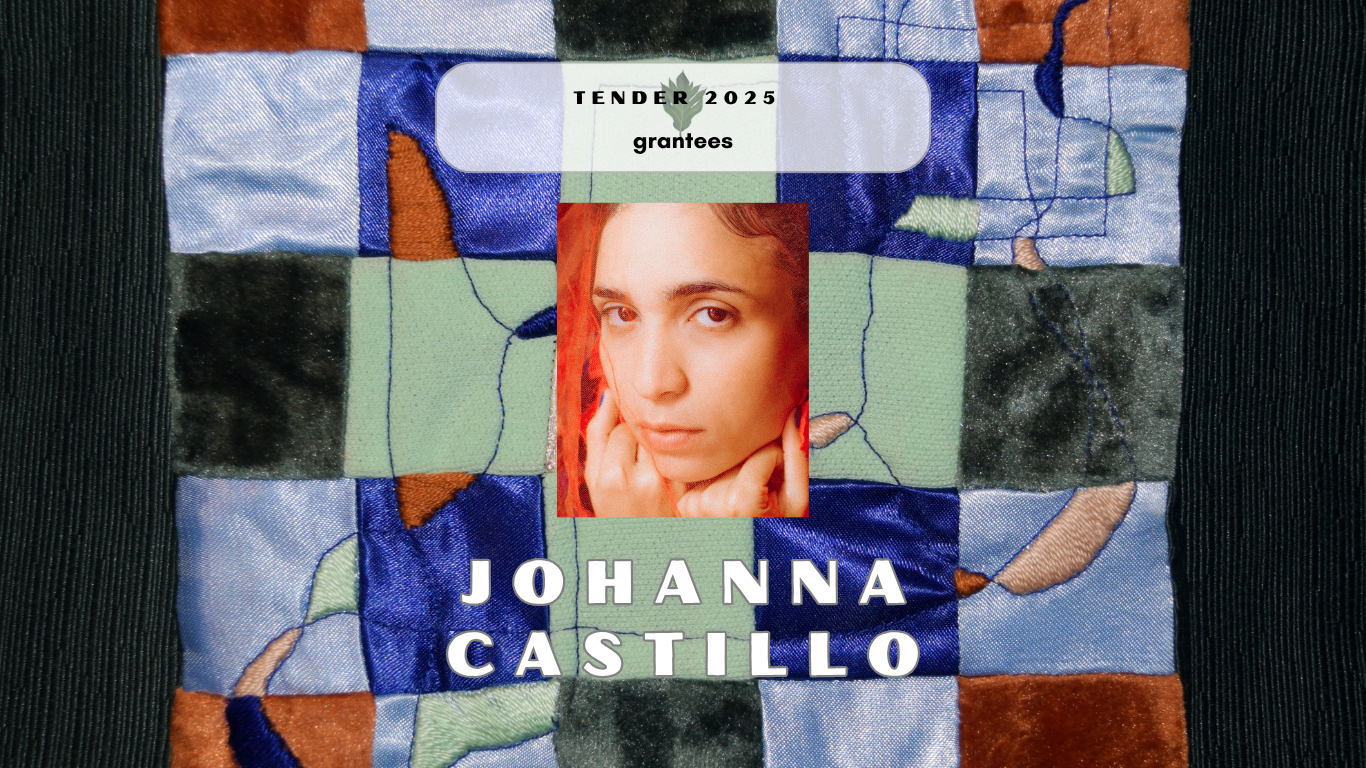
Hello, my name is Johanna Castillo (DR). I am an integrative textile artist and designer, in the process of weaving myself back in the entanglement of all living systems. My work explores human connections, multiplicity, localness, the act of listening, (re)integration, the circularity of things, and the material culture of emotions.
My practice is informed by my embodied experiences as a response to imposed and self-imposed ways of relating, linear notions of time, social fragmentation, power dynamics, climate crisis, and hyper-consumption through reclaiming textiles and old clothes in the form of collage, soft objects, transformed garments, collective maps, collaborative installations and experiences, Integrative Looms™, digital based tapestries, patterns, questions, workshops, and knots.


My project, TREPELITO, is an experimental space that co-creates softer ways of relating through lived-living textiles, repair and questions.
My work listens to personal and collective stories held in cloth, as an invitation to recognize the patterns we inhabit, to imagine new ones.
I gather textile fragments and gestures to honor what has been broken, discarded, or forgotten, inviting them back into a space of value. These pieces; maps, soft objects, offerings, emerge from chaos, wounds, curiosity and care. My process is slow, intuitive, and relational. It holds space for reflection, creation and collective imagination as a friendly reminder that everything-is-connected.
I am interested in keeping textiles circulating for longer, while activating their materiality as a transformation and world-making tool. I am equally interested in their potential as a healing tool; one that allows us to transmute our invisible patterns.
I’m wondering: what if textiles could help us release our inner knots, mend our heart, and re-thread-our-ways-of-being-world?
This approach positions making not as a path to fixed outcomes, but as a living tool, where the process becomes the work, and the visible object becomes a mirror that reflects our ongoing transformation.


What has your experience been deepening into both the extroverted and introverted desires of your practice, such as the community outreach workshops and developing archiving the living process book, and what has this revealed to you about your work “repairing the collective heart”, as you describe it?
I feel my practice lives on a thin line between the visible and the invisible. The world of feeling, dreams, energies, and the whispers of my ancestors.
I FEEL TOO MUCH
Sounds, colors, textures, glances, the movement of bodies. Sometimes it feels like I can sense the spirit of life in the smallest and most ordinary things.
I remember sharing a little about this on Instagram once. A friend replied with a podcast about Highly Sensitive People. I listened to it, felt deeply seen, picked up my new title, and kept walking.
Some time later I experienced another way of feeling.
I had a vision where I saw—felt—my heart connected to many other hearts. They were carrying so much pain that I started crying in a way I couldn’t explain, as if, for a brief moment, I could feel what all those hearts were feeling. That moment connected me to what I now call the collective heart. It felt like an invitation to move closer to the wisdom of the heart.
Since then I’ve been wondering:
How am I repairing the collective heart?


Maybe my practice is simply a way of getting closer. Closer to myself. Closer to others. Closer to the Earth.
I’ve been practicing this by moving more slowly. By having uncomfortable conversations. By recognizing my shadows. By following synchronicities. By finding lost hearts. By learning from hugging trees.
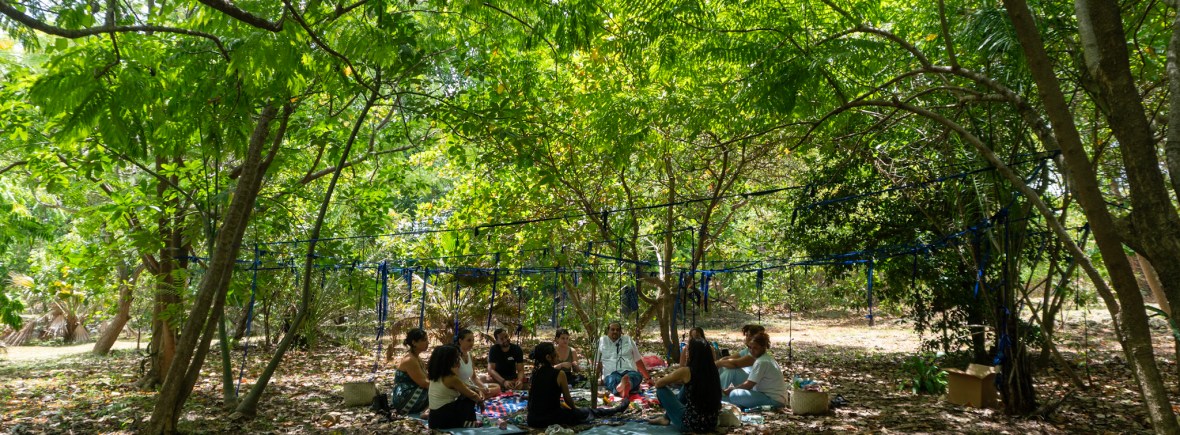
As a way of getting closer to my community the vision of workshops turned into Collective Mapping: gatherings where we honor existing relationships through intuitive embroidery and emotional textile fragments in parks, backyards, and everyday spaces.
At the same time, the book is turning into a living digital archive of these processes; Water Holds Memory, ¡SE BUSCAN CORAZONES PERDIDOS!, and the Collective Mapping Social Activations, to keep listening and responding to this vision.


In addition to initiatives like TENDER, what other kinds of support or programming geared towards the needs of contemporary creative practitioners would you like to see implemented in the Caribbean?
I would love to see more programs focused on writing; creative, research-based, and conceptual, on ways of communicating work when the process is just as important as the final object, and on curatorial mentorship for artworks and projects as a way for them to evolve and be enriched by other perspectives.
I also believe there is great value in supporting aspects of artistic practice that are often taken for granted such as artist bios, statements, CVs, and portfolios; developing catalogues; and, more broadly, designing applications for grants, residencies, and fellowships. I see this as a way for more Dominican-Caribbean artists to access opportunities both within and beyond the region but also as a practice of self-determination—one that generates culture by creating our own opportunities within our local context.
I also think it is important to offer support around financial literacy, contracts, artwork registration, pricing, and the realities of sustaining complementary practices so that an artistic career can be financially sustainable. On this note, if there are other ways an artistic practice can sustain itself, I’m always open to the conversation ———> @trepelito 🙂
And to close, a sweet note to my fellow world-makers:
If you feel you came into this world to create it, but you’re also carrying the weight of social injustice, the normalization of violence, or the contradictions of the Dominican state, please keep creating.
Creating from the heart is an act of resistance against hyper-consumption, living on autopilot, and the lack of humanity.
A society that only consumes, consumes itself. A society that creates, imagines, and shares, regenerates itself.
(((How can I get closer to what already surrounds me?)))

