Please introduce yourself, tell us a little bit about where in the region you are based, and share some of the major ideas and themes you engage with in your practice.
My name is Lyneisha Ince, and I am a contemporary visual artist based in Barbados. My practice is multidisciplinary, and I work across drawing, painting, sculpture, photography, installation and writing, often allowing the idea behind a work to determine the medium or combination of mediums I use. At the core of my practice is an interest in interpreting inner experience, particularly memory, dreams, escapism and psychological states. I am interested in giving form to experiences that can be intangible or difficult to articulate, while exploring how our internal worlds can be represented visually. In exploring these ideas, my work often draws on scientific, archival and speculative visual languages. I am particularly interested in borrowing from methods associated with observing, documenting and understanding the physical world and applying them to experiences that are much less tangible. As a result, my practice continues to evolve through experimentation with materials, processes and different forms of presentation. Through these approaches, I create works that exist somewhere between the familiar and imagined, giving physical presence to experiences that would otherwise exist primarily within the mind.


The invitation to participate in CARIFESTA 2025 provided you with an opportunity to present your work at a significant regional event. How did the TENDER grant facilitate your vision to create the ambitious work you visualized for this Caribbean platform?
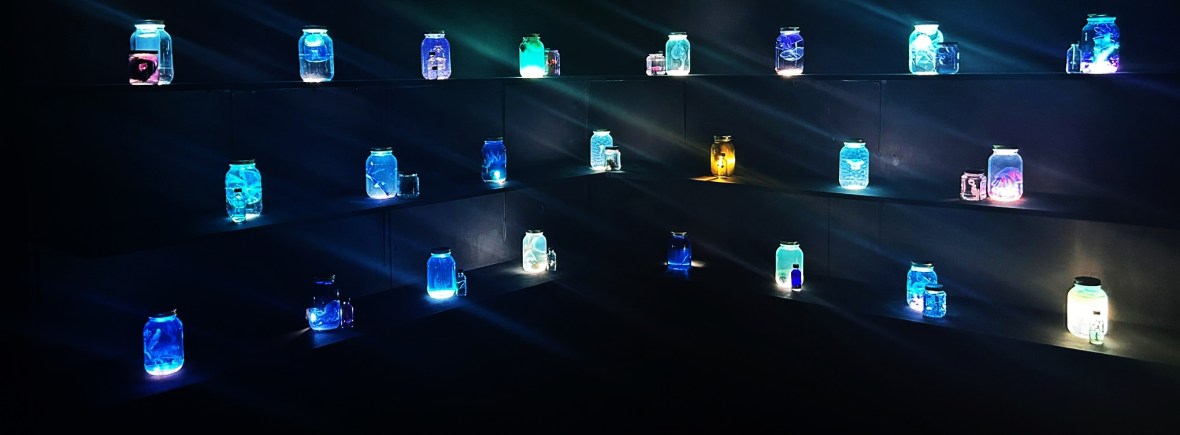
The work I had envisioned presenting as part of the visual arts programme at CARIFESTA 2025 was not completed in time for the festival. However, my work was still represented at CARIFESTA in another way. My 2024 installation, A Psychogenic Repository, was featured on the cover of Linda M. Deane’s Firefly Dreams and Other Quirks of Light, which was part of the festival’s literary programme. The TENDER grant came at an important point during that period, allowing me to purchase equipment and materials that expanded what I was able to explore in my practice. In particular, it gave me greater freedom to experiment with incorporating technology into my work. That experimentation ultimately contributed to the development of Microscapes, a new series and direction in my practice. While the original work was not realized in time for CARIFESTA, the support from TENDER has had an impact beyond the festival itself. The equipment I acquired and the possibilities it opened up continue to influence how I approach and develop new work.


In addition to initiatives like TENDER, what other kinds of support or programming geared towards the needs of contemporary creative practitioners would you like to see implemented in the Caribbean?
I would like to see more support that considers what creative practitioners need to build sustainable careers over time. Greater access to affordable studio spaces would be particularly valuable, giving artists room to experiment, produce work and develop their practices without the cost of maintaining a workspace becoming a major barrier. I am also interested in programming that strengthens the business and professional side of creative practice, whether through pricing and valuing work, contracts and intellectual property, financial management, marketing, accessing new markets or developing multiple income streams. Initiatives like TENDER provide important support for creating and developing work, and I think continuing to build an ecosystem around that, one that supports both the creative and professional realities of being a practitioner, would be incredibly valuable across the Caribbean.
 fresh milk barbados