
Please introduce yourself, tell us a little bit about where in the region you are based, and share some of the major ideas and themes you engage with in your practice.
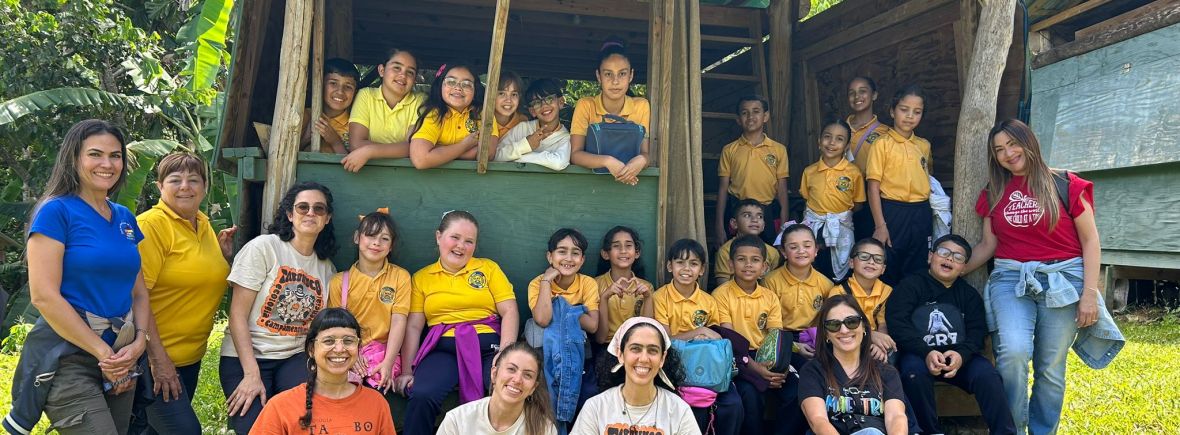
Tabonuco is an art and ecology experiential education initiative based in Jayuya, Puerto Rico, serving the rural municipalities of Jayuya, Utuado, and Ciales in the island’s north-central mountain region. Our mission is to empower children, youth, and adults through transformative learning experiences rooted in the arts and ecology, fostering cultural, social, and environmental awareness. Contemporary and traditional visual arts and crafts related to the land serve as the foundation connecting all of our programs and activities.
We work in communities that face challenges such as geographic isolation, limited access to healthcare, food insecurity, underfunded public services, and a lack of artistic and cultural opportunities. Founded and led by local residents, Tabonuco is a Boricua, BIPOC, women-led initiative composed of artists, educators, farmers, and advocates working across the fields of art, education, agriculture, environmental stewardship, and social justice. Most of our facilitators are Puerto Rican women from rural communities.


Our approach is inclusive, place-based, and responsive to community needs. We create safe and welcoming spaces where people can connect, learn, and express themselves through art and nature. Beyond skill-building, our programs support emotional, social, and cultural well-being in a region often affected by poverty, climate-related challenges, and social isolation.
Tabonuco’s work is guided by core values of inclusion, solidarity, creativity, environmental justice, cultural pertinence, and feminist community care. We believe in the power of art as a tool for transformation, at a personal, collective, and ecological level. Our approach is intersectional and interdisciplinary, weaving together practical knowledge, traditional wisdom, and creative expression to create meaningful and accessible learning opportunities.
For nearly a decade, Tabonuco has developed original programs that respond to the evolving needs of our community while adapting to environmental and cultural realities. Through these experiences, participants build lasting relationships with one another, the land, and the creative practices that strengthen community resilience.


It’s been a turbulent year for many entities figuring out, as you describe, “creative ways to activate our networks of solidarity that will allow us to raise funds without having to compromise our values and services to our neighbors” — what has the organisation’s experience been in terms of the challenges but also the benefits of activating alternative networks for funding? What advice would you give to fellow arts organisations based in the Caribbean experimenting with similar strategies?
We consider diversity to be a fundamental concept and practice for the sustainability of our project. Biodiversity, neurodiversity, and gender diversity are anchors that guide our values and practices. Financially, relying on diverse sources of income, exchanges, and collaborations has proven fruitful in helping us balance our income sources. For example, we design and write grant proposals that support free community projects; we host a small number of groups that pay for educational services; we sell products such as T-shirts and artwork; we organize fundraising campaigns and events; and we engage in trades/exchange (“trueke”) with neighbors and allied organizations. We are also part of a group of neighbors who rotate voluntary mutual aid work and support at our houses, farms or projects. This approach to financial diversification allows us to balance our sources of income authentically, without compromising our convictions.
In addition, with each passing year, as our work grows, we gain skills and experience, making the process more viable. The longer we carry out the proposed actions, the more visible and attainable grant funding and fundraising opportunities become. We also try to work and obtain funds within our means and capacity. Growing too fast can disrupt and disrupt the internal rhythms of a project, cause intense burn-out, or risk sacrificing long-term sustainability.
It is important to clarify that this is neither an easy nor an ideal process. Artists and organizations frequently exist in a state of uncertainty and constant work. For Tabonuco, 2027 brings some uncertainty, as the grants that support our community programs in 2026 will expire. Although we are not entirely sure how we will concretely finance the initiatives we hope to carry out after April 2027, we trust that we have enough time, different ways of achieving this and a network of mutual support that will allow us to adapt to the resources available.


In addition to initiatives like TENDER, what other kinds of support or programming geared towards the needs of contemporary creative practitioners would you like to see implemented in the Caribbean?
We would love to see even more unrestricted or flexible funding opportunities like Tender for artists, educators, and organizations. In general, I think funding opportunities should have flexible requirements, allowing artists and organizations to adapt their services and projects to needs and interests that emerge naturally rather than forcing them into rigid frameworks. Adopting a trust-based philanthropic approach would allow artists and organizations the freedom and flexibility to do their work and adapt to changing circumstances.
It would also be cool to see more travel grants and exchange opportunities for artists, educators, cultural coordinators, and other creatives. Something like a fully funded travel grant and stipend that allows people from across the Caribbean to attend events, conferences, residencies, conduct research interviews, or pursue other forms of professional and creative development. There is a huge logistical disconnect across the Caribbean archipelago due to colonial bureaucratic restrictions, capitalistic limitations in regional air travel, and language barriers. But people across the Caribbean express this over and over again: we are part of a shared, erased and often overlooked Caribbean experience. There is so much richness in both our diversity and our common histories. I wish it were easier and more accessible for us to connect with one another, learn from each other, and build stronger relationships across the region.

