Musings from the Milking Parlour Studio: What is contemporary art?

by Annalee Davis

April Article

A reader of my last article expressed confusion over the term contemporary art.  She wondered how it was that Joscelyn Gardner, (www.joscelyngardner.com) could be considered a contemporary artist even though she is working within the old tradition of lithography using stone.

Joscelyn Gardner, Mimosapudica (Yabba) Hand coloured Lithograph 2010

The use of the word ‘contemporary’ is confusing because it can suggest that all art made now is contemporary art.  But this is not the case.  The term ‘contemporary art’ has become a catch all phrase suggesting that there aren’t other movements happening and that all work produced conforms to some commonly understood manifesto.   The reality is more layered and the term ‘contemporary art’ both does and does not make things clear.

So what’s considered contemporary art?

I schooled in the USA in the eighties.  Although the work being produced at that time falls into what we still call ‘contemporary art’, there were many different kinds of work being produced at that time.  I spent weekends traveling mostly to NYC, as well as to Philadelphia, and Washington DC where I saw Appropriation Art, Video Installation Art, Graffiti Art, Postmodern Art, and Institutional Critique among other types of contemporary art.  The education I received visiting museums and galleries was supported by interacting with tutors who were very successful as contemporary visual artists, including Martha Rossler, Emma Amos and Leon Golub.  In addition we attended the MFA visiting artist class and were exposed to visiting luminaries such as Hans Haacke and Adrian Piper.

Since my return to the Caribbean throughout the nineties and the noughties I have witnessed the advent internationally of Internet Art, Digital Art, New Media Art, Information Art and the rise of the Young British Artists and more recently VJ Art, Videogame Art, Virtual Art and Relational Art, among others.

Does contemporary art include all of the above? Yes.  Does it include everything else being produced by all artists, everywhere, at the same time? No.  So what’s the difference?

Bottom Bay – Painting by Steve Bonner

Many museums of contemporary art state that their collections include works made after the second world war. In addition, one of the defining characteristics is that contemporary art refers to works that offer something new in terms of their ideas and/or technical manifestation.  In other words, there’s something unexpected and innovative conceptually and/or technically; the work makes us notice something in a fresh way.  In response to my reader’s question, contemporary artist Joscelyn Gardner uses the ancient art of stone lithography in a subversive way to explore her identity as a (white) Creole Caribbean woman, with a novel twist to the labour intensive medium she employs as a white woman visually acknowledging the historical toil of black female workers.

Contemporary Art in the Caribbean

There are many people in the Caribbean making artistic things at this particular moment in time, many of which are displayed in scores of art galleries throughout the islands.  This often includes watercolours and acrylic or oil paintings that portray the flora, fauna, land and seascapes and portraits of people in ways that may (or may not) stress the technical virtuosity of the practitioner.  Buyers of this work may enjoy the technical proficiency and beauty of these pictures.  Or, sometimes the images rendered are reminders of a beautiful location and buying this painting allows us to hold the memory in a more tangible way.  And yes, it might, on rare occasions, even include a lithograph portraying a riverside scene in a tropical forest.
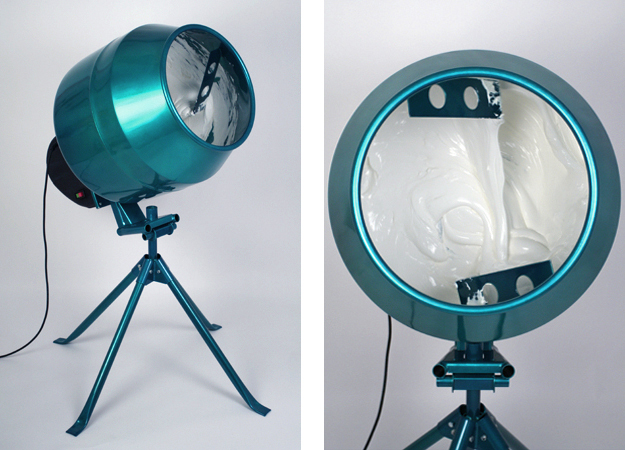
Work by artist Blue Curry using a customised cement mixer filled with sun cream for the 6th Liverpool Biennial.

This is emphatically different from the work contemporary art that I am interested in following and learning more about.  It’s work that surprises me when I see it because I have not seen the formula before.  Maybe I understand its reflection or its sentiment, not because I am already familiar with the particular image/performance/sound/installation/still or moving image but because it has a curious nature about it which resonates with my own inquiring mind.  I respond to this work at a visceral and an intellectual level – the work becomes an experience.  And it doesn’t happen often.

When we view the painting of Bottom Bay by English artist, Steve Bonner, those of us who have been to Bottom Bay on the east coast of Barbados, will recognize the rocky coastline and the wide expanse of beach.  Some might like this image because it’s familiar or because it evokes a fond memory even though it does not offer a new perspective on our reading of the beach.

Staying with the beach theme, we might view the subversive artwork by Blue Curry, a London based Bahamian artist, which was recently shown at the 6th Liverpool Biennial.

This installation uses an aquamarine coloured, customized cement mixer filled with twenty litres of sun cream.  The strong scent of the sun cream elicits memories of a tropical beach and relaxed moments of lying in the sun.   On closer examination, we understand that our tropical fantasy has been high-jacked and turned into a humorous even if frightening reflection on a region built as a playground for people from somewhere else, churning out all-inclusive, hedonistic getaways that local Caribbean people work at but don’t leisure in.

Both of these works were made in the same decade – Steven Bonner’s aged representation of a Caribbean seascape was painted in 2009, and Blue Curry’s satirical interpretation of tropical paradise was conceived and manufactured in 2010.  Although both art pieces were produced in a similar time about a similar space, they could not be further apart.  My sense is that a contemporary art museum might want to acquire only one of these works.  Which one do you think that may be?

Musing from the Milking Parlour – Sustainability and the Visual Arts

March 2011 Article for Barbados Today

Annalee Davis

Is living and working in the Caribbean as a contemporary visual artist a viable aspiration?  How is it possible to maintain the integrity of your practice while being economically viable?  Although not unfeasible, it’s quite an accomplishment if you can. And although this is a challenge for most contemporary artists all over the world, it is a small wonder that we still have practitioners in the Anglophone Caribbean who continue to make their work despite the difficult terrain. More importantly, why is this the case?

Charles Avery, Facets of Infinity

Contemporary visual artists who live in cities where there is an infrastructure to nurture the arts can access networks which make it possible to sustain production, find support in intellectual circles and earn a living.  It’s not easy anywhere to function exclusively as a Visual Artist, and more often than not, it’s fiercely competitive.  Comparatively, it’s very difficult in the Anglophone Caribbean because we don’t have branded (i) galleries, (ii) dealers, (iii) collectors (iv) prizes (v) fairs (vi) MFA or PhD degree programmes in the Visual Arts (vii) curators (viii) critics (ix) residencies, or (x) auction houses.

There are stamps of approval or markers that denote value in every field.  For example, a Mercedes Benz car or Luis Vuitton bag denotes worth. It’s the same in the world of contemporary art.  There is recognition, respect and added financial value for your work, if, for example, you’ve won a Guggenheim Grant, the Turner Prize or if your work is in a major private or corporate collection, such as the Charles Saatchi or JPMorgan Chase corporate collection.

Imagine if Rihanna, the global icon as we know her, stayed in Barbados.  How successful would she have been?  Her name would not be the household word it is today.  We have chosen not to develop or support excellence…we are more interested in maintaining a democratic approach towards the arts…Crop Over keeps us happy.  But if you’ve won Pic o’de Crop nine times…where do you go next?  You’ve hit the glass ceiling.

Rihanna on the Red Carpet at the Grammys in 2010

I draw these references because the readership will be more familiar with Red Plastic Bag and Rihanna than they will be with the world of contemporary visual art…but I want to draw a comparison with the ‘glass ceiling’ problem.  The National Cultural Foundation is interested in development – to a certain level – and the Festival experience.  But there is no existing state institution with the vision to take the talent any further and put it on the world stage.  Many of my colleagues in the region have been building impressive resumes over the past two decades and showing work internationally, but ask them if their work sells?

Dr. Keith Nurse spoke about “Cultural Policy and Cultural Industries” at a forum held on February 25th at UWI, Cave Hill campus.  He outlined that even though the world has changed, the Caribbean still functions as though it’s in the industrial era.  He gave the example of the sugar industry – the conceptualization and development of which happened in Europe, leaving us to provide the labour.  But the world has changed and now, for the first time, we are supposed to develop our concepts and take them to market.  This requires a paradigmatic shift for which the region has not been prepared – to manage our own company, on every level, and to go global is a daunting task.  The alternative, he suggests, is underdevelopment.

It is not that we lack the raw material, the intelligence, or the ability.  We simply have not been coached throughout our history to be anything other than labourers in the agricultural field and more recently how to work in the service industry in hotels. We are not taught to build our own chain of hotels, but to make up the bed in someone else’s hotel chain.

It’s the same in the contemporary visual arts arena.  There is endless talent and out put, nourished largely by an active regional informal network.  Sadly, the formal institutions function, as Dr. Nurse says, in an outdated way and have not kept abreast of the needs of the practitioners. I have become interested in figuring out what needs to be done to change the landscape.  What if a regional entity like the Caribbean Development Bank hired a curator and developed an outstanding regional collection of work?  Or corporate Caribbean bodies chose to build collections. Even the Embassy of the USA has a collection of work by artists from the Caribbean.  This is not a new idea. Deutsche Bank began acquiring work since 1978 and has one of the most comprehensive corporate art collections in the world boasting 55,000 photographs, drawings and prints worldwide.  The bank’s aim is” to support living artists, benefit local communities and create an energized work environment.”  The Deutsche Bank’s mandate is not about acquiring art for investment purposes, “rather, the primary objective is to display quality works that embrace and reflect their time.” 1.

 Now that’s refreshing!

End notes

  1. http://www.db.com/us/content/en/1097.html

“Musings from the Milking Parlour Studio” for Barbados Today

Annalee Davis.  February 2011

Tonya Wiles and Ebony Patterson (Jamaica/USA) Wrestling with the Image (Photographer – Nadia Huggins)

This monthly column will look at the practice of contemporary art from the Caribbean and examine issues surrounding the production and projection of the work into a wider arena. When considering the Caribbean, I think not only of the archipelago situated in the belly of the Americas but my mind travels across the Atlantic Ocean to other Caribbean spaces in Miami, Brooklyn, Toronto, Brixton, Amsterdam and further afar – the result of globalisation which began here centuries ago when the world came to shape plantation economies.

The link between the Internet and Artist Led Initiatives

Now, we experience globalization virtually.  The internet has opened up worlds of possibilities – significant for visual artists by facilitating the building of artist associations, allowing artists to access opportunities and function independently, and expanding awareness of work from the Caribbean.  This virtual gateway has become crucial since the feeble nature of the region’s formal art institutions has given rise to artist led initiatives orchestrated by very active visual artists who are reshaping the face of our art world.  Weary of a lack of acknowledgement or the formal institutional support required to take the visual arts into the 21st century, Caribbean practitioners have been renovating from the ground up by making refreshing work with breadth, depth and vitality while inventing constructive critical spaces to buttress their production.  Importantly, researchers are increasingly studying and writing about contemporary practice

Sheena Rose & Pauline Marcelle (Dominica/Austria) – Wrestling with the Image (Photographer – Nadia Huggins)

enriching the analysis of the work being produced.

These artist-led initiatives are exposing contemporary art to a wider domain. At this time, several Barbadians are participating in regional and international pursuits, expanding the latitude of contemporary art production nurtured by a south-south circuitry, vitally sustained by the informal networks.  For this first entry of Musings, I have chosen to highlight the current projection of Bajan artists.

The Reach of  Barbadian Artists

Global Caribbean began in Miami at Art Basel in December 2009 and in March 2010 was supported with the conference “Global Caribbean: Interrogating the Politics of Location in Literature and Culture”.  The exhibition was curated by Miami based Haitian artist, Edouard Duval-Carrie. http://theglobalcaribbean.org/about.php The three-day symposium included artists, writers, curators and academics discussing the Caribbean and its diaspora in relation to political, social and cultural issues. Canadian based, Barbadian, Joscelyn Gardner, (www.joscelyngardner.com) exhibited her work and was a keynote speaker in the symposium. The exhibition then moved to France and is now at the Museo de Arte Contemporaneo de Puerto Rico.  Joscelyn also has a solo exhibition at Adhoc Galleria in Spain, called “Tending to an “unspeakable” past”.   She recently collaborated on the Art Connections Residency Programme that brought together emerging Canadian and Barbadian artists who worked in Barbados throughout January.  Noteworthy, her print work was included in British author, Richard Noyce’s newly published book, “Critical Mass: Printmaking Beyond the Edge”.

Joscelyn Gardner , Marcel Pinas (Suriname) & Rodell Warner (Trinidad) – Wrestling with the Image (Photographer – Nadia Huggins)

Along with Gardner, three other Barbadian artists are currently showing work in an exhibition which opened in late January at the Art Museum of the Americas in Washington DC and includes works by Ewan Atkinson, www.ewanatkinson.com  Tonya Wiles and Sheena Rose.  Curated by Trinidad based visual artist and writer, Christopher Cozier, and art historian, Tatiana Flores; “Wrestling with the Image” exposes pieces by artists from twelve Caribbean countries.  The exhibition catalogue can be downloaded here at: http://www.artzpub.com/content/special-publications/wrestling-image

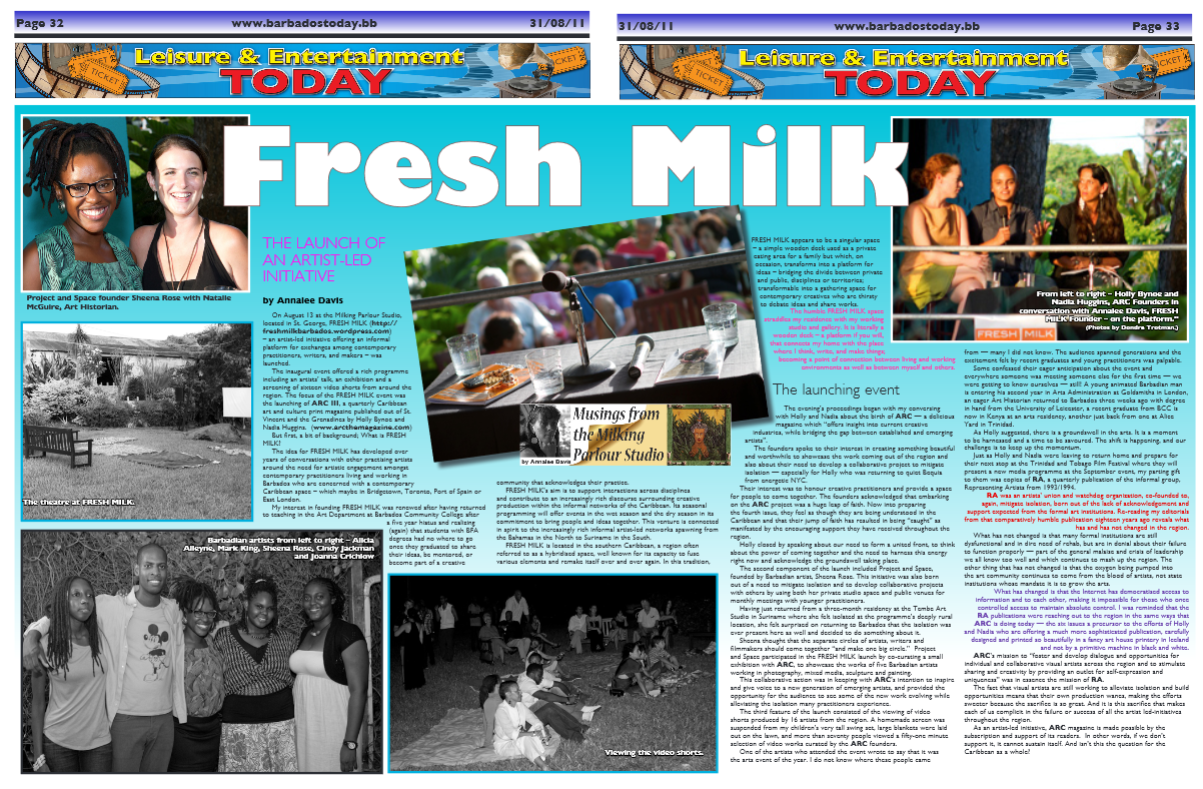
Shortly after “Wrestling” opened, Sheena Rose http://sroseart.tumblr.com/ travelled to Suriname to start her three-month residency at the Tembe Art Studio to work alongside two other artists from New York and The Netherlands.  Brainchild of Surinamese artist Marcel Pinas, the residency is part of his recently founded Kibii Foundation which includes an art park and art education centre housed in an old hospital building.   Tembe Art Studio advances the use of art and culture to positively influence the life and future of the local Maroon people.  Resident artists are required to build an installation for the park situated in the rural town, Moengo.  Sheena’s is a billboard project inspired by how local stores paint items for sale on the shop walls.  An article on Sheena’s work has been included in the current, inaugural issue of ARC – a quarterly Caribbean Art and Culture print and e-magazine, published by artists Holly Bynoe (St. Vincent/New York) and Nadia Huggins (St. Vincent/St. Lucia).  ARC was recently launched in New York, St. Lucia and St. Vincent and will soon become available in Barbados. http://www .arcthemag azine.com

The south-south web that has shaped the informal artist network continues to be successful because it has along-term vision based on solid, local foundations of inter-personal relationships among many practitioners.  These are dynamic times.  Stay tuned.

Annalee Davis is a visual artist who lives and works in Barbados.

Joscelyn Gardner – Global Caribbean, Puerto Rico – Image courtesy of the artist

Ewan Atkinson – Wrestling with the Image, (Photographer – Nadia Huggins)