Fresh Milk and the IBB Present: Creatives in Conversation


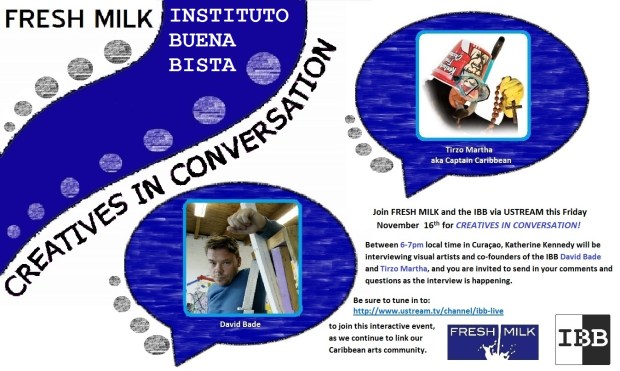
Remember to tune in to http://www.ustream.tv/channel/ibb-live  tonight at 6pm local time in Curaçao to watch CREATIVES IN CONVERSATION, an interactive Ustream interview with visual artists and co-founders of the Instituto Buena Bista (IBB) David Bade and Tirzo Martha.

This project, conceptualized by Barbadian art historian Natalie McGuire, recognises the internet as a medium where people in the Caribbean have been able to research what is happening regionally in the arts, but wants to take it a step further and proactively make the internet a space for critical dialogue and exchange.

Barbadian artist Katherine Kennedy will be representing FRESH MILK, interviewing visual artists and co-founders of the IBB David Bade and Tirzo Martha at the IBB in Curaçao, and you are invited to send in your comments and questions as the interview is occurring.

Be sure to tune in and be a part of this event, as we continue to link our Caribbean arts community.

Alberta Whittle Blogs about her Residency with FRESH MILK

Take a look at Alberta Whittle’s blog about her residency with FRESH MILK! Get some insight into her concepts so far, as she prepares for a performance at the upcoming event FRESH MILK IX on November 29th, 7pm.

‘Since I started the residency programme at Fresh Milk, I have been researching the relationships between hypermasculine, hyperfeminine and homoerotic imagery within Hip Hop/Dancehall culture, focusing on dress, body modification, costume and styling. Researching the emergence of new models of personhood, I want to investigate the complex signifiers for  contemporary sexuality.’ – Alberta Whittle

Follow her blog at http://albertawhittlenavigation.blogspot.com/

FRESH MILK at the IBB: Blog Post II

It’s been a very busy week at the IBB in Curaçao!

This Tuesday I had my first interview for FRESH MILK’s Satellite Programme, with the help of IBB students Tamika Lont, who is assisting me and taking notes on the project, Rashid Pieter and Friefabian Plantijn, who are both filming and editing the interview footage. I spoke with art historian and curator Jennifer Smit, who was born and raised in Curaçao, and has been instrumental in the advancement of the contemporary art scene. She curated the pivotal exhibition  Arte ’99 in Curaçao, co-founded  the ArteSwa foundation in 2004, and curated the show Antepasado di futuro in 2010, which also marked Curaçao becoming an autonomous country within the Kingdom. It was a privilege to be able to discuss her views on the art scene  locally and regionally, and especially her passionate views on how important it is for us to recognize ourselves as being from the Caribbean, no matter what island we are from, and to collaborate and come together through the arts to celebrate this connection – especially as there is no governmental framework for this, and it is an initiative pioneered by the artists and creatives themselves. It was a fantastic way to begin the interview process.

On Wednesday, Tamika, Rashid, Fabian and I traveled to the studio of Dutch artist Herman van Bergen, who has lived and worked in Curaçao since 1989. He was also fascinating to speak with, from hearing his story about traveling to the Caribbean because he met a beautiful girl, to also falling in love with the environment and way of life he found when he moved to Curaçao.  He has been inspired by the landscape he found here in contrast to Europe, which he appreciated through his art as, but the environment and landscape also have also been a double edged sword in his work. His current materials of choice are thorns which grow all over the island called Acacia Tortuosa, which began to cover the island after colonialism when all the native trees were cut down to build slave ships. He referred to human beings as ‘the thorns of the world,’ and described the thorns as mother nature’s way of fighting against the horrors humans force her to witness, from slavery to the wars that wage today. We even got the first glimpse of the piece he is currently working on, a tremendous work called ‘Cathedral of Thorns’ which will be an entire labyrinth constructed of Acacia Tortuosa, lit up through the walls to cast breathtaking shadows on the viewers as they actually move through the piece. In the center there will be a space for other artists to exhibit as well. This makes the work very interactive and community based – which factored into our discussion about coming together as artists to create and grow together in the region.

Thursday we visited the curator at the Landhuis Bloemhof, Nicole Henriquez. The gallery was officially opened under the name Bloemhof in 2002, and is dedicated to Nicole’s parents May and Max Henriquez; the studio of May Henriquez is also a permanent exhibition of the gallery, and we were lucky enough to be shown her sculptor studio and her work by Nicole, who inherited her love of the arts from her mother. During our tour of the studio space, she told us she insisted on keeping the same walls where her mother had done sketches before creating her work, even after the renovations that took place. We also spoke about the current exhibition in the gallery, which is of photographs of spaces that existed in Curaçao in the 70s called High Flying Parks; areas where the youth of the island would come, hang out and make their own – a kind of community artwork in itself. We also discussed the idea of community from the perspective of other Caribbean islands – not only the need for it, but also touched on the difficulties concerning travel and transport of works from island to island. She mentioned visiting the exhibition Caribbean: Crossroads of the World in New York, and that she thought it was beautiful to see work from throughout the region together in this way.

My last interview of the week was back at the IBB, this time in the studio space of the current local artist in residence, Ailsa Anastatia. In addition to her own practice, Ailsa is an art teacher at a secondary school, and we talked about the difficulties involved with balancing your own work with the responsibilities of being an educator. Having loved the arts her entire life, she finds a way to strike that balance, even if it involves working through vacations, because it part of who she is. It is also why initiatives like the IBB become important not only for the students, but for the arts in Curaçao on the whole – although she is primarily a painter, Ailsa will also be experimenting with three dimensional work during her residency, because she has the space, materials and time set aside to develop her practice, which is crucial for all artists; but sadly not something many Caribbean practitioners often have locally. Ailsa also participated in a residency in Holland, which was also an opportunity for her to develop her practice and connect with other artists, but has not traveled regionally in the arts as much as she would like; it is something she would love to do, and she is also supportive of the mission FRESH MILK is striving for with the IBB to bring the arts network closer.

It has been a long week – but a fruitful one, with so many stimulating conversations to be inspired by. Meeting the artistic figures here on Curaçao, as well as getting to know my way around the studios of the IBB and the staff and students here has been great so far, and I look forward to what next week will bring – especially now that Holly Bynoe has arrived, and will begin her new media Master Class titled The Five Obstructions  starting Monday!

Katherine Kennedy
FRESH MILK at the IBB: Blog Post I

On Friday, November 2nd, I was thrilled to finally be on my way to Curacao, where I am taking part in a collaborative project with the Instituto Buena Bista (IBB) on behalf of FRESH MILK. After two flights (and two security searches!), it was lovely to be greeted so warmly and enthusiastically by David Bade, visual artist and co-founder of the IBB – especially with the news that his fellow founder and artist Tirzo Martha had just become a father! From the airport, we traveled straight to the IBB headquarters, which is on the same compound as Klinika Capriles, a psychiatric clinic with which the IBB has a relationship. Some past students have been patients of the clinic, and some patients, while not being full-time students, still visit the studios and become involved. This itself can be a kind of art therapy, as it gives the patients an outlet for their thoughts and emotions, and a change of pace from their routine at the clinic.

Hearing David speak about this aspect of the IBB while he gave me a tour around the premises was an inspirational experience, as he and the IBB team are obviously very passionate about what they do, not only for the young students – with the mission to equip them with the tools they need to go on to further artistic studies as well as showing them viable outlets for their talents in the professional world – but to make a difference in society through the engagement with the clinic. In this way, the IBB becomes more than just an art school or a space to hold exhibitions; it is an ongoing vehicle for social change through the arts.

To this end, I also met Dutch artist Erik Habets, who is the current resident artist at the IBB, and my housemate during my stay. Alongside his own work, he is also very involved with the students, and is at present working with them to create a wooden installation in the courtyard of one of the long-stay wards of the clinic. This interaction between Erik and the students, combined with the curiosity and interest the patients had in this new hive of activity in their life, was a very moving sight, and highly indicative of the whole dynamic at the IBB; one of sharing, inspiring and supporting through open expression in the arts.

David then took me to the IBB Residency House, where I met Erik’s wife Marijn, and settled in. Erik and Marijn took me out to dinner that night, and I am so grateful to both them and David for making me feel welcome in Curacao. This continued into the weekend, when Erik, Marijn and I had a barbecue in our garden on Saturday, and on Sunday David took me for a drive around the island, briefly showing me the town and some places of interest (including the former sites of the IBB). Something I found fascinating about the island so far is how familiar, yet unfamiliar it feels; having never visited the Netherlands Antilles, I did not know what to expect. The distinctive Dutch architecture of some buildings made it feel like a different world, but then there were some areas we drove through, where people were ‘liming’ by what I would compare to Bajan rum shops – which of course is a typical part of the landscape I am used to at home. These kinds of differences were not only interesting for me as a spectator, but relate to the tension David mentioned is very much a part of the culture in Curacao, with their relationship to the Netherlands and the impact on Caribbean identity. I hope to get the chance soon to walk around the town and get to know it further – as well as take some pictures for you!

Today I was back at the IBB, where I discussed my segment of the residency in more detail. David gave me his input, and a list of key figures in the Curacao art scene to begin contacting to arrange interviews with. Tomorrow I will conduct the first interview, with art historian Jennifer Smit, who will visit the IBB headquarters. On Wednesday I will travel to the studio of visual artist Herman van Bergen. The last confirmed interview so far will happen on Thursday, with curator and director at the Bloemhof Gallery, Nicole Henriquez. These will be filmed and edited by two students at the IBB, and shared with you soon. Anxious to see what will come of these conversations! Also looking forward to the arrival of Holly Bynoe this Wednesday, after her unfortunate delay being stranded in New York during hurricane Sandy. We are all extremely relieved and thankful you are safely back in the Caribbean, Holly – and can’t wait for you to land in Curacao!

Look out for more updates and pictures from me soon!

Katherine Kennedy