Musings from the Milking Parlour Studio: The Launch of FRESH MILK – an artist led initiative in Barbados

For Barbados Today August 2011 

Annalee Davis

Photos Credit – Dondre Trotman   “The FRESH MILK platform”

Photos Credit – Dondre Trotman “The FRESH MILK platform”

On August 13th at the Milking Parlour Studio located in St. George, FRESH MILK, (www.freshmilkbarbados.com/) an artist led initiative offering an informal platform for exchanges among contemporary practitioners, writers and makers; was launched.  The inaugural event offered a rich programme including an artists’ talk, an exhibition and a screening of sixteen video shorts from around the region.  The focus of the FRESH MILK event was the launching of ARC III, a quarterly Caribbean art and culture print magazine published out of St. Vincent and the Grenadines by Holly Bynoe and Nadia Huggins.  (www.arcthemagazine.com)

But first, a bit of background – what is FRESH MILK?

The idea for FRESH MILK has developed over years of conversations with other practicing artists around the need for artistic engagement amongst contemporary practitioners living and working in Barbados who are concerned with a contemporary Caribbean space – which maybe in Bridgetown, Toronto, Port of Spain or East London.  My interest in founding FRESH MILK was renewed after having returned to teaching in the art department at BCC after a five year hiatus and realizing (again) that students with BFA degrees had no where to go once they graduated to share their ideas, be mentored or become part of a creative community that acknowledges their practice.

FRESH MILK’s aim is to support interactions across disciplines and contribute to an increasingly rich discourse surrounding creative production within the informal networks of the Caribbean.  Its seasonal programming will offer events in the Wet Season and the Dry Season in its commitment to bring people and ideas together.  This venture is connected in spirit to the increasingly rich informal artist-led networks spawning from the Bahamas in the North to Suriname in the South.

FRESH MILK is located in the Southern Caribbean, a region often referred to as a hybridized space, well known for its capacity to fuse various elements and remake itself over and over again.  In this tradition, FRESH MILK appears to be a singular space – a simple wooden deck used as a private eating area for a family but which on occasion transforms into a platform for ideas – bridging the divide between private and public, disciplines or territories; transformable into a gathering space for contemporary creatives who are thirsty to debate ideas and share works.

The humble FRESH MILK space straddles my residence with my working studio and gallery.  It is literally a wooden deck – a platform if you will, that connects my home with the place where I think, write, and make things; becoming a point of connection between living and working environments as well as between myself and others.

THE EVENT THAT LAUNCHED FRESH MILK

The evening’s proceedings began with my conversing with Holly and Nadia about the birth of ARC – a delicious magazine which “offers insight into current creative industries, while bridging the gap between established and emerging artists.”[i]  The founders spoke to their interest in creating something beautiful and worthwhile to showcase the work coming out of the region and also about their need to develop a collaborative project to mitigate isolation – especially for Holly who was returning to quiet Bequia from energetic NYC.  Their interest was to honour creative practitioners and provide a space for people to come together.  The founders acknowledged that embarking on the ARC project was a huge leap of faith.  Now into preparing the fourth issue, they feel as though they are being understood in the Caribbean and that their jump of faith has resulted in being ‘caught’ as manifested by the encouraging support they have received throughout the region.  Holly closed by speaking about our need to form a united front, to think about the power of coming together and the need to harness this energy right now and acknowledge the groundswell taking place.
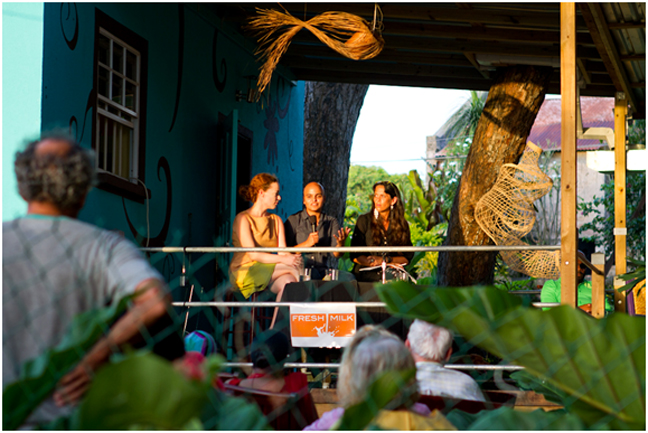
Photo Credit – Dondre Trotman. From left to right – Holly Bynoe and Nadia Huggins, ARC Founders in conversation with Annalee Davis, FRESH MILK Founder – on the platform.”

The second component of the launch included Project and Space, founded by Barbadian artist, Sheena Rose.  This initiative was also born out of a need to mitigate isolation and to develop collaborative projects with others by using both her private studio space and public venues for monthly meetings with younger practitioners.  Having just returned from a three-month residency at the Tembe Art Studio in Suriname where she felt isolated at the programme’s deeply rural location, she felt surprised on returning to Barbados that the isolation was ever present here as well and decided to do something about it.  Sheena thought that the separate circles of artists, writers and filmmakers should come together “and make one big circle.”  Project and Space participated in the Fresh Milk launch by co-curating a small exhibition with ARC, to showcase the works of five Barbadian artists working in photography, mixed media, sculpture and painting.  This collaborative action was in keeping with ARC’s intention to inspire and give voice to a new generation of emerging artists, and provided the opportunity for the audience to see some of the new work evolving while alleviating the isolation many practitioners experience.

Photo Credit – Dondre Trotman. Sheena Rose, Project and Space Founder with Natalie McGuire, Art Historian
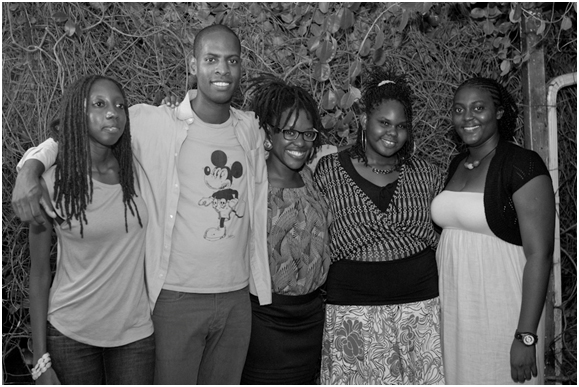
Photo Credit – Dondre Trotman. Barbadian artists from left to right – Alicia Alleyne, Mark King, Sheena Rose, Cindy Jackman and Joanna Crichlow

The third feature of the launch consisted of the viewing of video shorts produced by sixteen artists from the region.  A home made screen was suspended from my children’s very tall swing set, large blankets were laid out on the lawn, and more than seventy people viewed a fifty-one minute selection of video works curated by the ARC founders.

Photo Credit – Dondre Trotman. “The Theatre at FRESH MILK”

One of the artists who attended the event wrote to say that it was the arts event of the year.  I do not know where these people came from…many I did not know.  The audience spanned generations and the excitement felt by recent graduates and young practitioners was palpable.  Some confessed their eager anticipation about the event and everywhere someone was meeting someone else for the first time….we were getting to know ourselves….still!  A young animated Barbadian man is entering his second year in Arts Administration at Goldsmiths in London, an eager Art Historian returned to Barbados three weeks ago with degree in hand from the University of Leicester, a recent graduate from BCC is now in Kenya at an arts residency, another just back from one at Alice Yard in Trinidad.

As Holly suggested, there is a groundswell in the arts.  It is a moment to be harnessed and a time to be savored.  The shift is happening, and our challenge is to keep up the momentum.
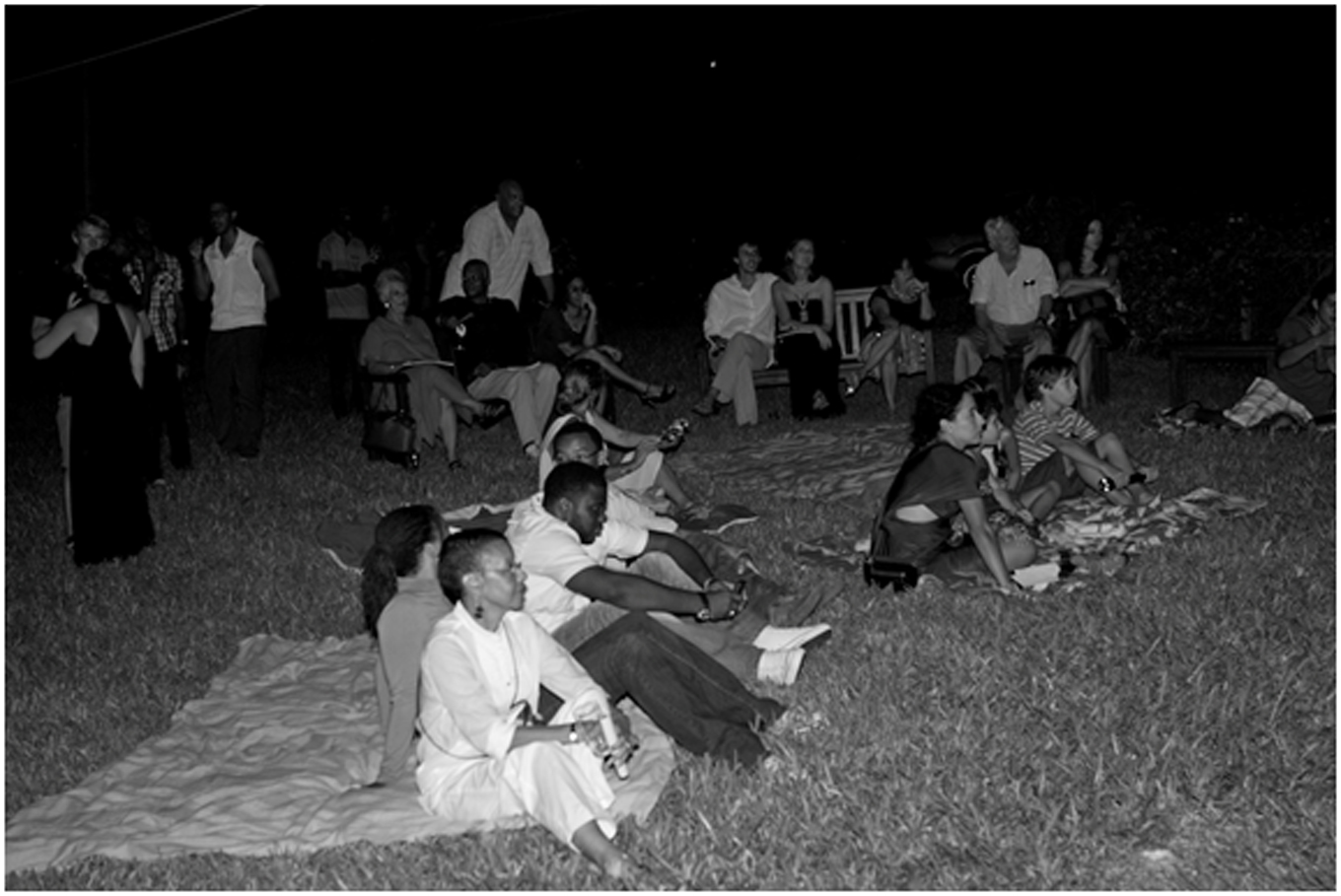
Photo Credit – Dondre Trotman – Viewing the Video Shorts

Just as Holly and Nadia were leaving to return home and prepare for their next stop at the Trinidad and Tobago Film Festival where they will present a new media programme at this September event, my parting gift to them was copies of RA, a quarterly publication of the informal group, Representing Artists from 1993/1994.  RA was an artists’ union and watchdog organization, co-founded to, again, mitigate isolation, born out of the lack of acknowledgement and support expected from the formal art institutions.  Re-reading my editorials from that comparatively humble publication eighteen years ago reveals what has and has not changed in the region.  What has not changed is that many formal institutions are still dysfunctional and in dire need of rehab but are in denial about their failure to function properly….part of the general malaise and crisis of leadership we all know too well and which continues to mash up the region. The other thing that has not changed is that the oxygen being pumped into the art community continues to come from the blood of artists – not state institutions whose mandate it is to grow the arts.

What has changed is that the internet has democratized access to information and to each other, making it impossible for those who once controlled access to maintain absolute control.  I was reminded that the RA publications were reaching out to the region in the same ways that ARC is doing today…the six issues a precursor to the efforts of Holly and Nadia who are offering a much more sophisticated publication, carefully designed and printed so beautifully in a fancy art house printery in Iceland and not by a primitive machine in black and white.  ARC’s mission to “foster and develop dialogue and opportunities for individual and collaborative visual artists across the region and to stimulate sharing and creativity by providing an outlet for self-expression and uniqueness” was in essence the mission of RA.

The fact that visual artists are still working to alleviate isolation and build opportunities means that their own production wanes, making the efforts sweeter because the sacrifice is so great.  And it is this sacrifice that makes each of us complicit in the failure or success of all the artist led-initiatives throughout the region.  As an artist-led initiative, ARC magazine is made possible by the subscription and support of its readers.  In other words, if we don’t support it, it cannot sustain itself.  And isn’t this the question for the Caribbean as a whole?


Musings from the Milking Parlour Studio – Come Out Tings – Barbados Community College’s BFA Studio Arts 2011 Portfolio Exhibition

May 2011 Article – Barbados Today

Annalee Davis

On May 5th, nine Studio Arts BFA students celebrated the opening of their exhibition at the Morningside

Melissa Mings

Gallery at the BCC. Senior Tutor, Allison Thompson noted in her message in the catalogue, “As a centre of learning that focuses on both Visual and Performing arts, the Division nurtures, develops and showcases the future of cultural production in the region.”

I am interested in how we get to the “future of cultural production in the region.”  The future for art graduates anywhere in the world is challenging and in the Caribbean it is even more so. Many BCC graduates spend more time decorating windows in retail outlets, making jewelry or teaching at primary or secondary school rather than making art.  Very few get signed onto a gallery, produce work full time, exhibit locally, regionally and internationally, and make a living off the sale of their works? This begs the question, what happens after the lights are turned off at Portfolio 2011

The Principal’s catalogue message gives much food for thought.  Dr. Best states that there is “currently much emphasis on the development of the cultural industries in Barbados” and “due to the dedication of students and staff in the various programmes that the quality of visual and performing arts in Barbados has improved in immeasurable terms to the point where these are recognized as fields in which careers may be built.” Do we even know how art careers are built?  There are persons (consultants, advisors, technocrats, experts, directors etc) who build their careers around the arts in this country, but it’s not the artists.

Yvan Jules, Rommel Chase & Ireka Jelani

Let’s begin with the BCC programme – the engine that shapes the young artists. I asked Ms. Thompson what the programme lacks.  She said “we need funds for the day-to-day running of the programme and maintenance of the physical plant.  The dance programme is located off campus.  The Performance Hall needs major repairs but has always been completely inadequate. We need a serious performance hall that can seat a minimum of 200 people. We rent tents and have people sit outside in the sun and rain to watch our performances.  We have to fight for chemicals for printmaking and photography.  We don’t have enough cameras.  We should have internet access in our classrooms. We need more classrooms.”

As someone who has recently started back teaching at the College, I am also aware that the library is not up to par.

In terms of the emphasis on the development of the cultural industries, the reality on the ground is that we are a ‘developed’ nation without a National Gallery of Art and the cultural industries legislation is yet to be passed. There is nowhere for artists to display experimental, unconventional works that push the

Alicia Daniel

boundaries of artistic practice.

Does the BCC, for example, have a collection of art, based on the regular acquisition of work from their graduating students?  How do we measure growth in the cultural industries?  Where is this immeasurable improvement that the Principal makes reference to?

Dr. Best suggests that the Portfolio ‘is arguably the most important exhibition and provides the base for the initial exposure and growth in confidence for graduates.”  The five-year journey for the art students is undeniably important in terms of their own personal growth and development.  That is clear.  My concern is what happens next. Where do these students go once they leave the nest of BCC?

Simone Padmore and Ireka Jelani

Dr. Best goes onto to write that ‘as more emphasis is placed on the development of the cultural industries we would likely see the names of the exhibitors in Portfolio 2011 featured because these students and their tutors will drive the growth of the industries.” The BCC is training artists and ushering them into the society – but does that mean that the cultural industry is growing in the way that these students or professional artists need? Which of the readers of this article have come or will come out to the see the show and when is the last time any of you bought a work of art?  Without visibility and without sales, there is no awareness of the production, no insight into the creative research being advanced by the practitioners and no growth – intellectually or economically.

Andrea Cumberbatch and Ireka Jelani

Andrea Cumberbatch and Ireka Jelani

All throughout the Anglophone Caribbean, the only oxygen keeping the visual arts alive, comes from the informal networks – the non-funded, independent artists and collectives, who at great personal costs, keep on keeping on.  Which leads to a positive note –  at the Portfolio 2011 opening, the Lesley’s Legacy Foundation – an informal initiative, gave the inaugural cash award of $500.00 to Ireka Jelani, the BFA student with the highest GPA.  The Division supports this award by offering the graduate the opportunity to hold a solo exhibition in the Morningside Gallery in the next 12-24 months. I challenge the BCC to contribute to this support and to the growth of the cultural industry by initiating the college’s own art collection by acquiring works every year from the Portfolio.  This will expand awareness of the cultural industry, contribute to an enriched cultural space and economic growth; and by extension, sustainable livelihoods for cultural producers.

Joanna Crichlow

Come Out Tings – Portfolio 2011 runs until Monday May 16th daily from 9am – 8pm.  Come out and see the show. Students are on hand to give you a tour. Purchase a catalogue for $5.00 which helps cover the costs of producing and printing the catalogue.  Acquire a work of art from the students – the 10% commission goes to running the Gallery.  Proceeds from the raffle of Ras Akyem-i’s limited edition lithograph go to the Creation Foundation which hopes to establish a scholarship for Graduate Studies in Art for graduates of BCC.

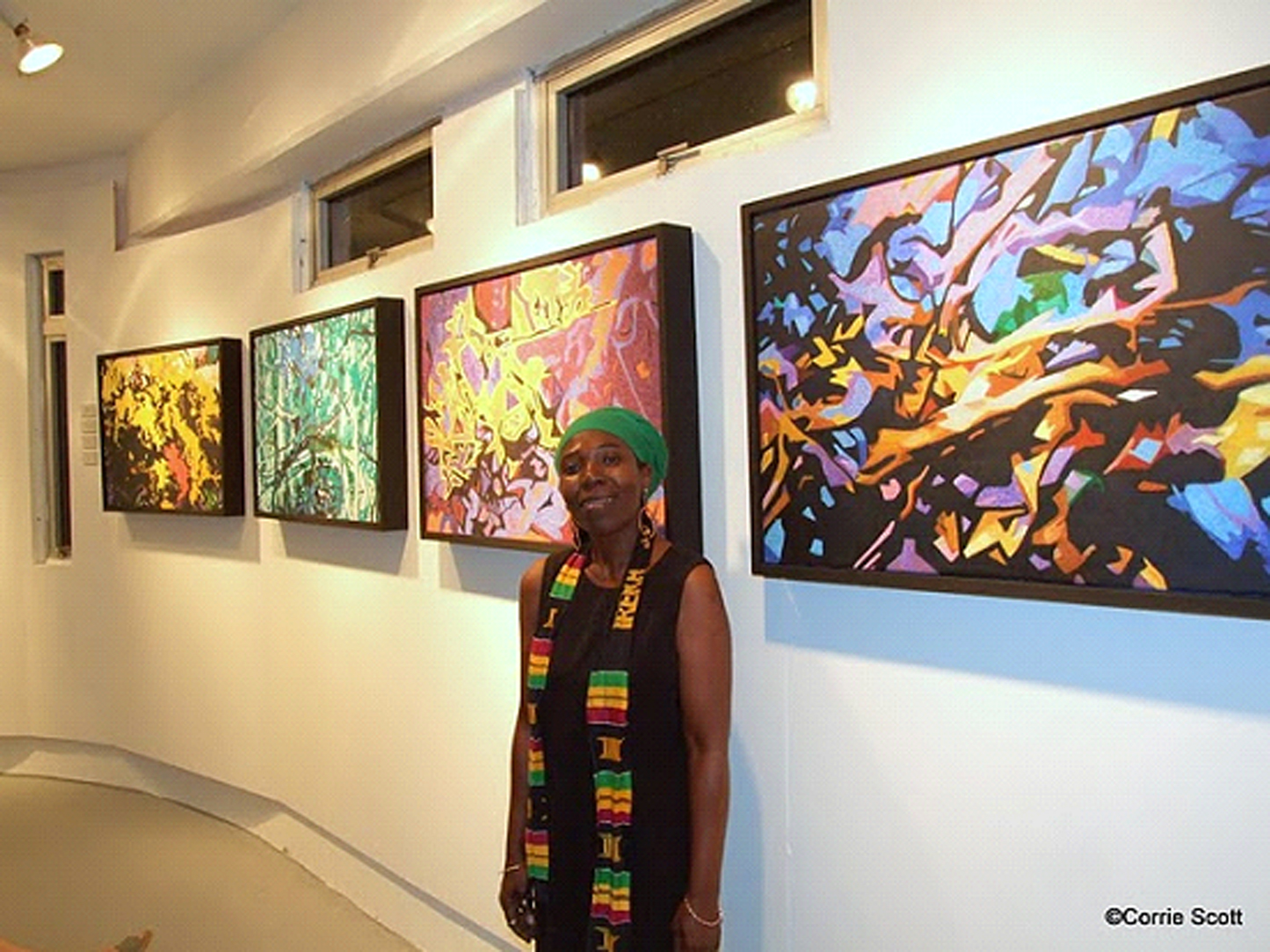
Photo credits – I gratefully acknowledge Corrie Scott who has kindly allowed me to use her photos of Come Out Tings. http://www.corriescott.net

Yvan Jules & Ireka Jelani

Ireka Jelani – Winner of the Lesley’s Legacy Foundation Award

Musings from the Milking Parlour Studio: What is contemporary art?

by Annalee Davis

April Article

A reader of my last article expressed confusion over the term contemporary art.  She wondered how it was that Joscelyn Gardner, (www.joscelyngardner.com) could be considered a contemporary artist even though she is working within the old tradition of lithography using stone.

Joscelyn Gardner, Mimosapudica (Yabba) Hand coloured Lithograph 2010

The use of the word ‘contemporary’ is confusing because it can suggest that all art made now is contemporary art.  But this is not the case.  The term ‘contemporary art’ has become a catch all phrase suggesting that there aren’t other movements happening and that all work produced conforms to some commonly understood manifesto.   The reality is more layered and the term ‘contemporary art’ both does and does not make things clear.

So what’s considered contemporary art?

I schooled in the USA in the eighties.  Although the work being produced at that time falls into what we still call ‘contemporary art’, there were many different kinds of work being produced at that time.  I spent weekends traveling mostly to NYC, as well as to Philadelphia, and Washington DC where I saw Appropriation Art, Video Installation Art, Graffiti Art, Postmodern Art, and Institutional Critique among other types of contemporary art.  The education I received visiting museums and galleries was supported by interacting with tutors who were very successful as contemporary visual artists, including Martha Rossler, Emma Amos and Leon Golub.  In addition we attended the MFA visiting artist class and were exposed to visiting luminaries such as Hans Haacke and Adrian Piper.

Since my return to the Caribbean throughout the nineties and the noughties I have witnessed the advent internationally of Internet Art, Digital Art, New Media Art, Information Art and the rise of the Young British Artists and more recently VJ Art, Videogame Art, Virtual Art and Relational Art, among others.

Does contemporary art include all of the above? Yes.  Does it include everything else being produced by all artists, everywhere, at the same time? No.  So what’s the difference?

Bottom Bay – Painting by Steve Bonner

Many museums of contemporary art state that their collections include works made after the second world war. In addition, one of the defining characteristics is that contemporary art refers to works that offer something new in terms of their ideas and/or technical manifestation.  In other words, there’s something unexpected and innovative conceptually and/or technically; the work makes us notice something in a fresh way.  In response to my reader’s question, contemporary artist Joscelyn Gardner uses the ancient art of stone lithography in a subversive way to explore her identity as a (white) Creole Caribbean woman, with a novel twist to the labour intensive medium she employs as a white woman visually acknowledging the historical toil of black female workers.

Contemporary Art in the Caribbean

There are many people in the Caribbean making artistic things at this particular moment in time, many of which are displayed in scores of art galleries throughout the islands.  This often includes watercolours and acrylic or oil paintings that portray the flora, fauna, land and seascapes and portraits of people in ways that may (or may not) stress the technical virtuosity of the practitioner.  Buyers of this work may enjoy the technical proficiency and beauty of these pictures.  Or, sometimes the images rendered are reminders of a beautiful location and buying this painting allows us to hold the memory in a more tangible way.  And yes, it might, on rare occasions, even include a lithograph portraying a riverside scene in a tropical forest.

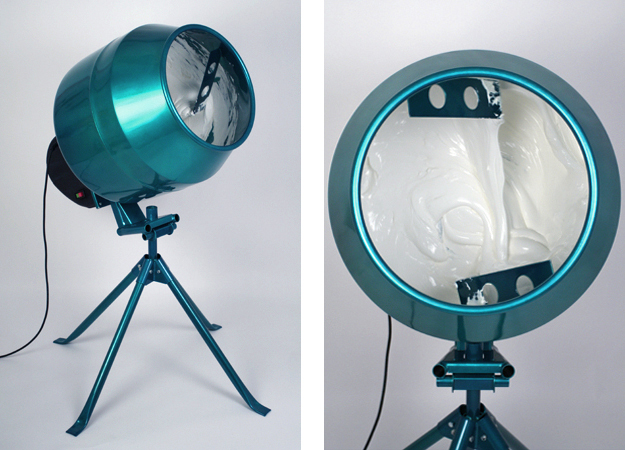
Work by artist Blue Curry using a customised cement mixer filled with sun cream for the 6th Liverpool Biennial.

This is emphatically different from the work contemporary art that I am interested in following and learning more about.  It’s work that surprises me when I see it because I have not seen the formula before.  Maybe I understand its reflection or its sentiment, not because I am already familiar with the particular image/performance/sound/installation/still or moving image but because it has a curious nature about it which resonates with my own inquiring mind.  I respond to this work at a visceral and an intellectual level – the work becomes an experience.  And it doesn’t happen often.

When we view the painting of Bottom Bay by English artist, Steve Bonner, those of us who have been to Bottom Bay on the east coast of Barbados, will recognize the rocky coastline and the wide expanse of beach.  Some might like this image because it’s familiar or because it evokes a fond memory even though it does not offer a new perspective on our reading of the beach.

Staying with the beach theme, we might view the subversive artwork by Blue Curry, a London based Bahamian artist, which was recently shown at the 6th Liverpool Biennial.

This installation uses an aquamarine coloured, customized cement mixer filled with twenty litres of sun cream.  The strong scent of the sun cream elicits memories of a tropical beach and relaxed moments of lying in the sun.   On closer examination, we understand that our tropical fantasy has been high-jacked and turned into a humorous even if frightening reflection on a region built as a playground for people from somewhere else, churning out all-inclusive, hedonistic getaways that local Caribbean people work at but don’t leisure in.

Both of these works were made in the same decade – Steven Bonner’s aged representation of a Caribbean seascape was painted in 2009, and Blue Curry’s satirical interpretation of tropical paradise was conceived and manufactured in 2010.  Although both art pieces were produced in a similar time about a similar space, they could not be further apart.  My sense is that a contemporary art museum might want to acquire only one of these works.  Which one do you think that may be?

Musing from the Milking Parlour – Sustainability and the Visual Arts

March 2011 Article for Barbados Today

Annalee Davis

Is living and working in the Caribbean as a contemporary visual artist a viable aspiration?  How is it possible to maintain the integrity of your practice while being economically viable?  Although not unfeasible, it’s quite an accomplishment if you can. And although this is a challenge for most contemporary artists all over the world, it is a small wonder that we still have practitioners in the Anglophone Caribbean who continue to make their work despite the difficult terrain. More importantly, why is this the case?

Charles Avery, Facets of Infinity

Contemporary visual artists who live in cities where there is an infrastructure to nurture the arts can access networks which make it possible to sustain production, find support in intellectual circles and earn a living.  It’s not easy anywhere to function exclusively as a Visual Artist, and more often than not, it’s fiercely competitive.  Comparatively, it’s very difficult in the Anglophone Caribbean because we don’t have branded (i) galleries, (ii) dealers, (iii) collectors (iv) prizes (v) fairs (vi) MFA or PhD degree programmes in the Visual Arts (vii) curators (viii) critics (ix) residencies, or (x) auction houses.

There are stamps of approval or markers that denote value in every field.  For example, a Mercedes Benz car or Luis Vuitton bag denotes worth. It’s the same in the world of contemporary art.  There is recognition, respect and added financial value for your work, if, for example, you’ve won a Guggenheim Grant, the Turner Prize or if your work is in a major private or corporate collection, such as the Charles Saatchi or JPMorgan Chase corporate collection.

Imagine if Rihanna, the global icon as we know her, stayed in Barbados.  How successful would she have been?  Her name would not be the household word it is today.  We have chosen not to develop or support excellence…we are more interested in maintaining a democratic approach towards the arts…Crop Over keeps us happy.  But if you’ve won Pic o’de Crop nine times…where do you go next?  You’ve hit the glass ceiling.

Rihanna on the Red Carpet at the Grammys in 2010

I draw these references because the readership will be more familiar with Red Plastic Bag and Rihanna than they will be with the world of contemporary visual art…but I want to draw a comparison with the ‘glass ceiling’ problem.  The National Cultural Foundation is interested in development – to a certain level – and the Festival experience.  But there is no existing state institution with the vision to take the talent any further and put it on the world stage.  Many of my colleagues in the region have been building impressive resumes over the past two decades and showing work internationally, but ask them if their work sells?

Dr. Keith Nurse spoke about “Cultural Policy and Cultural Industries” at a forum held on February 25th at UWI, Cave Hill campus.  He outlined that even though the world has changed, the Caribbean still functions as though it’s in the industrial era.  He gave the example of the sugar industry – the conceptualization and development of which happened in Europe, leaving us to provide the labour.  But the world has changed and now, for the first time, we are supposed to develop our concepts and take them to market.  This requires a paradigmatic shift for which the region has not been prepared – to manage our own company, on every level, and to go global is a daunting task.  The alternative, he suggests, is underdevelopment.

It is not that we lack the raw material, the intelligence, or the ability.  We simply have not been coached throughout our history to be anything other than labourers in the agricultural field and more recently how to work in the service industry in hotels. We are not taught to build our own chain of hotels, but to make up the bed in someone else’s hotel chain.

It’s the same in the contemporary visual arts arena.  There is endless talent and out put, nourished largely by an active regional informal network.  Sadly, the formal institutions function, as Dr. Nurse says, in an outdated way and have not kept abreast of the needs of the practitioners. I have become interested in figuring out what needs to be done to change the landscape.  What if a regional entity like the Caribbean Development Bank hired a curator and developed an outstanding regional collection of work?  Or corporate Caribbean bodies chose to build collections. Even the Embassy of the USA has a collection of work by artists from the Caribbean.  This is not a new idea. Deutsche Bank began acquiring work since 1978 and has one of the most comprehensive corporate art collections in the world boasting 55,000 photographs, drawings and prints worldwide.  The bank’s aim is” to support living artists, benefit local communities and create an energized work environment.”  The Deutsche Bank’s mandate is not about acquiring art for investment purposes, “rather, the primary objective is to display quality works that embrace and reflect their time.” 1.

 Now that’s refreshing!

End notes

  1. http://www.db.com/us/content/en/1097.html