Transoceanic Visual Exchange Caribbean 2015 Video

Take a look at a short video about Fresh Milk‘s recent project Transoceanic Visual Exchange (TVE) Caribbean, which was held throughout October. TVE 2015 was a survey of contemporary video art and film from across the Caribbean, Africa and Aotearoa that was presented in collaboration with Video Art Network Lagos (Nigeria) and RM (New Zealand).

Thanks so much to Sammy Davis for shooting and editing this video, to our local partners the Bim Films Festival, the Errol Barrow Centre for Creative Imagination (EBCCI) Film Club and the Barbados Community College (BCC), and to Stansfeld Scott Inc. for their sponsorship.

Maj Hasager & Ask Kæreby – Week 2 Blog Post

Fresh Milk resident artists Maj Hasager and Ask Kæreby share the second blog post about their time in Barbados, outlining their busy week that saw them continuing to learn about the island through research in the Barbados National Archives and by traversing the physical landscape. Both artists also began their community outreach, which included Maj’s first session with BFA students at Barbados Community College and day one of Ask’s experimental sound workshops being held at Fresh Milk. Read more below:

The blessed rain pours down massively. After a dry wet season the plants, trees and animals feel energized and revitalized. Monday is spent in the studio and the rain creates a perfect soundscape on the metal roof, where the sound is intensifying and suddenly loosens its loud grip to make the wind and the surrounding sounds audible. The studio is quiet and we are planning the South Coast trip later in the week. Our plan is to see the majority of the island by local buses and it demands a bit of logistics, good walking shoes and some determination to make this happen – as time is a luxury that many visitors to the island seem short of. Insisting on taking our time is indeed in stark contrast to the past year of activities, and it is highly appreciated.

Annalee is waiting in her car outside the apartment – I (Maj) can hear her beeping and grab my things before closing the door behind me. We move down the hill towards Barbados Community College (BCC) where half an hour later I will give a lecture on my work to a group of students from the fine arts department. Hours later, I am enriched by the level of conversation and questions raised amongst the students, and I can’t wait for the next session where we will go more in depth in terms of a close reading of a text, and thinking through social practice together. As we are leaving the BCC, Annalee takes me to the top of the campus to show me an old derelict building – despite it falling apart you can sense the grandeur of the structure. She tells me that it is a former sugar plantation house and it sits fairly dislocated or perhaps amputated at the edge of campus. Here the generic campus buildings seem to be rejecting a contested past, and the neglect of the house (or perhaps its symbolic meaning of colonial power) seems to be a way to suppress a past by letting it dissolve slowly by time. Though perhaps forgetting, as Annalee mentions, that the first black Chief Justice on the island Sir Conrad Reeves lived in this house too.

History spills out of wooden drawers in the chilled archival hall of the Barbados National Archives where we arrive Wednesday morning. We are slowly chewing our way through archival documents – via neatly organized index cards in perfectly fitted drawers tracing migration movements after the emancipation in the 1830’s – in particular looking at the massive exodus of young Barbadian men leaving for work in Panama either constructing the railway or later digging the Panama Canal. We are following the trail of the “Panama money”, the encouragement – and later restriction ­– of migration, the riots in 1937 and the formation of trade unions. One thing leads to the next as the hours vanish in the archive. The archive itself is somehow stuck in the past, and the sounds of heavy books being dropped on tables echo in the vast space. At 4 pm the archive is slowly shutting down, and we leave the air-conditioned hall with a chill. Outside the archive at 4 pm on the dot, the art historian Therese Hadchity picks us up. She left Denmark 25 years ago, and we spend hours over coffee discussing contemporary art in the Caribbean, social practice and the potential pitfalls of this type of practice – to mention a few of the many topics covered over three hours in good company – definitely a conversation to be continued.

Thursday morning begins with some more work on the hydrophone (underwater microphone) – Ask is still attempting to secure the cable so water is kept out when immersed. Thanks to the Colleen Lewis Soldering Iron, Annalee’s extended family and local hardware and music stores, an improvised solution begins to materialise. The plan is to test it over the weekend when we are walking along the South Coast. Thursday is also the first session of the sound workshop that Ask is teaching. Six people turn up at Fresh Milk for the first dose of soundscape recording and composition – some have a bit of a shell shock. It is a rocky ride through Musique concrète, Pierre Schaeffer, soundscape, acoustic ecology, Murray Schafer and the physics and technology behind it all. As the dust settles, questions arise and a most interesting debate takes form – I am very much looking forward to the continuation.

We head out early Friday morning, and as we leave the apartment at dawn, Annalee’s lovely father offers us a ride to St. Lawrence Gap at the South Coast, and thereby cuts our journey shorter by an hour or more. St. Lawrence Gap is the first place where we immerse the hydrophone fully in seawater, and thank goodness it is water proof despite its very homemade look. Maj has volunteered to be the assistant in the sea (what a dreadful task) and Ask is at shore with the recorder and headphones. Suddenly sounds of sand on the sea bottom are coming through and it is very exciting. The recordings continue throughout the weekend in different locations and both in the Caribbean Sea and Atlantic Ocean.

We end the weekend trip at the Good Life Café near Accra Beach, where we meet the multitalented artist Mark King, who quickly turns out to be a stimulating conversation on both art and global politics.

_____________________________

DanishArtsFound_LOGO_CMYK

This residency is supported in part by the Danish Arts Foundation

Nadijah Robinson’s Residency – Week 4 Blog Post

Nadijah Robinson shares her final blog post about her residency with Fresh Milk, concluding with her thoughts on how history is written, told and understood, and the value held in the land and our own bodies  in remembering/passing on these stories. She also shares the impact of her presentation to the final year students in the BFA programme at Barbados Community College (BCC) in considering her goals as a socially engaged artist. Read more below:

wk4_1

My last week at Fresh Milk. I have been wrapping up my work in the studio, making connections, having conversations, getting souvenirs, seeing my Bajan family and seeing some last sights.

On my last morning in the studio, I finished the piece I’ve been working on, although it doesn’t have a title yet. I know now that it is about how the history that I want to recognize is not written in books, it is written in the earth, in the land and in our bodies and blood. It is most accessible in oral stories, by observing ourselves and the culture we create, and by intuitively knowing what we do.

I did my presentation to a 3rd year art class at BCC this week. I gave a talk and slideshow presentation on my history of community-engaged work. This is a collection of my work that sometimes approaches and is within the realm of ‘social practice art’, but is also peppered by work that is more appropriately called arts-based youth work. In preparing this presentation I realized how much my practice has been formed from a desire to do something with my artwork.

I remembered a moment of crisis in high school when I felt like I had to make the choice that would change the rest of my life and set me on a particular path – the middle and high school years in Canada felt full of these deciding moments. I felt I had to choose between being a professional artist and a teacher, more specifically whether to take grade 11 Art, or something more ‘academic’. These were two career paths I’d known for a long time that I’d wanted to pursue. At the time, becoming a teacher was a promising career in Toronto – there was a teacher shortage that would soon after become an incredible teacher surplus. The pay was decent, and it was basically the definition of job security. I had watched all of the terrible, misguided teacher-saviour films, and they had created in my mind a sensational image of what being a teacher could be –  a way to effect change in the world, locally. I wanted that, to be a vehicle of social change. But mostly I just wanted to make art, though this was not the wise career choice. There’s no money in art, and I didn’t want to be poor and struggling forever. Not only that, but I didn’t want to be preoccupied with the self-involved, decorative, wishy-washy activities that having an art career seemed to be all about. I wanted a way to make artwork that meant more than that one-dimensional caricature-like story I was presented. My younger self wanted to make art that was all about edgy stuff and politics and was ground-breaking and would one day make it into an Adbusters magazine. I wanted to make artwork that would infect people’s minds with possibilities of better things to come, and place a how-to handbook in their hands. I chose in the end to take grade 11 Art, because I had the genius realization that I could be an art teacher, and have an art career in my off time. I’m glad I did.

wk4_2

In doing this presentation more than 10 years later, I realized how I came to reconcile wanting to make art that does stuff for people. I’m still working on it, but I have been listing for myself a set of guiding principles as I go, the first of which was that I must know what I am trying to do with my work, who I’m doing it with (as opposed to for), and in what language (medium and vernacular) I would do it. Along the way I added things like prioritizing integrity, and supporting community-led projects and speaking with my own voice.

I feel very grateful to have had this experience at Fresh Milk, and it is significant that I did my residency here, in Barbados. Being able to reconnect with my family, with Bajan culture and with the history of this place, and having had the conversations that I have had this month has shifted how I see my own particular cultural makeup. The diaspora upon diaspora, the historical memory and living in North America, Toronto in particular. Some ideas have shifted and some have solidified, but they are complex things to reconcile and I feel as if I’ve just begun again.

wk4_3

_______________________________________

2014 OAC logo RGB JPG

This residency is supported by the Ontario Arts Council.

Transoceanic Visual Exchange and the Fresh Milk Team featured in Barbados Today

In her arts column ‘About Town, Across Country’ for the Barbados Today e-newspaper, Katrina Marshall recently shared two articles: one on the Transoceanic Visual Exchange (TVE) programme, and one focusing on what it means to be an artist-in-residence, speaking with Fresh Milk’s Katherine Kennedy about her work and residency experiences to explore the topic.

Thanks very much, Katrina, for taking an interest in the arts!

Barbados today TVE

To read the article on TVE, which appeared on pages 12-13 of the October 22 edition of Barbados Today, click here.

Barbados today Katherine article

To read the article about Katherine Kennedy and her thoughts on artist residencies, which appeared on pages 12-13 of the October 30 edition of Barbados Today, click here.

Nadijah Robinson’s Residency – Week 3 Blog Post

In the third week of her Fresh Milk residency, Toronto-based artist Nadijah Robinson writes about her progress so far, shifting her focus from necessarily being on production to absorbing as much as she can from the experience, gathering information from a number of sources and letting things unfold in an organic way. Read more below:
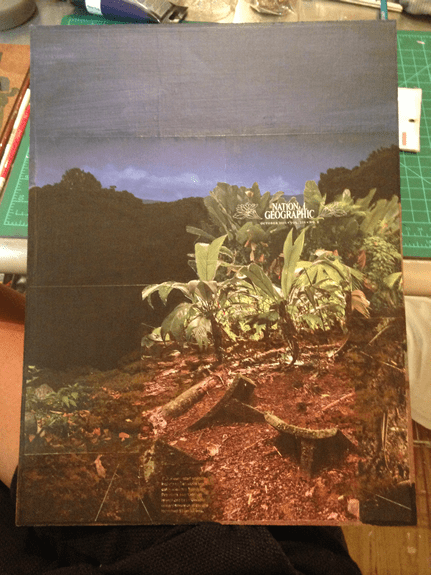
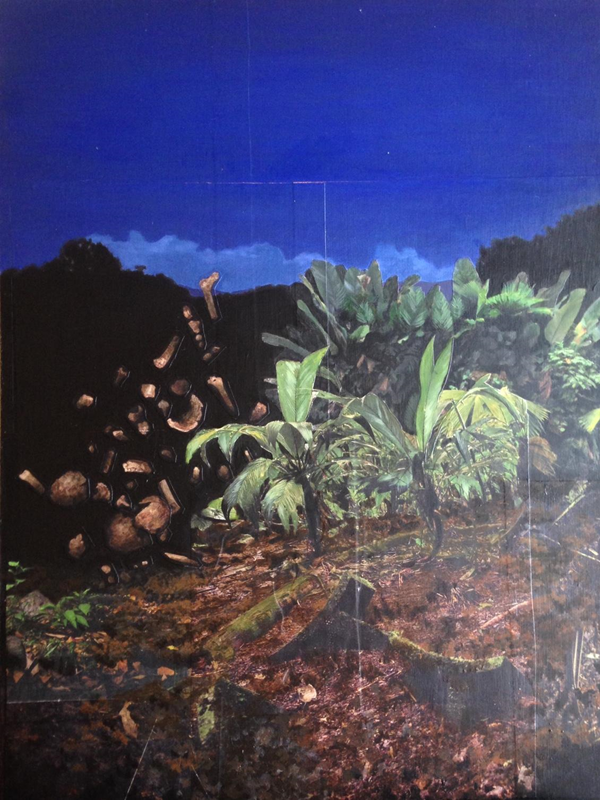
nad_wk3_1

This week was spent doing the most. Looking back on it, I have no reason to feel like I haven’t been doing enough.

This week I made some progress on the piece I am working on, the background is coming together slowly but surely. I know this piece is somehow about the land’s memory, but I am still unsure of the specifics.

I’ve decided to focus my energy on gathering as many resources and impressions as possible before I leave, rather than trying to know what I want to do specifically with them. It doesn’t seem like the most intentional way to go about this, but it seems like the best way to make the most of my remaining time here.

Early in the week, I attended Rayanne’s presentation to 3rd year art students at BCC. Meeting the students and participating in their discussion around different ways they felt under-represented in the Barbados narrative, society, or their early school years was eye-opening. That this experience is as common amongst these students as it is amongst my own peers in Toronto speaks to the ever present power dynamic that dictates who writes our histories, who frames the narrative, who has set up the norms we resist. These days I am preoccupied with the question of what story I end up living in/living out, and how much control I have over that story. Much of my education work, community and art work are born out of a reaction to a traumatic and white-supremacist teaching of history (at all levels of my schooling) and the daily experience of racism. These frame my understanding of everything. If I wasn’t preoccupied with trying to heal from this, then what else might I be doing? It often feels like a trap, to be consistently resisting a belief system so large and entrenched, to be trying to create small alternative visions and truths here and there. I know, in my more optimistic moments, that it is necessary work, and it is my generation’s work to be doing.

I went to the museum on Thursday, and was disappointed with the narrative that was presented to me. I shouldn’t have been, but the level of gloss applied over a violent history was glaring to me. Emancipation in many historical narratives is continually presented as a time where white people suddenly came to the realization that slavery was morally reprehensible and decided to give black people their freedom (in exchange for compensation, and after a period of “apprenticeship”).
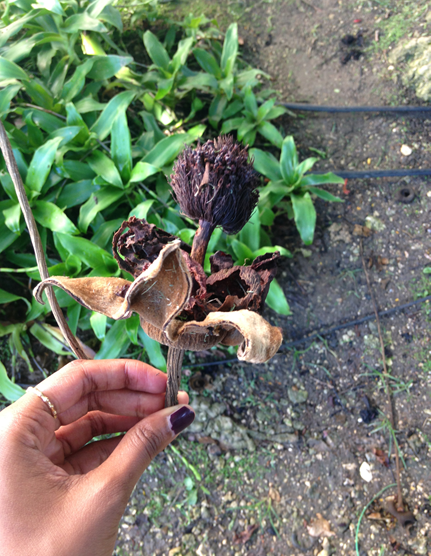
nad_wk3_2

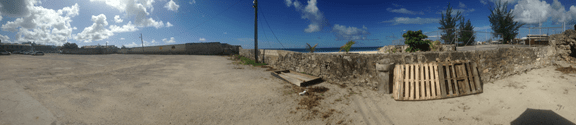
Friday morning made up for my disappointment as I got an amazing tour of plants around Barbados with Anthony Richards. I learned so much of Barbados/Caribbean history through plants and much about of the magic and symbolism of certain plants for different peoples. I made friends with a giant baobab tree of approximately 1000 years, a calabash tree, a black willow tree, and a giant silk-cotton tree. We spoke of mourning and burial beliefs and traditions, which because I live within the spectre of black death in North America, holds particular interest and urgency to me now. We also visited a number of historical sites, like the site of a mass grave that was found at the ports where slave ships used to come in, but which is now a parking lot, with no signs or markings to commemorate those lives or deaths. This tour is something I will most likely mull over for a long time.
nad_wk3_3

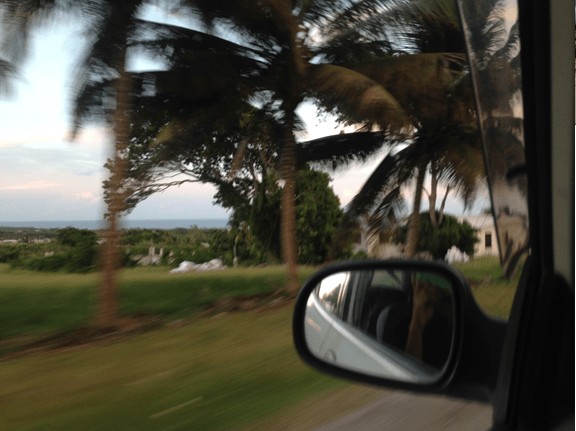
Later that day and over the next couple days I visited the national archives, got lost and cranky, went on a driving tour with my cousins and saw the Animal Flower Cave and Little Bay on the north east coast, and went on a challenging (for me) 3 hour hike with my cousin and the Barbados Hiking Association starting at Long Beach.
nad_wk3_4

What I’m reading these days is a mix of Octavia Butler’s Wild Seed to relax, Stuart Hall’s text Thinking the Diaspora: Home-Thoughts from Abroad and Ta-Nehisi Coates’  Between the World and Me. All of these are brilliant.

_______________________________________

2014 OAC logo RGB JPG

This residency is supported by the Ontario Arts Council.