Mariam Zulfiqar interviews Fresh Milk’s founding director Annalee Davis, getting some insight on the motivation behind the organization, some of its current and upcoming activities, challenges around its sustainability and the vision for Fresh Milk’s future. Read more below:
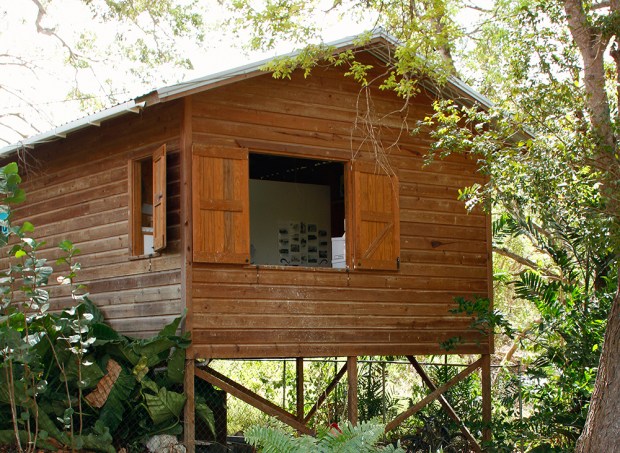
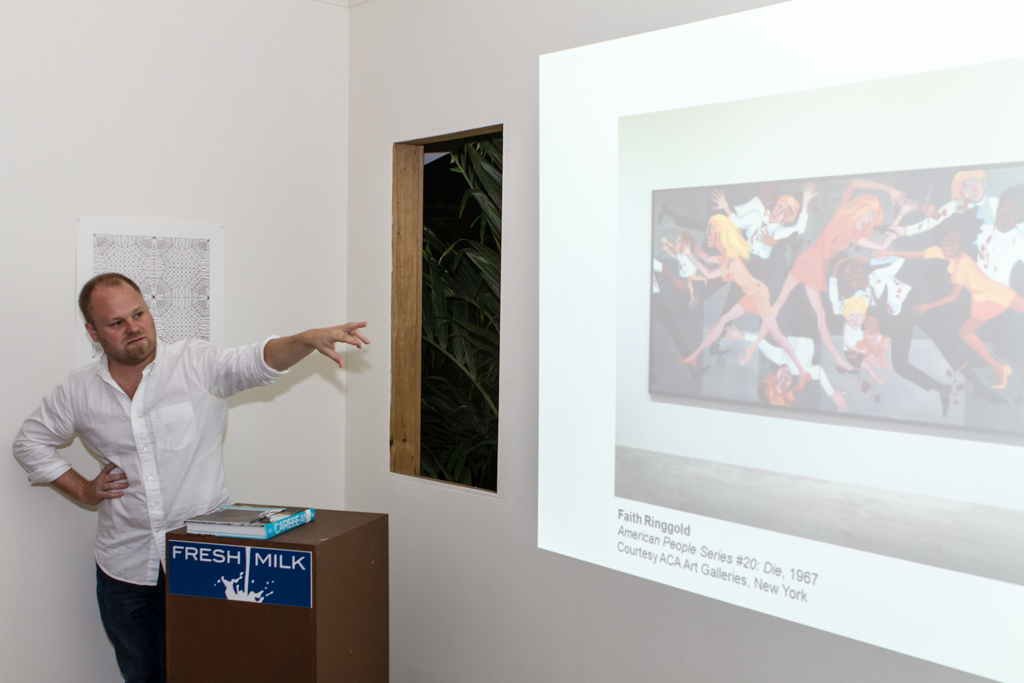
The Fresh Milk Studio. Photograph by Mark King.
Annalee Davis’ practice deals with a number of social issues around race, identity and migration. Her artworks have been exhibited nationally and internationally in group shows and Biennials.
The artist started Fresh Milk in 2011, the only contemporary art organisation in Barbados. The organisation offers a platform for international dialogue between artists, curators and writers working in the field of contemporary art and collaborates with organisations across the globe to provide national and international residencies for artists and curators.
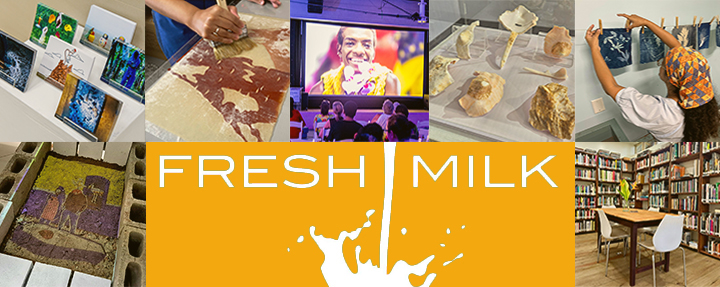
Offering a Library in the form of the Colleen Lewis Reading Room, a project space for artists and curators, and a programme of screenings and talks, Fresh Milk provides a platform for critical discourse to expand and support contemporary art production in Barbados.
I spoke to Annalee Davis during my two-month curatorial residency in Barbados about Fresh Milk and the challenges faced by artists in Barbados and the wider Caribbean.

The Fresh Milk Studio Space. Photograph by Annalee Davis.
MZ: What made you decide to start Fresh Milk and what type of space were you hoping to create?
AD: I’ve been teaching since the early 90s at Barbados Community College (BCC), off and on, for about 10 years. When I returned to Barbados from Trinidad a few years ago I realised that the attrition rate for our students was almost 100%, meaning that within a year of graduating almost none of the graduates were making art. There were no formal spaces for artists and as a result graduates were starting to find other jobs and their practice was dwindling. I felt that a support mechanism was needed to allow them to continue making work. I also felt that expanding the critical arena in Barbados was important and wanted to contribute to this.
The notion of creating a nurturing space was important. Given the traumatic history of the Caribbean, it’s not a region that necessarily connotes being nurtured. So I often think of Fresh Milk as both a nurturing environment and an act of resistance. Offering a space that is safe for people to experiment and innovate, and to gather, talk, think and make, is an act of resistance. So that’s the impetus out of which it came.
MZ: It’s interesting that you use the word nurturing because in my discussions with artists, one of the areas we discussed is their frustration in the lack of structural support for the arts in Barbados. Does Fresh Milk receive any support, financial or otherwise, on a Government or official level?
AD: Fresh Milk received small grants from the Maria Holder Memorial Trust, and the Art and Sport Promotion Fund which falls under the Ministry of Finance. This allowed us to hire an assistant for a couple of days a week and host four local residencies. We are currently in conversation with the Ministry of Culture and the Art and Sport Fund to see whether we can request a yearlong subvention. We are also keen to develop relationships with the National Cultural Foundation. We have had support from the US Embassy in terms of bringing in two artists from the US in support of their residency on the platform, contributing to the expansion of the reading room, and ascribing a Dewey decimal system to the collection so it can function more professionally. We are trying to develop partnerships across a number of different sectors to contribute to sustainability in the arts.
We’ve been able to demonstrate some measure of success by putting a real dent into that attrition rate as we work with at least 50% of recent graduates. So if the state continues its funding of the BFA programme, Fresh Milk offers the type of support necessary post graduation. In that respect it becomes a partnership where collaborators are working towards similar goals.
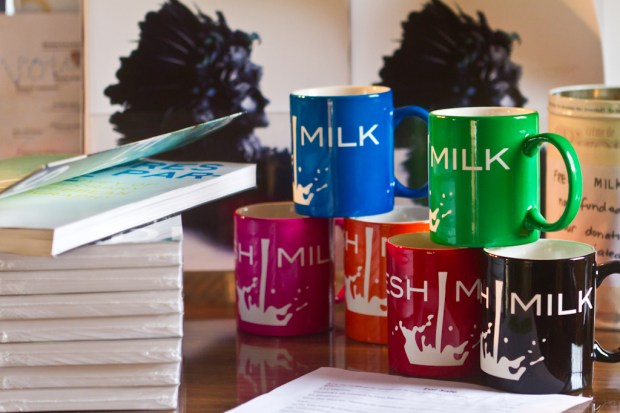
Photo by Dondré Trotman.
MZ: In terms of global partnerships with contemporary art organisations and practitioners, who are you working with?
AD: The Barbados Government hosted a symposium in April called e-Create, inviting people from the visual arts and music industries in Brazil to Barbados. Fresh Milk presented a platform of young artists to the delegates and that started a relationship with Videobrasil, a 30-year-old institution in Sao Paulo founded by Solange Farkas. My trip to Brazil cemented a relationship with Casa Tomada, an informal network in Sao Paulo similar to Fresh Milk. We are in conversation with a curator at the Perez Art Museum in Miami (PAMM) regarding collaborative programming. We have been invited by an artist-run space in Glasgow, The David Dale Gallery to present a project in July 2014. Glasgow is hosting the 2014 Commonwealth Games and the Gallery has invited six informal spaces from Cyprus, Nigeria, New Zealand, India, Canada and Barbados to collaborate.
We also have a very close relationship with ARC Magazine, a significant publication showcasing the work of Caribbean practitioners in the region and the diaspora. We work together to create opportunities for creatives and generate awareness of their practice. It’s all really happened because of the Internet! That’s how we are beginning to foster relationships with entities in the Dutch Caribbean including the IBB in Curaçao and Ateliers‘89 in Aruba.

From left to right: Alison Sealy-Smith (NCF), Katherine Kennedy (Fresh Milk), Thereza Farkas (Videobrasil), Diandra Martins (Casa Tomada), Flora Leite (Brazilian artist), Tainá Azeredo (Casa Tomada), Andrea Wells (NCF), Shanika Grimes (Barbadian artist) in Sao Paulo for the ‘fresh casa’ project – Photo by Simone Codrington
MZ: Fresh Milk’s location on a dairy farm is quite unusual. Can you tell me about how the space was created?
AD: It actually was my studio – I built it 7 years ago at my house located on a dairy farm dating back to the mid 1600s. I decided, stupidly, to marginalise myself outside of my own studio and use that as a space for Fresh Milk. The name obviously connects to our location on a dairy farm and the notion of Fresh Milk supporting young practitioners with fresh ideas, fresh work, fresh thinking, fresh collaborations. It is also connected to the idea of women turning their blood into milk to nurture their young. At first I felt concerned that the location was rural and not centrally located, but what I’ve since learned is when resident artists come, they exhale, absorb the environment – and feel ‘ahhh’….it’s a moment of calm. Located under a grove of mahogany trees surrounded by grass and cows, the quiet space allows focus and inspires reflection.
MZ: You also provide a reading room, named after Colleen Lewis. Can you tell me how the reading room came around?
AD: Colleen was my best friend who succumbed to breast cancer in September of 2006. She was a collector and an art history graduate. She had a library that she gave to me, and I wanted to keep her memory alive. She was an extraordinarily generous person, and I wanted to find a way to build on her collection and make it publicly available. Now I want to expand, acquiring publications that are not available at BCC or the University of the West Indies. We are filling a void by offering publications related to critical thinking and contemporary practice.
We also want a younger audience. We would like to work with art teachers at secondary schools to integrate critical discourse into their curriculum. Students at that level have to do research papers and we want to offer our reading room and work with students and teachers, in support of their work. We welcome workshops and events that involve sharing the books, talking about artists and inciting inspiration.

The Colleen Lewis Reading Room. Photo by Annalee Davis.
MZ: So, in a sense the reading room offers a platform for skills’ development for young people, where they see the work of emerging artists like Sheena Rose on your wall, who is now doing residencies worldwide. So you’re trying to create that bridge between school and BFA, and BFA level onwards.
AD: Right. And also challenge what they would normally see. Some years ago when I was teaching, my students were talking about Braque and Picasso as though this was current. The documents we select for the reading room reflect the most contemporary, cutting edge art production. Students should be exposed to current practices all over the world today, from Europe or North America, to Africa, Asia and Australia.
MZ: How big is your team?
AD: It’s very small. Katherine Kennedy is my dream assistant! We also have a board that meets periodically consisting of Ewan Atkinson, Simone Mangal, Yasmine Espert, Holly Bynoe and Natalie McGuire. We also have volunteers: Kriston Chen, Dondré Trotman, Sammy Davis, Alicia Alleyne and Versia Harris.
MZ: What are the challenges that artists from Barbados are currently facing nationally and internationally?
AD: I think issues around sustainability. It seems as though it’s paramount in everyone’s mind. We don’t have a fully developed creative industry including formal arts institutions, museums, galleries, auction houses, biennials, prizes, fairs, collectors, curators, historians and dealers. Artists often multi-task by writing, documenting, promoting and creating opportunities. It’s the challenge of functioning outside of a developed creative economy. Also, trying to create visibility around your work can be tough, which is why the Internet has changed so much for a lot of us by providing visibility.
MZ: Fresh Milk is very active online, how useful has an online presence been for you?
AD: It changed everything. It’s made so much more possible. My most common meetings are on Skype with people all over the world. Fresh Milk is being approached for all kinds of projects as a result of our online presence.
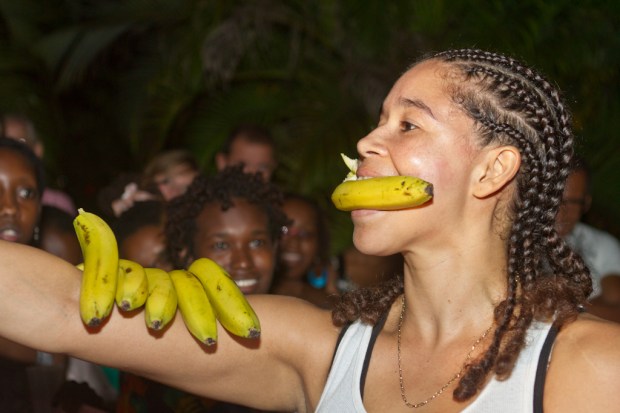
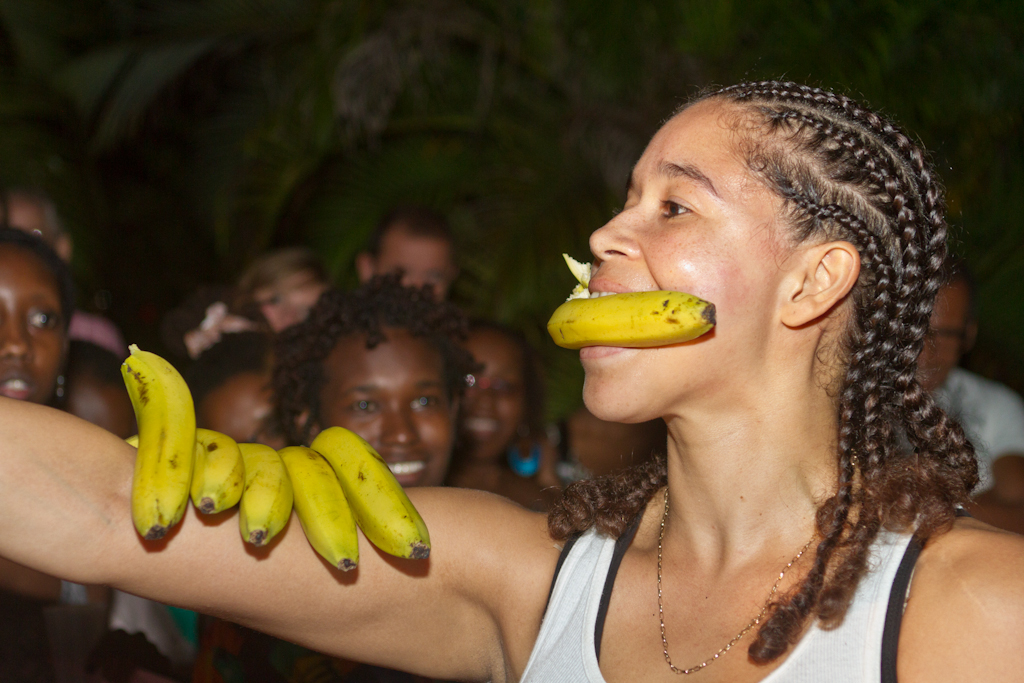
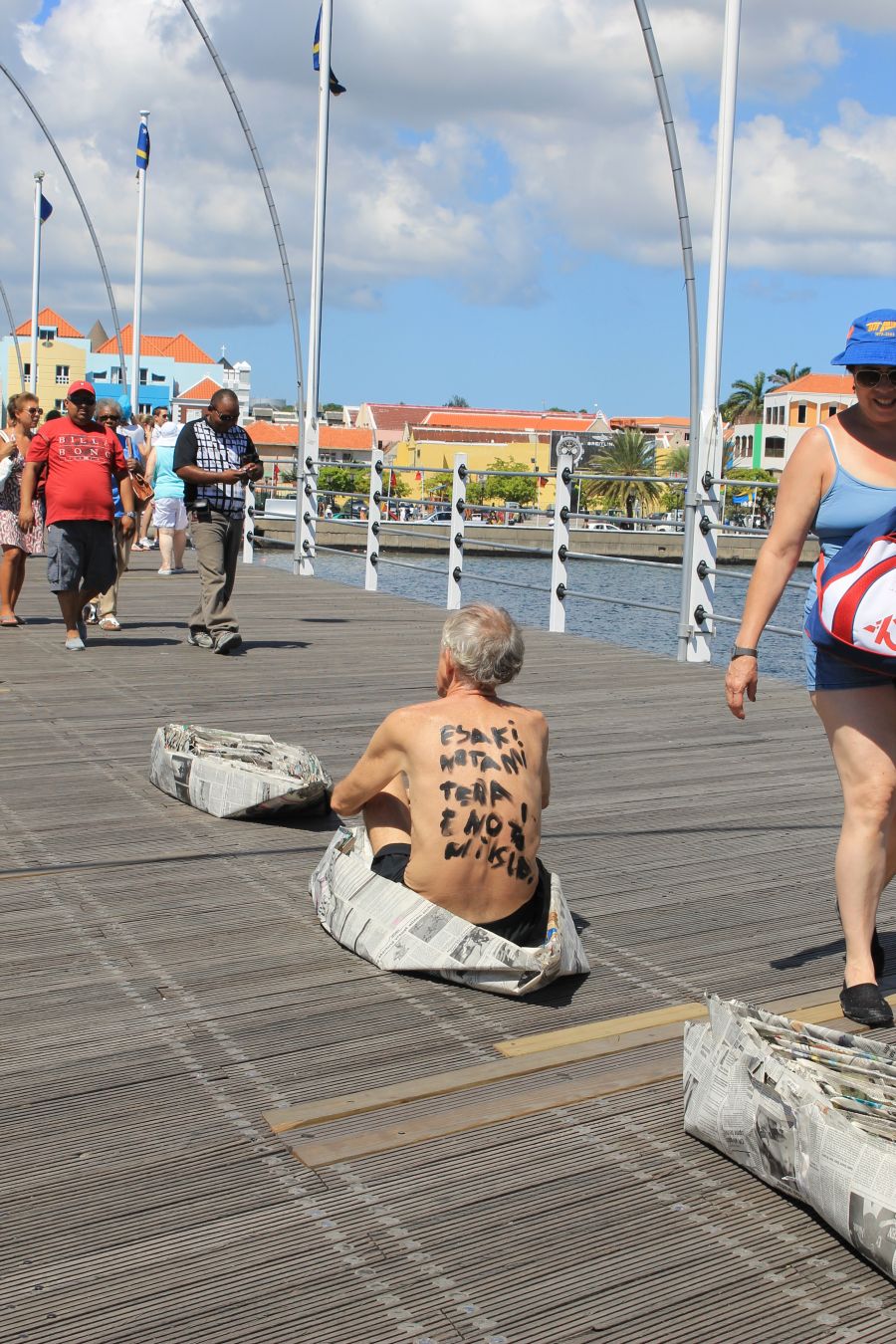
Alberta Whittle, performance still from ‘Hustle de Money a performance by Bertie aka Big Red aka General outta Glitter Zone’, 2012. Photo by Dondré Trotman.
MZ: Who are the artists that you have hosted at Fresh Milk?
AD: This year we had Mark King who generally works in photography but started the residency breaking out of that and doing drawings that were influenced by Origami, working with algorithms and fractals inspired by the North American ‘banking bubble’ and financial crisis. He started doing some really interesting work and experimented for the duration of the residency. We want to encourage resident artists to step outside oftheir comfort zone and not be pressured to have a final product at the end, to really challenge their practice. Prior to that we had Versia Harris, an animation artist, followed by a playwright Matthew Kupakwashe Murrell. We’ve had two Canadian artists, Conan Masterson and Marla Botterill, who worked collaboratively making puppets and video shorts. Malaika Brooks-Smith-Lowe, a photographer and video maker from Grenada worked with local actress Varia Williams to produce an experimental four-minute video short. Alberta Whittle was here for two months last November/December and she worked with traditional fete or party posters that you would see in the urban landscape, produced her own posters and closed with a performance work.
We have also supported off site projects including Fresh Performance with NY based Damali Abrams who has produced six videos linking Caribbean based and NY based performance artists speaking about their practices as well as Caribbean Linked II– a project in collaboration with ARC Inc., Ateleirs ’89 in Aruba which saw ten artists from the region spend two weeks in Aruba on a residency project.
MZ: How have people responded to Fresh Milk?
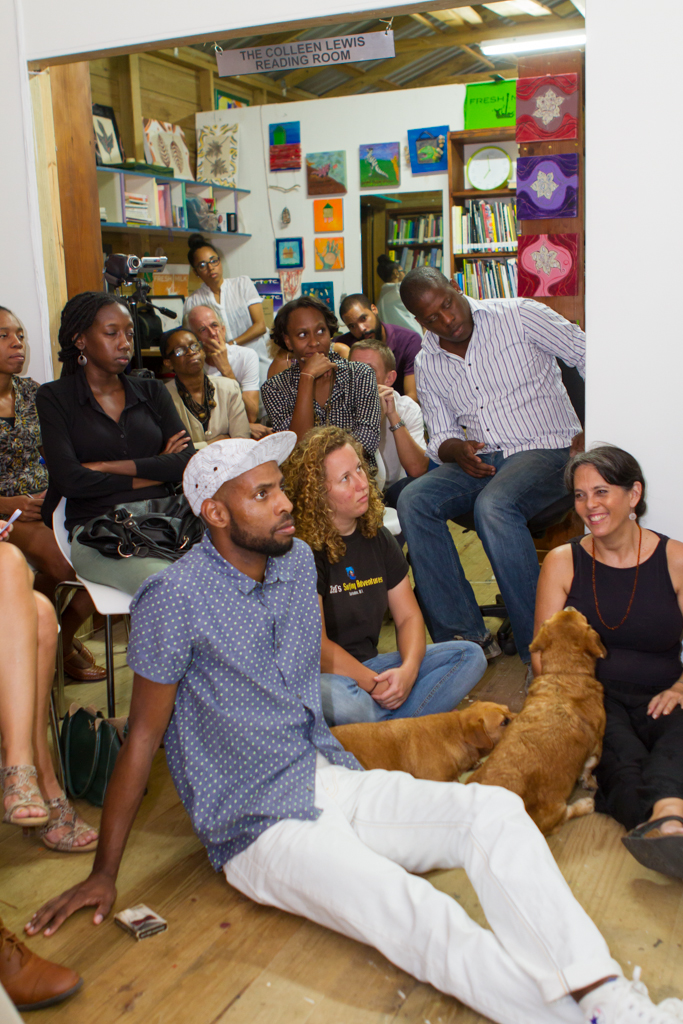
AD: For the first event, I imagined we would get an audience of 10 or 20 people. Over 100 people came – I didn’t know most of them. A lot of young people were interested to see what was happening. I think the time is right, there has been a lot of interest and we are being observed with great interest globally through our online presence.

Audience at Fresh Milk X – Photo by Dondré Trotman
MZ: How has running this organisation affected your practice?
AD: That’s funny! What practice? I’ve done a couple of pieces in the last 2 years and I’ve just spent the last 6 weeks trying to get back into the studio. It’s slowed down my own production, but it’s been absolutely fantastic and completely worth it. I felt really isolated and I wanted to have a more rigorous and stimulating environment to work in.
MZ: And a DIY approach has made it happen?
AD: Yeah for sure. I think partly it’s the absolute fear of growing older and feeling that nothing is changing, so let’s do something about it!
MZ: In terms of the future, how do you see Fresh Milk developing as an organisation?
AD: What I would like to do is make myself completely irrelevant within Fresh Milk. The organisation needs a young fresh team to run it. The baton should be passed on and my hope is that Fresh Milk becomes a sustainable entity in its own right. And then I’ll get to spend more time in my studio.
Written: August 2013

* Since our conversation, Fresh Milk has launched their online interactive map which is available here.
Article commissioned by Curating Contemporary Art Department, Royal College of Art
_________________________________________________
About Mariam Zulfiqar
Mariam graduated from the Curating Contemporary Art Inspire MA in 2012 during which time she was based at Art on the Underground where she continues to work in a curatorial capacity. Mariam recently curated the online Kurt Schwitters inspired project, MerzBank with Steven Bode for Film and Video Umbrella and is currently on a research residency in Barbados. Her research will culminate into a forthcoming exhibition that explores the impact of plant migration on the Barbadian visual and social landscape.













 fresh milk barbados