Caribbean Linked II Artist Blogs: Kevin Schuit

Aruban artist Kevin Schuit writes about his time during the Caribbean Linked II residency programme at Ateliers ’89, Aruba. Schuit reflects on certain coincidences he has noticed since embarking on the residency, some through interactions with his fellow participants, and the impact a studio visit with local artist Osaira Muyale had on his self awareness around these occurrences. He believes that even coincidences are selective on some level in art, and connects certain coincidences in the Caribbean to our shared cultural experiences..

photo 1 (1)

Kevin Schuit’s installation for Caribbean Linked II. Image courtesy of ARC Magazine

Breeze blocks. Fractals. Tool. California. Conundrum. Dog skulls. Chinese invasion. Roots. Mothers. Conspiracy. Punk rock. Jazz. Skateboarding. Friday Lopez. Ateliers ’89. El Camino. Gloomy cat. Coincidence.

This combination of words may seem random to most people reading this. It would’ve been random to me too if I had read this prior to my flight from Amsterdam to Aruba for my residency at Caribbean Linked II. But since my flight I’ve been having a bunch of weird coincidences. My mind as the needle in a patchwork of thought.

I was already aware of my awareness, but it wasn’t until we went to visit Osaira Muyale’s ‘Studio O’ that I started thinking. She showed us a stop-motion video work of hers which included a vast collection of cars that had ’11’ somewhere on the license plate numbers. She told us that the number had a spiritual significance to her.

Later that night we went back to Ateliers ’89 and we were talking about the video and how as soon as one pays attention to something, one will encounter it more often. This is where my passive awareness turned into an active awareness.

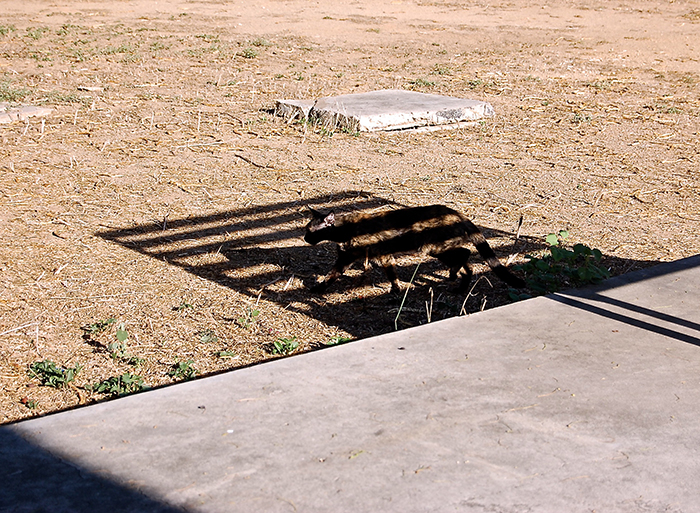
All these crazy things started happening. I was intrigued by a gloomy cat walking around the premises. I took a picture of it as it passed through diagonal shadow stripes. That same night Rodell came up to me and said he saw this interesting cat. I showed him the picture and asked him if that was the same cat, and it was. Later I went to pose for some of his pictures, in which he projects abstract shapes and colors on my body. We looked at the pictures and there is the cat’s face on my chest.

gloomycat

Image courtesy of the artist

I can go on and on. As I was writing this text Sofia came to me and made a joke about punk rock. I went outside to take a break from writing this text and spoke to Holly and she starts talking about China. And all of this after I wrote the first words of this blog post.

I could give a lot more examples of such incidents that happened during the residency, but I have to move on to the point I am trying to make.

I think coincidence is an important part about being an artist. When an artist picks something up, he does not do so without a reason. It’s what interests him. It’s what serves as a muse. When an artist is not actively working on a project, the pilot light in the brain is still on, subconsciously picking up all kinds of symbols and details that are related to the time and space the artist is in. This is why how coincidental something might seem, its still somewhat selective.

Relating all of this to the theme of Caribbean Linked II, it makes sense for me that I have been thinking about coincidence. The islands are living in some sort of synchronicity, being that we have the same cultural formula, only with the different cultures as ingredients. Things and thoughts wash ashore and the smaller the island, the bigger the part is of the inhabitants that share them.

photo 2 (1)

Kevin Schuit’s installation for Caribbean Linked II. Image courtesy of ARC Magazine

About Kevin Schuit:

Kevin Schuit was born in 1990 on Aruba, where he grew up. At the age of 16 he started taking art courses at Ateliers ’89. At 18 years old, he moved to Amsterdam to study audio/visual arts at the Gerrit Rietveld Academy. During his study he found a unique way of combining his drumming with art. In 2013 he graduated from VAV with a bachelor’s degree in Fine Arts.

CARIBBEAN LINKED II is a residency programme and exhibition organized by Ateliers ’89 Foundation in collaboration with ARC Inc. and The Fresh Milk Art Platform Inc. and funded by the Mondriaan Foundation. The programme took place from August 25th through September 6th, 2013 in Oranjestad, Aruba.

Fresh Performance Chapter 5: How Performance Communicates

FRESH MILK in collaboration with Damali Abrams presents Chapter 5 in the Fresh Performance Project: How Performance Communicates

I think that art is above all a form of communication. As much as I derive great pleasure from the mere act of making, no work feels complete to me until I share it with someone else. For artists who utilize performance, that communication has the potential for deep levels of intimacy. Performance can include one’s voice and body and energy with a sense of immediacy not always available through other mediums, as well as extreme vulnerability.

Both Zachary Fabri and Michelle Isava use performance to communicate their personal experiences. Zachary’s work largely pulls from the Black experience in the U.S. while Michelle’s work explores her concerns a as a young Trinidadian woman. A lot of Michelle’s work is very raw and visceral as she places her body in various scenarios, combines herself with technological machines, lays her body on the ground and interacts with the landscape. Zachary inserts his body in spaces throughout various New York City communities in order to make political statements. Sitting on a street corner or running down the block with helium balloons tied to his knee-length locs, leading visitors through exercises in popular museum lobbies or pushing himself down the streets of Alphabet City in a milk crate on wheels.

Ironically or (aptly?), I had more communication problems trying to schedule interviews with these two artists than with any of the prior chapters. Whether it was travel or just the usual drama of life, it was a feat trying to find a moment when I could speak with Zachary and Michelle. However, when we were finally able to connect, both conversations were fruitful and informative. I was curious about the way that these artists consider communication with viewers throughout their creative processes. It was interesting to hear Michelle talk about the differences between performing in Trinidad, Venezuela and Germany. Of course the same gesture can communicate very differently in different cultures. Zachary spoke about the way that viewers of different races experience his work and the ways that affects his practice.

I continue to learn through this project that artists turn to performance when what they seek to communicate will not manifest through any other form. In grad school I learned that in order to be effective, art has to have the intention to communicate something specific, something beyond that pleasure of making. Both Zachary and Michelle have powerful intentions that they communicate very clearly through their work and I hope that I have been able to communicate that as clearly through this video.

Damali Abrams

About Michelle Isava:

Michelle Isava (born 1985) holds dual nationality from Trinidad & Tobago and Venezuela. She is a conceptual artist who straddles across different mediums and genres to place the priority on message and experience. She experiments with drawing, painting, installation and video because she believes the message should decide the mode of expression. Her interests lie in the body as an object, and what it has the potential to reveal or betray about the subject.

About Zachary Fabri:

Zachary Fabri was born in Miami, Florida in 1977. His mother is Jamaican and his father is Hungarian. In 2007, he received his Master of Fine Arts from Hunter College in combined media. His work mines the intersection of personal and political spaces, often responding to a specific environment or context. Zachary’s work has been exhibited at Sequences Real-time Festival, Reykjavik, Iceland; Nordic Biennale: Momentum, Moss, Norway; Gallery Open, Berlin; the Museum of Contemporary African Diasporan Art, New York; the Jersey City Museum, and El Museo del Barrio, New York, The Studio Museum in Harlem, and The Contemporary Arts Museum Houston. He is a recipient of the Franklin Furnace Fund for Performance Art in 2011 and was awarded a New York Foundation for the Arts Fellowship in interdisciplinary work in 2012. Recent solo exhibitions include Third Streaming in New York City and Real Art Ways, in Hartford, Connecticut. He lives and works in Brooklyn.

Caribbean Linked II Artist Blogs: Omar Kuwas

Curaçaoan artist Omar Kuwas shares his experience with the Caribbean Linked II residency programme at Ateliers ’89, Aruba. He speaks about his misadventures leading up to his arrival in Aruba, and how his misfortune led to an unexpected form of bonding with his fellow resident artists. This led him to conclude that although each island in the Caribbean may take pride in their differences, there are some fundamental similarities which continue to ‘link’ us together.

All images courtesy of the artist.

IMG_0978

Traveling to Aruba for Caribbean Linked II would mark the second time I’ve traveled to the country. It is a trip that I’ve only done once before about three years ago despite having lived for more than 20 years on neighboring Curacao hardly 20 minutes away by plane. As such I was looking forward to the trip knowing that this time around I would have more time to explore the island; as last time I was here for barely three days.

This trip would also be both the first time that I participate in any kind of residency program and an exhibition supporting Caribbean works. I’m quite familiar with the workings of both, yet normally from the side of the facilitator being an employee of the Instituto Buena Bista (IBB) on Curacao.

scan49posWEB

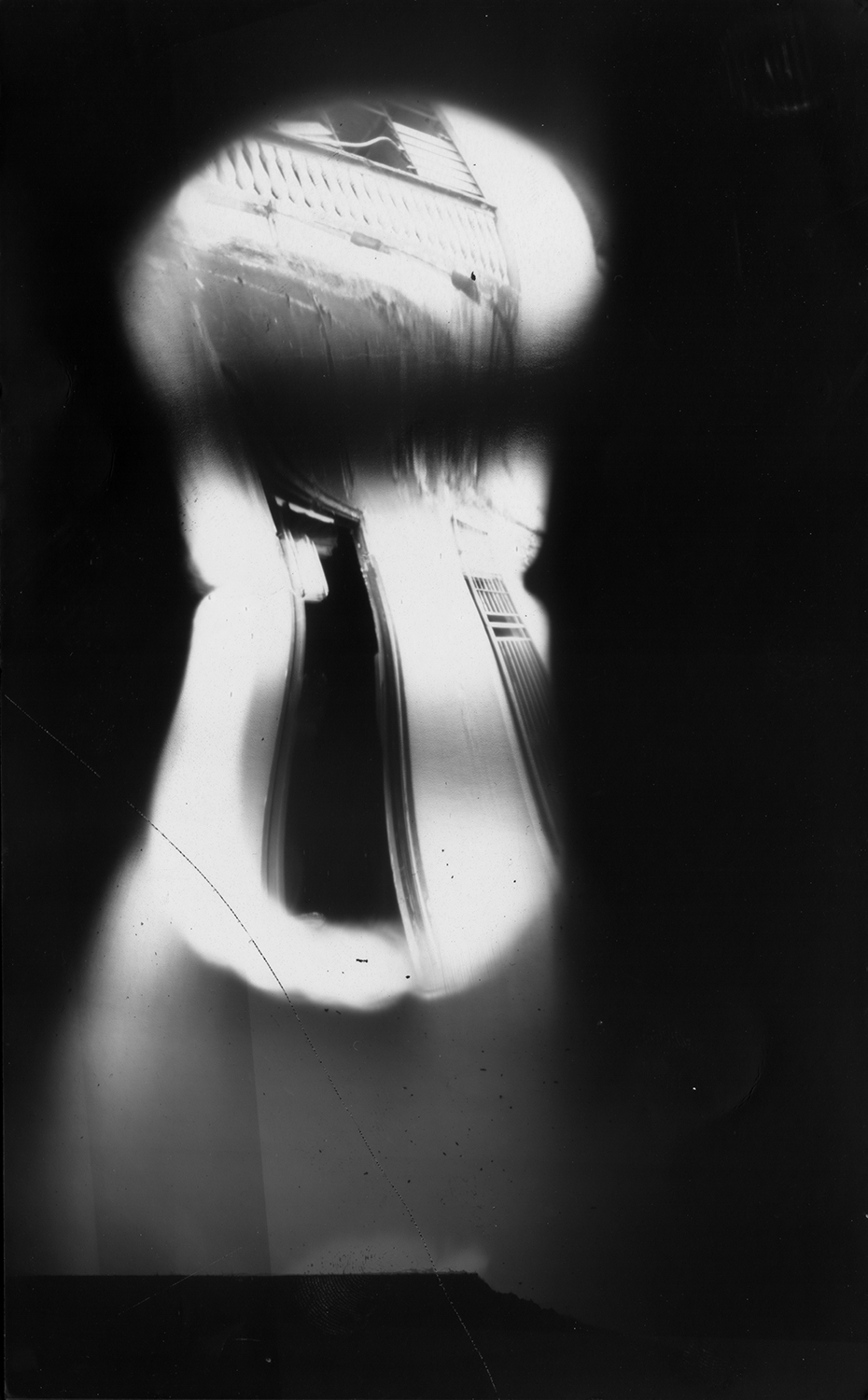
I knew from the get go that by extension of my line of work –analog pinhole photography– there would be some possibilities for things to go slightly askew based on what was planned. What I didn’t expect though, was for these deviations to start before I left Curacao. Due to a pretty interesting accumulation of unfortunate events, which included me forgetting my passport for the first time ever, and one of the local aviation companies going bankrupt the weekend before the North Sea Jazz Festival, one of the largest on the island and no mention of a check-in time anywhere on my ticket (or online for that matter), led to the loosing of my scheduled flight to Aruba.

A nice conversation with the company representative resulted in a rescheduled flight,  this was postponed to the last flight of the day as all of the earlier flights were fully booked with stranded travelers trying to get to their destinations and connecting flights.

scan16posWEB

Taking this situation in good stride, I decided to make good use of my free day to relax, have a nice Colombian lunch, nap and dispatch of as many clay pigeons as I could find time for. All of which were welcomed activities after a couple of intense weeks rushing to have all my work done in time for Aruba, while also managing the projects that I would be absent for at the IBB as the new school year started on the 2nd of September. At the end of the laxed day I showed up on time with my passport and boarded a surprisingly short flight to Aruba for Caribbean Linked II.

Little did I know that my misadventures with air travel to Aruba wouldn’t be a unique experience. It marked the start of a whole lot of similarities between the different islands that we would figure out during our increasingly longer nightly “linkings”.

If there is one single thing that I will take away from this experience, it’s that while there is great diversity and much pride among the islands in the Caribbean for not being the same as each other, we are more alike than I’m afraid we will ever be comfortable admitting.

IMG_0972

About Omar Kuwas:

Born on June 28, 1985. Graduated in 2009 with a degree in Communication & Multimedia Design with minors in software engineering and photography from The Hague University of applied sciences in The Netherlands. Has been involved with ArteSwa and Instituto Buena Bista since 2007 and been working there full time doing IT, design and teaching (analog) photography since 2009.

CARIBBEAN LINKED II is a residency programme and exhibition organized by Ateliers ’89 Foundation in collaboration with ARC Inc. and The Fresh Milk Art Platform Inc. and funded by the Mondriaan Foundation. The programme takes place from August 25th through September 6th, 2013 in Oranjestad, Aruba.

Caribbean Linked II – Opening Exhibition

Print

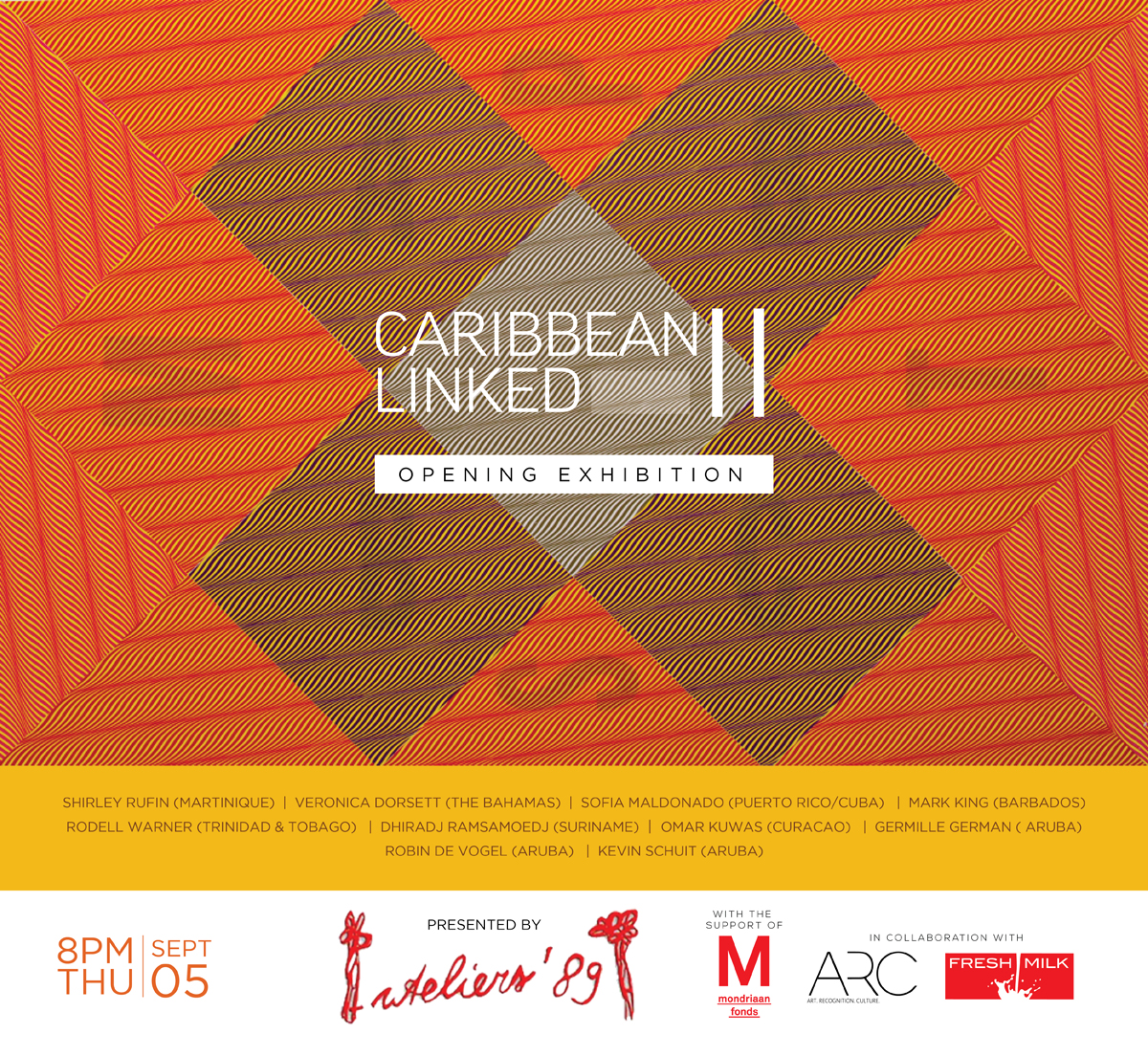
On Thursday, September 5th, 2013 from 8pm, the Ateliers ’89 in Orajanestad, Aruba welcomes the Aruban public to the Caribbean Linked II Opening Exhibition featuring new works by: Shirley Rufin (Martinique) | Veronica Dorsett (The Bahamas) | Sofia Maldonado (Puerto Rico/Cuba) | Mark King (Barbados) | Rodell Warner (Trinidad & Tobago) | Dhiradj Ramsamoedj (Suriname) | Omar Kuwas (Curacao) | Germille Geerman ( Aruba) | Robin de Vogel (Aruba) and Kevin Schuit (Aruba).

There will be an opening performance by Gang di Arte and this event is held in collaboration with ARC Magazine, The Fresh Milk Art Platform Inc, The Instituto Buena Bista, Studio O, Caribbean TV and San Nicolass TV.

The exhibition Halls are located at the Aterliers ’89 Foundation, Dominicanessenstr. 34, Oranjestad, Aruba. For more information call 565 4613.

Major sponsor of this event is the Mondriaan Foundation.

RSVP to attend here: http://on.fb.me/17CQHIH 

The NCF and Fresh Milk in collaboration with Casa Tomada present ‘fresh casa’

fresh casa flyer - English

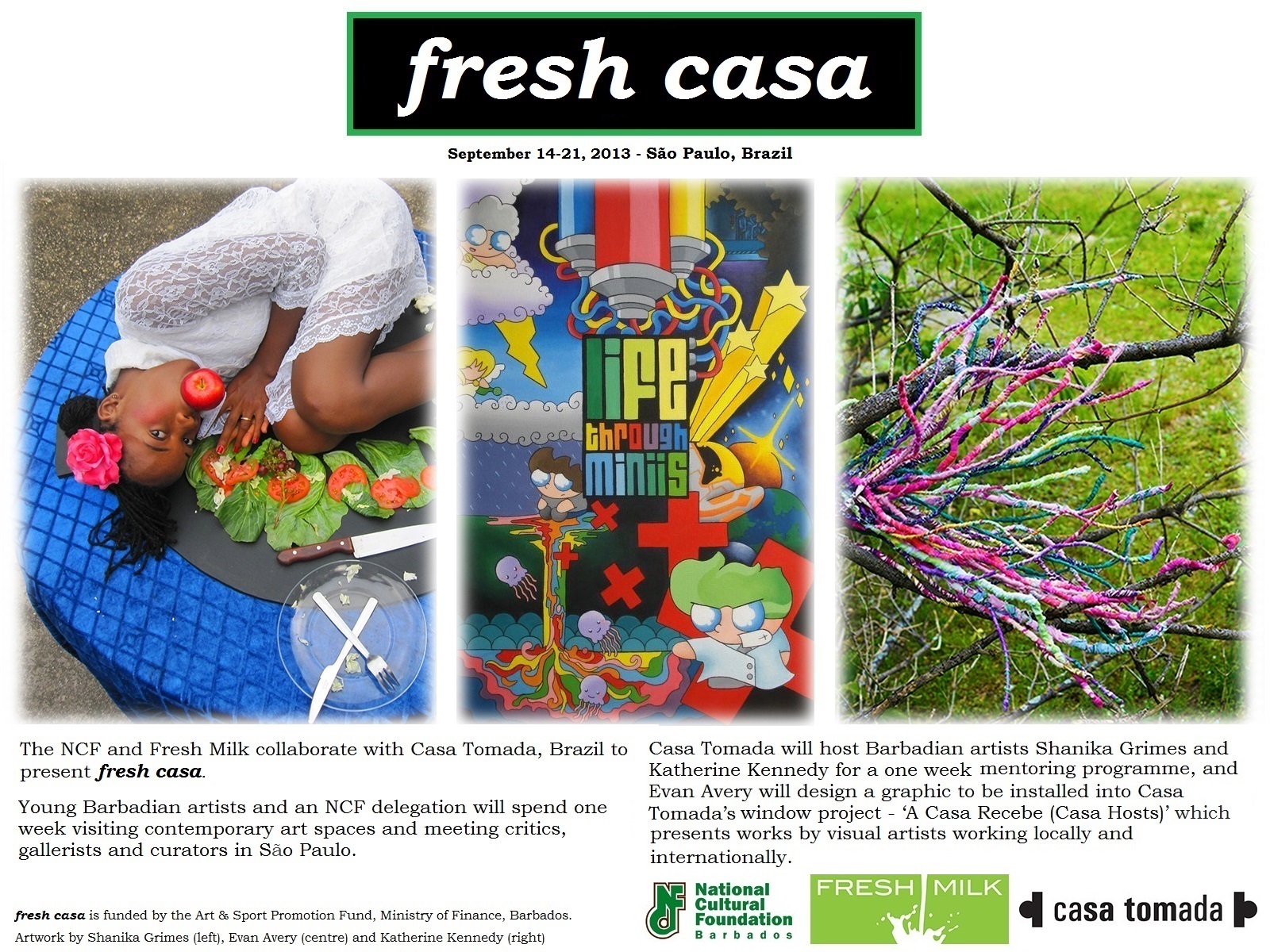
The National Cultural Foundation (NCF) and the Fresh Milk Art Platform Inc., in collaboration with Casa Tomada of Sao Paulo, Brazil present fresh casa which will take place in Sao Paulo from September 14th – 21st 2013. The project has three goals. Firstly, two young Barbadian artists, Shanika Grimes and Katherine Kennedy will participate in a mentoring programme hosted by Casa Tomada and focussing on the professionalization of artists, which will see the presentation of their art work as the focus of their one week intensive residency experience.

Grimes and Kennedy will be mentored by Brazilian arts professionals including professors, curators and critics, who are regularly engaged with Sao Paulo based creatives who focus on Performance Art, Sculpture and Installation. In addition, the young Barbadian artists will interact with Brazilian artists currently working out of Casa Tomada. At the end of the week, the Barbadian artists will make an oral presentation about their practice to a local Brazilian audience.

Secondly, Barbadian artist Evan Avery will design a graphic to be installed as an adhesive decal into Casa Tomada’s ‘A Casa Recebe’ – a street facing window which presents works by visual artists working in Brazil and internationally.

Thirdly, in a programme designed collaboratively by Fresh Milk and Casa Tomada for senior officials at the NCF, the artists will visit contemporary art spaces and meetcritics, gallerists and curators, allowing both the officials and the artists to gain an understanding of the contemporary art space in Sao Paulo. For example, they will attend the opening of ‘30 x bienal- Transformations in Brazilian art from the 1st to the 30th edition’ at Parque Ibirapuera, the home of the Sao Paulo Bienal.  Visits to contemporary commercial galleries, informal artist led initiatives, as well as museums, will form part of the dynamic programme.

Finally, a tour of Videobrasil will be coordinated for NCF delegates and the young artists. Videobrasil was present at the recently hosted e-Create symposium in Barbados last April. They are dedicated to the fostering, dissemination and mapping of contemporary art, as well as the public cultural promotion and exchange between artists, curators and researchers. Videobrasil devotes special attention to the production of the geopolitical South and supports an active network of international corporations which now include working with Barbadian entities to open up opportunities for Caribbean creatives.

Delegates from the NCF include the Chief Cultural Officer, Mrs Andrea Wells, Corporate Communications Specialist Ms Simone Codrington and Senior Business Development Officer, Ms Alison Sealy-Smith. fresh casa is funded by the Art and Sport Promotion Fund, Ministry of Finance, Barbados.

About Shanika Grimes:

shanika portrait

Shanika Grimes completed her Bachelor of Fine Arts at the Barbados Community college in 2012, while juggling the birth of her now two year old son. She displayed a proficiency in the arts from a very young age despite the pull of the business oriented society in which she lives. Shanika works in a variety of two dimensional formats and has more recently extended her practice to the realm of performance art, which is documented and presented through video or photography. She has acquired several gold and silver awards and a nomination for the Prime Minister’s award at Barbados’ national fine arts competition NIFCA. She focuses on an examination of self, which she uses as a catalyst for a barrage of ideas including, but not limited to, gender, culture and relationships.

In January 2013, she took part in a residency at Alice Yard, Trinidad, where she was paired with Trinidadian performance artist Michelle Isava and produced work individually and collaboratively.

About Katherine Kennedy:

katherine kennedy portrait

Katherine Kennedy is an artist and writer. She graduated from Lancaster University, UK with a degree in Creative Arts; her combined major of Fine Art and Creative Writing helped develop her keen interests in both visual and literary pursuits. She has won multiple awards for her artwork and writing in her home Barbados, and has exhibited internationally in London. Since returning home, she has remained immersed in creativity, completing a local artist residency, contributing to ARC Magazine by writing for their online forum and assisting the Editor-In-Chief, and working with the Fresh Milk Art Platform as Assistant to Director. Her visual practice is heavily tied to a sense of place, and often deals with interplay between found organic and inorganic objects, used as a way of asserting cultural identity in different environments.

Katherine travelled to the Instituto Buena Bista (IBB), Curaçao in November 2012 to take part in a two week collaborative project between the IBB and Fresh Milk, and undertook a residency at The Vermont Studio Center in May 2013.

About Evan Avery:

evan avery portrait

Evan Avery is a young, Barbadian artist and a 2012 graduate of the Barbados Community College, receiving a Bachelor’s Degree in Fine Arts. His primary medium is acrylic paint; working with flat, bright colours, he creates compositions with his original characters ‘the Miniis’, which he uses to represent himself or others, as well as events or things of significance in his life. He says there is “no right or wrong way” to read his work, as he wants the viewer to exercise their own imagination in their interpretation:  “The best part about being given an image without a story is in making your own. I create the work for me; it’s up to you to make it yours.”

Evan hopes to create a business, transferring his characters and ideas onto clothing and other objects as a means to share the ‘Miniis’ with people all over the world. “Miniis make people smile, and at the end of the day, that’s what matters.”

About Casa Tomada 

Created in October 2009, Casa Tomada is an independent spaced dedicated to practice, investigation and reflections of artistic nature. The project emerged from the desire to build a space that was a convergence point among the various fields in arts, discussing the hybridism of languages in the contemporary artistic processes. Focused in all the process of production and not just the final artistic product, Casa Tomada encourages the debate of young contemporary art, not only stimulating the development of artistic and theoretical work motivated by the shared experience, but acting as a catalyst space of experiences of connection among artists, art thinkers and other independent initiatives. Casa Tomada’s projects include:

Open Studio: Semester program for young artists and researchers (art criticism, curatorship and art history focus). The program proposes interchange among artists and art thinkers, stimulating one another in their own art production.

The House Hosts: A program that stimulates the interchange of independent art spaces and promotes the broadcasting of artistic publications. It has the objective enhance the relationship networks of these artistic centers with independent ones.

Portfolio’s Cycle: Annual program in which young artists and researchers currently performing in Sao Paulo are invited to present their portfolios taking advantage of the informal infrastructure of Casa Tomada for an open discussion. 

About Fresh Milk

The Fresh Milk Art Platform Inc. is a Caribbean non-profit, artist-led, inter-disciplinary organization that supports creatives and promotes wise social, economic, and environmental stewardship through creative engagement with society and by cultivating excellence in the arts. The idea for Fresh Milk developed over years of conversations with other practicing artists around the need for artistic engagement amongst contemporary practitioners living and working in Barbados, with an expressed need to strengthen links with the region and the diaspora. Fresh Milk bridges the divides between creative disciplines, generations of creatives, and works across all linguistic territories in the region – functioning as a cultural lab, constantly redefining itself. The platform transforms into a gathering space for contemporary creatives who are thirsty to debate ideas and share works through local and international residencies, lectures, screenings, workshops, exhibitions, projects etc.

About the NCF

The National Cultural Foundation (NCF) is a statutory body established by an Act of Parliament in 1983. Its mandate is to oversee the cultural landscape of Barbados.

Mission: To fuel the development of culture through training, research and the creation of opportunities in cultural industries.

The Role of the NCF: The NCF’s two major roles are: developmental and commercial. In its developmental role, the Foundation uses culture as a tool for national development, fostering and supporting the various art forms and new cultural products. In its commercial role, the Foundation is responsible for the promotion, production and hosting of cultural festivals and associated events.