Open Call: Fresh Milk Ecological Archives Fellowship

The Fresh Milk Art Platform is launching its pilot Ecological Archives Fellowship, granting $10,580 BBD for a local independent researcher to create a mixed-media bibliography and narrative of memory dedicated to the Barbadian landscape, its transformation over time, and a genealogy of the eco-critical activism carried out to protect the integrity of our various ecosystems.

Duration: 11 months [July 2026 — June 2027]
48 weeks @ 8 hours/week

Read more below, and see the application form here.

Background

This pilot fellowship is made possible with joint funding from Peter Lewis, through the Colleen Lewis Reading Room Slow Reading Programme, and from the Peter Moores Barbados Trust.

The 2026 Slow Reading Programme serves to activate Fresh Milk’s Colleen Lewis Reading Room (CLRR), in remembrance of Colleen Lewis and her legacy on the 20th anniversary of her passing. Colleen’s research, specifically her essay Pictorial Depictions of the West Indian Landscape in the 18th century and early 19th century: the sublime, the picturesque, the romantic (Barbados Museum & Historical Society Journal, Volume 50, 2004), invites us to pay particular attention to our landscape after centuries of artistic and ideological interpretation by foreign gazes and extractive interests.

The Colleen Lewis Reading Room, located in St. George, Barbados at The Fresh Milk Art Platform, is a site outfitted for accessing, cross-referencing and discussing thousands of texts relating to the genealogy of arts, literature, art history, theory, Caribbean history and critical thought — ranging from local, regional and international spheres. It provides an avenue to interrogate the social questions and challenges of our times.

The 2026 inaugural Ecological Archives Fellowship seeks to augment the library by establishing a collection of scholarly and creative materials focussed on the environment, which will also be facilitated in part on the Fresh Milk website.

This Fellowship stems from Ariella Aïsha Azoulay’s work Potential History: Unlearning Imperialism (2019), which presents the notion of “cocitizens” as those who “care for the common world they share with (…) others and are committed to dismantling the principle of differentiality that organises it”. The political principle of differentiality is recognised as being exemplary in the Barbadian historical context — citing Hillary Beckles’ work Britain’s Black Debt (2013) — as amongst the first legally constituted “offshore outpost” territories of the New World. She explains “People started to be governed differentially from others, by other people whose rights were inscribed in the worlds that the governed were forced to build and within which they were denied the right to feel at home.” This principle enabled people living in the mainland (Europe) “not to associate themselves with forms of brutal violence… even when they directly benefited from them.” (pg. 35-36)

Azoulay’s work, which aims to “reject imperialism’s conceptual apparatus altogether” presents an unorthodox approach to the archives, positioning it not as a neutral site, but as a technology. Potential history “is a form of being with others, both living and dead, across time, against the separation of the past from the present, and history from politics.” (pg. 43) The arts, and the archives of the development of the cultural ecosystem in the Caribbean, is indispensable to the work of defining the principles of our citizenship, working within this enmeshment of imperial history and politics: “Art should be understood as a world-building set of activities irreducible to the creation of discrete objects. Through these activities, people’s place in a shared world and their right to this place are carved.” (pg. 140)

This interdisciplinary archive seeks to counteract the generalised narratives of “passivity” in the Barbadian context, by highlighting the lineage of proactive and engaged ecological activism, demonstrating resistance to the touristification of the small island, both currently and historically.

It also seeks to include resistance to overdevelopment and usurpation of our land, through the eyes of scholars, educators, journalists, musicians, artists, poets, politicians, ecologists, biologists and activists cognisant of some of the island’s most compromised physical assets including:

  • Coastal areas
  • Mangroves
  • Parks
  • Public beach access points
  • Gullies and forests

Also considering the presence in our socio-economic matrix of artificial landscapes such as:

  • Agricultural lands
  • Wind and solar farms
  • Golf courses

Fellowship Goals

 Design a research framework that generates an inspiring perspective on the intersections of science, art and culture, in order to exalt our historical and current civic relationship to our natural environment.

 Consolidate an initial compilation of archival material related to the specific theme of Barbadian ecology, and its relevant socio-cultural and political-economic intersections.

 Including, but not limited to: public and community archival materials; informal oral histories and diaries; published academic articles; visual, musical, theatrical and literary arts; archival videos and photographs.

 •  Promote awareness of our historical and current civic relationship to our environment in a way that is broadly accessible and counteracts the isolated silo effect between both different generations, and different knowledge sectors.

As this is a pilot Fellowship, a desired outcome specific to this first iteration (developed in collaboration with the Fresh Milk team) is to determine an overarching understanding of i) how to best disseminate and publicly engage an Ecological Archive, and ii) what local conditions and approaches are necessary in order to guarantee continued independent research, including encouraging contributions from a community-led, citizen science approach.


Eligibility

  • Applicants must be 21 years of age or older.
  • Applicants must be based in Barbados.
  • Applications are welcomed from a variety of backgrounds, such as (but not limited to) environmental/conservation scientists; journalists; librarians; archivists; art researchers etc.
  • Applicants must possess research skills and integrity, as well as strong communication skills and tech literacy (Google suite, internet research, Zoom; ability to record audio preferred, but not required).
  • As the Fellowship is intended to support independent investigation, Applicants cannot use Fellowship funds to conduct research on behalf of another institution, corporation or nonprofit organisation.

Review Process

  • June 1st: Applications open.
  • June 26th [26/06 Midnight AST]: Applications close
  • July 7th/8th: Shortlisted candidates notified.
  • July 28th: Final decision made.
  • July 31st: Public Announcement of selected Fellow.
  • August 1st: Fellowship commences

The applications will be reviewed by the Fresh Milk team; Fresh Milk Advisory Board member, Peter Lawrence Thompson; and two external Experts: Dr. Robin Mahon, retired Director and Professor Emeritus at the Centre for Resource Management and Environmental Studies (CERMES), at the University of the West Indies (UWI); and Dr. Carla Daniel, Director of Public Awareness and Education with the Barbados Sea Turtle Project.

The applications will be evaluated based on the following criteria:

 Precedence of workThe Application should provide a concrete background of formal and/or informal: studies, work, and/or activities relevant to the themes of the Fellowship.

 CriticalityThe Application should demonstrate a reflexive perspective that leads through constructive questioning, curiosity and innovative contextual understanding.

 Eco-centric CreativityThe Application reflects a creative approach to the Fellowship goals which centres experimentation and a desire to re-think the role the Archives and storytelling can have in nurturing a relationship of stewardship to our land.


Timeline

Phase 1 — Gathering

[July/August/September/October]

  • Establish research plan
  • Conduct site visits and online research
  • Create a database of recorded oral accounts

Phase 2 — Organising

[November/December/January/February]

  • Determine and populate the technical and narrative structure to organise the materials gathered, thinking through the practical and aesthetic needs of hosting and using a mix-media and interdisciplinary archive as technology.

Phase 3 — Sharing

[March/April/May/June]

  • Generate and carry out an accessible format and strategy that can be used to disseminate the Ecological Archive, in a way that raises awareness, engagement and relevance for the general public and practitioners across the respective disciplines.

For example, this can include a public event, a video series, a printed zine, a community workshop series etc.


Commitments of Fellow

Schedule: The Fellow is available to work either 1 full day a week, or 2 half days a week for the 11 month period.

Site-based work: The Fellow’s work hours must be undertaken in the CLRR, or when appropriate, to the archival institutions or field work.

Reporting: The Fellow will commit to provide content once a month in the form of brief reflections and videos/photographs of their process, created in collaboration with Fresh Milk’s content specialist.


Release of Funds

  • Forty percent (40%) — $4,232 — will be awarded upon mutual completion of the grant agreement.
  • Twenty percent (20%) — $2,116 — will be awarded upon completion of phase 1.
  • Twenty percent (20%) — $2,116 — will be awarded upon completion of phase 2.
  • Twenty percent (20%) — $2,116 — will be awarded upon completion of final report submission.

The Fellowship funds are intended to be used at the Fellow’s discretion, as well as to cover expenses related to local travel to the CLRR and other locations of research.


How to Apply (Form)

To apply, please fill out the Google Form application form by midnight, June 26th.

Main questions:

1.In 250-500 words, describe your background and interest as it relates to the themes and work of ecology, eco-critical activism and archival practices in the Barbadian context?

2.In 400-800 words, describe your perspective as it relates to our historical and current civic relationship to our natural environment.

3.In 500—900 words, share your ideas to pursue the Fellowship goals, and vision for how the Archives and storytelling can be experimented with in order to nurture a relationship of stewardship to our land.

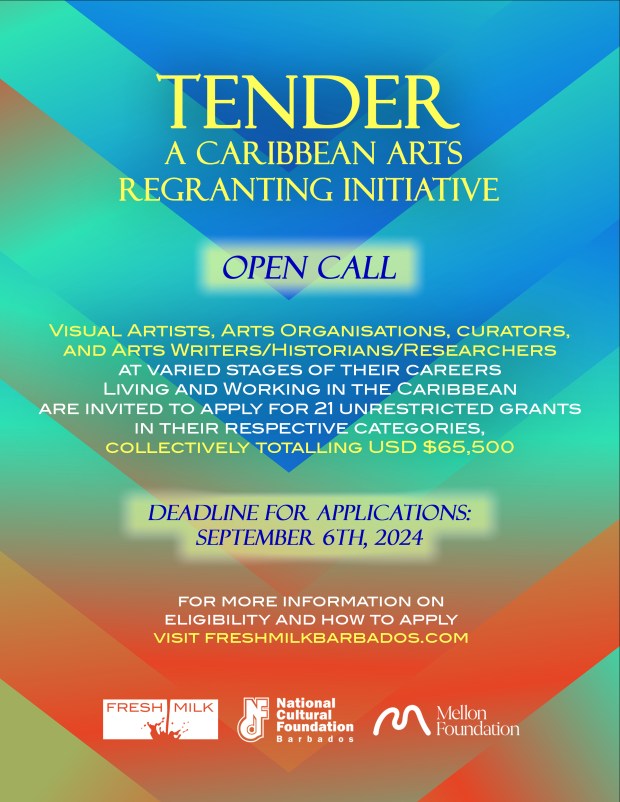
Open Call – TENDER: A Caribbean Arts Regranting Initiative

IMPORTANT DATES:

  • July 29th – September 6th, 2024 – Open call submission window
  • September – October, 2024 – Review of applications by jury
  • October 21st – 25th, 2024 – Contacting of successful applicants 
  • October 28th, 2024 – Announcement of results 
  • November, 2024 – Disbursal of funds


[ ten-der ] definition: 
1. gentle, loving, or kind;
2. something offered especially money, as in payment.


The Fresh Milk Art Platform, with the generous support of the US-based Andrew W. Mellon Foundation and the National Cultural Foundation (NCF), is excited to launch the inaugural edition of TENDER: A Caribbean Arts Regranting Initiative.

In 2024, Fresh Milk was awarded a major grant from the Mellon Foundation’s Arts and Culture programme supporting its operating and programming expenses. This unprecedented level of funding to the platform has inspired the organisation to pay it forward, designing a programme where unrestricted grants can be accessed by Caribbean contemporary visual artists, arts-focused organisations, curators, and art historians/writers/researchers who are living and working in the Caribbean. The NCF, as one of the main entities supporting cultural activities that benefit the citizens of Barbados while also promoting cultural exchanges on an international level, has graciously joined us in this effort, extending our support even further for eligible applicants in Barbados and throughout the English, Spanish, French or Dutch-speaking Caribbean territories. 

The ethos of this programme is centred on generosity, faith, and care; Fresh Milk has always had an unwavering belief in the talent and potential of artists from this region, and as an artist-led space, we are intimately familiar with the range of challenges involved in maintaining a practice. These twenty-one (21) unrestricted grants will be awarded to eligible creatives, who can use the funds as they see fit. Whether it is towards creating new work, acquiring materials, research and development, designing new or continuing existing programmes, pursuing further studies, exhibition preparation or production, participating in artist residencies, or any general living expenses; a tender gesture of appreciation to the recipients for their commitment to working in the arts.

Along with financial support, the work of each successful grantee will be promoted widely through Fresh Milk and the NCF’s local and regional networks in the form of a featured page on our website, extensive social media coverage, and a recorded interview with the recipient discussing their practice. In this way, we also hope to strengthen artists’ networks, further contributing to a sense of community and the public archiving of Caribbean creativity.

Fresh Milk is interested in supporting experimental contemporary visual art, and curatorial and research-based practices that explore structure, content, and expanded exhibition approaches in new ways. The grants will fall into three levels of funding:


1. TEN (10) grants valued at USD $1,500.00 (BBD $3,000.00) each, which will be awarded to:

      • FIVE (5) Barbados-based recent visual arts graduates;
      • FIVE (5) Caribbean-based recent visual arts graduates.

ELIGIBILITY REQUIREMENTS:

      • Artists must have graduated with a BFA or equivalent degree within the last 6 years (2019-2024);
      • Artists must be currently living and practising in the Caribbean
      • Artists’ work can span any discipline/media of contemporary visual arts practice (painting, drawing, printmaking, photography, mixed media, sculpture, installation, video, new media, experimental audiovisual art, performance art, interdisciplinary/multidisciplinary);
      • Artists must demonstrate a high standard of work in keeping with their level of experience, and a commitment to the continued development of their practice.

2. EIGHT (8) grants valued at USD $3,500.00 (BBD $7,000.00) each, which will be awarded to:

      • TWO (2) Barbados-based emerging/mid-career visual artists;
      • ONE (1) Barbados-based independent/non-profit arts-focused organisation;
      • ONE (1) Barbados-based curator or art historian/writer/researcher.
      • TWO (2) Caribbean-based emerging/mid-career visual artists;
      • ONE (1) Caribbean-based independent/non-profit arts-focused organisation;
      • ONE (1) Caribbean-based curator or art historian/writer/researcher.

ELIGIBILITY REQUIREMENTS:

VISUAL ARTISTS:

      • Artists must have been living and practising in the Caribbean for a minimum of 7 years;
      • Artists’ work can span any discipline/media of contemporary visual arts practice (painting, drawing, printmaking, photography, mixed media, sculpture, installation, video, new media, experimental audiovisual art, performance art, interdisciplinary/multidisciplinary);
      • Artists must demonstrate a high standard of work and professional endeavours (participation in exhibitions, residencies, workshops, programming etc.) in keeping with their level of experience.

ARTS ORGANISATIONS:

      • Organisations must have been operating within the Caribbean for a minimum of 3 years;
      • Organisations must be independent/non-governmental;
      • Organisations need not be registered charities/non-profits but must be able to demonstrate best practices in terms of governance and operations management.
      • Organisations must demonstrate a clear commitment to their mission and vision as it relates to contemporary Caribbean art and give examples of their work in alignment with this.

CURATORS & ART HISTORIANS/WRITERS/RESEARCHERS:

      • Practitioners must have been living and working in the Caribbean for a minimum of 7 years;
      • Practitioners must give examples of their work (whether through exhibitions, published written work, or research) demonstrating their commitment to exploring and showcasing contemporary Caribbean art practices.

3. THREE (3) grants valued at USD $7,500.00 (BBD $15,000.00) each, which will be awarded to:

      • ONE (1) established Barbados-based visual artist
      • TWO (2) established Caribbean-based visual artists

ELIGIBILITY REQUIREMENTS:

      • Artists must have been living and practising in the Caribbean for a minimum of 20 years;
      • Artists’ work can span any discipline/media of contemporary visual arts practice (painting, drawing, printmaking, photography, mixed media, sculpture, installation, video, new media, experimental audiovisual art, performance art, interdisciplinary/multidisciplinary);
      • Artists must demonstrate a high standard of work and professional endeavours (participation in exhibitions, residencies, workshops, programming etc.) in keeping with their long and influential careers.

SUBMISSION REQUIREMENTS:

ALL applications must be submitted through the official Google Form provided (any submissions sent by email or in hard copy will not be eligible for review).

The APPLICATION FORM includes the following:

FOR VISUAL ARTISTS:

      • Submission of a brief bio (250 words maximum); 
      • Submission of an artist statement, providing an overview of your practice to help contextualise the artworks shared for review (250 words maximum);
      • Submission of an up-to-date CV (2 pages maximum);
      • 5-8 clearly labelled samples of work that best showcase your practice (accepted file formats include JPEG, PNG, GIF, MP4, MP3, DOC, DOCX and PDF. In the case of video works, YouTube or Vimeo links may be provided, along with passwords if applicable). Document files should not exceed 10 MB. Image/audio/video files should not exceed 100MB.

FOR ARTS ORGANISATIONS:

      • Submission of an overview of the organisation, including its mission, vision, key personnel, and a brief history of the work it has done in the Caribbean (500 words maximum); 
      • Submission of a list of the organisation’s projects/programming and any notable accolades achieved (2 pages maximum);
      • 5-8 clearly labelled samples of work that best showcase the organisation’s output (accepted file formats include JPEG, PNG, GIF, MP4, MP3, DOC, DOCX, and PDF. In the case of video works, YouTube or Vimeo links may be provided, along with passwords if applicable). Document files should not exceed 10 MB. Image/audio/video files should not exceed 100MB.

FOR CURATORS:

      • Submission of a brief bio (250 words maximum); 
      • Submission of a statement outlining main curatorial interests and concerns (250 words maximum);
      • Submission of an up-to-date CV (2 pages maximum);
      • 5-8 clearly labelled samples of work that best showcase your curatorial output (accepted file formats include JPEG, PNG, GIF, MP4, MP3, DOC, DOCX, and PDF. In the case of video works, YouTube or Vimeo links may be provided, along with passwords if applicable). Document files should not exceed 10 MB. Image/audio/video files should not exceed 100MB.

FOR ART HISTORIANS/WRITERS/RESEARCHERS:

      • Submission of a brief bio (250 words maximum); 
      • Submission of a statement outlining main areas of writing/research (250 words maximum);
      • Submission of an up-to-date CV (2 pages maximum);
      • 3-5 clearly labelled samples of written work, no more than 2500 words each (accepted file formats include DOC, DOCX, and PDF). Document files should not exceed 10 MB. 

All applicants will also be asked for a brief statement on why the receipt of this grant would be timely for their practice. Those fitting the above criteria and based in the following countries may apply:

Anguilla, Antigua & Barbuda, Aruba, The Bahamas, Barbados, Belize, Bermuda, Bonaire, British Virgin Islands, Cayman Islands, Cuba, Curaçao, Dominica, Dominican Republic, French Guiana, Grenada, Guadeloupe, Guyana, Haiti, Jamaica, Martinique, Montserrat, Puerto Rico, Saba, St. Barthelemy, St. Eustatius, St. Kitts & Nevis, St. Lucia, St. Vincent & the Grenadines, Saint Martin, Sint Maarten, Suriname, Trinidad & Tobago, Turks & Caicos Islands, US Virgin Islands. 

SELECTION PROCESS:

Applications will be independently reviewed by a 3-member jury comprising one Barbadian, one Caribbean, and one international jury member, each of whom will be an expert in their field and familiar with contemporary art practice in the Caribbean. Jurors will assign scores to each segment of the applicants’ submissions, and a jury meeting will be held once scores have been collated. The jury’s decision will be final, and a jury report will be released publicly when successful applicants are announced. Neither the jury members nor the Fresh Milk Team will be able to offer feedback on individual applications.

JURY MEMBERS:

      • Dr. Therese Hadchity, Art historian and professor in Cultural Studies at The University of the West Indies Cave Hill Campus, Barbados;
      • Tirzo Martha, Visual artist and co-founder of the Instituto Buena Bista, Curaçao;
      • Maria Elena Ortiz, Curator at the Modern Art Museum of Fort Worth, Texas, USA.


About Fresh Milk:

Fresh Milk is an artist-led, non-profit organisation founded in 2011 and based in Barbados. It is a platform which supports excellence in the visual arts through residencies and programmes that provide Caribbean artists with opportunities for development, fostering a thriving art community. Fresh Milk offers professional support to artists from the Caribbean and further afield and seeks to stimulate critical thinking in contemporary visual art. Its goal is to nurture artists, raise regional awareness about contemporary arts and provide Caribbean artists with opportunities for growth, excellence and success.


About the NCF:

The National Cultural Foundation (NCF) is a statutory body established by an Act of Parliament in 1983. Its mandate is to oversee the cultural landscape of Barbados. The NCF’s role revolves around the preservation of our cultural heritage and promotion of all forms of art and culture, both tangible and intangible through developmental and commercial programmes and products. The functional spectrum ranges from, generating cultural awareness at the grassroots level to promoting cultural exchanges at an international level. In its developmental role, the Foundation uses culture as a tool for national development, fostering and supporting the various art forms and new cultural products. In its commercial role, the Foundation is responsible for the promotion, production and hosting of cultural festivals and associated events.


About the Mellon Foundation:

The Andrew W. Mellon Foundation is the USA’s largest supporter of the arts and humanities. Since 1969, the Foundation has been guided by its core belief that the humanities and arts are essential to human understanding. The Foundation believes that the arts and humanities are where we express our complex humanity, and that everyone deserves the beauty, transcendence, and freedom that can be found there. Through our grants, we seek to build just communities enriched by meaning and empowered by critical thinking, where ideas and imagination can thrive.

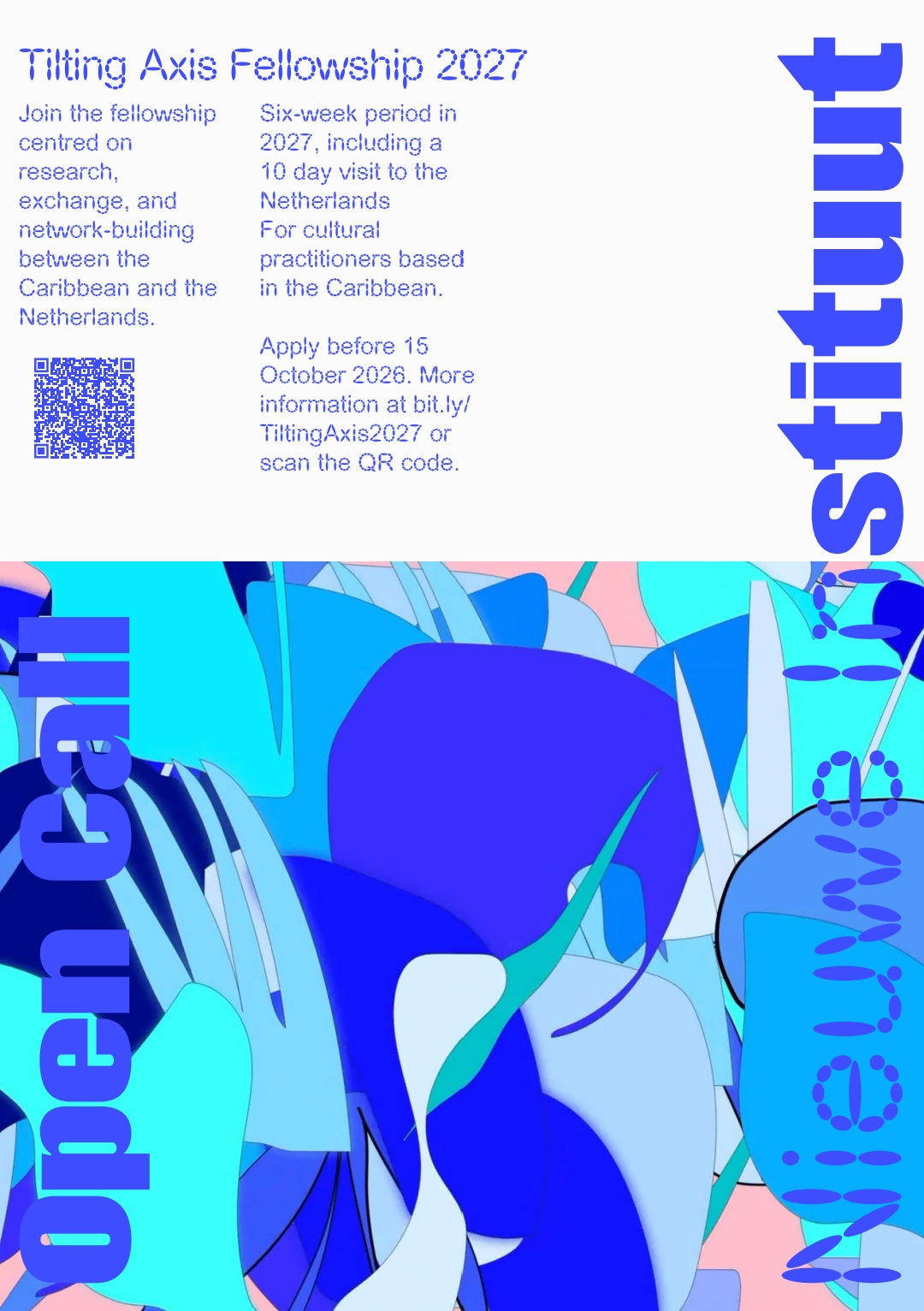
Open Call: Tilting Axis Fellowship 2025

Nieuwe Instituut and Tilting Axis are launching the fifth iteration of the Fellowship program for applicants based in the Caribbean. The initiative aims to foster and support research based practices and stimulate mutual exchange between the Caribbean region and the Dutch cultural field. Together with the leading partners – Nieuwe Instituut and Tilting Axis – other cultural institutions including The Amsterdam MuseumDe AppelStedelijk Museum Amsterdam, and Kunstinstituut Melly will engage with the selected applicant during the Fellowship.
About the Fellowship

This Fellowship focuses on applicants living and working within the Caribbean region offering the space to think through research and practice. The selected applicant will be based in Rotterdam at Nieuwe Instituut and will have access to other partner cultural institutions in Rotterdam and Amsterdam.

The Fellowship will be developed through independent research; individual support and interaction with the Research Department team at Nieuwe Instituut; monthly meetings to discuss thematic and methodological aspects of the project; and diverse collaborations with partner institutions.

Applicants are invited to submit a proposal that addresses their current investigations and research interests through the lens of architecture, design and digital culture.

Read more about the past editions of the Tilting Axis Fellowship with Fellow Sean Leonard in 2020-2021, Fernando Martirena and Anadis Gonzálezin 2021-2022, Israel Mapp in 2023, and Klieon John in 2024.

For whom?

A researcher, designer, writer, curator, or cultural producer based in the Caribbean region who is interested in building new links with cultural institutions in the Netherlands, and developing the research practice around themes related to architecture, spatial practice, design or digital culture.

Neither a curriculum vitae nor letters of recommendation are requested. The Fellowship is open to all degree-levels in design, architecture, and digital culture. Equal priority will be given to those without a degree or institutional affiliation who can also demonstrate a high levels of creativity, critical thought, and other potential in their respective fields. There is no age limit for applicants.

Artists who are residents of and based in the following countries can apply: Anguilla, Antigua, Aruba & Barbuda, The Bahamas, Barbados, Belize, Bermuda, Bonaire, British Virgin Islands, Cayman Islands, Cuba, Curaçao, Dominica, Dominican Republic, French Guiana, Grenada, Guadeloupe, Guyana, Haiti, Jamaica, Martinique, Montserrat, Puerto Rico, Saba, St. Barthélemy, St. Eustatius, St. Kitts & Nevis, St. Vincent & the Grenadines, Saint Martin, Sint Martin, Suriname, Trinidad & Tobago, Turks & Caicos Islands, US Virgin Islands.

Resources offered by the Fellowship

  • Stimulate and visualise curatorial, design, and artistic realities coming from the Caribbean region;
  • Enhance knowledge exchange and collaboration with a cross-section of Dutch cultural institutions;
  • Network and exchange with a variety of platforms for professional experience;
  • Produce critical knowledge on inter-disciplinary exchanges as well as visual culture;
  • Offer practical support for travel to the Netherlands;
  • Engage with hosting and collaborating institutions to interrogate and challenge their institutional structures and methodologies;
  • Utilise the existing Tilting Axis network.

The Fellow will be invited to:

  • Make a series of presentations in Rotterdam & Amsterdam at host and partner institutions on their research/practice;
  • Produce a monthly text/sound/video/photo essay as potential options to be discussed with the fellow. The fellow’s research could lead to an installation, exhibition, or further events at partner institutions during or after the Fellowship;
  • Write a final reflective report on the Fellowship experience is required and will be posted on the websites of Tilting Axis and Nieuwe Instituut, with links to the partner institutions.

The Fellow is not expected to produce an outcome or finished artwork or product but will be encouraged to present their ongoing research interests to the public whilst in the Netherlands. The research will also be published via the Nieuwe Instituut and partner institutions’ websites, newsletters, or other publications.

Research Stipend and Travelling to the Netherlands

Nieuwe Instituut will grant a total stipend of €12,000 to cover living expenses and, in addition to the stipend, will cover one round-trip airfare from any country within the Caribbean to the Netherlands. Accommodation costs will be reimbursed to the fellow in the Netherlands for a maximum of €800 per month. Stipends may be subject to a withholding tax.

Government policies regarding visa restrictions will be adhered to. This means that Fellows who can only reside in the Netherlands for 90 days, will undertake their fellowship partly remotely.

Crossovers Programme

This Fellowship is part of the Nieuwe Instituut’s crossovers programme that aims to stimulate the international exchange of knowledge and research through collaborative fellowships, events, exhibitions, and publications involving designers, researchers, and partners across the world. Broader alliances can contribute to cultural and political change, and eventually to policy adjustments.

Apply

The Open Call for 2025 is available from May 30, 2024, with a deadline for submission on June 30, 2024. Proposals should be submitted to ta-fellowship@nieuweinstituut.nl with the subject Tilting Axis Fellowship 2024<name>.

To be considered, proposals should include the following information:

  • An introductory video, max 3 minutes, in which applicants introduce themselves, their initial project idea, and what inspired them to apply.

  • A written proposal of max 1000 words in which applicants detail: a statement of intent which should explain the applicant’s research focus and its methodology, highlighting its connection to architecture, design, or digital culture; the relation between their interests and at least two of the hosting partners and institutions; the proposal should be content-driven and can be based on already existing research or offer new projects; a proposed working calendar with availability to take up the fellowship from February – July 2025; Relevant documentation of previous work (maximum 10 works), and/or links to audio or video files (maximum 5 minutes) in PDF format with an accompanying caption list.

Proposals should be written in English and applicants must have a working knowledge of English. While we understand that English proficiency may vary or that English may not be the applicant’s first or primary language, unfortunately, we are unable to offer translation support at this time. Applicants with specific questions are encouraged to contact ta-fellowship@nieuweinstituut.nlabout the availability of any support service.

Selection process

Proposals will be considered by an international committee including the Tilting Axis and the Nieuwe Instituut teams and representatives from the partner institutions including curators, academics, and museum professionals.

The review committee includes:

  • Tijn van de Wijdeven, Nieuwe Instituut

  • Holly Bynoe, ARC Magazine, Sour Grass and Tilting Axis co-founder

  • Annalee Davis, Visual Artist, Founding Director of Fresh Milk, Sour Grass, and Tilting Axis co-founder

  • Jessy Koeiman, Curator of Collective Learning, Kunstinstituut Melly

  • Mark Raymond, Director of the Graduate School of Architecture at the University of Johannesburg in South Africa

  • Lara Khaldi, Direct at De Appel

  • Imara Limon, Curator, Amsterdam Museum & Silke Kamp, Curator-in-Training, Amsterdam Museum

  • Charl Landvreugd, Head of Research and Curatorial Practice, Stedelijk Museum Amsterdam

Shortlisted candidates will be invited to an online interview with members of the selection committee. Candidates must hold the dates July 10th and July 11th, 2024 for the interview.

Read more about the Tilting Axis Fellowship and the call for applications on the website of the Nieuwe Instituut.


Open Call: TVE 5 2024

Imporant dates:

  • Start of application period: Tuesday May 14th, 2024
  • End of application period: Sunday June 30th, 2024
  • Community of curatorial practice workshops: July/August, 2024
  • Public announcement of results: September, 2024
  • Polish Screenings: September, 2024
  • Caribbean Screenings: November, 2024
  • Online Exhibition: December, 2024

Call for Works:

The Fresh Milk Art Platform (Barbados) and the Centre for Culture in Lublin (Poland) as part of Lublin’s bid for the European Capital of Culture 2029 title are pleased to welcome submissions of recent film and video works – screenings, installations, new media, time-based media and expanded cinema – by contemporary artists, to be included in the fifth edition of Transoceanic Visual Exchange (TVE), a series of programmes taking place this year between Barbados and Poland, with an accompanying online exhibition. 

Submitted works must have been completed in the last five years and must be made by artists practicing in the Caribbean, Poland, Ukraine and their diasporas. 

TVE 5 will be a collection of recent artists’ films and videos from each region. However, the final shape and content of the programme will be informed by a community curatorial process, which aims to involve and promote discussion within the wider creative communities of each participating initiative.

Working between the Caribbean, Poland and Ukraine, TVE 5 aims to negotiate the in-between space of our cultural communities outside of traditional geo-political zones of encounter and trade. TVE intends to build relations and open up greater pathways of visibility, discourse and knowledge production between the regional art spaces and their publics.

Submission requirements:

  • Must be work from artists practicing in the Caribbean, Ukraine, Poland or their diasporas;
  • Must be work that has been completed/made in the last five years;
  • Can be films of any length (shorts, experimental, features and video artworks);
  • Can be in any language (films originally produced in regional languages are welcome);
  • Up to 3 submissions per applicant are welcome;
  • Must be accompanied by a description of the work (500 words max), a bio (200 words max) and details of any technical requirements i.e. audio, installation, equipment required, preferred setting etc.;
  • Works must be mp4 files no larger than 100MB, or Vimeo/Youtube links with passwords if applicable;
  • Works must not have been submitted to the previous edition of TVE;
  • Please specify whether your submitted works have permission to be exhibited on an online space.

Selection Process:

One of the core values of TVE is the model of community curatorial practice as opposed to one of solely contracting curators or hiring a jury to review submissions in isolation. This has taken the shape of open roundtable conversations with interested members of the community in each partner’s country/region, where current trends, concerns and interests in the areas of video art, film and new media are discussed. After these conversations, the partners will convene to select works which align with and reflect the research gathered, including the community’s input in the design of the final programme.

What TVE 5 Offers:

  • Each selected artist will receive a stipend of $250.00 USD for their participation in the programme;
  • Artists’ work will be showcased in a series of events in Barbados and Poland and a virtual exhibition on the TVE website, facilitated and promoted by the TVE partners;
  • The artists’ profiles will be permanently housed on the TVE website, and their work will be widely promoted throughout Fresh Milk’s and the Centre for Culture in Lublin’s networks in the Caribbean and Eastern Europe;
  • The artists will have the opportunity to grow their own networks and knowledge regarding video arts and filmmaking practices across the Caribbean, Poland and Ukraine, deepening understanding between the regions and opening up greater possibilities of collaboration.

Deadline for submissions: June 30th 2024

Click here for the online form for Caribbean submissions
Click here for the online form for Polish submissions
Click here for the online form for Ukrainian submissions

For more information on TVE and its first four iterations, visit the website transoceanicvisualexchange.com

This edition of TVE is also supported in part by TEOR/éTica, our partner organisation for TVE 4, from whom we received a 2023 Catalyst Grant with the generous support of Arts Collaboratory, and by a grant received from the Mellon Foundation.

About the Partners:

Fresh Milk

Fresh Milk is an artist-led, non-profit organisation founded in 2011 and based in Barbados. It is a platform which supports excellence in the visual arts through residencies and programmes that provide Caribbean artists with opportunities for development, fostering a thriving art community.

Fresh Milk offers professional support to artists from the Caribbean and further afield and seeks to stimulate critical thinking in contemporary visual art. Its goal is to nurture artists, raise regional awareness about contemporary arts and provide Caribbean artists with opportunities for growth, excellence and success.

The Centre for Culture in Lublin

At the Centre for Culture, our “home of imagination” we want to manage human talents wisely and create favourable conditions for artistic work, education and presentation of art and artistic activities. We want to be open to new people, new projects and phenomena. We believe that we will have the courage to take creative risks.

Lublin 2029 – European Capital of Culture Candidate City

The project is part of Lublin’s bid for the European Capital of Culture 2029 title. Re:Union, the bid’s motto refers to the historic concept of the Union of Lublin (1569), a commonwealth treaty signed by the Kingdom of Poland and the Grand Duchy of Lithuania. It is understood as reintegration, reconnection of broken ties, cross-generational, cross-cultural and intersectional dialogue.


DEADLINE EXTENDED – Fresh Milk/Healing Arts Initiative: Call for Artworks #2

Earlier this year, The Fresh Milk Art Platform, Future Centre Trust, Environ Ltd (Adopt A Stop Barbados) and The Healing Arts Initiative in partnership with CULTURUNNERS as part of the World Health Organization, welcomed proposals by Barbadian-based contemporary artists for artworks to be installed along the Barbados Trailway.

While we plan for the upcoming launch and unveiling of these pieces to the public, we are thrilled to announce Phase 2 of our collaboration, with our second open call for works. This time around, three Barbadian artists will be selected to have their artwork featured on solar bus shelters, to be installed in rurally located, underserved areas of the island.

IMPORTANT DATES for PHASE 2:

Open Call Announcement: October 4th, 2022
Extended Submission Deadline: December 2nd, 2022
Jury Review of Proposals: December 3rd – December 9th, 2022
Artists Informed: December 12th, 2022
Public announcement of results: December 16th, 2022
Production of new works:
December 18th, 2022 – January 27th, 2023
Submission of completed works:
January 27th, 2023
Production and installation of works:
January-February 2023


ABOUT THE PROJECT:

This project recognises the role of the arts sector in addressing the growing mental health crisis caused by the COVID-19 pandemic, followed and further impacted by the La Soufriere volcanic eruption and Category 1 Hurricane Elsa.

The pandemic and occurrence of natural disasters have reminded us of the value of green spaces and the natural environment to enhance our physical, mental and spiritual wellness. It is well known that people, and children in particular, recover better and flourish in the outdoors. While Barbados is blessed with many beaches where locals can recreate, there isn’t enough variety of safe outdoor recreational activities promoting active mobility for young people and families.

The Future Centre Trust has been working for some time to repurpose the historic train line located in the south-central part of the island in the St. George Valley.

With the support of the Healing Arts Initiative, Fresh Milk is pleased to be collaborating with the Future Centre Trust and Environ Ltd (Adopt A Stop Barbados) to work with local artists and to strategically install these artistic interventions on the trailway as a linear outdoor exhibition opportunity, giving artists a chance to contribute to this dynamic and highly anticipated public project. Secondly, we propose the intervention of three additional outreach solar bus shelters to be placed in underserved rural communities.


Healing Arts launched in 2020 under the auspices of the World Health organization as part of The Future is Unwritten, a global initiative calling for urgent cooperation between the Arts Sector and United Nations Agencies in order to amplify and accelerate implementation of the UN Sustainable Development Goals, the most ambitious and comprehensive global development plan in human history. With leading UN Agencies describing the recent pandemic as nature’s first ‘warning shot’ to civilizations playing with fire, global cultural action that contributes to the envisioning and shaping of a more resilient, healthy and sustainable future is now more urgent than ever.

Established as part of the United Nations’ 75th Anniversary Programme (UN75) and Decade of Action, Healing Arts 2020-2030 is produced in 2022 by CULTURUNNERS and Arts & Health @ NYU under the secretariat of the World Health Organization’s Arts and Health Program.


SUBMISSION REQUIREMENTS:

●  Must be work from artists living and working in Barbados;
●  Must be new work produced for this commission;
●  The solar bus shelter dimensions for the back of the bench should be 96″ x 24″, and for the side panel (two-sided) should be 32″ x 48″, both with a ¾” bleed included;
●  Artists may submit more than one design idea, however only one commission for a bus shelter will be awarded to each of the three artists.


How to Apply:

●  Application forms must be submitted through the Google forms portal here;
●  Proposals must be formatted and uploaded to the form as ONE PDF including:

A description of the proposed work specifically responding to the call (500 words max);
2-3 concept sketches/work samples (embedded in the PDF);
A bio (200 words max);
A portfolio of 5 previous artworks (fully captioned).

●  Submissions should be titled as follows:
Surname_First Name_Healing_Bus Shelter

Submissions that do not conform to this requirement will not be reviewed. Each separate project proposal must be submitted as a new application form.

CLICK HERE TO SUBMIT YOUR PROPOSAL!

If selected, final artworks must be submitted as files via WeTransfer, following the below guidelines:


SELECTION PROCESS:

The selection process will be led by Fresh Milk in collaboration with representatives from the three partner entities who will contribute to the review and selection process through a roundtable conversation to select works which align with the project overviews and the mission of the Healing Arts Initiative stated above. A total of three artists will be selected from this open call, one artist for each of the bus shelters.


WHAT THE PROJECT OFFERS:

●  The three selected artists for the solar bus shelters will each receive an artist fee of $1,000.00 USD;
●  Artists’ work will be showcased and promoted on all partner’s websites;
●  Artists’ work will be permanently installed in rurally located, underserved areas of the community;
●  The artists’ profile will be permanently housed on the Fresh Milk and partner websites, and their work will be widely promoted throughout Fresh Milk and partners’ networks.

DEADLINE FOR SUBMISSIONS EXTENDED TO DECEMBER 2nd 2022


About the Partners:

CULTURUNNERS produces cross-cultural campaigns, exhibitions and journeys, promoting peace-building & sustainable development through art. Launching at MIT in 2014, CULTURUNNERS’ first project was a multi-year artists’ road-trip broadcasting between the United States and the Middle East. It has since grown to encompass large-scale cultural exchange and diplomacy projects, an artist-led media platform, artists’ spaces and partnerships with institutions around the world.


Fresh Milk is an artist-led, non-profit organisation founded in 2011 and based in Barbados. It is a platform which supports excellence in the visual arts through residencies and programmes that provide Caribbean artists with opportunities for development, fostering a thriving art community.

Fresh Milk offers professional support to artists from the Caribbean and further afield and seeks to stimulate critical thinking in contemporary visual art. Its goal is to nurture artists, raise regional awareness about contemporary arts and provide Caribbean artists with opportunities for growth, excellence and success.


The Future Centre Trust is a non-governmental organisation focused on raising awareness of environmental impacts to Barbados and the planet with a vision to be “a catalyst for sustainable living today and tomorrow”.  It is the main executing entity for the Barbados Trailway Project – a paved bicycle and pedestrian path located primarily on right-of-way lands of the former Barbados Railway.

This network of multi-purpose walking, hiking, running and cycling trails will provide year round recreational access for both locals and visitors, considerably expanding much needed public green space on the island.


For the past 25 years, Adopt A Stop has provided regional and international companies with a unique opportunity to display their products and services on bus shelters and benches in Barbados. The concept for Adopt A Stop was created by Barbadian Barney Gibbs while studying at Cambridge University. The project was then introduced to the island in 1993 as a socially-conscious way to provide a much-needed amenity. The priority was tropical designs constructed with local materials, placed at prime locations to give maximum impact.

The traveling public has embraced the project. The medium provides popular seating and shade for users; while increasing traffic rates mean drivers and passengers are frequently stopped in front of sponsor’s signage.