Announcing the Lucayan Archipelago Residency

Fresh Milk in partnership with Poinciana Paper Press and supported by the Panta Rhea Foundation are delighted to announce an 8-week Lucayan Archipelago Residency which will take place in The Bahamas between September and November 2024.

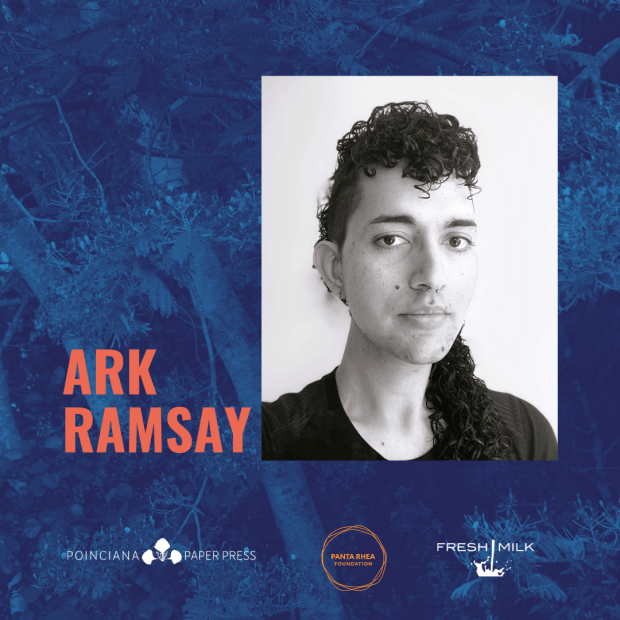
In response to the critical need for exchange across creative and environmental ecosystems, this residency brings together a writer and a visual artist from the Caribbean to imagine and co-create a critical cultural dialogue with the environment and resources in The Bahamas through the crafts of book arts. Our two residents are Ark Ramsay (Barbados) and Jocmarys Viruet Feliciano (Puerto Rico).


Ark Ramsay (Bridgetown, 1994), is a non-binary writer based in Barbados. Their work has appeared in or is forthcoming from The A-Line: Journal of Progressive Thought, Small Axe, Gertrude Press, Meridian, Adda, The Rumpus, Passages North, and The Gulf Coast. They have been a finalist for the Inaugural Story Foundation Prize through Story Magazine, an honorable mention in Ninth Letter’s 2021 Literary Award for Nonfiction, and shortlisted for the 2024 Commonwealth Short Story Award. They have received an MFA from The Ohio State University.


Puerto Rican-based Jocmarys Viruet Feliciano, a visual artist from Puerto Rico focuses on hand papermaking and book arts. She holds a bachelor’s degree in Fine Arts from the University of Puerto Rico, Mayagüez Campus and a master’s degree from the University of Iowa, Center of the Book. Jocmarys worked as an intern at the Morgan Conservatory in Cleveland, Ohio and has been an assistant at the Rare Book School at the University of Virginia. Her first experience with handmade paper was in 2014 as an exchange student in South Korea. Jocmarys has taught several bookbinding and handmade paper workshops in Puerto Rico and in the United States. Her artist’s books are part of special collections such as University of Miami, University of Iowa, Yale University, University of Pennsylvania and Stanford University. 


Together, Ark and Joko while based in Nassau will explore some of the family islands of this 700-coral island archipelago, meet with contemporary visual artists and writers, ecologists, and environmentalists to understand the ecological reality of the Lucayan Archipelago that sits within the Atlatnic Ocean. We can hardly wait to see what emerges from this collaboration!


About Fresh Milk:

Fresh Milk is an artist-led, non-profit organisation founded in 2011 and based in Barbados. It is a platform which supports excellence in the visual arts through residencies and programmes that provide Caribbean artists with opportunities for development, fostering a thriving art community. Fresh Milk offers professional support to artists from the Caribbean and further afield and seeks to stimulate critical thinking in contemporary visual art. Its goal is to nurture artists, raise regional awareness about contemporary arts and provide Caribbean artists with opportunities for growth, excellence and success.


About Poinciana Paper Press:

Located in the capital of the archipelagic nation of The Bahamas, Poinciana Paper Press provides opportunities to engage with books and their allied crafts to empower people to share their narratives in a region that has historically erased, marginalized, and exploited the culture and lived experiences of its inhabitants.

Bahamian writer and artist Sonia Farmer created Poinciana Paper Press as an independent book publisher in 2010, releasing handmade limited-edition chapbooks and artists’ books of Caribbean poetry, short stories, and experimental writing. Her vision is to advance the diversity of narratives and publishing modalities in The Caribbean.

In 2022, she established Poinciana Paper Press as the first Center for Writing, Book Arts & Publishing in The Bahamas—arguably, in the wider Caribbean—to expand this vision, developing visibility in the literary and book arts from within the Caribbean cultural ecosystem.

A major collaborator in the literary and visual arts communities in the region, Poinciana Paper Press facilitates programming aligned with its mission by providing opportunities to engage with the form of the book and its allied crafts of writing, bookbinding, letterpress printing, handmade paper, printmaking, book design, and calligraphy. This includes workshops, community outreach and engagement, exhibitions, publications, and residencies.


About Panta Rhea Foundation:

Mission: To catalyze a just and sustainable world through food sovereignty, community power building, and grassroots liberation around the globe.

The Panta Rhea Foundation (PRF) was established in 2001 as a private foundation devoted to researching issues and analyzing the operations, goals and potential of organizations committed to building a more just and sustainable world. The Foundation advises individual donors and other charitable entities on grantmaking strategies and specific grants.

We believe that lasting, authentic change must come from the grassroots; from the organized efforts of people and organizations to enliven the social imagination and envision a better future, to experiment with new ideas, and to hold elected leaders and corporations accountable to the communities they serve.

Our foundation name, Panta Rhea, is inspired by Ancient Greek philosopher Heraclitus. It roughly translates to “You never step into the same river twice” or “All things change, all things flow”—suggesting both inherent constancy and change as a fundamental of life itself. 

Aliyah Hasinah’s Fresh Milk Residency – Week 1 Blog Post

UK-based writer and curator of Bajan and Jamaican heritage, Aliyah Hasinah, shares her first blog post about her Fresh Milk international residency. Using this time primarily for research into the art scene and cultural policy in a Barbadian context, Aliyah kicks off her blogs by reflecting on some of the texts she has immersed herself in to ground her knowledge and understanding of the space, and looks forward to having more in-person discussions with artists, creatives and cultural practitioners as the weeks progress. Read more below:


It’s been a week since I started my residency at Fresh Milk with the intention of immersing myself in study to learn more about the art world and cultural policy in Barbados. Having not had the means to attend university, I’m always profoundly grateful for moments to study away from the day-to-day grind of trying to pay your rent in London, so hearing monkeys (my favourite animals) on the library roof has been a well welcomed change. I’d also like to thank Arts Council England for funding this residency because I’ve been LEARNING, I’ve been learning *Beyonce voice*. 

Prior to this, I met with Annalee Davis last year when starting my research into ‘Decolonising the Curatorial’, as funded by Arts Council England. My research was looking at the role of Crop Over as a space for exhibition outside the white walls of the gallery, a topic Claire Tancons discusses well in her essay ‘Curating Carnival’, and how galleries can never do justice to the embodied experience of carnival. 

Through my research, I sought to further understand the colonial history and how rebellions birthed art practices – or continued them – as we’ve always found ways to make art. Having only scratched the surface last year, I was keen to take more time to understand the layers and nuance of Bajan Art and cultural expression, outside of what was familial and familiar to me.

Just to prefix, I’m a loud mouth when it comes to explaining or calling out the manifestations of coloniality in the modern day in England. However, I’m very aware of my positionality as a curator from Britain researching in Barbados. My gaze does not come from one of authority but is an opinion formed from the research and conversations had with some of the island’s artists, art producers, essays as well as what I observe. 

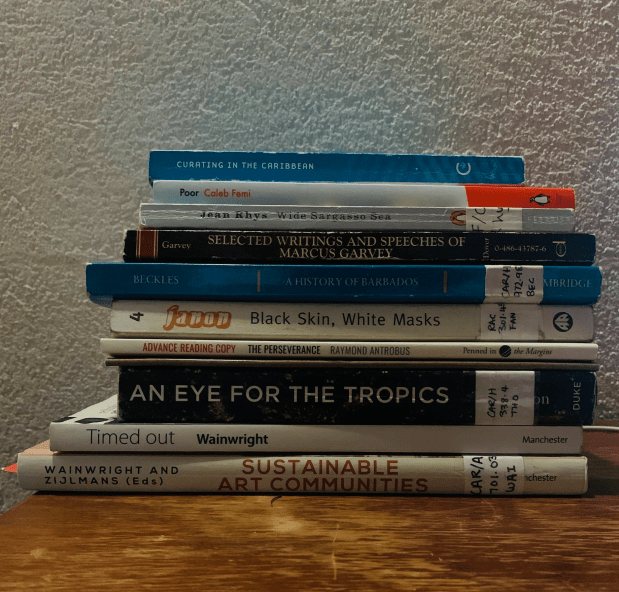
One of the writings I’ve been reading this week that deeply resonated with me was Winston Kellman’s Between A Rock And A Hard Place’ published in Sustainable Art Communities, as edited by Leon Wainwright and Kitty Zijlmans. Kellman explores several historical threads to bring us to the modern day, including the relationships with the UK and US following Barbados’ independence in 1966.

Kellman’s particular highlighting of how western modernity has shunned Caribbean art practice of landscape painting and sculpture, alluding to it being devoid of conceptual fervour is, in my mind, linked to a colonial mindset that deems ‘conceptual art’ in a particular way. 

This perspective ignores the context of the space and time that these artworks were created in, and instead attributes an archetypal aesthetic to the notion of contemporary art as opposed to understanding that sculpture and painting of the island has a deeper rooted contextualisation in the resources i.e. clay, and historical craftsmanship of the land – and is therefore contemporary if it is being made in the present. This disregard for painting and sculpture subconsciously alludes to artworks, often by Black artists, specifically in the Caribbean, being inferiorized because of a lack of contextual understanding of how the work came into being, and is additionally sidelined in national and international discourses surrounding contemporary conceptual art. All due to a lack of understanding of the context of the work. 

Anywho, I could go on for days about the learnings of the last week, all to say I’m very excited to deepen my study and continue learning about policy, sustainability and the hopes/dreams of emerging artists on the Island. The culture is very much being pushed forward by multiple artists. It is with thanks to those who have laid the foundations that younger artists today are scoping out what is possible in the process of building visual arts communities and infrastructures across Barbados that do not solely privilege the tourist economy (more on that real soon, hold tight tourism as neo-colonialism and insert Mo the Comedian saying ‘Barbados’).

I’m excited to start my new week, meeting more artists, collectors and academics. I may also post some of my readings and thoughts on my instagram (@aliyahhasinah) as I jump into my second week at Fresh Milk.

To end lightly here are 5 songs I’ve had on loop this week:

Until next week.

Lots of love and take care

Aliyah xx

P.s. Here’s some of what I’m reading / have been the last week and will continue to delve into this week, and hold tight Caleb Femi on the release of his new poetry book ‘Poor’ which everyone should cop if they can. (Feel free to send me reading and art recommendations on twitter @aliyahhasinah)

Open Call: CONTESTED DESIRES

CONTESTED DESIRES is a transnational project exploring our shared and contested colonial heritage and its influence on contemporary culture.
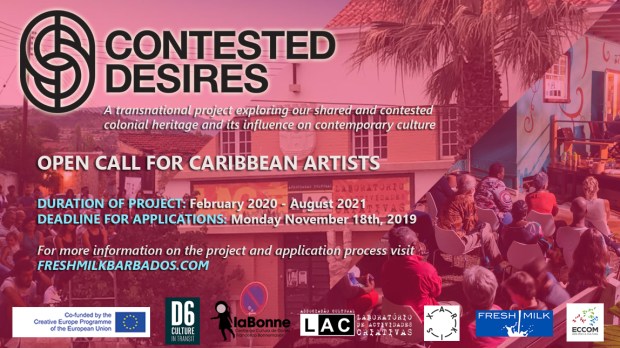
Project Duration: 14th Feb 2020 – August 2021
Project Fee:  €4,339.98 (per diems, travel and accommodation are covered separately)
Artist Geographies: Caribbean based (Applicants must have proficiency in English)
Art form: Visual arts (including but not limited to: film, digital, sound art, installation)

From the Greeks, to the Romans, the Ottomans to the Venetians, from the seafaring nations of Northern and Western Europe embarking on crusades and trade missions, Europeans have exploited, imposed and foraged cultures and communities to build their Empires.

This legacy presents a complex shared cultural heritage, too often untold, unknown and contested.  A legacy where individuals, communities and nation states have constructed their identities through a mosaic of cultural choices and desires.

CONTESTED DESIRES is a transnational capacity building programme for artists and producers engaging with communities and heritage spaces. With a focus on exchange and learning, the programme will offer unique opportunities for artists and communities to explore our shared heritage through research, workshops, residencies and exhibitions.  Working in the UK, Portugal, Cyprus, Spain, and Barbados CONTESTED DESIRES will dig deep to explore, and reveal the links between our shared colonial history and our cultural identities today – from the diverse perspectives of those working across Europe and in the Caribbean.

At a time of increasing right wing populism, CONTESTED DESIRES aims to challenge the de-stabilising and divisive impact of political landscapes of Europe both on the continent and in places like the Caribbean. The response to the complexities, diversity and expansion of European communities, continues to be met with the power play of fear-mongering, discrimination and exclusion; where its borders become its protectors and its heritage is used as a tool of inclsuion or exclusion.

Through a new and dynamic partnership, CONTESTED DESIRES connects six innovative arts and cultural organisations across the global north and south. Led by D6: Culture in Transit (UK) they include La Bonne (Spain), LAC (Portugal), Xarkis (Cyprus) and Fresh Milk (Barbados). ECCOM (Italy), cultural experts in the field of interdisciplinary practice, will develop a unique capacity building and evaluation strand to the project, in association with the writer and researcher, François Matarasso.

CONTESTED DESIRES is supported by Creative Europe, and as a legacy of the European Year of Cultural Heritage in 2018, uses the positive forces of co-operation and co-production to address the ‘authenticity’ and values of the heritage we share.


ARTIST BRIEF

CONTESTED DESIRES will engage nine exceptional artists (from the UK, Spain, Portugal, Cyprus and the Caribbean) to participate in this ambitious and collaborative project from January 2020 until September 2021. This call is for 1 artist based in the Caribbean (artist can be from any Caribbean country but must be proficient in English).

(For our partners’ calls, please see: D6: Culture in Transit, UK; La Bonne, Spain; LAC, Portugal; and Xarkis, Cyprus)

Please note: CONTESTED DESIRES will also release a future call for a complimentary artist film and video programme, which will be open to artists beyond the geographies of the partners to submit existing works that connect to the themes of CONTESTED DESIRES.

Working closely with producers, cultural experts and communities across a variety of local contexts, the selected Caribbean Artist will have the opportunity to be part of a programme of interrelated activities across several partner countries including research, training, symposia and the production and presentation of new work in site-specific contexts and online.

The selected Caribbean artist will participate in the following activities:

  • X 1 month-long European-based residency in Spain or Portugal (to be decided by the partnership), concluding with an exhibition/ presentation of work in progress. This will be a joint residency alongside two other visiting artists from the partners’ countries.
  • X 3 capacity building workshops in Portugal, Spain and the UK;
  • X 1 digital training lab in the UK;
  • Online presentation including the participation in a digital lab (May 2021, UK);
  • X 1 group residency and final exhibition of work in site-specific settings as part of the Xarkis Festival (Polystipos, Cyprus) in 2021;
  • Evaluation (as directed).


TIMELINE of activities for the participating Caribbean artist

Each artist must be available to participate in and commit to all activities listed. The selected Caribbean artist will participate in one joint residency in Portugal and a Micro Residency in Barbados, and a final joint residency with all artists in Cyprus. Please identify at application stage if you are not able to participate in any of these activities.

January 2020 CONTESTED DESIRES Artists announced
February 2020 Capacity building workshop 1 hosted by LAC (Lagos, Portugal).

Theme: Cultural Genealogies

An exploration of the genealogies of cultural heritage and their value in contemporary culture – How do we identify and map these connections from the perspective of those working across Europe and in the Caribbean? Are they valued? Who owns this heritage? How is this impacting societal change and intercultural dialogue on both sides of the Atlantic?

February – March 2020 Joint residency 1 for three artists (including the Caribbean Artist), hosted by LAC (Lagos, Portugal).
March – April 2020 Joint iterative exhibition by three resident artists, hosted by LAC (Lagos, Portugal).
June 2020 Capacity building workshop 2 hosted by D6: Culture in Transit (North East England).

Theme: Statecraft

An exploration of the construct of the nation state the workshop will consider: How do we navigate statecraft? How do we tell our histories and stories that  represent inextricable connections globally? How and why do value systems change?

September 2020 Joint residency 2 for three artists, hosted by D6: Culture in Transit

(North East England).

November 2020 Capacity building workshop 3 hosted by La Bonne (Barcelona, Spain).

Theme: Gender equality in Cultural Heritage

An exploration of gender equality issues considering issues such as access, participation and representation of women in the heritage narratives; the role of women as artists, and women in the cultural labour market.

February 2021 Joint residency 3 for three artists, hosted by La Bonne (Barcelona, Spain
March – April 2021 Joint iterative exhibition by three resident artists, hosted by La Bonne (Barcelona, Spain).
March 2021 Micro residency for Caribbean artist ONLY hosted by Fresh Milk (Barbados).
May – June 2021 Joint iterative exhibition by three resident artists, hosted by D6: Culture in Transit (North East England)
May 2021 Digital training lab for all artists and producers, hosted by D6: Culture in Transit (North East England).
August 2021 Group residency for all artists and final exhibition of work in site-specific settings as part of the Xarkis Festival (Polystipos, Cyprus). And launch of all artists’ digital works online.


ARTIST FEE

The total fee for the work described in the brief is €4,339.98 for which the artist is expected to participate fully in the programme. In addition to the artist fee, CONTESTED DESIRES will cover travel, accommodation and a daily per diem/catering for subsistence for international travel. Payment will be made according to an agreed schedule and on receipt of invoices.

The selected Caribbean artist will be provided a contract and will be managed by Fresh Milk. All copyrights for the work produced will remain with the artist. 

Please note:

There is a limited and finite transportation budget for the shipping of artworks. Selected artists will be asked to consider the mobility of their work.


HOW TO APPLY

CONTESTED DESIRES will be developed in response to the context of each place. Therefore, we are not looking for artists to submit fixed ideas or resolved project proposals in their application.

To apply, please complete an application form (available to download here) and send to freshmilkbarbados@gmail.com. Your application should be a single PDF or Word Document no larger than 15MB and must include:

  • Contact details
  • An artist statement (250 words maximum)
  • An outline of how you would like to approach the themes of CONTESTED DESIRES (350 words maximum)
  • A brief CV (2 sides of A4 maximum)
  • Up to 3 examples of relevant previous projects that demonstrate the quality of your practice and relevance to the selection criteria (below). For each project, please submit up to 2 images (or a URL for video/sound work) and a maximum 150 word description

Application opens:  WEDNESDAY 16th OCTOBER 2019
Application closes:  MONDAY 18th NOVEMBER 2019, MIDNIGHT AST
Shortlisted applicants will be notified by: WEDNESDAY 27th NOVEMBER 2019
Selected applicants will be notified by: TUESDAY 10th DECEMBER 2019

All selection decisions are final.


ABOUT Fresh Milk

Mission:

Fresh Milk supports excellence in the visual arts through residencies and programmes that provide Caribbean artists with opportunities for development and foster a thriving art community

Vision:

To nurture, empower and connect Caribbean artists, raise regional awareness about contemporary arts and provide global opportunities for growth, excellence and success.

The idea for Fresh Milk developed over years of conversations around the need for artistic engagement among artists in Barbados, to strengthen regional and diasporic links and shape new relationships globally. The platform was established in 2011 as a social practice experiment to counter the nearly 100% attrition rate of BFA students at Barbados Community College, the only institution on the island offering a BFA programme.

The Fresh Milk studio is located on a working dairy farm; the name ‘Fresh Milk’ also references the idea of nurturing, as the platform is committed to the healthy growth of contemporary arts & culture in the region. By offering a safe space for people to innovate, gather, and create, Fresh Milk moves against the Caribbean’s traumatic history as a platform of excellence and diversity. Operating out of a former seventeenth-century sugar plantation, Fresh Milk aims to shift the kind of activity that happens in this historically loaded site by fostering an open, critical environment.

Fresh Milk spans creative disciplines, generations, and linguistic territories in the Caribbean by functioning as a “cultural lab,” a dynamic space for artists through local, regional, and international programming including: residencies, lectures, screenings, workshops, conferences, exhibitions, projects, etc. We aspire to be a sustainable organization contributing to a healthy cultural ecosystem.


SELECTION CRITERIA

Artists will be selected on the following criteria:

  • Response to the brief;
  • Quality of visual arts practice;
  • Experience/ approach of engaging innovatively with local communities through collaborative/ participatory methods;
  • Interest in the role of contemporary visual arts in heritage contexts, with particular reference to the themes of the programme.

We welcome applications from artists with experience of presenting work both within and outside traditional gallery settings, and who are able to navigate multi-partnered projects in an open and collaborative way.

English is the primary language across the CONTESTED DESIRES programme. However, artists must be able to demonstrate ways of communicating effectively with speakers of other languages as part of the development, production and presentation of CONTESTED DESIRES.


FURTHER INFORMATION

Please contact Annalee Davis, Founding Director or Katherine Kennedy, Communications & Operations Manager / freshmilkbarbados@gmail.com
Fresh Milk Welcomes Marianne Keating to the Platform

Fresh Milk is pleased to welcome Irish artist Marianne Keating to the platform between March 11th – April 18th, 2019.

Landlessness, 2 Channel Video Installation, StudioRCA, London 2017.

Residency Statement:

Harnessing post-colonial and archival theory to analyse the migration of the Irish diaspora to the Caribbean during Ireland’s colonial rule by Britain, my research focuses its attention on the complex histories of the movement of Irish indentured labourers from Ireland to the Caribbean.

My focus in Barbados addresses the subaltern ‘poor whites’ community on the East Coast of the island, who are believed to be direct descendants of indentured labourers from Ireland, England, Scotland and Wales who arrived in the seventeenth century, although through creolisation their direct origins can no longer be determined. During my residency at Fresh Milk, I aim to visit and document regions related to this community in the villages of the parish of St John where the ‘poor whites’ still live today and other sites of importance including the “vanishing villages” of Irish Town and Below Cliff. The analyses of this material and sites are fundamental to my research and development of my practice-based output, which involves the gathering of oral histories through interviews, film footage, research and documentation.

Excavating the official government documents at the Irish, English, Jamaican and the Bajan National Archives, alongside on-site investigation of other remaining visual and material traces, and through new oral histories, I begin to reconstruct this history.  Accumulating these disregarded and overlooked traces of different histories, I seek to insert a series of previously muted or silent voices into the archive and to give them presence through my practice-based work as an artist-researcher.

Situating my practice within the historiographic turn in contemporary art discourse and in relation to the Archive, notably through the examination of unrecorded, private and disregarded histories, my multi-disciplinary approach to the research, the archival record and the archival image questions the legitimacy of the archive and falsification within the recorded image and text. My research involves the gathering of oral histories through interviews, film footage, analysis, documentation and re-documentation. Through my research and the study of archival theory, I wish to challenge the definitions and meanings of the archive itself. By recovering photographic and textual traces, which had been consigned to disappear within the archive, I question what the archive remembers and what it forgets; for whom and for what purpose. By investigating collective, social and individual memory through a series of video interviews, I accumulate accounts and memories of a particular time and consider how they have been affected by the passage of time. My engagement with archival and personal accounts and embodied memories positions my research as anti-monumental, counterpoising monumental official state histories, and developing strategies to address excluded narratives, enabling previously muted voices to inform a counter-narrative assembled through creative practice, exhibition and written accounts.

About Marianne Keating:

Marianne Keating graduated with an MA from the Royal College of Art, London, and a BA from Limerick School of Art and Design, Ireland. She has exhibited extensively including exhibitions in London, Paris, New York, Melbourne and Shanghai. She is currently preparing for upcoming solo shows for the Crawford Art Gallery, Cork, Ireland and Rampa Gallery, Porto, Portugal. Recent group shows include New Contemporaries, South London Gallery and as part of the Liverpool Biennial; Arrivants: Art and Migration in the Anglophone Caribbean, Barbados Museum and Historical Society, Bridgetown, Barbados and Between Us And, Embassy Gallery, Edinburgh, Scotland (2018). 

Deadline extended: The NCF and Fresh Milk Emerging Directors Residency 2017

The National Cultural Foundation (NCF) and the Fresh Milk Art Platform are pleased to share an open call for the Emerging Directors Residency 2017. Launched for the first time last year, this exciting programme is a paid artist residency for early career theatre directors, which will provide them with an opportunity to conduct much needed research into Caribbean theatre heritage and to explore and create through theatre form and style.

The deadline for applications has been extended until October 18th, and the residency will take place between November 6th – December 8th. Read more below:

One residency will be offered for one emerging Barbadian director, who will receive a stipend of $1,000.00 BBD. The residency will be based at the Fresh Milk studio in Walkers, St. George, and will run for a 50 hour period which the resident must complete over five weeks, between November 6th – December 8th, 2017. The deadline for applications is October 18th, 2017.

The selected resident will be mentored over the course of the programme by a noted Caribbean Director and, at the close of the period, will present by way of an intimate, private showcase with their actors and specially invited theatre professionals, aspects of the work they have been exploring.

Rationale:

Residency programmes afford professionals time and space away from the demands of daily work life to carry out much needed professional development, with the emphasis on process rather than necessarily having the pressure of producing a finished body of work. Outside of traditional longer term training, a paid residency allows artists time for contemplative study and exploration. In the Barbadian context, there is much focus on the training of performers, however there are considerably fewer opportunities for those theatre artists with a special interest in directing to hone and develop their skills. Highly skilled, culturally aware and visionary directors are needed, as we move nationally to advance our cultural industries sector, and to enrich the quality of small and large scale staged events, whether drama, music, dance, or indeed multimedia events.

Greater awareness of Barbadian/Caribbean theatre form and style will serve to enhance the ideological and interpretive output of those up and coming directors on the local theatre scene, and equip them to create work that consciously and profoundly engages with Barbadian tradition. ‘Emerging Directors Residency’ offers an opportunity to design and apply staging concepts for ‘alternative spaces’, i.e. the “site-specific”, and otherwise environmental concept. It offers mentorship, access to archival material, and affords time for creativity.

Eligibility:

The ideal candidate should be a trained Barbadian theatre artist, who has directed between 1 and 4 plays.

Duration of Programme:

50 hours to be undertaken between November 6th – December 8th, 2017.

*Please note that your application must include a timeline mapping out your use of the set 50 hour period. While access to the Fresh Milk studio may be granted in addition to this timetable which may inform the work, it would be considered as work done outside of the parameters of the residency

Application process:

Prospective candidates can apply with the completed application form (which includes a bio/artist statement, project proposal and detailed timetable outlining the 50-hours of the residency, and can be downloaded here), full CV and portfolio, writing samples from your director’s notebook and 2-3 critical (newspaper, peer or academic) reviews of recent work to the National Cultural Foundation, Theatre Arts Office at the email address lisa-cumberbatch@ncf.bb before midnight on Wednesday, October 18th, 2017. They will be interviewed by a panel comprising NCF and Fresh Milk officials.

The successful candidate for the residency will be offered a stipend of $1,000.00 BBD. The mentor will spend 10 hours in total with the resident over each 50 hour residency. The resident will have access to two actors for 15 hours to experiment and/or create work. At the end of the residency period, there will be a short, private showcase where the resident can share aspects of the work they have been contemplating with a small audience of invited theatre professionals.

Expectations:

In addition to the 50 hours spent at Fresh Milk, each resident will be required to keep a weekly blog of text and images documenting their thoughts and processes which will be shared on the Fresh Milk website. At the close of the residency, each resident will also be required to submit a report according to Fresh Milk and the NCF’s guidelines.