Fresh Milk welcomes Leann Edghill and Raquel Marshall to the platform

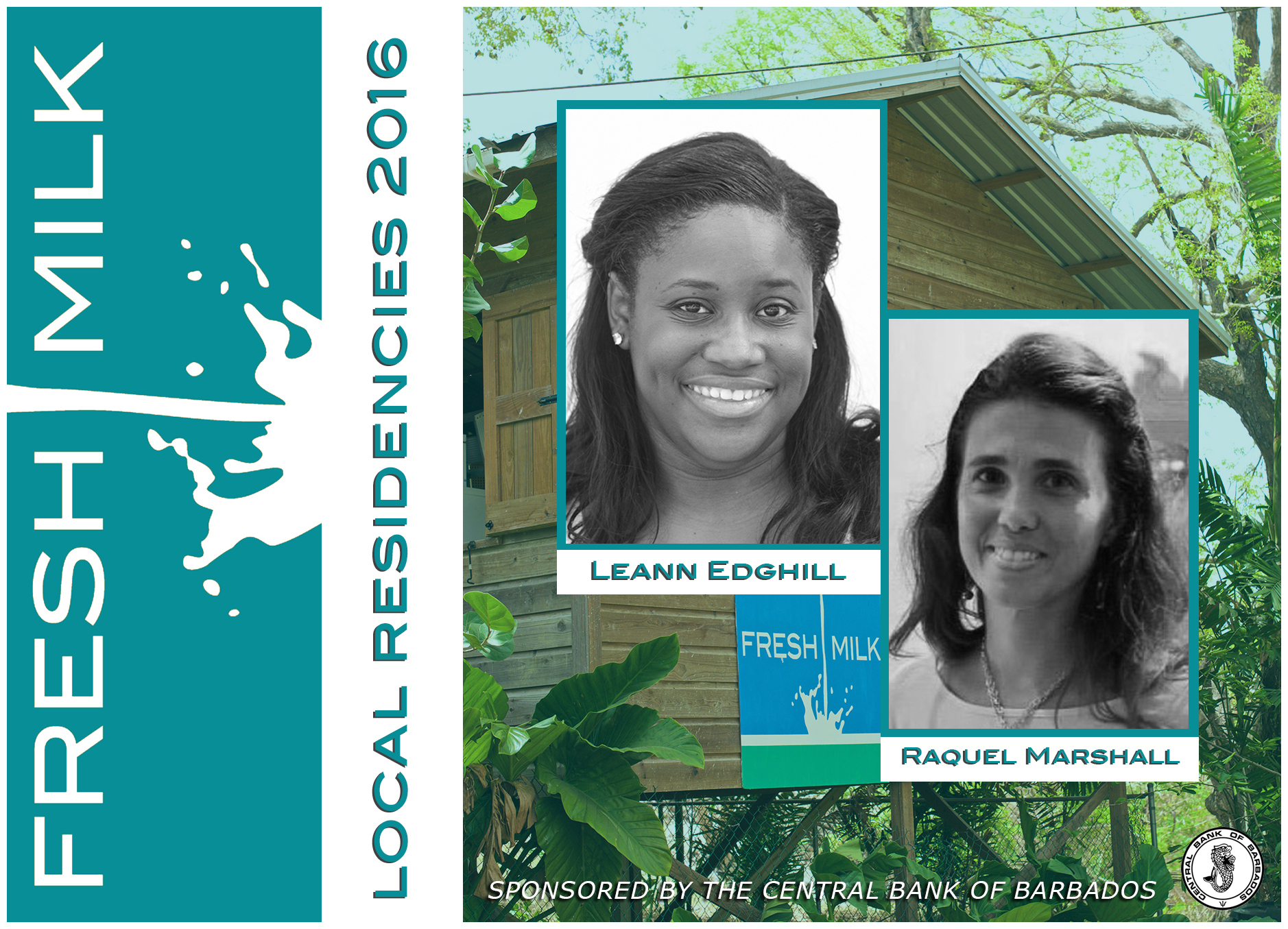
Leann and Raquel Flyer

Fresh Milk is excited to welcome our next two local residents for 2016, Barbadian artists Leann Edghill and Raquel Marshall, who will be on the platform between September 5 – 30, 2016. Their residency is generously supported by the Central Bank of Barbados.

During the one-month residency, Leann will continue her series of work  which explores the naivety of ‘Barbie and her friends’, whose perfect fantasy world she has previously collided with historical, real-world events, this time using a more local Barbadian context. Raquel’s work will be exploring the effects of alcoholism and addictive behaviours, particularly the denial that is often encountered in relation to these issues, which are sometimes accepted or even celebrated.

Leann crop

About Leann:

Leann Edghill is a twenty-three year old Barbadian artist working predominantly with painting. She completed her Bachelor of Fine Arts at the Barbados Community College in 2015. Edghill is currently a member of two art communities in Barbados: ‘Strokes’, a group of artists that hosts annual art exhibitions, and the Barbados Arts Council. Edghill’s artwork uses monochromatic colour schemes, minimal pop art structures, simplistic shapes and symmetry, breaking down images to minimalist forms.

Her current body of work uses imagery of Barbie dolls, making reference to her childhood, which she inserts into visual representations of major events that have occurred over the years from 1959 (the year Barbie was first introduced) to present day . Although a number of significant historical events have taken place, whether positive or negative, the character of ‘Barbie’ remained unaffected, living her own fantasy with no regard for the world around her or her impact on young girls.

Edghill also has a love for makeup artistry, and has combined this with her skills as a painter to create designs through body-painting, which is another aspect of her artistic practice.

IMG_3447

About Raquel:

Barbadian born Raquel Marshall is an artist who is slowly returning to the national arena. For the past decade or so she has dedicated her time to her family while also working as an office administrator and private art tutor. Marshall is a mother of two boys and shares her love of art with her husband, Nicky Marshall.

Marshall prefers to use images rather than words to express her experiences and feelings, and much of her work is an overflow of situations, thoughts, and concerns, both past and present. Her pet themes deal with racial issues, women’s issues, spirituality, alcoholism and escapism.  Although serious topics, she portrays them in playful ways.

Since graduating from the Barbados Community College in 1998 with a Bachelors in Fine Arts (First Class Honours), she has had the privilege of exhibiting locally and internationally, including in London, France, Cuba and Belgium, mainly working in assemblages and printmaking. In college she discovered the work of Robert Rauschenberg and Joseph Cornell, who inspired her and set the foundation for her work at an early stage. Marshall also paints, and is currently experimenting with video, sound and photography. She draws on any technique that will help her achieve her vision and is not afraid to adapt, learn something new or collaborate.

_____________________
CBB Logo White & Black Text

This residency is sponsored by the Central Bank of Barbados

Anisah Wood’s Residency – Week 2 Blog Post

Barbadian artist Anisah Wood writes about the second week of her Fresh Milk ‘My Time’ Local Residency. The community outreach component of her residency, the Quid Pro Quo skills exchange programme, continues to be a highlight of her experience, as well as interacting and sharing knowledge with fellow resident Torika Bolatagici and reconsidering perceptions of the Caribbean space. Read more below.

13417555_10153689261938499_8399003833907728347_n

Quid Pro Quo was indeed one of the highlights of the week. This particular session was hosted by Sheena Weekes, who enlightened us on the process of a medical examination.  As we in the audience keenly listened and participated in the session, we also witnessed Sheena’s visible eagerness to extend her knowledge of the medical field to us. It was that enthusiasm shown by both parties coupled with the feeling of satisfaction having learned something new and practical, that convinced me that Quid Pro Quo was indeed a great idea that will benefit all involved.

13435551_10153687527618499_6103612845447588998_n

I also had my first Hasselblad experience thanks to Torika Bolatagici. That was a heavy piece of equipment, but the experience of peering into the view finder at a flipped frame dwarfs the digital live view any day. However, I eventually returned to the digital world as my means of production. I’ve started editing another video to add to my body of work. As I engaged in this process, I found myself frequently contemplating on how my work can better address the peculiarities of the Caribbean space, and the various relationships as well as tensions that exist within it. What really is the Caribbean space? How is it on one hand interconnected and on the other hand fragmented? Inviting yet hostile? And how can my observations of these enquiries be represented? … I am still turning these thoughts over in my head and with each turn I unearth a new possibility.

Torika Bolatagici’s Residency – Week 2 Blog Post

Pacific artist Torika Bolatagici shares her second blog post reflecting on her Fresh Milk residency. Highlights of the week included attending a lecture by Dr. Matthew C. Reilly at the Barbados Museum and Historical Society and discovering more about both the arts ecology and environmental ecology of the island through fruitful conversations, and by exploring the island armed with her new understanding of the space. Read more below:

One of the highlights of my 2nd week was attending Dr. Matthew C. Reilly’s lecture at the Barbados Museum and Historical Society titled “Contesting the ‘White Slavery’ Narrative:  Repositioning the “Redlegs” in Barbadian History and Society.” While I was aware of the history of African slavery in Barbados, I was not aware of the simultaneous history of white indentured servants, and the legacy that this has left for their descendants. I get the impression that the evidence-based research that Matthew presents is not convenient for those who cling to the Barbadian ‘white slave’ mythology that has become a reference point for many right-wing movements outside of Barbados.

Matthew’s subjectivity as an Irish-American is important and I found his work to be incredibly complex and nuanced, but presented in a clear and fascinating format. His lecture really opened my eyes to seeing the Barbadian landscape in a different way, and is helping me to understand this idea of ‘territoriality’ that Anisah Wood addresses in her work. I was particularly intrigued by the research he has been conducting in the area referred to as “Below Cliff” in the parish of St John on the rugged east coast of the island and I was humbled by the way Matthew’s work has reconnected communities that had been estranged for many years. I look forward to reading Matthew’s forthcoming publication and following his research as it unfolds.

The other highlight of Week 2 was sitting down with the Founder and Director of Fresh Milk, Annalee Davis and finding out more about the origins of the arts ecology here in Barbados, from tertiary arts education, to artist spaces, the positioning of contemporary Barbadian art within the Caribbean, to the reason she set up Fresh Milk and the Colleen Lewis Reading Room. Most importantly we were able to chat about her practice, which with all her competing responsibilities, I’m amazed she has time to nurture.

Unlike Jamaica, the Bahamas and Bermuda – Barbados does not have a National Gallery. So it’s clear that spaces like Fresh Milk are crucial for providing the physical space and intellectual context for critical thinking about contemporary art and building the capacity for local art writers. Fresh Milk is a space where socially engaged practice and connection to the community is welcomed and the role of art in society is valued. But it’s also very outward looking, and a lot of work has gone in to connecting with institutions like Videobrasil and the Pérez Art Museum Miami for their Tilting Axis conference. I look at a space like Fresh Milk and I wish that someone would be able to set up a space like this in Fiji (I’m looking at you Ema Tavola).

During my weekend downtime, I continue to explore the island, and after a week of thinking about race, plantations, slavery and identity – the politics of space, visibility and invisibility are becoming more evident. The contrast between the chattels and fenced resorts remind me of the village/resort dichotomy of the Pacific. And as I look at the imported flora of the island, I’m thinking about what it means to explant botanical matter and what it means for a space to ex-plantation.

As I sat on the boardwalk in Bridgetown one evening and watched planes pass overhead, I was reminded of the proximity of Barbados to the other Islands in the Caribbean, South America, Europe and the United States – and I really felt the geographic isolation of Australia. Next week I’m looking forward to meeting with some local artist and curators!

_______________________

AusCo

This project has been assisted by the Australian Government through the Australia Council, its arts funding and advisory body.

Alex Kelly’s Residency – Week 3 Blog Post

Trinbagonian artist Alex Kelly shares a third blog post about his Fresh Milk residency, which took place earlier this year in March. Looking at his last night in Barbados, spent liming with some of the people he encountered while in the island, Alex reflects on some of the collective aspects of the Caribbean experience he has noticed, and the fine line between comforting familiarity and complacency around regional issues. Read more below:

It’s the last lime before I leave Barbados. I’m having a chat with my Bahamian flatmate and her friend, a fellow Bahamian who’s lived in Barbados since she was a child. There is a bowl of chips and two bowls of dip on the coffee table in front of us. A fly lands on one of the chips and begins to survey the bowl. We continue having our conversation.

Someone gets up and, paying no attention to the fly, takes a chip out of the bowl, scoops up some dip and returns to their seat to enjoy. The fly has of course exited the conversation at this point, but that just happened, and we all let it. In that moment, I once again felt strangely at home in Barbados.

It’s not that we’re particularly fond of flies in TT, in fact I’m sure that the average person, including myself on another day, would have hastily gotten rid of the fly before it could ever desecrate the surface of a single chip; we love we belly. But there was something so unpretentious and confident about the imagined Caribbean that I learned to appreciate, and while on an average day I feel that I am constantly surrounded by actors playing out a role or as Chang might have said, artists more interested in their title than in the work, in that moment I saw an image of that Caribbean. No one pretended to be offended by the presence of that fly.

I am aware that this is an odd and, perhaps for some, off putting example, but I went to Barbados hoping to find a way that my own Caribbean experience could connect to others. I found it yet again in those moments. In that interaction, I was reminded of all the tension that I experience in my work; a practice that examines a way of life that is deeply troublesome and often dangerous, but one that is full of little subversions that make life so much more beautifully subtle and complex.

The frightening question that I am now comforted by, after having been reminded that it is our breaking of the rules that often makes life so nice, is how does a people manage to keep their beautiful conversation going, with that fly still in the bowl, and yet avoid all of the horrors associated with its kind. I believe that we can find a better way, but I’m not sure that I ever want that way to include fussing over a bowl of imported chips. What doh kill does fatten.

________________________

Tridium

This residency is supported by Tridium Caribbean Limited

Open Call: Fresh Milk and the NCF announce Emerging Directors Residency

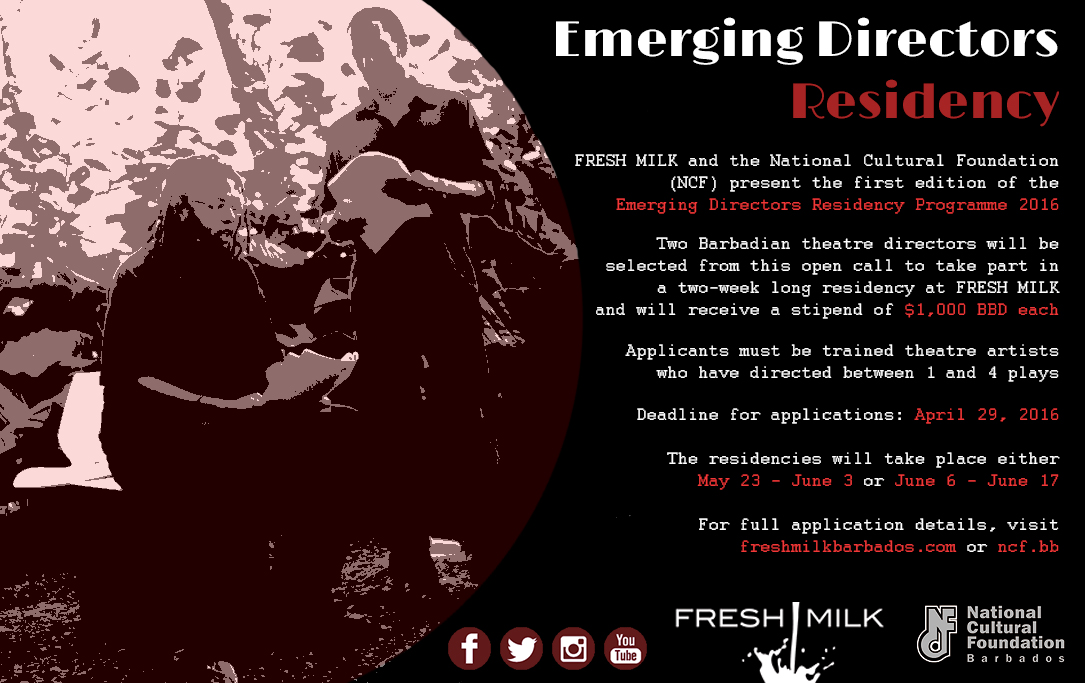
The Fresh Milk Art Platform and the National Cultural Foundation (NCF) are pleased to share an open call for their first collaborative Emerging Directors Residency 2016. This exciting new partnership is a paid artist residency for early career theatre directors, which will provide them with an opportunity to conduct much needed research into Caribbean theatre heritage and to explore and create through theatre form and style.

FM-NCF Emerging Director Residency Flyer

Two residencies will be offered, for two emerging Barbadian directors who will receive a stipend of $1,000.00 BBD each. Each residency, which will be based at the Fresh Milk studio in Walkers, St. George, will run for a 50 hour period which the resident must complete over two weeks. There are two fortnightly time-frames scheduled between May 23 – June 3 or June 6 – June 17, and each candidate may choose which time-frame is suitable for them. The deadline for applications is April 29, 2016.

Residents will be mentored over the course of the programme by a noted Barbadian/Caribbean Director and, at the close of the period, each will present, by way of a small showcase with actors, aspects of the work they have been exploring.

Rationale:

Residency programmes afford professionals time and space away from the demands of daily work life to carry out much needed professional development. Outside of traditional longer term training, a paid residency allows artists time, however short, for contemplative study and exploration. In the Barbadian context, there is much focus on the training of performers, however there are considerably fewer opportunities for those theatre artists with a special interest in directing to hone and develop their skills. Highly skilled, culturally aware and visionary directors are needed, as we move nationally to advance our cultural industries sector, and to enrich the quality of small and large scale staged events, whether drama, music, dance, or indeed multimedia events.

Greater awareness of Barbadian/Caribbean theatre form and style will serve to enhance the ideological and interpretive output of those up and coming directors on the local theatre scene, and equip them to create work that consciously and profoundly engages with Barbadian tradition. ‘Emerging Directors Residency’ offers an opportunity to design and apply staging concepts for ‘alternative spaces’, i.e. the “site-specific”, and otherwise environmental concept. It offers mentorship, access to archival material, and affords time for creativity.

Objectives:

– Partner with local and regional arts platforms to offer developmental opportunities for artists;

– Provide a forum for emerging directors to research their craft through mentorship, and through access to documented and archived material;

– Provide emerging directors with a secure and rigorous environment for practice, and the resources with which he or she may develop emerging work, and/or experiment with new ideas;

– Provide opportunities for actors to work with emerging directors in a developmental and experimental workshop setting.

Eligibility:

The ideal candidate should be a trained Barbadian theatre artist, who has directed between 1 and 4 plays.

Duration of Programme:

1 Session per Resident: 50 hours to be undertaken over EITHER May 23 – June 3, 2016, OR June 6 – 17, 2016.

Application process:

Prospective candidates can apply with the completed application form (which includes a bio/artist statement and project proposal, and can be downloaded here), full CV and portfolio, writing samples from your director’s notebook and 2-3 critical (newspaper, peer or academic) reviews of recent work to the National Cultural Foundation, Theatre Arts Office at the email address ncftheatrearts@gmail.com or lisa-cumberbatch@ncf.bb before midnight on Friday, April 29, 2016. They will be interviewed by a panel comprising NCF and Fresh Milk officials.

Successful candidates for the residency will be offered a stipend of $1,000.00. The resident is required to spend 50 hours at Fresh Milk in Walkers, St. George and should indicate a potential schedule of days and times they might be available during the interview process. The mentor will spend 10 hours in total with each resident over each 50 hour session. Each resident will have access to two actors for 15 hours to experiment and/or create work. At the end of each period, there will be a short showcase where the residents share aspects of the work they have been contemplating.

Expectations:

In addition to the 50 hours spent at Fresh Milk, each resident will be required to keep a weekly blog of text and images documenting their thoughts and processes which will be shared on the Fresh Milk website. At the close of the residency, each resident will also be required to submit a report according to Fresh Milk and the NCF’s guidelines.