Fresh Milk welcomes Sonia Farmer and Alex Kelly to the Platform

Fresh Milk is pleased to welcome Bahamian artist and writer Sonia Farmer and Trinbagonian artist Alex Kelly to the platform for the month of March, 2016.

Sonia will spend her time at Fresh Milk working on two main projects—one a personal creative project, and the second a wider community endeavour.

The personal writing project will be a series of experimental poems with the working title ‘The Best Estimation in the World’. Sonia will work with transcriptions gathered from interviews conducted during her work in the art department at Baha Mar, the mutli-million resort development in Nassau. Using a voice recognition software, she has collected dense blocks of mostly indistinguishable text rife with errors from these interactions. Part erasure and part found text, she will comb through the material to identify phrases and words, and separate and re-structure them into poetry. Though completely void of all content and subject matter from the original interview, the poems based on the mistranslations would nonetheless develop around an unsettling alternate reality of the tourism model in The Bahamas.

Additionally, she will establish a relationship between Fresh Milk and her larger creative endeavour, Poinciana Paper Press, by conducting a series of workshops on book-binding and design entitled The Art of the Book.

Alex’s work explores the “how come” of life in Trinidad and Tobago. By applying an understanding of human nature, considering the population as both a community and as an individual in a larger global community and by utilising images from the past and the present that act as culturally specific ideograms, he examines cultural, social and historical circumstances that have lead to the development of the present realities of life in Trinidad and Tobago.

His work intends to engage the public by providing familiar points of reference while calling into question prevailing assumptions about Caribbean life that often serve as cushioning from harsh realities. The intention is to confront the audience with a more honest discourse about Trinbagonian culture.

Alex’s aim is that this residency will facilitate the expansion of the scope of his work, building on links established during his participation in the Caribbean Linked III residency in Aruba. This experience reignited a desire to participate in solving problems surrounding Caribbean life and Caribbean connectivity.

_______________________

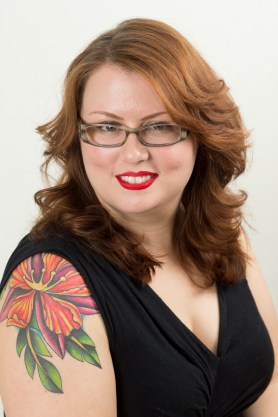
IMG_9023

About Sonia Farmer:

A Bahamian writer who uses the crafts of book binding, letterpress printing, hand papermaking and printmaking, Sonia’s work is intimately tied to the Caribbean landscape and identity. Often her work engages with contemporary Bahamian society through the lens of history and mythology, specifically in the realms of feminism and the tourism industry. She is the founder of Poinciana Paper Press, a small and independent press located in Nassau, The Bahamas, which produces handmade and limited edition chapbooks of Caribbean literature and promotes the crafts of book arts through workshops and creative collaborations. Her artwork has been exhibited throughout Nassau including at the National Art Gallery of The Bahamas, Doongalik Studios, The Hub, & the Central Bank Art Gallery. Her poetry has won the 2011 Prize in the Small Axe Literary Competition and has appeared in tongues of the ocean, The Caribbean Writer, Poui, The WomanSpeak Journal, and Moko Magazine. She holds a BFA in Writing from Pratt institute. Visit poincianapaperpress.com to learn more.

_______________________

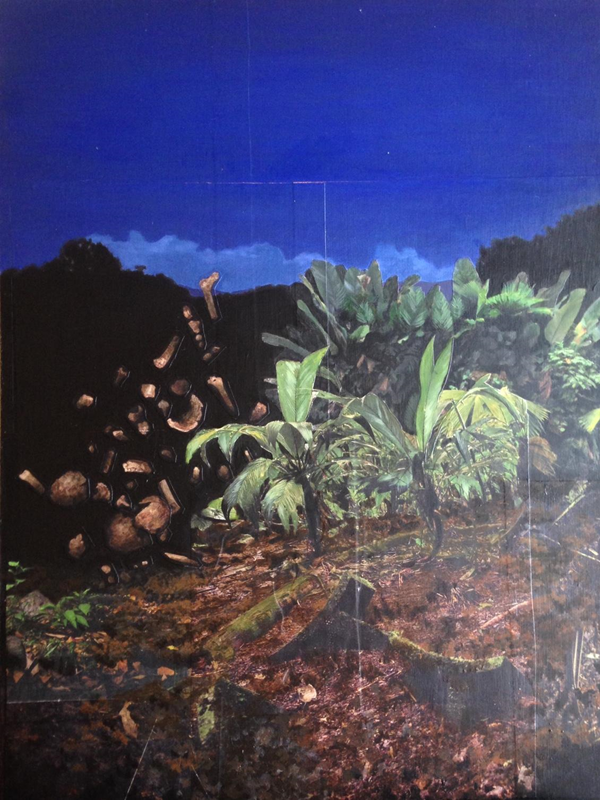
Alex Kelly

About Alex Kelly:

Alex Kelly is a contemporary artist living and working in Trinidad and Tobago. Kelly recently graduated from The University of the West Indies, St Augustine with a Bachelor of Arts degree in Visual Arts. Over the period of his study at the university Kelly participated in several public art projects. Among them are the mural “Hope” at the Family Development and Children’s Research Centre, St Augustine, for which he acted as co-facilitator; an art outreach program at Mayaro Government Primary School, Trinidad and Tobago, which formed part of a collaboration between The University of the West Indies and the Bridge Foundation; and a collaboration with the College of Science Technology and Applied Arts of Trinidad and Tobago designing a fundraising campaign for the creation of new student bursaries at the institution. Kelly has exhibited in three group shows with The University of the West Indies and in 2012 produced the mural “Slave” at the Night Gallery in Woodbrook, Port of Spain.

In 2015 he began occupying a studio space at Granderson Lab, a project of Alice Yard. In August of that year Kelly participated in the Caribbean Linked III artist residency and exhibition in Aruba, where he spent three weeks producing original works and participating in engagements that have expanded the scope of his practice from a national focus to a regional one. In September of 2015 he began working with the University of The West Indies, St Augustine as a guest lecturer and visual arts demonstrator. Kelly is currently interested in facilitating further integration of contemporary art into the national consciousness and public policy, and in providing opportunities for greater connectivity between art communities in the Caribbean.
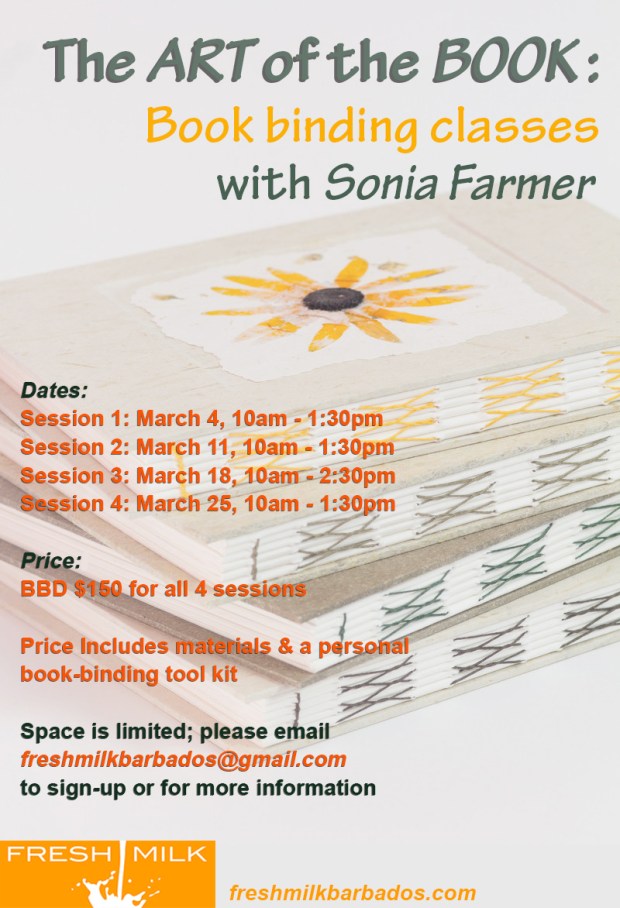
The Art of the Book: Book Binding Classes with Sonia Farmer

Fresh Milk’s upcoming resident, Bahamian writer and artist Sonia Farmer, will be offering a series of four workshops on different methods of book binding and design at Fresh Milk in March, 2016. This four week course will examine the intersection of text and the book form. Covering a range of book structures, participants will be encouraged to consider the book as an active part of their storytelling practice rather than as simply a vessel. Each class will build upon the former to provide students who wish to take all four classes with a thorough beginner knowledge in making handmade books and book objects and fresh ideas on how to approach narratives.

Sonia Farmer_Art of the Book Flyer2

Participants can also take individual classes to explore a particular structure or group of structures that appeal to them. Included in registration for all four classes will be a book-binding kit to continue their practice outside of these workshops.

You can learn more about each of the sessions below. Spaces will be limited, so please email freshmilkbarbados@gmail.com to register your interest. Applications should include a brief bio and reasons for wishing to participate in the course, based on which Sonia will make the final selection of participants. Please indicate when signing up which sessions you wish to attend.

Registration is now closed.

Number of participants per class: Up to 7

Preparation: All materials will be provided for binding, but students are encouraged to bring any decorative papers, magazines or found materials they may want to explore and include in their practice. Each participant will get a basic book-binding kit with a bonefolder, awl, needles, thread and materials/suppliers list if they wish to explore the medium further. Students will also receive how-to worksheets to reference later at home. Other special tools that will be used together in classes, and the correct PVA adhesive will also be provided.

Tea, coffee and drinks will be available during the short breaks, but participants should bring their lunch as the workshops will be 3-4 hours long, depending on the content of the session.

Participants must understand that if they register for Week Two, they must provide a poem by February 15 to include in the class anthology so it can be laid out and printed on the pages that will be bound together before the session. It can be a poem you wrote yourself or just a poem you like.

Week One: Experimental Poetry and Folded Structures
March 4, 10:00am – 1:30pm

Participants will be led through simple binding structures using only folds and adhesives. Considering the “exquisite corpse” exercises of the surrealists, we will explore the accordion book through a collaborative poem and collage, while use of found text will drive an examination of folded books using a single sheet of paper. Participants will leave with two book structures to reference at home and a variety of new approaches to storytelling.

Week Two: Limited Editions, Zine Culture & Chapbooks
March 11, 10:00am – 1:30pm

Moving into book structures using needle and thread bindings, participants will explore simple softcover books and their many applications. Everyone will be encouraged to share a poem of their choice before class (by February 15) that they would like to appear in a class anthology, bound into a limited edition chapbook using the elegant Japanese stab binding. Then, we will explore zine culture through collecting found language and materials into a pamphlet stitch book. The technicalities of edition bindings will be discussed so that participants will be encouraged to explore making their own editions at home in the future.

Week Three: Hardcover Notebooks & Leather Journals
March 18, 10:00am – 2:30pm

In this class participants will leave with two small blank notebooks to fill with their written inspirations. Utilizing the basic cross-stitch, participants will build two multi-signature textblocks to use in two different casing-in methods: a hardcover notebook wrapped in decorative papers with an exposed spine, and a fully cased-in leather journal with rounded spine.

Week Four: Book Sculptures, Objects & Alternative Narratives
March 25, 10:00am – 1:30pm

In this final class, participants will think about how books can challenge their traditional form and become three dimensional storytelling objects. They will explore playful and alternative structures such as simple pop-up techniques, the tunnel book, and the flag book, and consider how alternative materials and unconventional processes can open up new possibilities in narrative structures.

Price: $150 BBD for all four sessions, which includes materials and a personal book-binding tool-kit.

* Persons may choose to sign up for individual classes rather than the full suite, but there is a base cost of $70 BBD for the book-binding kit, and an additional cost of $10 per chosen class (with the exception of Week 3’s session on hardcover & leather bound journals, which will be $50).

___________________

IMG_9023

About Sonia Farmer:

A Bahamian writer who uses the crafts of book binding, letterpress printing, hand papermaking and printmaking, Sonia’s work is intimately tied to the Caribbean landscape and identity. Often her work engages with contemporary Bahamian society through the lens of history and mythology, specifically in the realms of feminism and the tourism industry. She is the founder of Poinciana Paper Press, a small and independent press located in Nassau, The Bahamas, which produces handmade and limited edition chapbooks of Caribbean literature and promotes the crafts of book arts through workshops and creative collaborations. Her artwork has been exhibited throughout Nassau including at the National Art Gallery of The Bahamas, Doongalik Studios, The Hub, & the Central Bank Art Gallery. Her poetry has won the 2011 Prize in the Small Axe Literary Competition and has appeared in tongues of the ocean, The Caribbean Writer, Poui, The WomanSpeak Journal, and Moko Magazine. She holds a BFA in Writing from Pratt institute. Visit poincianapaperpress.com to learn more.

Fresh Milk welcomes Helen Cammock and Emma Critchley to the Platform

Fresh Milk is excited to welcome our first resident artists for 2016, Helen Cammock and Emma Critchley, who will be travelling from London to be in residence with us between February 1 – 26.

Helen, who is of British and Caribbean descent, works with video, photography, installation and text to consider how individual and collective experiences expose structural inequality through exploring the politics of society and visual, spoken and written language and of representation. Her planned project under the working title Myth, Lie and Omission will explore the ‘inopportunity’ of acknowledgement, hidden achievements and perceptions of worth, aspiration and value, particularly as they relate to race and gender, science and invention.

Emma’s practice is rooted in the underwater environment. She is particularly interested in the way sound is perceived beneath the water’s surface, and how this affects our relationship to our surroundings. She will use the residency to explore these concepts and the idea of echolocation as a way of using sound to explore the rich natural environments that Barbados has to offer. By working with a variety of underwater locations, very different to everyday experiences, and placing them within more familiar spaces, she hopes to question notions about the role of the acoustic landscape and our perception and relationship to the spaces around us.

Helen and Emma are taking this opportunity to continue dialogues that they have already begun about filmmaking. Both their concerns and work are very different, but they see a real value in some of the conversations that have emerged, and view this residency as a prime chance for a peer development discourse that is already proving productive for both of them to further evolve.

_________________

IMG_0133

About Helen Cammock:

Helen Cammock graduated with an MA from the Royal College of Art, London in 2011. Her work spans photography, video, poetry, printmaking and installation.

Helen says about her work: Using installation, video, photography and text, my practice considers how individual and collective experience exposes structural inequality through exploring the politics of society, of visual, spoken and written language and of representation. I often use archival material and historical points/events that are connected to my subject position. I am invested in the relationship between the individual lived experience and the connection to the wider post colonial context. In constructing narratives that in general pivot around historical or contemporary events the viewer might recognise particular dates, events and speeches, but they are woven into a narrated if fragmented story. I am interested in the idea of authorship – and something I call ‘the audible fingerprint’. I will always be drawn to the question Who represents whom, and for whom?

Recent screenings and exhibitions include:  Hmn4, London, 2016, Carte de Visite, Hollybush Gardens, London, Dec’15-Jan‘16 Transform, Tate Artists Moving Image Screening Programme, Tate Britain, 2015, Changing Room, in Common Place, Brighton Photo Fringe, 2014, Scene, Pitzhanger Manor Gallery, London, 2014 You don’t need a weather man to know which way the wind blows, Hollybush Gardens, 2014, Reach out and Touch Me, Hollybush Gardens, London,2013, London Art Now, curated by Armesden, Lodge Park National Trust, 2013 Oriel Davis Open, selectors Ben Borthwick & Ann Jones.

Her writing has appeared on photoworks.org.uk and Aperture Magazine and she was shortlisted for the Bridport poetry prize in 2015. Helen was Co-Director of Brighton Photo Fringe 2008-12 has has run projects for The Photographers Gallery, London, Open School East, London, Photoworks, London and PhotoVoice, London.

__________________

EC16

About Emma Critchley:

Emma Critchley has worked as an underwater image-maker for over ten years. In 2011 she graduated with an MA from the Royal College of Art. Through working with a combination of photography, video and installation she explores the human relationship with the underwater environment. Emma has developed works funded by The National Media Museum, The Photographers Gallery, The Arts Council England, The British Council, the Singapore International Foundation and INTERREG IVC (financed by the European Regional Development Fund). Awards include the Royal College of Art Sustain ‘Moving Minds’ award, winner of the British Underwater Image Festival, finalists in the Saatchi Gallery & Channel 4’s New Sensations, the Saatchi Gallery & Google’s Motion Photography Prize and most recently the Firtish Foundation & Saatchi Gallery’s UK/RAINE award. Her work has been exhibited extensively both nationally and internationally, including exhibitions at The Australian Centre of Photography, the ICA Singapore, Gerhard Marcks Haus Germany, The National Portrait Gallery, The Photographers Gallery and the Royal Academy. 

Immanuel Hunte shares his experience with Ask Kæreby’s experimental sound workshops

During the month of November, Fresh Milk resident artist Ask Kæreby held a series of three workshops looking at experimental ways of working with sound. One of the participants, Immanuel Hunte, wrote about his experience with the workshops, as well as sharing two of the pieces he created based on what was discussed in the sessions. Read more below:

I attended a 3 day workshop, which was held by Fresh Milk via their Artist Residency Programme. Ask Kæreby, a Danish composer and sound designer was the chief facilitator of this particular project, being that it was about sound and sound design. I have to say that in my opinion, even though only a few people attended the workshop, it was AWESOME. Ask helped me to open my eyes to how sound can be used in unconventional ways to express one’s self creatively.

Over the course of 3 days we looked at the technical aspects of sound and talked about the the artistic and philosophical aspects of it as well. During that time, I gained an understanding about sound and sound design; ie. that sound does not only come from musical instruments, or an orchestra, or notes and pitches. Sound is present in our everyday surroundings and in our everyday lives, whether it is natural ( eg. wind, water, trees, animals) or generated/man-made (eg. engines, machines, traffic, interaction of objects). To sum it all up, I was informally introduced to the world of sound art: Sound art is a contemporary art form in which sound (natural or artificial) is utilised as a medium or a form of expression. Sound art comprises of different elements that are often intertwined eg. audio media, electronic synthesizers, noise music, acoustic or psychoacoustic art, to name a few. Sound art tends to be experimental in that it gives the artist a chance to stretch his/her imagination. I got to learn about the people who were pioneers in this sound art movement, such as Luigi Russolo, who composed for noise machines (which he created) and had members of a London-based orchestra play them, …….which did NOT go down too well with the traditional audience! Russolo at that time wanted to escape the confines of what his generation called traditional music.

There was also Pierre Schaeffer, who was into experimental sound in the 1940s and developed musique concrète. We listened to one of his manipulated recordings of trains. My favourite part was learning about Delia Derbyshire, a woman who was instrumental in the early days of the BBC in London in the BBC Radiophonic Workshop. She has been revered for being a pioneer in electronic music. This unique workshop consisted only of oscillators and various analogue machines. Music for radio and television was scored using only these machines, including sound effects. One famous example is her electronic rendition of Ron Grainer’s theme to Doctor Who, one of the first television themes to be created and produced by entirely electronic means.

Immanuel Hunte’s Soundscape

Also, during this time, the group was given assignments to record our environments, and to manipulate them in an artistic manner. The sounds I used were recordings of my toilet flushing, the washing machine, doors, a spray-can and my voice. Using what I learned in the workshop, plus my experience in making music on computers, I got some satisfyingly interesting results. I edited parts of the audio from my raw recordings and I applied some delay and reverb effects, as well as vocoder effects. The recordings were made using my phone, and the finishing touches were done in digital audio workstations called Propellerhead Reason and FL studio.

Immanuel Hunte’s Desert  Scape

_________________

Thanks to all of those who participated in the sessions, including Annalee Davis, Adrian Green, Immanuel Hunte, Katherine Kennedy, Jesse Phillips, Melanie Springer and Andre Woodvine.

Nadijah Robinson’s Residency – Week 4 Blog Post

Nadijah Robinson shares her final blog post about her residency with Fresh Milk, concluding with her thoughts on how history is written, told and understood, and the value held in the land and our own bodies  in remembering/passing on these stories. She also shares the impact of her presentation to the final year students in the BFA programme at Barbados Community College (BCC) in considering her goals as a socially engaged artist. Read more below:

wk4_1

My last week at Fresh Milk. I have been wrapping up my work in the studio, making connections, having conversations, getting souvenirs, seeing my Bajan family and seeing some last sights.

On my last morning in the studio, I finished the piece I’ve been working on, although it doesn’t have a title yet. I know now that it is about how the history that I want to recognize is not written in books, it is written in the earth, in the land and in our bodies and blood. It is most accessible in oral stories, by observing ourselves and the culture we create, and by intuitively knowing what we do.

I did my presentation to a 3rd year art class at BCC this week. I gave a talk and slideshow presentation on my history of community-engaged work. This is a collection of my work that sometimes approaches and is within the realm of ‘social practice art’, but is also peppered by work that is more appropriately called arts-based youth work. In preparing this presentation I realized how much my practice has been formed from a desire to do something with my artwork.

I remembered a moment of crisis in high school when I felt like I had to make the choice that would change the rest of my life and set me on a particular path – the middle and high school years in Canada felt full of these deciding moments. I felt I had to choose between being a professional artist and a teacher, more specifically whether to take grade 11 Art, or something more ‘academic’. These were two career paths I’d known for a long time that I’d wanted to pursue. At the time, becoming a teacher was a promising career in Toronto – there was a teacher shortage that would soon after become an incredible teacher surplus. The pay was decent, and it was basically the definition of job security. I had watched all of the terrible, misguided teacher-saviour films, and they had created in my mind a sensational image of what being a teacher could be –  a way to effect change in the world, locally. I wanted that, to be a vehicle of social change. But mostly I just wanted to make art, though this was not the wise career choice. There’s no money in art, and I didn’t want to be poor and struggling forever. Not only that, but I didn’t want to be preoccupied with the self-involved, decorative, wishy-washy activities that having an art career seemed to be all about. I wanted a way to make artwork that meant more than that one-dimensional caricature-like story I was presented. My younger self wanted to make art that was all about edgy stuff and politics and was ground-breaking and would one day make it into an Adbusters magazine. I wanted to make artwork that would infect people’s minds with possibilities of better things to come, and place a how-to handbook in their hands. I chose in the end to take grade 11 Art, because I had the genius realization that I could be an art teacher, and have an art career in my off time. I’m glad I did.

wk4_2

In doing this presentation more than 10 years later, I realized how I came to reconcile wanting to make art that does stuff for people. I’m still working on it, but I have been listing for myself a set of guiding principles as I go, the first of which was that I must know what I am trying to do with my work, who I’m doing it with (as opposed to for), and in what language (medium and vernacular) I would do it. Along the way I added things like prioritizing integrity, and supporting community-led projects and speaking with my own voice.

I feel very grateful to have had this experience at Fresh Milk, and it is significant that I did my residency here, in Barbados. Being able to reconnect with my family, with Bajan culture and with the history of this place, and having had the conversations that I have had this month has shifted how I see my own particular cultural makeup. The diaspora upon diaspora, the historical memory and living in North America, Toronto in particular. Some ideas have shifted and some have solidified, but they are complex things to reconcile and I feel as if I’ve just begun again.

wk4_3

_______________________________________

2014 OAC logo RGB JPG

This residency is supported by the Ontario Arts Council.