Ronald Williams’ Fresh Milk Residency – Week 1 Blog Post

Barbadian artist Ronald Williams, the recipient of the 2018 Fresh Milk ‘My Time’ Local Artist Residency, shares his first blog post. Fresh Milk is by no means foreign territory for Ronald, as he has volunteered with us and participated in a number of our projects in the past, but as this is his first residency within the space, the focus of his work while here has shifted – leaving a familiar platform open for new encounters & experiences. Read more below:

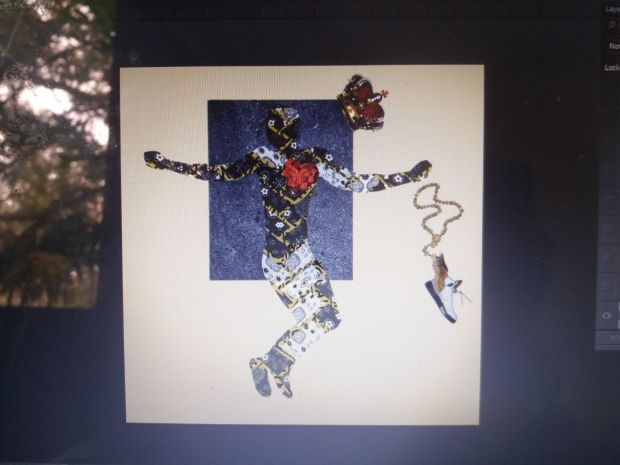
A new old space. That’s how this familiar environment feels. I’m used to the wind chimes, the mahogany pods licking shots on the roof intermittently and the moo-mooing along with the rest of nature, but something‘s different in this country atmosphere. It’s not a sense of purpose, as I’ve always felt that here, nor would I call it pressure; but maybe it’s an accountability/responsibility to get cracking and produce as much as possible in these four weeks. This is perhaps/most definitely driven by the fact that I’ve got a certain goal by the end of the year. More on that later.

My initial plan was to gather as much potential reading material from the Colleen Lewis Reading Room and start doing some research in this space that I’m sharing with the quiet (as far as I can tell) and quite nice international resident artist Daisy Diamond. Given her focus on Judaism in Barbados and my ideas of decadence, materialism, mortality and their relation to religion/spirituality, I think there are interesting things to come.

I must confess to veering from my plan, as Sonia Farmer’s extremely dope work and setup kept calling for my attention. As a result, I put more of my energy into working on a piece I’d laid the foundation for just before the residency started. My time since has been split unevenly between producing and research.

Then Friday came, and with it Amanda Haynes who was setting up for Fresh Milk’s reading room open day. And the critical conversations started, with it the jokes came too, and it was a throwback…no, a Flashback Friday if you will. An old face in an old space where new things are happening.

Fresh Milk hosts ‘A True & Exact History’ by Sonia Farmer

On Monday, April 30th, 2018 Fresh Milk hosted an exhibition & panel discussion around ‘A True & Exact History‘ – an erasure poem by Bahamian writer & artist Sonia Farmer, using Richard Ligon’s publication A True & Exact History of the Island of Barbadoes (1657) as its source material.

Sonia was in conversation about her work with Ayesha Gibson-Gill, Cultural Officer for Literary Arts at the National Cultural Foundation, and Tara Inniss-Gibbs, Lecturer in the Department of History and Philosophy at The University of the West Indies, Cave Hill Campus.

Thanks as always to our photographer Dondré Trotman for these images!

Artist Statement for A True & Exact History

I consider my writing practice a tool for disrupting and investigating existing narratives, forming a response that is not necessarily preoccupied with making new narratives to replace them, but rather exposing different narratives as a parallel, ultimately calling into question the inherent power structure in the existing narrative (such as historical accounts, folktales, mythologies, canonical books, etc). Experimental process of generation, such as erasure, found text, mistranslation, technological intervention, or other restrictive methods, are especially exciting opportunities to create direct responses to existing narratives by using its own language against itself. The resulting text then becomes the content for my final projects.

The core of my artist book A True & Exact History is an erasure of one of the most formative descriptions of the English Caribbean in the seventeenth Century, Richard Ligon’s 1657 guidebook, “A True and Exact History of Barbadoes.” This project began during March 2016 at a writing residency at Fresh Milk, an art platform in St. George, Barbados, where I encountered Ligon’s book through their Colleen Lewis Reading Room. Using the language, imagery, and thematic drives at the core of this text to disrupt the teleology of colonial Caribbean history, these unbound poetic fragments scattered among a shifting landscape simultaneously re-create and resist narrative as a device of cohesive history, ultimately calling into question what it means to write “a true and exact history” of anything.

TVE Exhibition at Deakin University

Fresh Milk is pleased to share that one of our partner institutions, Deakin University, Melbourne, recently hosted another iteration Transoceanic Visual Exchange (TVE) from April 11th-27th, 2018 in ‘The Project Space‘, the contemporary & experimental exhibition space at Deakin’s Geelong Waterfront Campus.

This slideshow requires JavaScript.

TVE is a collection of recent films and videos from artists practicing in the Caribbean, Oceania and their diasporas. The project aims to negotiate the in-between space of our cultural communities outside of traditional geo-political zones of encounter and trade, intending to build relations and open up greater pathways of visibility, discourse and knowledge production between regional art spaces and their networks.

This slideshow requires JavaScript.

On Thursday, April 26th, there was a special viewing and floor talk led by Dr. Torika Bolatagici, Lecturer (Art and Performance) at Deakin University, and our core partner for all of the Melbourne screenings of TVE.

Enormous thanks to all of the participating Caribbean and Oceanic artists, and to the team at Deakin for facilitating TVE reaching broader audiences!

This slideshow requires JavaScript.

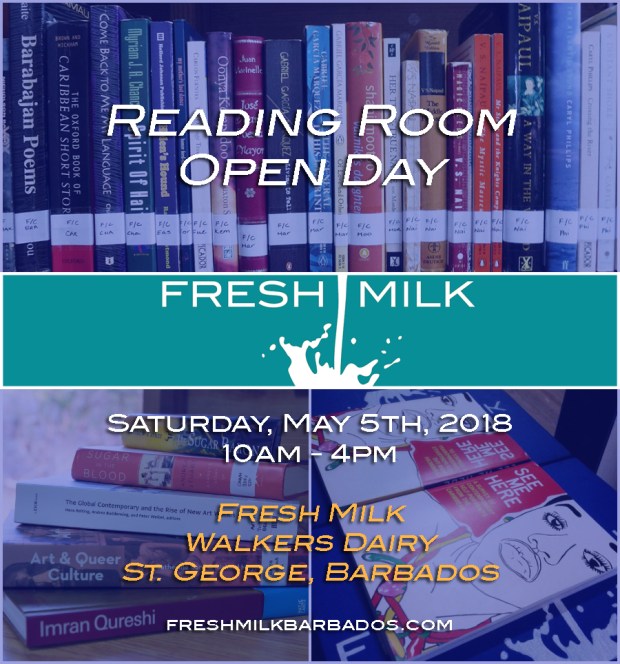
Reading Room Open Day – Saturday May 5th, 2018

Fresh Milk invites you to come check out our Reading Room Open Day, this Saturday, May 5th 2018, anytime between the hours of 10am-4pm!

The Colleen Lewis Reading Room at Fresh Milk is a mini-library of about 3,000 items, including books, films, journals, magazines etc. While there is a focus on contemporary arts publications, we also have a great selection of design, craft, fiction, non-fiction and history books among others. Our bibliography can be browsed online here.

Our team is working hard to improve how we share this material with creatives and researchers in Barbados. As practitioners ourselves, we know just how useful access to quality info about regional and international art worlds can be – whether for research, professional development or inspiration.

The aim of this open day is to create a space for dialogue; to not only run ideas we have had for the library by the public, but to really learn about the desires and needs of creative communities and find out if or how they can benefit from this resource.

Directions can be found on the ‘About Page‘ of our website. We hope to see you pass through to browse the collection and chat with us then!


Levi King’s Emerging Directors Residency – Week 5 Blog Post

Fresh Milk shares the fifth and final blog post by Barbadian actor & director Levi King, who recently completed the Emerging Directors Residency Programme held in collaboration with the National Cultural Foundation (NCF). Levi’s final blog reflects on the process as a whole; what he has learned, who he has worked with and how he has grown as a director, from writing his initial application to seeing the work come to life during the small showcase held at the close of the residency. Thanks to Levi, his mentor Sonia Williams and his actors Kim Weekes, Dy Browne, Melissa Hunte and Asha Elcock for their stellar work! Read more below:

Trust the process

To be honest, I struggled to write this blog. Not because it is the final blog for the residency process and I’m overwhelmed with emotions and separation anxiety and stuff (cause I’m not, I’ll miss it and the wonderful people who took this journey with me, but I’m not). Nah, I struggled because I knew what I wanted to express but I didn’t know what to say.

I wanted to speak about how my process of learning began even before I set foot in the Fresh Milk residency space. How I had to learn a way to write a proposal, just to apply (I really needed to spend time with making proposals). Fortunately the proposal was accepted and I was chosen.

I wanted to speak about how choosing the work was a difficult choice, then I chose a piece that brought with it its own learning curve. I chose a piece that I felt I was able to use the space most creatively with. I chose a piece that had a story and themes I felt we need to explore in Caribbean media (childhood prostitution, poverty and cycles of abuse). I chose a piece with heavy subject matter. I had to do some cutting and editing which took more time than I anticipated.

I wanted to speak about the books I read which really gave me an insight into some techniques and styles which relate to directing and some acting.

I wanted to speak about how I chose most of the cast before I even applied (they don’t know that though, I chose them before I even asked). I was fortunate they said yes.

I wanted to speak about how I had trouble setting a rehearsal schedule because even though I knew the actors were right for the process, all our times constantly clashed. I had cast one man and three women. One man was unable to continue after the first rehearsal. I had to wait a week to recast. I recast. He played the part great.

I wanted to speak about how I spoke with my mentor. and from the beginning, she was upfront about her concerns and her support. Sonia Williams was fully supportive and fully honest throughout the process. Sometimes even just a simple suggestion, question or non-verbal expression was all I needed to know that I may have other choices to pick from that may be better.

I wanted to speak about how my rehearsal process kept evolving with each rehearsal and each conversation with Sonia.

I wanted to say that I was at times unsure I was making the right choices. That I had fluctuating confidence in my ability to deliver what I wanted to deliver. Not because I wasn’t able, but because I faced several personal challenges during the residency.

That there were challenges that arose at points, not my personal challenges this time, that in my mind threatened to halt the process.

That Janelle Mitchell was great at navigating those challenges with me.

That Katherine Kennedy was also great at navigating those challenges with me.

That actors Kim Weekes, Dy Browne, Melissa Hunte and Asha Elcock and my mentor Sonia were all great at navigating those challenges with me.

That at one point, I felt it may have been best to stop because I was becoming too stressed about what I thought was my inability to finish in the face of the challenges (yes, me, stressed).

That I learned so much more than just how to cut a script and find the story, how to work with actors with this kind of material and how to handle production meetings.

That I was grateful every day i was able to work on this.

That the feedback given was invaluable and deeply appreciated.

That I can be a little more forward in my approach as opposed to laid back, and I still need to work on how I communicate my vision to people who aren’t myself and actors.

That I was glad everything worked out in the end.

I struggled because there is lots I could talk about. There was so much that went through my mind during this process. The biggest lessons I learned weren’t academic, they were personal and professional. The reaffirmation of my love for directing was priceless to me. Being able to learn from a director that I respect and whose work I admire, was great. Even though I had struggles throughout, I was happy.

The biggest lesson I learned, or re-learned was simple…Trust the process.

Till next time

Your friendly neighbourhood rastaman.

___________________

ncf mark rgb2This project is a collaborative initiative, funded by the NCF Barbados