Jordan Clarke’s Residency – Week 2 Blog Post

Barbadian-Canadian painter Jordan Clarke shares her second blog post about her Fresh Milk residency. She addresses the direction her work is taking, focusing on self-portraiture and developing the background of her pieces to suggest a sense of space, and has continued to explore the island alongside fellow resident artists Daniel Fernández Pascual and Alon Schwabe of Cooking Sections. Read more below:

Self portait

Two weeks into the residency and it feels like I just arrived.

I’ve been spending the majority of my time in the studio creating, reflecting and taking everything in. I’m sensing this as a time for gathering images, ideas and information that will find expression in my future creations.

It seems that I have gravitated towards self-portraiture as a way to access how I am feeling and thinking about myself in relation to this new place, Barbados. In addition to working from images, I have taken on the challenge of drawing myself from life each day. To assist me, Annalee set up a large mirror in the studio space. What I’ve found interesting is that none of the portraits drawn from life look completely like me.

Over the past week, I have been thinking about identity and how it is shaped. I realize now that my sense of identity is not linked directly to Barbados, despite my father’s Bajan roots.  This is the perfect opportunity for me to think about how I would like to identify, how I see myself, as well as how my life experiences have shaped me.

Mid week I met Barbadian artist Simone Padmore who addresses themes of identity in her work.  Some of her illustrations can be found in ARC magazine issue #5.

Towards the end of the week I began to think about the landscape, and how I could paint myself into one. The figure and landscape have always been separate for me. In my work the background suggests a sense of space rather than a specific place or location. I’m not sure where this will go, but it is something I am working on.

It was Easter weekend, and on Good Friday Annalee made a delicious gluten free quiche for our lunch. I am definitely being spoiled here!

An exciting event for me was finding out that early Saturday morning a horse was born on the family farm.

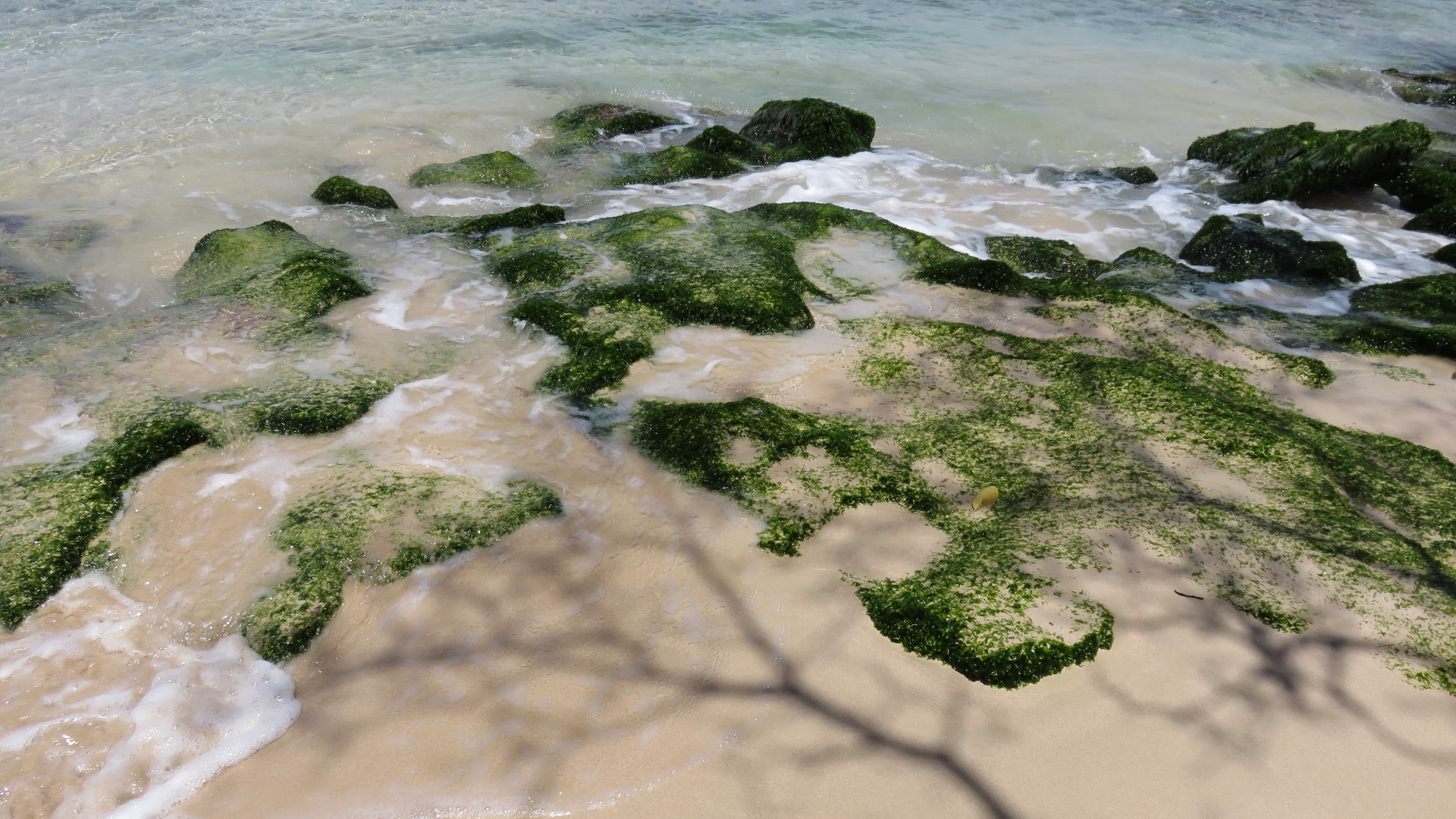
West coast beach

I ended the week traveling part of the West Coast with Alon and Daniel of Cooking Sections, who are also doing a residency here at Fresh Milk. We started at a lively market in Bridgetown. It was a completely different experience from the quiet and serene studio in St. George. I enjoyed the liveliness and dancehall music on the mini buses. We also took some time to enjoy ourselves on the beach. The West Coast is ideal for swimming, in contrast to the rugged picturesque East Coast. Our day ended with food and music at the Oistins Fish Fry on the South Coast.

Looking forward to the week ahead.

_______________________________________

2014 OAC logo RGB JPG

This residency is supported by the Ontario Arts Council.

Jordan Clarke’s Residency – Week 1 Blog Post

Barbadian-Canadian painter Jordan Clarke shares her first blog post about her Fresh Milk residency. In addition to familiarizing herself with Barbados, which she has never visited before, Jordan shares some of her thoughts on grappling with notions of identity and belonging in an environment that is both a part of her heritage yet still a foreign space. Read more below:

Cloud study 1

I cannot believe it’s been almost a week since I arrived in Barbados.

Shortly after landing on Monday we headed over to Fresh Milk where Annalee gave a lecture to a couple art students from the University of the West Indies.  The lecture was a great introduction to the Caribbean and its art scene. We were introduced to the various informal art networks happening throughout the Caribbean such as Alice Yard (Trinidad), Popopstudios (Bahamas), Tembe Art Studios (Suriname), NLS (Jamaica), Beta Local (Puerto Rico), Instituto Buena Bista (Curacao), and Ateliers ’89 (Aruba).  

Annalee referenced the book, An Eye For The Tropics by Krista Thompson, to discuss how tropicalization has developed throughout the Caribbean, and how the image alone has been used as a tool in creating this inaccurate idea of a ‘tropical paradise’. It seems that these networks are creating platforms for contemporary artists to be able to experiment and to exchange ideas, while providing safe spaces to foster self-expression.

Both Annalee and Katherine have pointed out various books from the Colleen Lewis Reading Room they thought would be of interest to my art practice.

See Me Here: A Survey of Contemporary Self Portraiture From The Caribbean really stood out for me because I am also dealing with self-portraiture in my work. It’s interesting to see how Caribbean artists are examining, exploring and expressing their identity.

Thinking The Diaspora: Home Thoughts From Abroad by Stuart Hall, was suggested to me after an insightful conversation I had with Annalee about feeling disconnected from Barbados. Because I am mixed race and have a Barbadian father I thought I would feel more at home.  But the truth is, I don’t. So once again I’m continuing to question my identity. I am coming to the realization that this is okay!

I was fortunate enough to visit Bathsheba with Aaron Kamugisha who is a professor of Cultural Studies at the University of the West Indies. We drove along the rugged East Coast with a stop at St. John’s Parish Church, one of the oldest in Barbados. Looking out from the church was a breathtaking view of the Atlantic Ocean. I also made a visit to Rockley Beach in Christ Church with Annalee. It was an absolutely beautiful evening walking while listing to the rolling waves, after which we headed over to Mojos for dinner, drinks and to meet with local artists Katherine Kennedy, Versia Harris, and Mark King, who I got to meet for the first time.

In addition to sightseeing I’ve been spending a lot of time in the studio. I’m really enjoying just being in this wonderful space that is full of natural light and which also provides a fresh cooling breeze. I began my week with sketching various plants growing around the Fresh Milk space. On Friday I began to work with oil paints on mylar paper. I’m finding the drying time to be a bit slower than what I would like at this point. So in the coming days I will be exploring other mediums such as graphite, charcoal and oil pastels.

_______________________________________

2014 OAC logo RGB JPG

This residency is supported by the Ontario Arts Council.

Fresh Milk welcomes Cooking Sections to the platform

Fresh Milk is happy to announce that between March 30 – April 10, 2015, we will host Cooking Sections, the London-based duo of Daniel Fernández Pascual and Alon Schwabe. Read more about their research-based practice that explores the overlapping boundaries between visual arts, architecture, geopolitics and food:

Empire Remains Christmas Pudding__ Cooking Sections 2013, Delfina Foundation, London.

Empire Remains Christmas Pudding, Cooking Sections 2013, Delfina Foundation, London.

Cooking Sections is a London based duo of spatial practitioners with a research based practice that is focused on the organisations of the world through food. For the past two years our work has been mainly devoted to the Empire Remains. The project explores the infrastructure and cultural imaginaries that were set up by the British Empire to promote the food and agricultural industry between home and overseas territories at the beginning of the 20th century. The Empire Remains attests the ways global food networks have evolved until today. The work traces the contemporary history of imperial bananas, sugar, tobacco, cacao, fruits, spices, condiments as well as the new economies and visions that emerged out of them. During the course of the project they are developing a series of objects and products reflecting on the legacy of such trade networks and how they affect the world we live in. The project will culminate in 2016 with The Empire Remains Shop in London, a project space exhibiting the process and research.

The Empire Remains project is developed through various research trips and residencies around the world in collaboration with a number of cultural institutions. Thanks to the support of Fundación Jumex Arte Contemporáneo, Cooking Sections will spend the month of April in the Caribbean, taking on the Fresh Milk Residency. This trip will investigate the sharp decline in the Caribbean food crops and the critical reinvention of the landscape through agricultural innovation, tourism and offshore activities. In June, Cooking Sections will participate in a residency at Artport, Jaffa-Tel Aviv, dedicated to researching the Jaffa brand in oranges since its establishment during the British Mandate until its current state, when it has been mostly outsourced to groves in Spain and Morocco. Currently several more research trips are being developed towards fieldwork in New Zealand, Hong Kong, Montreal, Mumbai and South Africa.

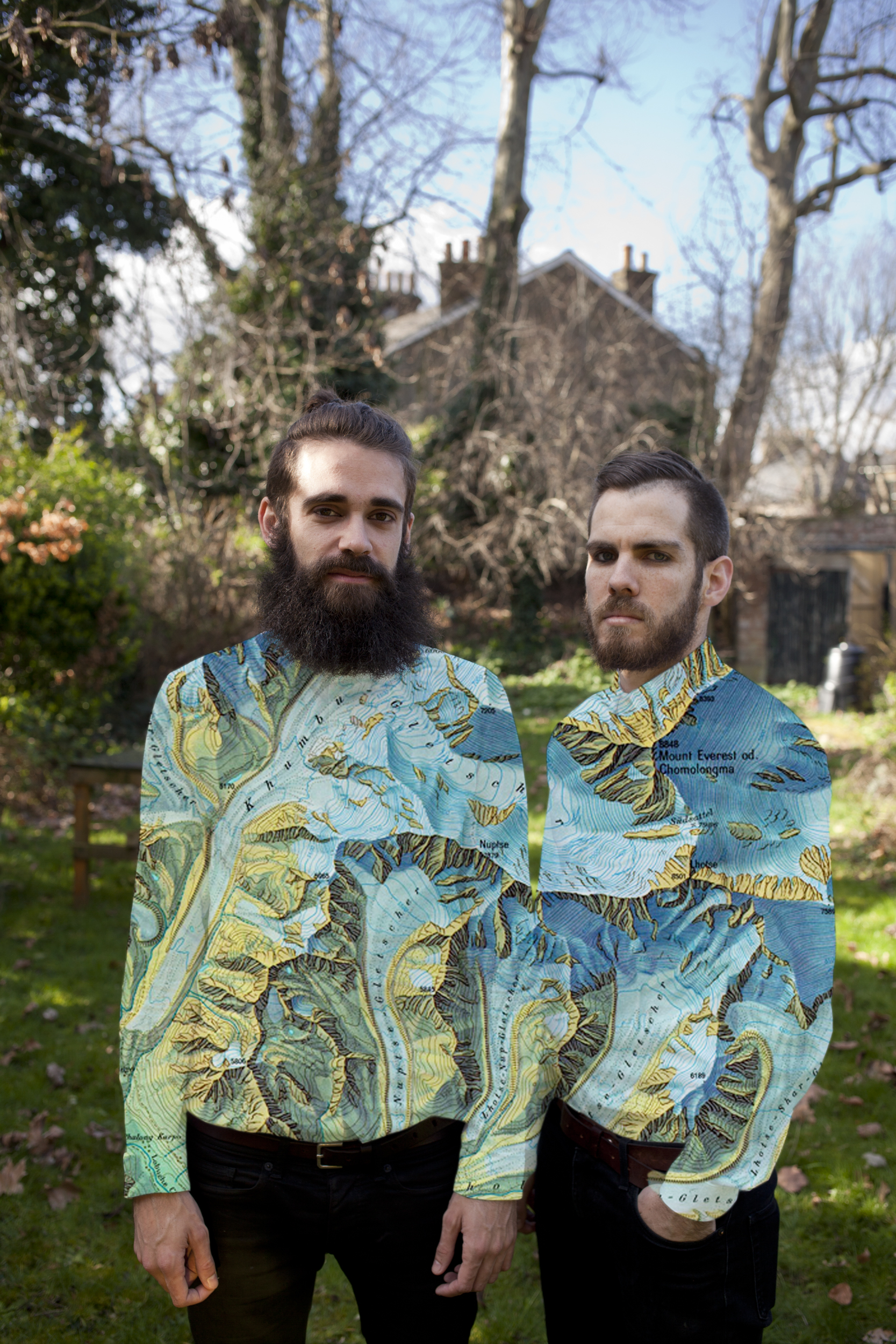
Daniel Fernández Pascual and Alon Schwabe. Image by Victor Staaf.

 Daniel Fernández Pascual and Alon Schwabe. Image by Victor Staaf.

About Cooking Sections:

Cooking Sections is Daniel Fernández Pascual & Alon Schwabe. They are a duo of spatial practitioners based out of London that emerged out of Goldsmiths University. Using installation, performance, mapping and video, their research-based practice explores the overlapping boundaries between visual arts, architecture, geopolitics and food. Cooking Sections was selected for OFFICEUS, the exhibition at the U.S. Pavilion, 2014 Venice Architecture Biennale commissioned by Storefront for Art and Architecture, New York. Their work has also been exhibited at the Festival of Future Nows, Institut Für Raumexperimente, Neue Nationalgalerie Berlin; dOCUMENTA(13); Peggy Guggenheim Collection, Venice; CA2M, Madrid; TEDxTalks, Madrid; Fiorucci Art Trust, London; xACC Weimar; SOS 4.8, Murcia; Haus der Kulturen der Welt, Berlin; Storefront for Art & Architecture New York; 2014 Biennale INTERIEUR, Kortrijk; and have been 2014 residents in The Politics of Food at Delfina Foundation, London. They have recently been recipients of the 2015 Jumex Fundación de Arte Contemporáneo research grants. Their work has been published by Sternberg Press, Lars Müller, Punctum Books, and several international magazines and journals, like Volume, Domus, 2G, The State, Zawia and Utopia amongst others.

The development of The Empire Remains project in The Caribbean was made possible with the supported of the 2015 research travel grant from Fundación Jumex Arte Contemporáneo, Mexico.

Tilting Axis: Day Two Video

The two-day conference Tilting Axis: Within and Beyond the Caribbean – Shifting Models of Sustainability and Connectivity was held at The Fresh Milk Art Platform, Barbados on February 27-28, 2015. This meeting aimed to promote greater conversations and engagement between artists and professionals working within artist-led initiatives across the wider Caribbean region, build and redefine historical relationships with those in the North, and establish open dialogue with active networks emerging in the Global South.

Organized by Fresh Milk, ARC Inc., Res Artis and Pérez Art Museum Miami, Tilting Axis saw the founders/directors of several of the region’s artist-led initiatives coming together to engage in face to face conversations, along with a number of professionals from outside the region interested in working with Caribbean based initiatives.

Tilting Axis was supported by the Arts and Sport Promotion Fund Committee (Barbados), the Davidoff Art Initiative, the British Council and the Prince Claus Fund.

Take a look at a short video from the second day of Tilting Axis. Thanks to Sammy Davis for shooting and editing this video!

Mother Tongue’s Residency – Final Blog Post

Mother Tongue, the curatorial duo of Jessica Carden and Tiffany Boyle, share their final blog post about their Fresh Milk residency, which concluded at the end of February 2015. They recount the last set of meetings they were able to conduct in their very full and productive schedule, including speaking with more artists & academics, visiting collections, and finally attending the Tilting Axis conference. Read the full post below: 

Walking Tour with Dr Anthony Richards

Walking Tour with Dr Anthony Richards

The final two weeks of our residency with Fresh Milk were incredibly full and productive, and left us with little time to put down in words how things had been progressing for us. So, belatedly – and from our colder home climates – here is our final blog, as we begin to reflect more widely on our time and research in Barbados.
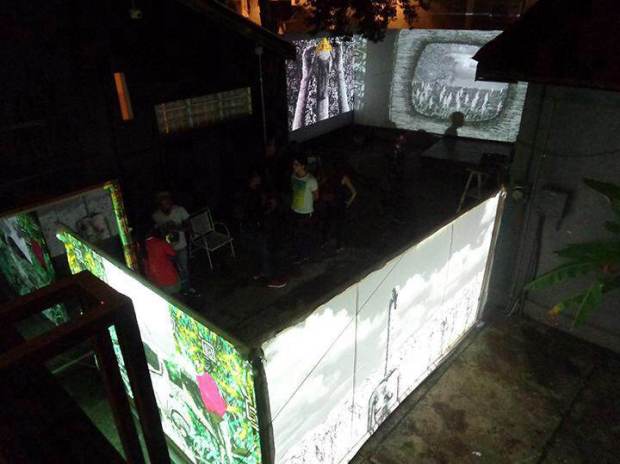
Work by Versia Harris installed at Alice Yard, Trinidad

Work by Versia Harris installed at Alice Yard, Trinidad

We began our fourth week at the Fresh Milk studio where the emerging Barbadian artist Versia Harris talked us through her latest videoworks. Versia has had a really busy couple of years with residencies and exhibitions across Europe, Russia, the USA and the Caribbean, so we were fortunate to have the opportunity to discuss her work in-person. In the afternoon, we led a curating workshop with the Fresh Milk Books group. Within this session, the group worked together to select an exhibition and then present to us an exhibition redux, making  revisions, reimaginings and remodellings of the original exhibition’s concept and execution. The workshop proved to be a successful method of furthering the FMB groups’ understanding and expectations around curatorial practice, and how it yields a huge affect on the way their own work is framed and represented.

Mid-week we met with Dr. Aaron Kamugisha, Senior Lecturer in Cultural Studies at the University of the West Indies where we discussed his work on coloniality, cultural citizenship and freedom in the contemporary Anglophone Caribbean, as well as his role of editor for the ‘Caribbean Political Thought: The Colonial State to Caribbean Internationalisms’ (2013) which has been an influential reference point for our own research in Barbados. Also situated on the Cave Hill campus at UWI is the Errol Barrow Centre for Creative Imagination which offers  BA and postgraduate degree programmes. At the EBCCI we met with the director, Gladstone Yearwood, who gave us a tour of the building and described some of the educational approaches the centre is taking in relation to arts education. Later in the day, we visited with Therese Hadchity the private collection of architect Mervyn Awon, whose collection has been amassed over a period of 40 years and predominantly consists of Caribbean modern and contemporary art.

Hosted within the capital’s Grande Salle, we attended the film screening of documentary ‘Chinee Girl’ by Natalie Wei which formed the later part of the Fish and Dragon Festival opening reception on the 19th. ‘Chinee Girl’ interweaves testimonials from twelve Chinese-Trinidadian women from all different walks of life to explore the various stereotypes and issues of identity they face daily in Trinidadian society. The end of the week was marked by our visit to the home of the artist Nick Whittle; an artist who has been making work in Barbados since the 70’s. Nick talked us through his recent works including his ongoing collaboration with his daughter and fellow artist Alberta Whittle, before allowing us to search through his print archive consisting of some of the older works. Nick was really instrumental in helping us to map the arts scene during the 80’s and 90’s, through his involvement in many of the local and regional exhibitions. Our visit ended with a very special reading from Nick; his poem ‘This Is Not My Land,’ is still echoing in our thoughts.
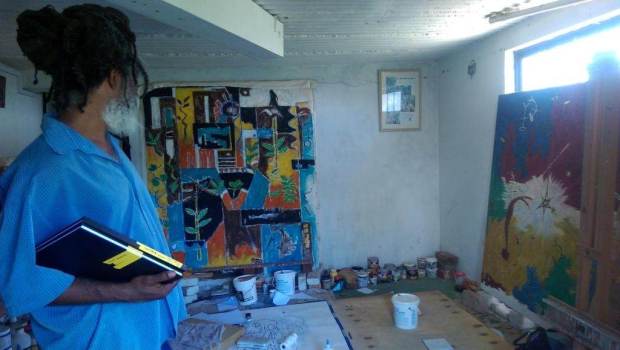
Ras Ishi Butcher

Ras Ishi Butcher

Our fifth and final week began with a visit to the National Cultural Foundation where we met with Andrea Wells, Chief Cultural Officer, and Rodney Ifill, Visual Arts Officer, focusing on their remits across the arts sector. We then travelled northeast across the island to make a studio visit with the prominent artist Ras Ishi Butcher. Previously working closely with the artist Ras Akyem, Ishi and Akyem left Barbados in the 90’s to study in Cuba. Ishi showed us new works, particularly focused on the female body and gender in the context of the Caribbean. We then viewed some of his older works whilst discussing his views on sustaining a practice on the island. That evening, we met with Dr. Anthony Richards, a biotechnologist based in Barbados who gave us a walking tour of the city centre. We discussed the spiritual meanings of the island’s flora and fauna, as well as being taken to a number of sites which are known to be important for the history of slavery and the sugar industry on the including the dockyard and city port.

On Tuesday we met with the dancer, choreographer and academic Dr. Yanique Hume. Co-editor alongside Aaron Kamugisha of the ‘Caribbean Political Thought’ volume, Yanique is also based within the Cultural Studies department of the University of the West Indies. Our conversation began with discussing the evolution of Yanique’s own practice in dance and choreography, before discussing her research into the arts in Barbados in the 70’s (primarily around Elombe Mottley’s ‘Yoruba Yard’ and Ras Akyem and Ras Ishi’s public painting projects), before discussing examples of exhibition-making focused around colonialism and race.

On Wednesday morning, we were very lucky to be granted access to the Barbados Gallery Association’s collection which is currently housed in the national museum’s storage facility in Holetown, located on the west coast of the island. We were accompanied by a number of the association’s committee members who talked us through their acquisitions process and future plans for the collection. We picked out works from the store to view, from artists including Stanley Greaves, Arthur Atkinson and Norma Talma; works which we had only previously seen in catalogues and books. On Thursday evening after visits to the British High Commission and the Ministry of Culture, we returned to Mojo’s bar on the south coast where we had met with the local artists and Fresh Milk team four weeks previously for welcoming drinks. This time, we were celebrating our four weeks and saying our farewells, whilst also welcoming a number of participants who had arrived early for the Tilting Axis international symposium which would be taking place at Fresh Milk later in the week. Directors Max Slaven and Ellie Royle arrived from David Dale Gallery, Scotland, alongside CCA Glasgow curator Remco de Blaaij.

Our final day before our residency came to an end was spent with the artist and curator Joscelyn Gardener. Joscelyn met with us in the Fresh Milk studio and described her experiences of being both an artist and  curator in Barbados, her framing of her heritage as ‘white-creole’ and the challenges she faced whilst running the Art Foundry; a gallery space which has now closed but was an important landmark within the arts scene for bringing international work and challenging subject-matter to the island. An established artist now living in Canada, Joscelyn spoke about the difficulties facing all artists in Barbados and her role on various committees attempting to secure a national gallery throughout the 90’s.

The following two days were dedicated to the international symposium ‘Tilting Axis: Within and Beyond the Caribbean – Shifting Models of Sustainability and Connectivity’ which was held at Fresh Milk. A partnership between ARC Magazine, Res Artis, Perez Art Museum Miami and Fresh Milk, the aim of the meeting was to promote conversations and engagement between artists and professionals within artist-led initiatives across the wider Caribbean region, build and redefine historical relationships with those in the North, and establish open dialogues and networks emerging in the Global south. Alongside David Dale Gallery and CCA Glasgow, we were present and supported by the British Council Scotland, representing artistic activity across Scotland. The conference witnessed 34 participants from all across the Caribbean come together in order to exchange experiences and form strategies for future support and collaborations. It was a rich experience and one that will undoubtedly have lasting effects. We will be sharing a report on the conference, alongside all participants in the coming month. We will also be reporting back on the outcomes of our residency with Fresh Milk, as well as information on the return project to take place in Scotland – more coming soon!