FRESH MILK will be hosting a two day workshop on “The Art of the Essay/The Essay on Art” with Christian Campbell on Saturday December 6th &13th. Join us from 10:00am – 12:00pm, to discover new ways of writing about expressive culture. Registration and fee required. Read more in the flyer below.
Category: Artists
Caribbean Digital 4-5 December 2014, A Small Axe Conference
Small Axe presents Caribbean Digital, a unique two-day conference in which they intend to engage critically with the digital as practice and as historicized societal phenomenon, reflecting on the challenges and opportunities presented by the media technologies that evermore intensely reconfigure the social and geo-political contours of the Caribbean and its diasporas. Presenters will consider the intersection of digital technology, new media, and Caribbean studies in a series of wide-ranging panel discussions. The conference will be preceded by a one-day researchathon dedicated to the construction of a comprehensive bibliography of and on the work of Kamau Brathwaite. They look forward to engaging with you – live or online!
The transformation of the academy by the digital revolution presents challenges customary ways of learning, teaching, conducting research, and presenting findings. It also offers great opportunities in each of these areas. New media enable oration, graphics, objects, and even embodied performance to supplement existing forms of scholarly production as well as to constitute entirely original platforms. Textual artifacts have been rendered literally and figuratively three-dimensional; opportunities for interdisciplinary collaboration have expanded exponentially; information has been made more accessible and research made more efficient on multiple levels. Scholars are called upon, with some urgency, to adapt their research and pedagogical methods to an academic climate deluged by a superabundance of information and analysis. This has created opportunities for open-ended and multiform engagements, interactive and continually updating archives and other databases, cartographic applications that enrich places with historical information, and online dialogues with peers and the public.
The need for such engagements is especially immediate among the people of the Caribbean and its diasporas. Information technology has become an increasingly significant part of the way that people frame pressing social problems and political aspirations. Moreover, the Internet is analogous in important ways to the Caribbean itself as dynamic and fluid cultural space: it is generated from disparate places and by disparate peoples; it challenges fundamentally the geographical and physical barriers that disrupt or disallow connection; and it places others and elsewheres in relentless relation. Yet while we celebrate these opportunities for connectedness, we also must make certain that the digital realm undermine and confront rather than re-inscribe forms of silencing and exclusion in the Caribbean.
Fresh Milk will be participating in Session 7 – Trans-Caribbean Creative Praxis at 3:45 EST / 4:45 pm Barbados time. Fresh Milk presenters include Amanda Haynes and Annalee Davis. See full schedule.
Fresh Milk welcomes International Resident Creatives from Toronto – Christian Campbell and Kara Springer
FRESH MILK is happy to welcome Toronto based poet and cultural critic Christian Campbell and industrial designer and visual artist Kara Springer to our International Residency Programme between December 1st – 19th, 2014. While in residence, Christian, a Trinidadian-Bahamian, will be working on poems for a new manuscript and on essays. In addition he will be offering two “creative critical writing” workshops to Barbadian writers as a way to open up exciting and rigorous new ways of talking about writing and expressive cultures. Christian’s “Critical creative writing” workshops will be held on Saturday December 6th and 13th at Fresh Milk.
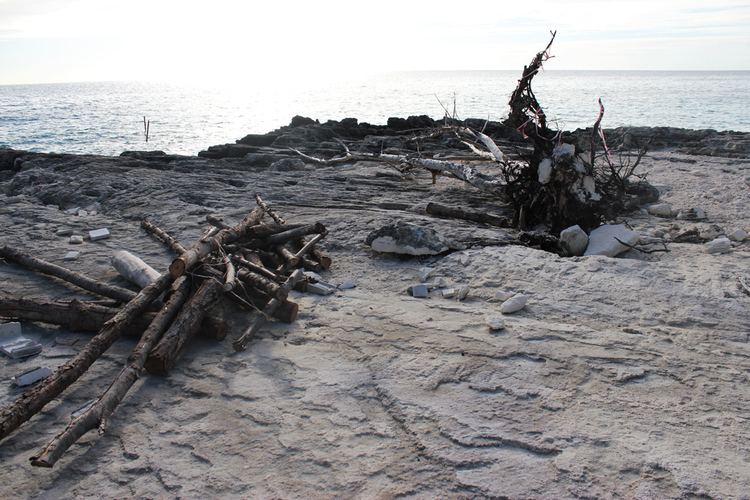
Of Bajan and Jamaican heritage, Kara was born in Barbados, and raised in Southern Ontario, Canada. This residency will provide her with a first opportunity to develop her art practice in her native island, Barbados. Kara will work on a series of temporal sculptural installations in the natural landscape – a continuation of a series begun in Nassau earlier this year. Her minimalist structural installations exist in the natural landscape and establish a dialogue that challenges standard ideas of minimalism as an aesthetic and a practice.
Stay tuned for more information including more on Fresh Milk’s final public event for the year which will take place on Friday December 19th from 6.30-8.30pm where Christian will read from his writing, Kara will share work produced on the residency and we’ll kick off the season with cheer!
Read more about the residents and their practices below.
About Christian Campbell
Christian Campbell is a Trinidadian-Bahamian poet and cultural critic. His widely acclaimed first book, Running the Dusk (Peepal Tree Press, 2010), won the Aldeburgh First Collection Prize and was a finalist for the Forward Prize for the Best First Collection, among many other awards. Running the Dusk was also named one of the best books of 2010 by the Caribbean Review of Books,Horizon Review and Poetry International. In 2015 Running the Dusk will be translated into Spanish and published as Correr el Crepúsculo by Ediciones Santiago in Cuba. His poetry and essays have been published widely in journals and newspapers such as Callaloo, The Financial Times, The Guardian, Small Axe and Wasafiri. He studied at Oxford as a Rhodes Scholar and currently teaches at the University of Toronto.
About Kara Springer
Kara Springer is an industrial designer and visual artist. Born in Bridgetown, Barbados, she currently lives and works between Toronto and Detroit. Her interdisciplinary practice explores the intersections of the body and industrial modes of production through sculpture, photography and designed objects. Kara completed an Hon.B.Sc. in Life Sciences from the University of Toronto concurrent to a B.Des. in Industrial Design from the Ontario College of Art & Design. She received her M.A. in New Media and Contemporary Technology from ENSCI Les Ateliers in Paris in 2007. Her work has been exhibited at the Frankfurt Museum of Applied Arts in Germany, the Politecnico di Torino in Italy, the Cultural Center of Belem in Portugal, and is currently included in the 2014 Jamaica Biennial.
Lauren Craig and Annalee Davis in Conversation
Fresh Milk‘s Founding Director, Annalee Davis sits down for a chat with recent Fresh Milk resident artist, Lauren Craig. Lauren is a London based multimedia visual artist who developed ‘floral installation” to describe her creative practice. During their conversation, Lauren spoke about some of the projects she has been working on in the UK including her work for the British museum and the Petrie Museum of Egyptian Archaeology. In addition, Lauren shares her collaborative work with British women of colour as they develop the Women of Colour Index and ‘X Marks the Spot’, in contribution to an archive at the library at Goldsmiths University in London. Below are photographs that Lauren produced while on her residency at Fresh Milk.
Lauren Craig and Annalee Davis In Conversation Part 1
Lauren Craig and Annalee Davis In Conversation Part 2
For more on Lauren’s residency and the continuation of her ‘Cleanse’ project, read Lauren’s exchange with Llanor Alleyne here: http://bit.ly/1EvPQdF
Lauren Craig’s Biography
Lauren Craig is a social entrepreneur and artist researcher based in London. She has designed systems and living business models that have challenged large corporations in areas of racism, minority and women’s rights. Her art and entrepreneurial activity tackle big questions around ethics, equality, sustainability and community engagement in the cut flower industry whilst delivering practical floral alternatives locally, through her organization ‘Thinking Flowers?’
As an entrepreneur, Lauren is involved with social issues such as environmental destruction, London street crime and equality, aiming to promote positive change through ethics, sustainability and engagement. She has developed therapeutic methods using photography to document and tackle street crime and runs a pioneering ethical florist. Additionally, she has founded ‘Field’ – an innovative pop-up community retail space in Brixton Village, pioneered urban green waste schemes and floral donations services whilst campaigning for human, working and women’s rights further afield. She is currently setting up the Field Foundation, which will work to reconnect people with the creative cultural industries.
Her recent work includes ‘Petal Tank’, an experimental film featuring collage of autoethnographic darkroom photography, poetry and sculpture. (Tate Modern Tanks, 2012) ; An artist residency at the Women’s Art Library at Goldsmiths College, University of London (2013-2014) ; Sculptural Garden, collaboration with Paul Jones, Royal Collage of Art for Space Station 65, London (2014) ; ‘Sense and Sensibilities’ at Victoria and Albert Museum, London (2014) ‘Modern Measures – Holding, Pouring, Stirring’ at The Petrie Museum of Egyptian Archaeology in London as part of University College London Museums & Collections (2014). Collaboration with visual arts and research collective ‘X Marks the Spot’, initiated at Studio Voltaire 2011, engages with the archive of photographer Jo Spence to explore concepts of class, race, gender and wellbeing.
Lauren Craig’s Residency – blog post #2
Fresh Milk‘s UK based resident artist Lauren Craig met up serendipitously with New York based Barbadian artist Llanor Alleyne at Hunte’s Gardens. Llanor came out to participate in Lauren’s ‘Cleanse’ session. This impromptu dialogue is a direct outgrowth of questions Llanor posed to Lauren over the past few days.
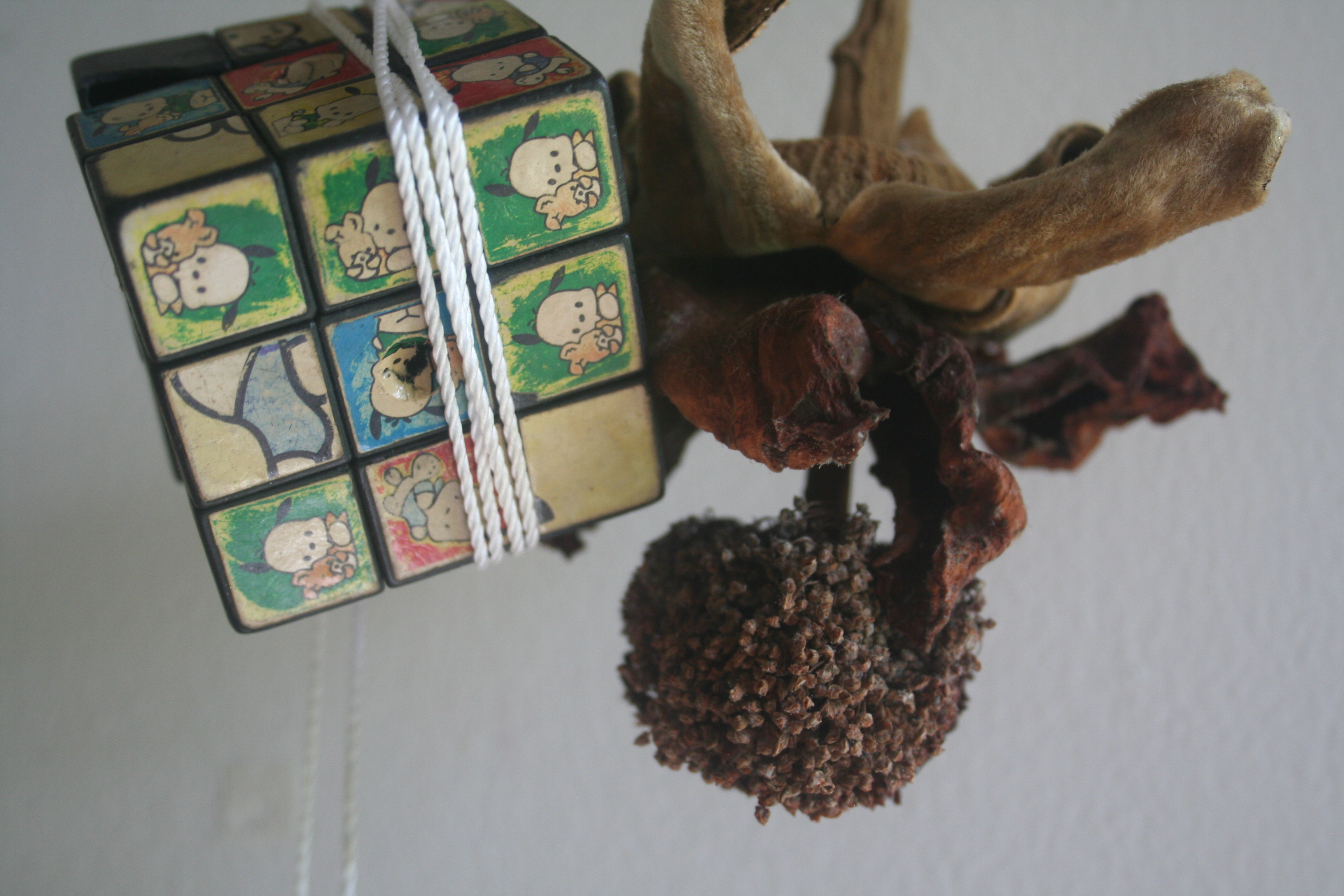
‘Cleanse’ involved a group of women who came out to Fresh Milk to participate in interactive sessions examining mental and creative blockages that build up through busy, overworked lives. Lauren speaks with Llanor about how our bodies do not discriminate against what information they retain in daily life, and how they act as repositories or ‘palettes/palates’ that accumulate everything, becoming overloaded with unnecessary or negative content. The suite of images attached are born out of the Cleanse sessions that took place at Fresh Milk during the course of Lauren’s residency.
Llanor Alleyne: How did you move from your initial art practice of flower conservation, floral design and installation to the conception of Cleanse? What is fuelling that transition?
Lauren Craig: I think in some ways all the media I have worked with are connected. Dance, modelling, photography and floral installation all come from the same place and have helped me explore my concerns. When I initially named my way of working ‘floral installation’, the term was not being used by anyone else. But with other artists now framing their practice in this way, I felt the need to re-examine my own. Cleanse is in some ways an attempt to distil or turn the floral installation work inside out. It questions the notion of power being given to icons versus the power of collective attention and action. We tend to hold these things as sacred secrets and administer a pedestal to people that are perceived as able to give you the key. In the process, I’ve noticed that despite elements of performance and alternative therapies becoming more overt, photography—or what I like to call image making—still plays a big part. I think what fuels this transition is my curiosity as well as my shortcomings in the skills needed to express what I want to share and find the most harmonious way to do this.
LA: How have you structured the Cleanse practice? Walk us through a Cleanse session.
LC: The Cleanse format is loosely based around a few features. Every edition is different and responds to the space, but I can share the process for the group session. Participants are asked to bring an object that represents a feeling/emotion/attribute they would like to let go of or ones that they would like to foster more. It is also fine if they do not want to bring/leave the object. We open with a two-minute moment of silence. Then I give the group time to ask clarifying questions. We work on the confidentiality bond—communicating with the group things we want to put out of our mind, things that are bothering us and that we cannot change, or things that the participants do not want to focus on in the session. An introduction of each participant to other group members and discussion of brought objects follows. Participants are given the opportunity to leave these objects to become part of a sculpture made up of all the left objects. You can choose your modality for individual/group creative reflection. During this period I work with each participant individually.
LA: What are the basic tenets of Cleanse? Are they rooted in traditional forms we have come to associate with alternative life therapies such as meditation, reflexology, aromatherapy, etc.?
LC: I don’t know if ‘Cleanse’ has tenets, as in beliefs except that in my imagination there is a ‘palette’ that we have; they are like non-discriminatory depositories, they become overwhelmed and blocked, they stop us collecting the information we need and creating the things that keep us healthy. ‘Cleanse’ is about the everyday rituals and social skills we have to keep healthy relationships and environments. It risks questioning what happens if we are given a safe space to let go of what we do not need. These things are equally important to the opportunity to engage in meditation or aromatherapy during a session, if that is what you gravitate towards, also equal is the opportunity to go for a walk, make a sound recording or dance.
LA: What is the significance of the “object” in Cleanse?
LC: I think objects can hold a lot of meaning for people. The physical manifestation of emotions and feeling is much easier to conceive for some people. It adds a visual, spatial element to the session, many people have described it as being a real freeing experience. I am one of these people that sometimes needs to make a physical object that encompasses the ideas. The objects also allow me to do that through the sculptural element of the installation and then the photography.
LA: What does it mean to release our object to you? Do you see yourself as the caretaker of that object or the documenting disposer? What significance does your role as facilitator hold?
LC: I think in releasing the object to me you are letting go and giving in to the process of unblocking and becoming less stuck. I am in some part a taking care of the objects, in a sort of suspended space, I guess. I don’t think I document them, the process is more about including them in the production of the installation, allowing them to become part of the place/site to inform the work. As the facilitator, I call and hold the group during the process. I help set the boundaries, mainly around confidentiality. That is about it, the rest is about the participants and their context and the elements they have chosen to work on during the process.
LA: Can you talk a little about wanting to shatter this idea that life therapy practices are only for a select few and, that in practicing Cleanse as you envision it, you are breaking a cycle that sometimes involves holding such traditions as a secret?
LC: Well, Cleanse demonstrates that we don’t need to bestow power on one person but possess democratic social skills that can heal our issues as a collective. As some issues are site specific, most people in the group are better placed to be support systems than I am. The transformation is theirs; I am not the cause. The Cleanse sessions mainly use methods we can all use. They are resilient, hyper local and idiosyncratic.
LA: If a group Cleanse is done with a pact of confidentiality, does it still hold that the practice has avoided secrecy? Is there a difference?
LC: There is a difference to secrecy and confidentially to me, yes. People share personal things that they are holding on to, so people are courageous and share things that have never been voiced and it is no longer a secret. It is held and then processed collectively by the group and they then have a support network to help them work through it as and when they are ready.
LA: How would you like to see Cleanse evolve and spread? What would you like individual participants to take away and build on after attending either a one-on-one Cleanse session or a group session?
LC: The concept was originally born out of the busy urban environment and imagined as happening in places crowed with artistic and commercial stimuli such as an art fair or outside a gallery, for example. It is most satisfying for me that people take away what they need and let go of what they don’t. That they feel better able to function at their full capacity, or gain a better idea of what that is. I guess a lot of Cleanse is about remembering we have these skills and collective capacities.
LA: Bringing things full circle, how does Cleanse inform your art practice and evolution?
LC: Cleanse allows me to explore how the disparate parts of my practice interconnect within specific sites and cultures. People bring their situation and the work becomes an imprint of that, a cluster or essence of that place and its people. I hope to keep offering Cleanse in different parts of the world, mapping what people what to let go off and building a constellation. I continue to wonder if what is brought to a session in London would be the same as what is brought to a session in Barbados—or Italy or Uganda—and what they would all look like together.
Llanor Alleyne Artist, Writer and Editor
Biography
Llanor Alleyne is a Barbadian artist and writer living in Brooklyn, New York. Using collage techniques, her work is a dissection of the interior life of her figures and employs tearing, cutting, and layering to allude to the emotional and physical presence/absence mirrored in the wider world. In addition to her artwork, she is the author of the novella, Leave to Remain and the screenplay, “The Mango Eaters”. Having served as a ghostwriter for and contributing editor to Random House, she has also written lifestyle and culture articles for Time Out New York, TheLoop21.com and Metro Newspapers.Llanor is currently a contributing writer and editor for Residential Systems, Sound and Video Contractor, and the London-based publication, Installation Europe.