TVE Open Call – Deadline Extended

TVE (transoceanic visual exchange) is making an open call in search of recent artists’ films and videos to be included in an exchange between Fresh Milk (Barbados), RM, (Auckland) and VAN Lagos (Nigeria). The deadline for submissions has been extended until February 27, 2015.
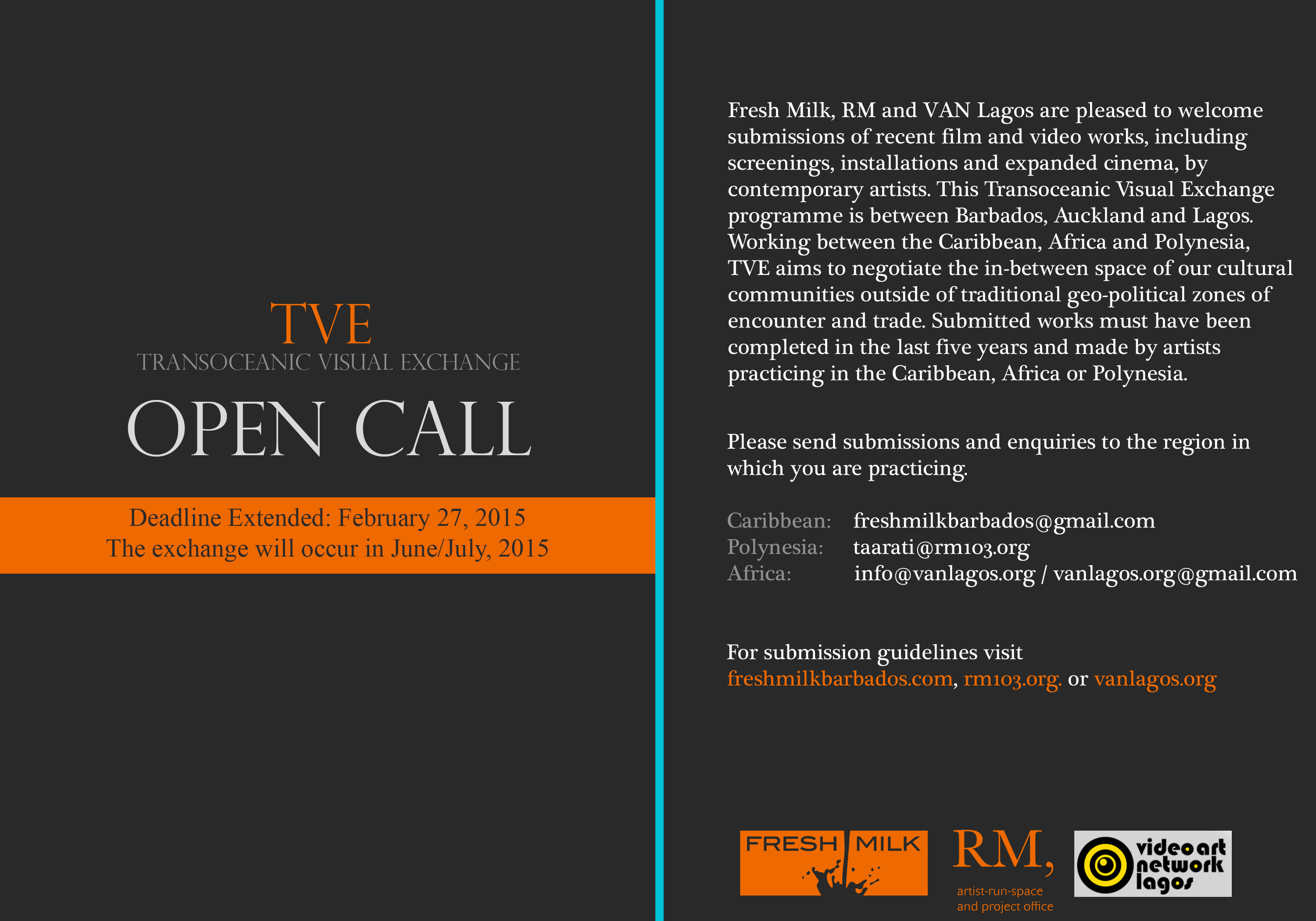
TVE flyer Extension

Fresh Milk, RM and VAN Lagos, are pleased to welcome submissions of recent film and video works – screenings, installations and expanded cinema – by contemporary artists, to be included in programmes for exchange between Barbados, Auckland and Lagos. Submitted works must have been completed in the last five years and must be made by artists practicing in the Caribbean, Africa or Polynesia.

The foundation of this transoceanic visual exchange (TVE) will be a collection of recent artist’s film and video from each region. However, the final shape and content of the programme will be informed by an open workshop process, which aims to involve and promote discussion within the wider arts communities of each arts initiative.

Working between the Caribbean, Africa and Polynesia, TVE aims to negotiate the in-between space of our cultural communities outside of traditional geo-political zones of encounter and trade. Fresh Milk, VAN Lagos and RM first met as participants of International Artists Initiated, a programme organized and facilitated by David Dale Gallery, Glasgow, in July 2014. TVE intends to build upon relations established during this initial encounter and open up greater pathways of visibility, discourse and knowledge production between the artist run initiatives and their communities.

Submissions:  

  • Must be work from artists practicing in the Caribbean, Africa or Polynesia.
  • Must be work that has been completed/made in the last five years.
  • Can be films of any length (shorts, experimental, features and video artworks)
  • Can be in any language (films originally produced in regional languages are welcome) with English subtitles.
  • Multiple submissions are welcome
  • Must be accompanied by a description of the work (500 words max), a bio (200 words max) and detail of any technical requirements i.e. audio, installation, equipment required, preferred setting etc.
  • Works must be in the form of mp4 files no larger than 10MB, or private Vimeo / Youtube links

The new deadline for submission is February 27, 2015 for all regions.

The exchange will occur in June/July 2015

Please send submissions and enquiries to the region in which you are practicing:

Caribbean: freshmilkbarbados@gmail.com
Polynesia: taarati@rm103.org
Africa: info@vanlagos.org / vanlagos.org@gmail.com

About the Spaces

Fresh milk colours

The Fresh Milk Art Platform Inc. is a Caribbean non-profit, artist-led, inter-disciplinary organization that supports creatives and promotes wise social, economic, and environmental stewardship through creative engagement with society and by cultivating excellence in the arts. Fresh Milk bridges the divides between creative disciplines, generations of creatives, and all linguistic territories in the region. It functions as a cultural lab, fostering critical, creative practices through local, regional and international programming. The platform transforms into a gathering space for contemporary creatives who are thirsty to debate ideas and share works through residencies, lectures, screenings, workshops, exhibitions, projects etc.
van lagos logo

The Video Art Network, Lagos (VAN, Lagos) is a Lagos based New Media art organization, established by the collaborative efforts of artists Emeka Ogboh, Jude Anogwih and cultural producer Oyindamola Fakeye. The organizations objectives are to develop educational and public programmes that promote and create new media art awareness in Nigeria. This is realized through curated screenings and exhibitions of both established and emerging New Media artists.

RM

RM is an artist-run space, project office and (gradually developing) archive. Based in Auckland, New Zealand, RM is a gallery that places the work of local emerging artists alongside more seasoned practitioners. RM seeks to engage with the practices, discourses and modes of presentation that aren’t well-supported or easily accessible in Auckland. Though we might look like a white cube, we are more interested in the potentials of an empty room – a space to gather, to think, to talk, to make, to share… Established in 1997, RM is the country’s longest running artist-run-space. The co-directors are Eleanor Cooper, Melanie Kung, Ziggy Lever, Fleur Sandbrook, Taarati Taiaroa, and co-founder Nick Spratt. Previous incarnations of the rm project have included rm3, rm212, rm401 and rm103.

Mother Tongue’s Residency – Week 2 Blog Post

Mother Tongue, the curatorial duo of Jessica Carden and Tiffany Boyle, share a blog post about their second week at Fresh Milk, which kept them busy with a number of meetings and visits. These sessions were not only with artists, but also focused on the island’s history, geography and social environment; topics that feed into a number of the art practices they have encountered so far, and contribute to Mother Tongue’s overall understanding of the space. Read their report below: 

photo(7)

Whilst our first week in Barbados took the form of an introduction to Fresh Milk, the reading room collection and the studio space, our second week has been a flurry of meetings, studio visits and trips around the island to meet with various individuals, museums and organisations. It has been a week of connecting with a whole host of people who are instrumental to the arts scene here on the island – both in the past and in the present – with established and emergent practitioners. We have also consciously widened our scope to look at the rich histories outside of the arts, but which have been preoccupying local artists, such as the sugar industry, tourism and the colonial role in the horticulture of the island.

photo(5)

On Monday we met with the Barbadian artist Alberta Whittle, who we were originally introduced to in Glasgow whilst she was studying at Glasgow School of Art. Alberta gave us a tour of the National Museum of Barbados, and provided a brilliant insight into her position as a Barbadian artist who has become established outside of the island but returns regularly to make work here as an invested member of the arts community. Alberta also introduced us to our very first Caribbean snow cone, which consists of crushed ice, sugar syrup and condensed milk; perfect for a Scottish sweet tooth! We attended a lecture at the museum which was focused on the evolution of the tourist industry here in Barbados from the early 19th century onwards, and how it has become central for the islands’ economy, which was for such a long time monopolised by sugar cane.

Having become aware of their work through various Caribbean art publications in the Fresh Milk reading room, Director Annalee set-up studio visits with the artists Ewan Atkinson and Mark King. We were really lucky to have caught a sneak preview of Ewan’s exciting new work for the Havana Biennial which he will be taking over later this year. He also gave us some really interesting background information to his recent series ‘The Neighbourhood Report’, which comprises of several fictional characters exploring notions of identity, sexuality and gender representations. In our conversation with artist Mark King, he charted his journey from the US and Holland, and why he has chosen to return to Barbados to make it his base, while he continues to exhibit internationally.

This week we have also been really fortunate to spend some time with the artist Holly Bynoe, who is also the Co-Founder and Director of Caribbean Arts and culture magazine ARC. Throughout her career as an artist, researcher, curator and writer in the Caribbean, Holly has been an invaluable source in providing references and links to artists and projects across the region. We were able to discuss the role ARC magazine has been taking as a platform for many projects – written and beyond – over dinner with Holly and Assistant to the Director Katherine Kennedy, who is also an artist and an integral member of the Fresh Milk team.

On Friday we were introduced to the artist Denyse Menard Greenidge, who founded Dayrells Art Gallery in Barbados in the 70s, and continues to curate the work of Barbadian artists locally and internationally. Talking us through documentation from the 70’s and 80’s, Denyse was able to provide us with an overview of how governmental support for the arts has changed over the years and how this has impacted the current activity on the island. We visited her husband Newlands Greenidge‘s self-founded Springvale Indigenous Folk Museum, which is located in the Scottish district on the east of the island. The museum hosts a collection of artefacts which describe what life would have been like on the island in the early 19th century. Created through a labour of love by Newlands and Denyse, their passion for the island’s history is clear through the wealth of information they provided about the collection and its significance for Barbados.

In our second week, we were also visited in the Fresh Milk studio by Sean Carrington, Professor of Plant Biology at the University of the West Indies, Cave Hill Campus. We had a really stimulating conversation about the importation of species into the island, indigenousness and plant life, and the problems language causes between islands in the region, in terms of classification and keeping track of plant populations. Following our meeting with Sean, we went to meet Dr. Anthony Kennedy, Director of the West Indies Central Sugar Cane Breeding Station. The station is one of the most successful breeding centres in the world, whose work and research helps to develop sugar industries across the Southern Hemisphere. During our visit we were talked through the history of sugar on the island, and how it formed and influenced the way we see not just the agricultural formations but the human geography and architecture of the island too. This history is so significant for any attempt to understand the island, and it’s something that we’re trying to grasp as best as we can during our visit.

We look forward to a busy third week that will include two presentations at Barbados Community College on curating, and a re-screening of our ‘Afrofuturism’ programme, originally developed for the Africa in Motion Film Festival 2012.

Open Call: FRESH MILK International Residency 2015

FM International open call 2015

FRESH MILK is seeking proposals from artists working outside of Barbados to apply for our international residency programme in 2015. Available dates for the residencies to take place are between March 23 – June 12, 2015 and November 2 – 30, 2015.

This residency aims to support visual artists, writers and curators by offering a peaceful working space for a minimum of 4 weeks for creative production, the opportunity to interface with contemporary practitioners living and working in Barbados, access to the on-site Colleen Lewis Reading Room, the chance to broaden understanding of the work being produced locally and regionally in the Caribbean, and to strengthen international networks and relationships. For more information on the residency, application process and associated costs, please visit our International Residency Opportunity page.

The deadline for applications is March 13, 2015.

Mother Tongue’s Residency – Week 1 Blog Post

Mother Tongue, the curatorial duo of Jessica Carden and Tiffany Boyle, share their first blog post about their Fresh Milk residency. Coming from Scotland and never having been to the Caribbean before, they describe their introduction to the Barbadian art scene and share some of their evolving plans for engaging with the creative community over the next few weeks. Read their blog post below:

Our first week at Fresh Milk simultaneously marks our first week in the Caribbean; a region whose artists and writers we have been engaging with from a distance for some time now. We arrived with a mix of anticipation and genuine excitement at the opportunities that lie ahead. We had previously met with Fresh Milk’s director Annalee Davis on her visit to Glasgow for the 2014 Commonwealth Games cultural programme, at the ‘International Artist Initiated’ panel discussion at David Dale Gallery, Glasgow, and had been in dialogue since then. Fresh Milk played a central role in the critical discussions unpacking the commonwealth as a loaded cultural event and its enduring impact for the Caribbean, whilst also representing artist-led activity in Barbados.

Our first day at the Fresh Milk residency space took the form of an introduction to the impressive collection within the Colleen Lewis reading room. Annalee talked us through the collection’s categories, and picked out for us seminal texts and exhibitions catalogues which have been helping to give us an overview of not only the current artistic activity and infrastructure in the region, but also the history of artistic practice in Barbados and its ties with elsewhere.

The Fresh Milk ArtBoard featuring work by Ronald Williams.

We were then introduced to the Fresh Milk Books team. After introducing our practice and discussing a number of our curatorial projects, we started to informally talk with the group about their experience of making work in Barbados, the support the Fresh Milk Books group provides for them, and the manner in which they position their work in relation to specialised interests pursued through this meeting point. The discussion then went off in a number of tangents, from notions of whiteness, skin and beauty ideals, both historically and contemporary. We’re going to be discussing with the group a format for understanding curatorial practice this week, which will lead to a kind of workshop in Week 3, the same week that we will be re-screening our 2012 Afrofuturism artist film and video programme for students at the Barbados Community College.

We were also delighted to bring with us a collection of publications generously donated from UK based organisations and individuals, which now call the Colleen Lewis Reading Room their new home. These include Map Magazine; Variant Magazine; Chelsea Space publication archive; University of the Arts London Graduate School; TrAIN Research Centre for Art, Identity and Nation; Flat Time House London; Lyndsay Mann, and Alex Hetherington’s Modern Edinburgh Film School. We hope these publications will be a welcome connection between the UK and Barbados.

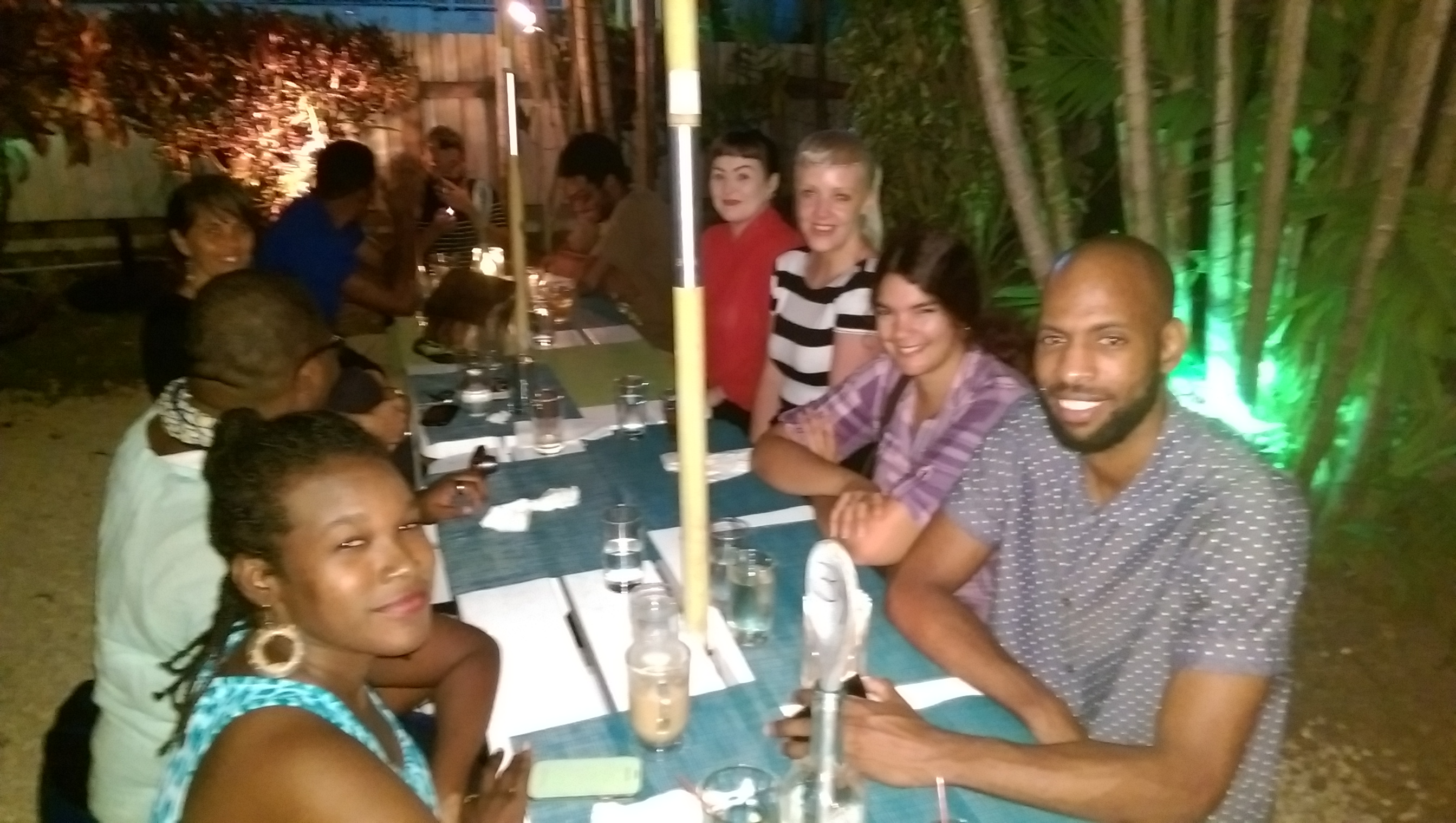
Creatives gathering at Mojo's on the south coast.

We also took a trip into the capital of Bridgetown, and later in the week met with a group of local and visiting artists, Fresh Milk friends and the Fresh Milk Books group. After some rum punches at Mojo’s on the south coast, we had the chance to talk about our practice and our aspirations for the residency, as well as to connect with artists and discuss not only their work but their views on being Bajan practitioners. Among the artists we met was the wonderful Alberta Whittle, whom we have existing connections with from her studies and career in Glasgow. The evening was informal and provided a perfect introduction to the local arts community, before we set up further discussions in the weeks ahead.

For now, we are implementing all the planning the first week provided, and will spend our second week mostly outside the studio, meeting with practitioners, and looking towards our return UK project.

FRESH MILK XVII Review

Kwame Slusher, writer and current team leader of Fresh Milk Books, shares a review of our final event for 2014, FRESH MILK XVII which took place on December 19. The event featured presentations by resident artists, overviews of past and upcoming projects & activities, and a potluck celebration dinner to close out our year. 

All photography by Dondré Trotman.

IMG_0016

…so we jewel the edges of his body

With shattered bottles, then bear him
to the foot of the casuarinas in order that his born
silhouette may freely flash and prance—

– Christian Campbell
Goodmans Bay II

The game described in Campbell’s poem, which he read at the event FRESH MILK XVII that took place on December 19, 2014, is known as Moon Shine Baby/Dolly—a traditional game played by children in the Caribbean and West Africa. One person is chosen or chooses to be the ‘baby/dolly’ and they lie down on the ground, while the other children outline the ‘baby/dolly’ with limestone and broken shards of glass. When the other children are finished, ‘baby/dolly’ gets up and their silhouette of found things would glitter in the moonlight. The game in Campbell’s poem is reminiscent of the Ancient Greek girl that wanted to preserve the memory of her lover who, after a time, had to return to his homeland. As the story goes, she made her lover stand still while she traced the outline of his shadow, then later, got her father to fill it in with clay. Inadvertently, like the game in Campbell’s poem, she not only created a space to remember someone by, but where something new can be developed.

FRESH MILK XVII was not just a space for the latest two resident artists to formally present on their work and experiences, but also an opportunity for members of the Fresh Milk platform to recount recent activities and to look to the future. In the wake of not having a National Art Gallery, Fresh Milk’s director Annalee Davis stated in her opening remarks that “…we live in an era necessarily of self-organization. Civil society must self-organize and build the spaces we want and need for ourselves.” Like the gathered bits of limestone and glass on the beach and the outline of the lost lover, Fresh Milk is  attempting to reimagine a historical space that fosters creativity.

The first presenter, Barbadian arts writer Natalie McGuire, spoke about the Transoceanic Visual Exchange, which is a project Fresh Milk is working on in conjunction with two other art communities: RM in New Zealand and Video Art Network (VAN) Lagos in Nigeria. McGuire said that the project was about upending traditional notions of geo-political space and cultural exchanges. The project is looking for submissions from filmmakers, video artists or artists that work between these spaces—those whose works don’t quite qualify to be shown in a gallery or in a cinema —to go about creating a digital sphere where these cultural exchanges can take place.

Barbadian visual artist and writer Katherine Kennedy then spoke about her experiences at Akadamie Schloss Solitude in Germany, where she had been selected to participate in the ResSupport Fellowship Programme offered by Res Artis on behalf of Fresh Milk from September 1st to December 1st. In her presentation, Kennedy looked at the different connections and encounters that she made with a diverse cross-section of people from around the world. In addition to the interconnection of ideas in a single space, she said that it was good to be able to find the familiar in an unfamiliar environment. She spoke about attending the opening of an exhibition in Memmingen, which focused on carnival, and seeing the work of Trinidadian visual artists Marlon Griffith and Barbadian visual artist Ewan Atkinson. Kennedy pointed out that what was interesting about the exhibition is while the theme was carnival, it was looking at both European and Caribbean depictions instead of just focusing on one locale.

In the second half of the evening, the two artists in residence – Toronto-Based, Bajan-Jamaican industrial designer and visual artist Kara Springer and Toronto-based, Trinidadian-Bahamian poet and cultural critic Christian Campbell – presented their work and what they had accomplished during the residency. Kara talked about her project, Repositioned Objects, which involved the building of 4x4x4ft wooden structures that create tension between the controlled and the uncontrollable. Kara, with the assistance of Christian, went around different points of the island installing the cubes and photographing them. In some cases the structures were left overnight, and in others she only had a short time to construct, photograph and break the structures back down again. What she did not expect was to not only have to deal with destructive natural elements, but also with people who went out of their way to destroy her structures. She was forced to then contend with the intersection of creation and destruction; the difficulty of trying to create order in a chaotic environment.

The final address was given by Christian Campbell, who began by speaking a little about the workshop he led titled ‘The Art of the Essay/The Essay on Art’. The workshop focused on ekphrasis, which has traditionally been a creatively written description on a visual work of art, however for the purposes of the workshop the definition was expanded to include any art form responding to another. Christian’s presentation, unlike the others, was really a series of readings. The first was Martin Carter’s Till I Collect to commemorate the 17th anniversary of Martin Carter’s death, which would have been on the second and last day of the critical writing workshops, held on December 13th. He also read Till I Collect because the last two lines of the poem, “till I collect my scattered skeleton/till I collect…” seemed to correlate with Jean Michel Basquiat’s X-Ray-like self portrait. Campbell read what he considered the ‘most important’ thing that he achieved during the residency, an essay on Jean Michel Basquiat, before adding to the selection with three poems from his own collection ‘Running the Dusk’: Goodmans Bay II, Curry Powder and Iguana. The last poem he read was one of his newer pieces, Names.

In his piece on Basquiat, Campbell read that the Haitian-American artist tried to collect everything, “…the way the Caribbean is the cross-cultural crossroads for the whole damn world”. In many ways that represents what art communities such as Fresh Milk, RM and VAN Lagos are and try to be with projects like the Transoceanic Visual Exchange; to create spaces with what is there, so that something new can develop. This makes it possible for artists like Katherine to go to places like Akadamie Schloss Solitude to work with and connect with other artists from all over the world.

After the presentations were over, and the rain that threatened to drown them had petered out, everyone gathered on the veranda to partake in the Christmas Potluck; to create a new space filled with the holiday spirit and hope for the New Year.