Performance Art @ Fresh Milk II St. George Barbados by Yasmine Espert

Fullbright Scholar Yasmine Espert shares her thoughts on the Fresh Milk II event:

Performance Art @ Fresh Milk II
St. George, BARBADOS.

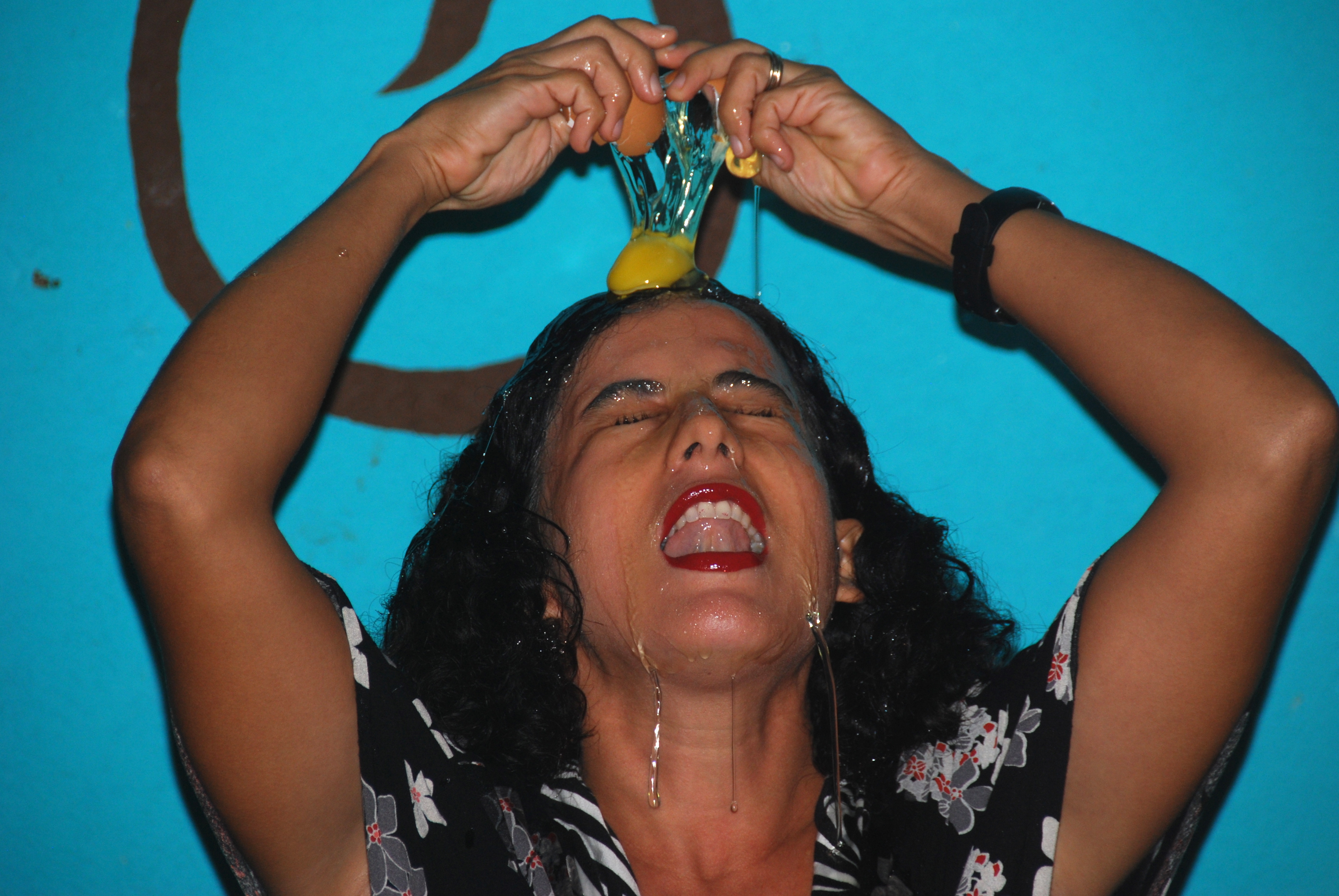
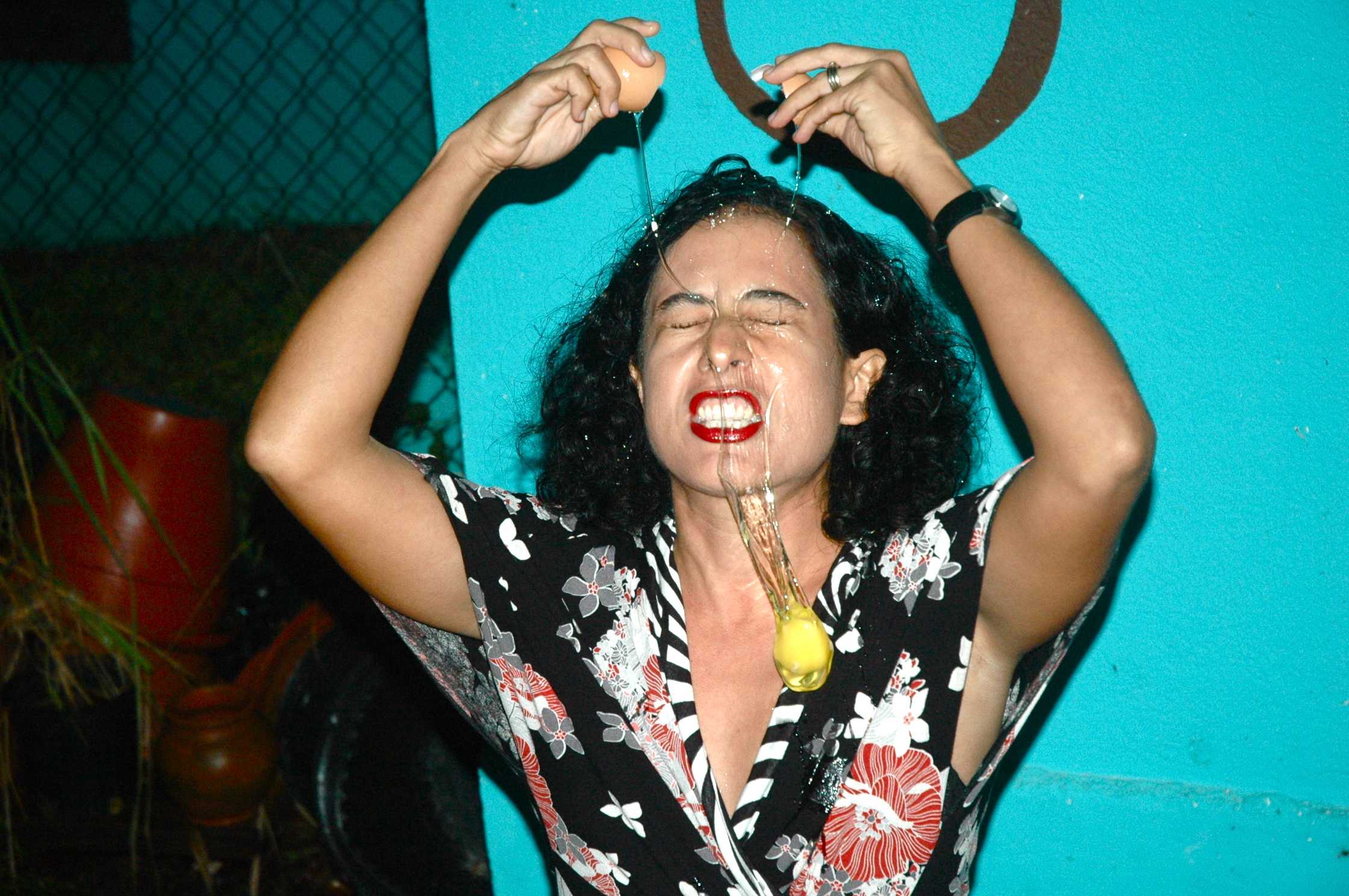
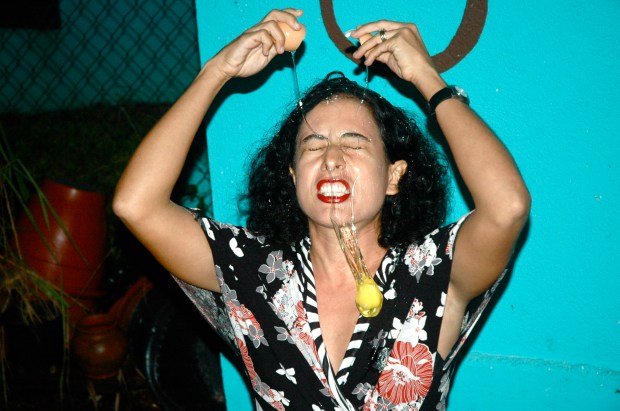
This is Sandra Vivas. And believe it or not, this (was) performance art. The only thing missing from this image is the elegy she belted out as she bathed herself in fresh, uncooked eggs.

I tried to put the protein aside and focus on the poem she laced with resentment but…

1. I was confounded by the use of eggs. During the performance, I kept asking myself: is she really going to use the whole dozen?

2. She chose to speak in Spanish. I was able to grasp a line here and there (thank you high school/college español), but for the most part, I was lost between her garbled words and the occasional egg yolk that landed in her mouth.

Did she plan this? Why aim for the grotesque?

Vivas’ performance did result in a few chuckles from the audience. I’m not sure if that was her intention — but I am sure that she got my attention. Later that night I came across an English translation of her piece. Like many of her works, it gave a fascinating, albeit bizarre, unveiling of the issues women face today (take a look at her YouTube page for more)

Leandro Soto, a contemporary Cuban performance artist (aka “the first performance artist de Cuba) told me that performance art is about the now…”you never choreograph. You always trust in the moment.”

No matter what your (political) message is, you have to confide in improvisation. Even if it means you have to bathe in raw eggs.

Imagine if we all approached life that way.

Food For Thought

© Carlie Ester Pipe


Sandra Vivas performance piece at Fresh Milk

On Saturday, November 19th Fresh Milk offered Barbados a taste of performance art. Coming to us with the distinct Venezuelan flavour of Sandra Vivas, an inspirational performance artist from Caracas, we were given the opportunity to consume art in a whole new way.

Performance art, is an abstruse concept. In my humble understandings (for I’m a writer, not a historian) what I will ignorantly-just-for-this-essay call “regular art” is easier to define and therefore control. It’s trappable between the edges of the canvas, the brushstrokes that are created at 4.55pm on Tuesday are then frozen in time and so remain until they are destroyed. The author will not outlive her work, and she may hide from it, reject it, and walk away from it. In essence, “regular art” is a tangible, touchable creation that is confined to a four sided parallelogram that may never be altered from the day it was birthed, and may be viewed in exactly the same state by anyone, anywhere, at any given moment.

Performance art, on the other hand, is intangible. The author IS the performance, and for that reason she can never walk away from her piece. She is the piece. She is not confined to a canvas, she is only restricted to the 3D limitations of our perceptions of the realm in which we live. Though her performance may be viewed (live) again and again and again…it will never be the same twice. What we viewed on Saturday, she may well have performed in likeness elsewhere, but given the environment, audience, available props and humanity of the author, it was unique.

Sandra’s piece was the first act of performance art that I have ever encountered in person. For those of you unfortunate enough not to be there, this is my opinion of what happened:

Sandra stood in front of a wooden table with two dozen eggs. One by one, she cracked the eggs on the table, and poured the raw, slimy viscera over her face and lamented loudly:

According to you, I’m the bad one. Your poisonous words have hurt me, your vampire speech has hurt me, and according to you, I’m the bad one.

That’s not verbatim, that’s the gist. Her speech was in Spanish and her movements methodical. The eggs, a symbol of dreams not brought to fruition, life that could not be fulfilled, are dashed, cracked, and she is punished as the slime which symbolizes the hurtful words of “you” are poured all over her. There is pain in the relationship between herself and this “you” she refers to. We the audience are feeling her anguish, and watching her be mocked in this monotonous and repetitive punishment.

But, there is a catch. Sandra says, “I came out ahead.” Repeating this line at the end of her verses, her pain suddenly changes into pleasure.

The eggs she cracks allow her to break out of her shell, and away from this tormentuous “you”. She’s no longer pouring slime on her head, she’s nourishing her body and mind with yolk. Sandra becomes more confident and slowly but surely, she has cracked twenty-two of the two dozen eggs. The two remaining eggs are left in opposite crates, alone but separate. This separation represents the separation of herself, from “you”. By the time the final egg has been cracked and fed to her body, she is lavishing in its maternal yolk, and welcomes it into her mouth. Then, with a cheeky lifting of her skirt to show off glowing panties, she taunts the audience and reminds us that she indeed came out ahead.
The raw and hurtful words that “you” inflicted upon her, in the end only made her a stronger woman.

Sandra’s performance was the icing on the cake, but it certainly wasn’t all that was on the menu. Fresh Milk also presented to us an idea of what it is like to be an artist in residence, with talks by Ewan Atkinson, Sheena Rose, Mark King and Joanna Crichlow, as well as a video presentation by Annalee Davis’ final year fine arts students at BCC. Though they all had varied experiences, suffice to say that being in residency sounds like a vacation of creation. Yes, “creating” can be hard work, but how many of us have the privilege to be a full time artist? Quite a few of us, myself included, are full time clerks-managers-sales reps-whatever and part time when-we-have-the-time artists. Listening to these four artists recant their experiences in residency was inspirational. It made me think of how important “space” is to an artist, and more importantly, how important our space should be to Government and society on a whole.

Artists, in order to all be able to explore, create, inspire and develop our culture, need spaces to inhabit, and there are simply not enough. Thankfully, we have Fresh Milk to continue to nourish our intellects and souls with its food for thought.

Performance Art, Not the Art of Performance

Performance Art as a movement and style is a somewhat hazy area for definition in the language of art. When asking a non practitioner or academic, the response usually points to the most familiar direction: theatre. Desperately, you try to find words to describe to them that yes what appears to be theatrical is not theatre as the level of concept behind the piece goes beyond any sort of script, the site specification means it can never (mostly) be reproduced, bought, or re- exhibited, and there is little room for traditional narrative. But when it comes to handing out technique terms to the arts, Performance Art has been neglected. Even the word ‘Performance’ is spread out thickly as an adjective across multiple disciplines, making its meaning almost generic.

Trinidadian performance artist Michelle Isava outlines a version of the term, stating:

“I usually define performance art by what it is not: it is not theater and it is not dance although it does use the body. It is important for me to do that because in the development of the arts in Trinidad & Tobago people tend to have a clear reference of theatre and dance through our rich folk traditions. However it must also be those things because our folk traditions are an important aspect of our history in which as a people we were able to create a voice through reclaiming an identity using the body; this is also crucial if we are to understand performance art in a historical and local perspective and truly claim it instead of borrowing it. At the moment it is something more ephemeral- something being created so it is and is not anything but once we realize how richly performative our culture is we will know that we are in a fertile space for performance art…Performance art in the Caribbean does not have to fit any mold or definition once we can clearly see the performative qualities of a transformation taking place. New media is fluid in this way and so photography can be a performance, an opening of an event can be a performance….”

This provides a localized relevance to Performance Art. Being an underexposed medium in the region, Caribbean viewers appear to find it hard to engage with or interpret Performance Art other than in the sense of theatrics. This could be due to a combination of the conservative nature of Caribbean people when it comes to art, as well as the lack of a formal Art History curriculum to provide a background on the origin of the movement.

Performance art first surfaced arguably during the brief art movements of Dadaism and Futurism, which were founded on questioning the perception of art and society at the time. For example, the Dadaist Hugo Ball in the early 20th century would present his ‘sound-poems’ to audiences, taking apart words and exhibiting them phonetically rather than for their meaning, deconstructing the function of language, as a demonstration of his dissatisfaction with the structure of society. However, it wasn’t until the Conceptual Art era of the 1960s-1970s that Performance Art really came into a medium of its own. Some notable artists to emerge at this time were Bruce Nauman, Joseph Beuys and Gilbert and George. Nauman highlighted the often repetitive nature of the relationship between body and object, through his monotonous works such as Eating My Words from 1966-1967, where he is depicted continuously spreading jelly on bread letters.

British duo Gilbert and George viewed their everyday life as an art form, and so incorporated this theme in their performance pieces, effectively constructing live self portraits, claiming every action they carried out is an art piece. Joseph Beuys took on a more holistic approach through his performance pieces, drawing on the Dadaist principles of re-defining the boundaries of art. For example, in his work How to Explain Pictures to a Dead Hare from 1965, the audience were prohibited from entering the gallery space where Beuys performed, rather, they had to view through the windows. Beuys then preceded to explain in hushed whispers to the carcass of a hare a series of artworks on display. The concept of the artist as a Shaman (spiritual, inverted self) also resonated with Beuys, a concept which Michelle Isava said she connected with in relation to Annalee Davis’ use of the term for Barbadian artist Joscelyn Gardner’s work White Skin. Black Kin. Speaking the Unspeakable. It would appear this sense of introversion as inspiration, the desire to self transform rather than perform, crosses cultural barriers when it comes to performance artists and is a key aspect of the work produced in the Caribbean.

Joseph Beuys ‘How to Explain Pictures to a Dead Hare’ 1965

In the contemporary Caribbean art scene, Venezuelan Sandra Vivas as well as Michelle Isava seem to be the fore runners for Performance Art. In her own words, Vivas sees her works as “a sort of contemporary pastiche that deals with the irony of things from our daily lives, the questioning of certain ideas taken for granted…” This ideology can be seen in a recent performance work of hers, Bolero IV from 2008. In this piece, Vivas encircled herself in a ring of liquid fire, ritualistically using a spoon to draw the ring with the gas. Then she preceded to light it, and inside the burning entrapment, she sang “Rien de Rien”. The conclusion of the performance was Vivas extinguishing the fire. This work could be viewed as depicting woman trapped within the definitions of gender roles, the lyrics of the song roughly translate to “Nothing at all…it never happens to me”. The extinguishing could be seen as Vivas liberating herself from these roles simply by exhibiting and questioning them. Another interesting piece was her 2006 work XYZ carried out at the Galeria de Arte Nacional in Caracas. During this performance, Vivas was sat at a typewriter, typing paragraphs on a long sheet of paper which was then passed over her head and to her husband who sat behind her at a second typewriter and edited the material. This was interpreted as a commentary on the censorship of the Venezuelan press. However it could also be viewed as a type of oppression for women, that the woman’s thoughts must be edited by a man before they are deemed acceptable. Universally it seems slightly patronizing as well, in the visual of the material literally going over both of their heads, perhaps suggesting that the Venezuelan people are oblivious to the censorship.

Sandra Vivas ‘XYZ’ 2006

Michelle Isava’s work appears to demonstrate the correlation between her space and anxiety. This is seen in the performance piece Why Did You Go So Far? from this year. In this performance, Isava begins by being trapped between a sheeted bed frame which has been fixed vertically to a window sill. She proceeds to remove the white sheet from the frame, and reveals herself wearing a white child’s dress. The next section of the performance sees her attempting to escape from between the frame and window, whilst periodically chanting ‘Emergency’. Finally, she frees herself from the contraption and slides down onto a pile of white feathers collected on the floor. However, she seems unable to retain any balance in her freedom, and her attempts to stand up continuously fail. In the end, she covers herself with the white sheet amongst the feathers. Inside the cage, she is in full control of her limbs and desperate to escape. Once escaped however, she finds that she is no longer able to communicate function through her movement, and so the paradox is revealed: If we escape from our stereotypes, our heritage that cages us, are we, as Caribbean people, still able to function and communicate some sort of identity? Or do we just suffer from a different version of our anxiety?

 
Photography and video are crucial to the preservation of Performance Art, something which makes the pieces accessible to a vast range of audiences and a beneficial tool for the exposure of the medium to the Caribbean. However, the best way to view a performance piece is in its original space. For Performance Art is not a commodity of entertainment, it is not meant to be distributed or applauded at. You wouldn’t applaud at a painting, so likewise, a performance piece should be engaged with on a conceptual level. It is Performance Art, after all, not the art of performance.

©Natalie McGuire 2011