‘A thought on Mediating Matter(s) in Arab and Caribbean Contemporary Art’ by Natalie McGuire

Fresh Milk board member and contributor Natalie McGuire shares a review of the recent exhibition The Place of Silence at the Stal Gallery, Oman. While this show featured work by Middle Eastern artists, McGuire parallels their work with that coming out of the Caribbean, particularly between Iraqi-British artist Estabrak Al-Ansari and regional artists Nadia Huggins and James Cooper, all of whom deal with the materiality and implications of water as a medium. Read more below: 
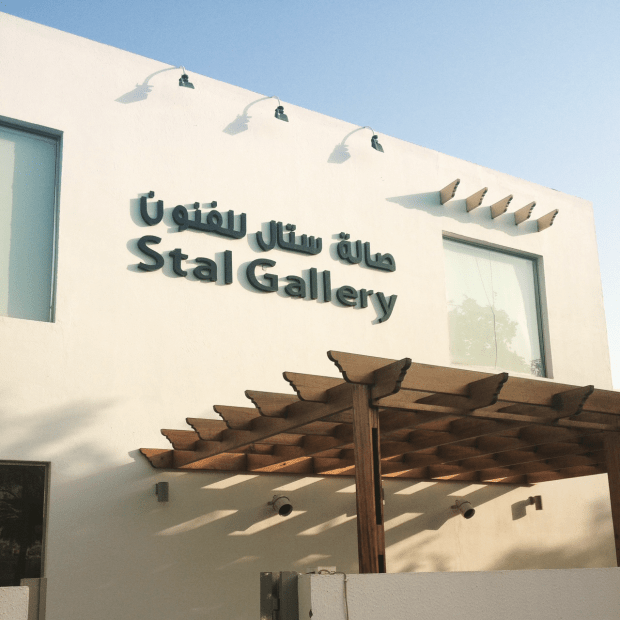
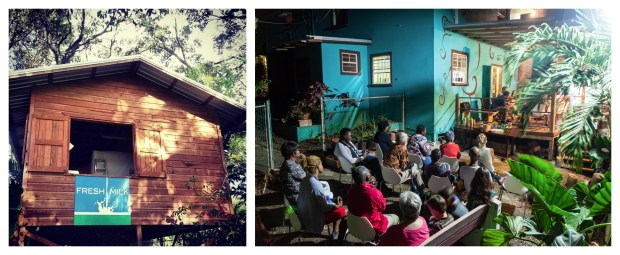
Stal Gallery, Muscat, Oman. Photo credit: Natalie McGuire.

Stal Gallery, Muscat, Oman. Photo credit: Natalie McGuire.

Not work, taut, deaf, monotonous as a sea, endlessly sculpted—but
eruptions yielding to earth’s effervescence—that expose the heart, beyond
worry anguishes, to a stridency of beaches—always dislocated, always
recovered, and beyond completion—not works but matter itself through
which the work navigates—attached to and quickly discarded by some
plan—first cries, innocent rumors, tired forms—untimely witnesses to this
endeavor—perfectly fusing as their imperfections meet—persuading one to
stop at the uncertain—that which trembles, wavers, and ceaselessly
becomes—like a devastated land—scattered.

– Edouard Glissant, Poem for the World

Standing in the Stal Gallery, Muscat, in March 2015, the exhibition The Place of Silence exhumed an atmosphere so familiar to that of Caribbean art spaces. The works of six Middle Eastern artists commanded attention in the three enclave-spaced gallery, saturated in context and concepts that brought to mind Glissant’s phrase: “Not works, but matter itself through which the work navigates.” From Dada-inspired installations reviewing existence and death (Raiya Al Rawahi’s Life, Being and Death) to an unearthing of self-reflection, a photographic self-portrait mirrored and repeated almost to geometric abstraction (Ahmed Al Mullahi’s Gazing Through the Divine), there were challenging thoughts and narratives seeping through every pore of the walls. The exhibition was physically navigating through the matter of an upscale avenue in the heart of the city, sitting on Al Inshirah Street, a British Council Service Road.

Raiya Al Rawahi,  Life, Being and Death (detail). Installation: photographs, IV bags/stands, headphones, charts. Stal Gallery, 2015.

Raiya Al Rawahi, Life, Being and Death (detail). Installation: photographs, IV bags/stands, headphones, charts. Stal Gallery, 2015.

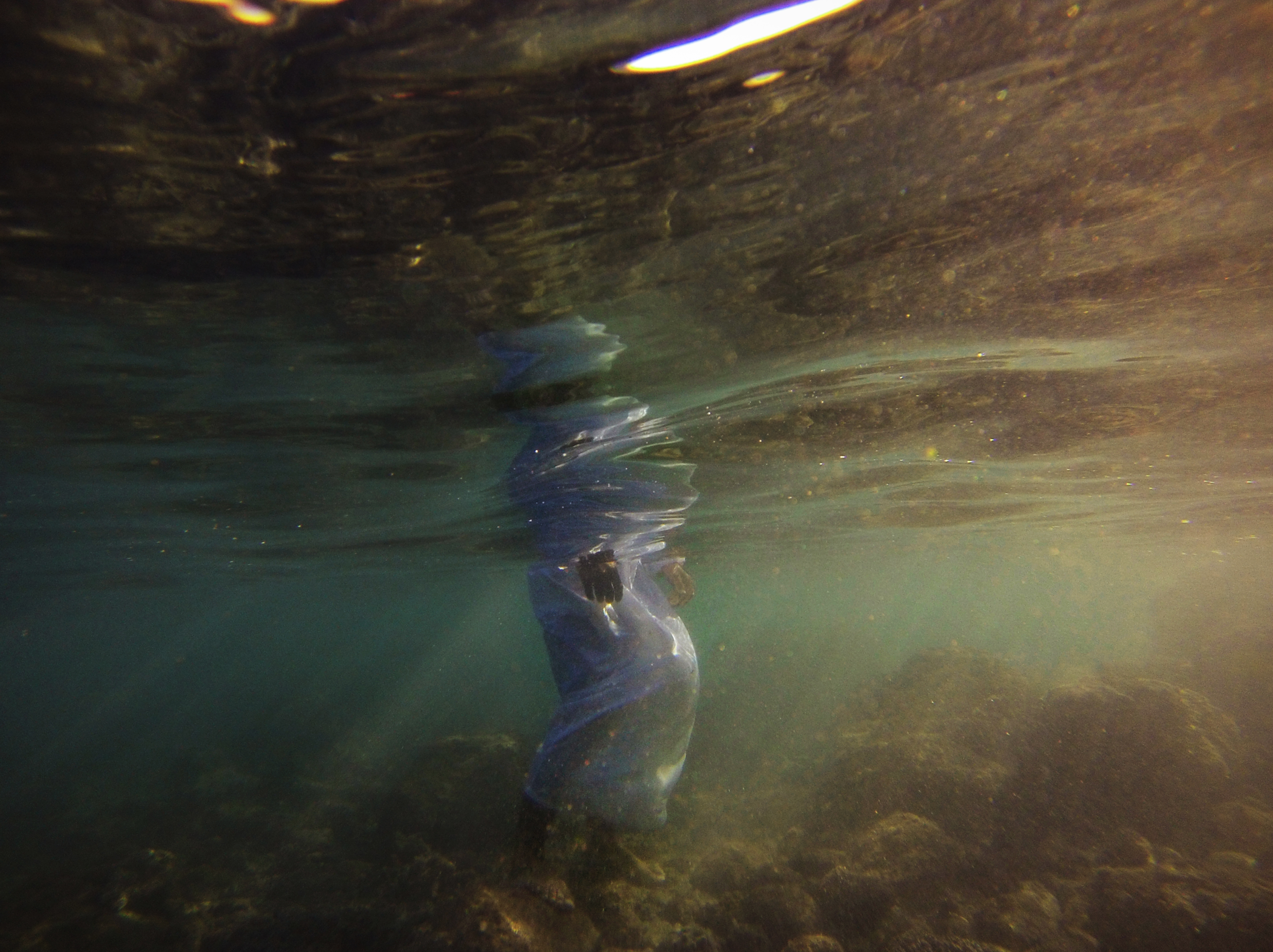
One in particular was the piece Sayed, a component of the series ‘Omani’s Under Water’, by Estabrak Al-Ansari, an Iraqi-British new media artist and filmmaker, who is currently at the centre of a surging movement in Omani contemporary art. The photograph depicts an underwater view of half the figure of an Omani man in his dishdasha, submerged and poised on the reef. The white gown plays with being transparent in the sunlight that penetrates the water, and clings to the backs of his legs and lower torso. In the accompanying wall text, Al-Ansari emphasized her exploration of “taboo concepts such as sexuality, privilege, oppression, power and understanding.” By having the body of her subject submerged in water, in this realm of nature that becomes somewhat abstracted from the landscape of society, she can unpack the restraints around its presentation and movement. Implementing her concepts ‘under the surface’, the discourse she wishes to raise is mediated by this matter. For Sayed, no conservative Omani could accuse Al-Ansari of presenting him in an immodest manner; it was a natural reflection of the current of the ocean she photographed him in. She later stated, “I might direct a person, an image with my camera, but natural elements like water take over, and the element of the water plays with what I want to convey.”

Estabrak Al-Ansari, ‘Sayed’, Omani’s Under Water. Limited Edition Photographic Prints, Stal Gallery, 2015.

Estabrak Al-Ansari, ‘Sayed’, Omani’s Under Water. Limited Edition Photographic Prints, Stal Gallery, 2015.

I had a chance to visit Al-Ansari at her sea-front studio in Al Bustan, and as she shared with me her thoughts about functioning in a Middle Eastern creative space, the familiarity of her new found artistic community with that of my own Caribbean one was undeniable.

Being her first exhibition in Oman, Al-Ansari believed some movements of the body encompassing a relationship with the sea would be acceptable for display outside of the water. At the opening of The Place of Silence, she presented her live projection painting piece Djinn and Motion. She explained:

Djinn is huge here. It’s in the Qur’an and states that Djinn do exist, it is like the ‘other’, a spiritual world. In countries there can be voodoo, and in Oman there is a big history of that. One reason why the title Djinn and Motion came to me is because I live by the sea within the mountains…and I have friends who refuse to visit me, because the belief is that the Djinn prefer to chill out by the sea, especially at night. Whether or not you believe in it is irrelevant, to me this is all myth and story, and this is the part I enjoy, that has been translated in all of my work.

Live projection painting originated in Al-Ansari’s London work with the group Thre3 Strokes, and stemmed from a desire to connect oneself and one’s viewers with an alternate space of reality. And although response to the medium was positive, the Muscat-based audience had difficulty accepting the title Djinn and Motion. Al-Ansari elaborates, “I had an interview with a guy from one of the newspapers here who was fine with discussing Omani’s Under Water, but as soon as I talked about Djinn and Motion he refused to talk to me, he walked away. He didn’t want anything to do with it. It was weird because for me, I was just normalizing what is here and what people talk about.”

Continue reading

Jordan Clarke’s Residency – Week 4 Blog Post

Barbadian-Canadian painter Jordan Clarke shares her fourth blog post about her Fresh Milk residency. In her final week, Jordan confronts some of the underlying reasons for her disconnect with the Barbadian side of her identity, and sees her experience in the island as a starting point to build on as she investigates this part of her culture and herself. Read more below:

IMG_0977-1

“As is common to most transnational communities, the extended family – as network and site of memory – is the critical conduit between the two locations.” (Stuart Hall, ‘Thinking the Diaspora: Home – Thoughts from Abroad’, Caribbean Political Thought)

It is typically through family that Caribbean migrants are able to maintain a sense of connection to their Caribbean culture. What happens, however, when there isn’t a sense of cultural sharing through family? How does this affect one’s sense of cultural identity?

IMG_0978

In my fourth week at Fresh Milk, I confronted the fact that my father has never been solidly present to share his cultural identity and family with me. I drew a self-portrait in response, with the intention of representing a conversation I would have with my father. A more confident me stares out, confronting.

I realize that the work I have created here during my residency represents a starting point for further investigation of the theme of self-perception, as well as self-discovery. It will act as a guide for future work once I’m home.

In thinking about the four weeks I’ve been here, I couldn’t be more grateful for this rewarding experience. Having such a wonderful studio to work in, without the usual daily distractions, has been refreshing and inspirational. Fresh Milk’s extensive library, full of contemporary Caribbean literature and art publications, has been an invaluable tool for informing my work here. I can’t thank both Annalee Davis and Katherine Kennedy enough for all their help and support. Annalee is full of knowledge and has been able to point me in directions I showed interest in, while leaving me space to navigate my art practice. I would also like to thank Aaron Kamugisha for his help and good company.

It has been so stimulating to connect with all the artists who have visited Fresh Milk during my residency. I see my time here as a starting point, a spark that will encourage further exploration and dialogue in my art practice.

_______________________________________

2014 OAC logo RGB JPG

This residency is supported by the Ontario Arts Council.

Jordan Clarke’s Residency – Week 3 Blog Post

Barbadian-Canadian painter Jordan Clarke shares her third blog post about her Fresh Milk residency, continuing to use self-portraiture and exploration of her surroundings for self-discovery and both personal and artistic growth, reckoning with the multiple facets and cultures that comprise her identity. Read more below:

IMG_0488

While at Fresh Milk, I have been working through self-portraiture, landscapes, photography and journaling as a means to document my first visit to Barbados. Born in Canada, I am the daughter of a Canadian mother with Scottish and English roots and a Barbadian father who has now spent 75% of his life in Canada. As a result, I possess multiple identities. I see myself as mixed-race, Black and Canadian.

In Barbados, where I have no family members, I feel disconnected and exposed. I am an outsider in my father’s homeland where I had hoped to feel a sense of homecoming and belonging. Not surprisingly, the work I have been producing here is introspective, exploring the theme of self-perception. My double self-portrait in graphite really expresses the sense of vulnerability and sadness I felt soon after my arrival in Barbados.

I have also been looking outwards, exploring landscapes in my work, specifically sky and cloudscapes. I’m attracted to clouds because they are always in movement and constantly changing, creating new formations that never repeat. I also find them to be majestic and beautiful. For me, clouds represent a universal space rather than a specific place, a space that is similar in both Toronto and Barbados.

At the moment, I see landscapes and portraits as two different practices. I had originally intended to insert myself into the landscape to create a connection with the land and Barbados. Interestingly enough, this joining of my body and a still unfamiliar landscape isn’t happening.

This residency is a special opportunity for self-discovery and evolution. I am realizing that change is not always comfortable, but is an essential part of my growth as a woman and as an artist. What is most painful is the feeling that I am missing a large part of my cultural roots and identity.

_______________________________________

2014 OAC logo RGB JPG

This residency is supported by the Ontario Arts Council.

Jordan Clarke’s Residency – Week 2 Blog Post

Barbadian-Canadian painter Jordan Clarke shares her second blog post about her Fresh Milk residency. She addresses the direction her work is taking, focusing on self-portraiture and developing the background of her pieces to suggest a sense of space, and has continued to explore the island alongside fellow resident artists Daniel Fernández Pascual and Alon Schwabe of Cooking Sections. Read more below:

Self portait

Two weeks into the residency and it feels like I just arrived.

I’ve been spending the majority of my time in the studio creating, reflecting and taking everything in. I’m sensing this as a time for gathering images, ideas and information that will find expression in my future creations.

It seems that I have gravitated towards self-portraiture as a way to access how I am feeling and thinking about myself in relation to this new place, Barbados. In addition to working from images, I have taken on the challenge of drawing myself from life each day. To assist me, Annalee set up a large mirror in the studio space. What I’ve found interesting is that none of the portraits drawn from life look completely like me.

Over the past week, I have been thinking about identity and how it is shaped. I realize now that my sense of identity is not linked directly to Barbados, despite my father’s Bajan roots.  This is the perfect opportunity for me to think about how I would like to identify, how I see myself, as well as how my life experiences have shaped me.

Mid week I met Barbadian artist Simone Padmore who addresses themes of identity in her work.  Some of her illustrations can be found in ARC magazine issue #5.

Towards the end of the week I began to think about the landscape, and how I could paint myself into one. The figure and landscape have always been separate for me. In my work the background suggests a sense of space rather than a specific place or location. I’m not sure where this will go, but it is something I am working on.

It was Easter weekend, and on Good Friday Annalee made a delicious gluten free quiche for our lunch. I am definitely being spoiled here!

An exciting event for me was finding out that early Saturday morning a horse was born on the family farm.

West coast beach

I ended the week traveling part of the West Coast with Alon and Daniel of Cooking Sections, who are also doing a residency here at Fresh Milk. We started at a lively market in Bridgetown. It was a completely different experience from the quiet and serene studio in St. George. I enjoyed the liveliness and dancehall music on the mini buses. We also took some time to enjoy ourselves on the beach. The West Coast is ideal for swimming, in contrast to the rugged picturesque East Coast. Our day ended with food and music at the Oistins Fish Fry on the South Coast.

Looking forward to the week ahead.

_______________________________________

2014 OAC logo RGB JPG

This residency is supported by the Ontario Arts Council.