»Redefining Practice« Reflections with Maj Hasager

During her ongoing residency at Akademie Schloss Solitude, Katherine Kennedy – current fellow in the ResSupport programme supported by Res Artis, representing the Fresh Milk Art Platform at the Akademie – had a conversation with Danish artist and Solitude fellow Maj Hasager reflecting on integrated & socially aware ways of looking at artistic practice. Read the article, originally published on the Akademie Schloss Solitude Blog, below:

Maj's studio at Akademie Schloss Solitude.

Maj’s studio at Akademie Schloss Solitude.

When we speak about art, we often use the word »practice« as a multipurpose term to cover the thinking, the making, the product…all the processes that build towards something such as an exhibition or a clearly defined project. But what about the moments that occur in between, not necessarily linked to a finished piece? Where do ‘non artistic’ tasks fall in the realm of this all encompassing »practice«, and how do our actions influence or become part of our artistic work? These questions led to a discussion between Katherine Kennedy and Maj Hasager, both fellows at Akademie Schloss Solitude. Read more about their talk below:

I began my exchange with Maj by introducing the Fresh Milk Art Platform, a Barbadian cultural arts centre and residency programme, and ARC Magazine of contemporary Caribbean art, the two spaces I work for; speaking about these organizations has become almost second nature to me.

It was when Maj asked about my own art »practice« that I suddenly felt unsure…I wondered, as I showed her my artist website, is this reaction backwards? The balance between making work and my other roles is something I continue to struggle with, and there are a number of doubts that arise when I confront it; am I still an artist? Will I produce work again? Have I given up my »practice«? I’m not unique in these crises…these are common questions faced by many artists whose lives teeter between other jobs and responsibilities.

Maj's studio at Akademie Schloss Solitude.

Maj’s studio at Akademie Schloss Solitude.

Maj and I spoke about these anxieties, which had interesting associations to the MA programme she leads at Malmö Art Academy, Sweden, called Critical & Pedagogical Studies. This degree crosses the supposed boundaries between art, theory and pedagogy, framing relationships between production, teaching, administration and curatorship as »integrated practice« rather than distinct disciplines. While the stretch between one actual creation to the next may be long, that doesn’t negate the importance of what happens in those gaps, or the larger impact of knowledge transfer to personal and public creative growth.

I could already see how the importance of circulating information and operating in intermediary ways was applicable to the work of Fresh Milk and ARC; the foundations we are trying to lay for contemporary art in the Caribbean can very much be read as »social practice«, and affect the wider context I work within, along with my individual outlook. We spoke about whether there was a chance to marry this social »practice« with my visual one; the interconnectivity of art and life means that things are rarely as separate or stagnant as they may seem, and dormant seeds of production may just need the opportunity to flourish. We were both in agreement that Solitude can be considered fertile soil, with the freedom afforded to map out and nourish these connections.

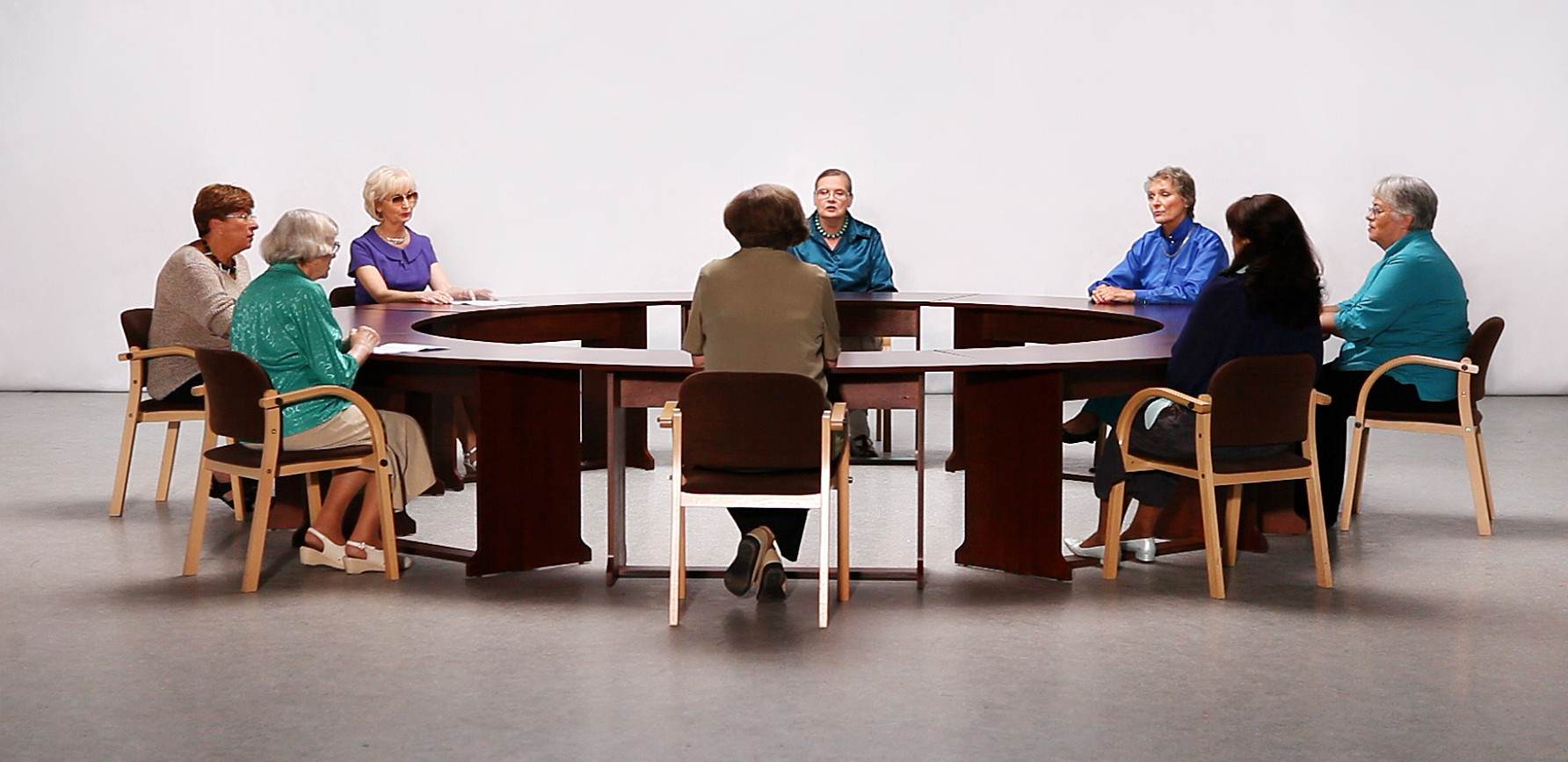
Maj Hasager, Decembers – performing a past, 2013. Courtesy of the artist.

Maj Hasager, Decembers – performing a past, 2013. Courtesy of the artist.

Maj’s personal »practice« also exemplifies hybridity. In addition to her academic pursuits, she negotiates delineations between history/lived reality; archive/interpretation; geopolitical North/South; utopia/dystopia. She took me through some of her multimedia work, which is heavily driven by communities and their geographical and socio-political positions in the environments they inhabit. Displacement is a common theme in her »practice«; she has conducted socially charged projects where she speaks and works with immigrant or underrepresented populations, such as the Filipino community in Italy, or documenting the perspective of Polish women during the solidarity movements of the 70s and 80s. The space she explores is a limbo of sorts; neither dwelling explicitly on the past nor idolizing the future, but the somehow honing in on the forgotten present, and how these communities function – or »practice« – in daily life, which inherently retains the weight of history and the possibility of tomorrow.

Relational »practice« is the core of her work, taking into account and being organically informed the multiple cultures she encounters. The drastically different points of view between herself and the societies she engages are not lost on her; she acknowledges that she is coming from a position of privilege, and does not try to overshadow the voice of the community. As a citizen of an island that is often defined from the outside rather than within, I appreciated this concession, and the genuine interest Maj takes in authenticity when treading this fine, complex line. For example, in her work Decembers – performing a past, 2013 there is no translation from Polish of the exchange between women of a certain generation sharing their stories – this is not done to exclude viewers, but to allow them to enter the moment and feel the dynamic without being distracted by divisive constructs such as language:

Spilled in the language’s veins
A militant regards
When will words be
A tool for something other

– Thom Donovan

Film still: Contemporary dancer Maria Concetta Borgese in ‘Bifurcating Futures’, directed by Maj Hasager.

Film still: Contemporary dancer Maria Concetta Borgese in ‘Bifurcating Futures’, directed by Maj Hasager.

This excerpt is taken from a poem by American poet Thom Donovan, whose work Maj used in a recent project that she directed and was editing while at Solitude. A departure from the usual way in which she works, the piece titled Bifurcating Futures is more abstract; it features a performance by a contemporary dancer interspersed with moving shots of an empty city and stanzas from Donovan’s poem, all overlaid with a haunting track of urban sounds, warped into a futuristic, ominous refrain that echoes the dystopic landscape. The dancer, deliberately chosen for the experience and maturity her body brought to the role, performs a series of gestures in the space, always inaudible but never truly silent. The piece straddles new media and documentary filmmaking, challenging Maj’s usual »practice«, but still referencing themes such as feminism, futurism and creating a platform for the unheard.

What remained with me after our meeting is that we have the artistic license to define »practice« as we see fit; we can use residencies as creative incubators for our work, but »practice« comes from lived experience. Even if not specifically deemed »social practice«, it still absorbs our thoughts, actions and interactions with others, and in the end, cannot be predicted, relegated or compartmentalized – only manifested, one way or another, in the direction we channel it.

Read the original article on the Akademie Schloss Solitude Blog here.

Lauren Craig and Annalee Davis in Conversation

Photograph by Rachelle Gray

Lauren Craig (left), Annalee Davis (right) – Photograph by Rachelle Gray

Fresh Milk‘s Founding Director, Annalee Davis sits down for a chat with recent Fresh Milk resident artist, Lauren Craig. Lauren is  a London based multimedia visual artist who developed ‘floral installation” to describe her creative practice.  During their conversation, Lauren spoke about some of the projects she has been working on in the UK including her work for the British museum and the Petrie Museum of Egyptian Archaeology. In addition, Lauren shares her collaborative work with British women of colour as they develop the Women of Colour Index and X Marks the Spot,  in contribution to an archive at the library at Goldsmiths University in London. Below are  photographs that Lauren produced while on her residency at Fresh Milk.

Lauren Craig and Annalee Davis In Conversation Part 1

Lauren Craig and Annalee Davis In Conversation Part 2


For more on Lauren’s residency and the continuation of her ‘Cleanse’ project, read Lauren’s exchange with Llanor Alleyne here: http://bit.ly/1EvPQdF

Lauren Craig’s Biography

Lauren Craig is a social entrepreneur and artist researcher based in London. She has designed systems and living business models that have challenged large corporations in areas of racism, minority and women’s rights. Her art and entrepreneurial activity tackle big questions around ethics, equality, sustainability and community engagement in the cut flower industry whilst delivering practical floral alternatives locally, through her organization ‘Thinking Flowers?’

As an entrepreneur, Lauren is involved with social issues such as environmental destruction, London street crime and equality, aiming to promote positive change through ethics, sustainability and engagement. She has developed therapeutic methods using photography to document and tackle street crime and runs a pioneering ethical florist. Additionally, she has founded ‘Field’ – an innovative pop-up community retail space in Brixton Village, pioneered urban green waste schemes and floral donations services whilst campaigning for human, working and women’s rights further afield. She is currently setting up the Field Foundation, which will work to reconnect people with the creative cultural industries.

Her recent work includes ‘Petal Tank’, an experimental film featuring collage of autoethnographic darkroom photography, poetry and sculpture. (Tate Modern Tanks, 2012) ; An artist residency at the Women’s Art Library at Goldsmiths College, University of London (2013-2014) ; Sculptural Garden, collaboration with Paul Jones, Royal Collage of Art for Space Station 65, London (2014) ; ‘Sense and Sensibilities’ at Victoria and Albert Museum, London (2014) ‘Modern Measures – Holding, Pouring, Stirring’ at The Petrie Museum of Egyptian Archaeology in London as part of University College London Museums & Collections (2014). Collaboration with visual arts and research collective X Marks the Spot, initiated at Studio Voltaire 2011, engages with the archive of photographer Jo Spence to explore concepts of class, race, gender and wellbeing.

OPEN CALL – 19th Contemporary Art Festival Sesc_Videobrasil

Associação Cultural Videobrasil and Sesc São Paulo are calling upon artists interested in taking part in the 19th edition of the Contemporary Art Festival Sesc_Videobrasil, due from October 6 to December 6, 2015 at Sesc Pompeia, in São Paulo, Brazil. Entries will be accepted from September 15 to November 16, 2014.

Open Call

19th Contemporary Art Festival Sesc_Videobrasil OPEN CALL

 The Contemporary Art Festival Sesc_Videobrasil has become established over the years as a diverse, multiple framework designed to spread, foster and reflect on art production from the “global South”, understood as Latin America, the Caribbean, Africa, the Middle East, Oceania, parts of Europe and Asia.Significant geopolitical changes are underway, radically resizing the notions of North and South. Nonetheless, the need persists to work for art and culture in areas that are yet to invent new forms of circulation and visibility.

In its 19th edition, the Festival aligns its curated sections with the South, rather than its competitive show only, as it did in the past. The entire program is therefore oriented towards the South and its myriad issues. These issues – which provide inspiration and parameters for the selection of artworks and projects for the Festival – concern the diasporas, hybrid identities, travel and migration flows, personal narratives, isolation, the social fabric and insularity

For the first time ever, the call for submissions comprises two separate open calls: one for artworks and another for projects, to be developed under the oversight of curators and with backing from the Festival; both the artworks and the projects are to be featured in the upcoming edition of the Festival. Artworks and projects will be accepted in all supports, artistic expressions and techniques, by artists either born or resident in the Festival’s target areas for over five years. Each artist may submit up to three (03) artworks and/or one (01) project, in keeping with the terms set forth in the open calls available on the website as of the opening date for entry.

The Curatorial Committee will select 4 (four) projects for production of artworks. Each project will receive financial support of up to R$ 30,000 (thirty thousand reais) and will be overseen by one of the curators until its presentation at the Festival.

In this edition, the Curatorial Committee is formed by Solange Farkas and by invited curators Bernardo de Souza, Bitu Cassunde, João Laia and Júlia Rebouças.

Based on the Award Jury’s selection (to be announced in 2015), the Festival will grant 1 (one) cash prize of R$ 75,000 (seventy-five thousand reais) and 9 (nine) two-month artist residency prizes  to be undertaken in Videobrasil Residency Network’s partner organizations around the world. Prizes do not apply to the projects produced by the Festival.

As a strategy of publicizing the selected artworks and spreading knowledge about the artists’ creative processes, the Festival will showcase the works via Associação’s online research tool PLATFORM:VB; publications; and documentary films and interviews produced for VB Channel.

Aiming to consolidate an active network of exchange that contributes to the insertion of the selected artists on the contemporary artistic and cultural circuit, the 19th edition of the Festival will also promote Public Programs activities, with meetings between artists, curators, critics, researchers, delegates from different organizations and residency sponsors.

Carefully read both calls for entries prior to your application on Videobrasil’s website

More on the Festival

In addition to exhibiting artworks and projects by shortlisted and guest artists, the Contemporary Art Festival Sesc_Videobrasil offers artist residencies, public programs, educational actions and publication launches.

In a bid to publicize the productions of shortlisted artists, the Festival also conducts actions to make their work available in its digital research platforms, books, websites, social media, as well as documentaries and TV programs produced by the organization. The artists also participate in meetings and debates that bring together curators, critics, researchers and delegates from art institutions and artist residencies to reflect on and discuss pressing issues in contemporary art and culture.

The Festival also awards a cash prize and nine artist residency prizes to be undertaken at Videobrasil Residency Network partner organizations around the world. All of the winners are given trophies designed for each edition by artists such as Tunga, Rosângela Rennó, Erika Verzutti, Carmela Gross, Luiz Zerbini, Raquel Garbelotti, among others.

Studio Conversations with Annalee Davis, Mariam Zulfiqar and Christina Millare

Fresh Milk is pleased to share the archive of a conversation which took place on August 15th 2013 between UK based Christina Millare, visiting curator, Mariam Zulfiqar and Founding Director of Fresh Milk, Annalee Davis.

Studio Conversations caught up with curator and Curating Contemporary Art Inspire graduate, Mariam Zulfiqar to discuss her research residency in Barbados, which will culminate into a forthcoming exhibition that explores the impact of plant migration on the Barbadian visual and social landscape.

They also spoke with Visual Artist, Annalee Davis, the founder of The Fresh Milk Art Platform Inc., an artist led initiative that contributes to the discourse surrounding creative production within the informal networks of the Caribbean and its diaspora by offering a platform for exchanges among contemporary practitioners.

Curator, Christina Millare, a graduate of the Curating Contemporary Art Inspire MA (2010/2012) has programmed Studio Conversations and chaired the event.

Studio Conversations is a series of live video linked studio visits with artists and curators. These events aim to give audiences an opportunity to engage in a dialogue with internationally based artists and curators to explore how their practice might be translated within transglobal contexts.

 About Mariam Zulfiqar:

DSC00074_2

Mariam Zulfiqar graduated from the Curating Contemporary Art Inspire MA in 2012 during which time she was based at Art on the Underground where she continues to work in a curatorial capacity. Mariam recently curated the online Kurt Schwitters inspired project, MerzBank with Steven Bode for Film and Video Umbrella and is currently on a research residency in Barbados. Her research will culminate into a forthcoming exhibition that explores the impact of plant migration on the Barbadian visual and social landscape.

About Annalee Davis:

Founder of Fresh Milk Art Platform Inc.

Founder of Fresh Milk Art Platform

Annalee Davis is a Visual Artist.  She has been making and showing her work regionally and internationally since returning to the Caribbean in 1989.  She is the founder of The Fresh Milk Art Platform Inc., an artist led initiative for exchanges among contemporary creatives supporting interactions across disciplines and contributing to an increasingly rich discourse surrounding creative production within the informal networks of the Caribbean and its diaspora. She is a part-time tutor in the BFA programme at the Barbados Community College.  For more on her practice, visit her website.

About Christina Millare

Christina Millare

Christina Millare is a curator based in London, UK. She is interested in considering alternative venues as locations for unique presentations of artists’ moving image, performance, sound and digital work. Christina’s projects have a strong collaborative approach with host venues, enabling her to draw upon pre-existing audiences as well as offer alternative experiences of a familiar location. In 2013 she was awarded Grants for the Arts, Arts Council England funding to explore this notion further and worked with established artists including, Janek Schaefer, The Bohman Brothers and Fabienne Audeoud.

Currently, Christina is developing; ‘The Cross Continent Vloging Project’, an ambitious international exhibition and live public programme featuring live art, sound, performance and moving image exploring the trans-global and migratory behaviour of online video blogging.

A graduate of the Royal College of Art’s MA in Curating Contemporary Art, Christina previously held curatorial and programme coordinator positions at Abandon Normal Devices Festival and Cornerhouse, where she produced the group exhibition ‘New Cartographies: Algeria – France – UK’ (featuring Kader Attia and Zineb Sedira) and produced various aspects of both organisations’ public programming.

Link to two of Christina Millare’s projects can be found below:

“Machines by Other Means” – http://vimeo.com/51430133
“Pleasure Box” – http://vimeo.com/80374088