Mother Tongue’s Residency – Week 1 Blog Post

Mother Tongue, the curatorial duo of Jessica Carden and Tiffany Boyle, share their first blog post about their Fresh Milk residency. Coming from Scotland and never having been to the Caribbean before, they describe their introduction to the Barbadian art scene and share some of their evolving plans for engaging with the creative community over the next few weeks. Read their blog post below:

Our first week at Fresh Milk simultaneously marks our first week in the Caribbean; a region whose artists and writers we have been engaging with from a distance for some time now. We arrived with a mix of anticipation and genuine excitement at the opportunities that lie ahead. We had previously met with Fresh Milk’s director Annalee Davis on her visit to Glasgow for the 2014 Commonwealth Games cultural programme, at the ‘International Artist Initiated’ panel discussion at David Dale Gallery, Glasgow, and had been in dialogue since then. Fresh Milk played a central role in the critical discussions unpacking the commonwealth as a loaded cultural event and its enduring impact for the Caribbean, whilst also representing artist-led activity in Barbados.

Our first day at the Fresh Milk residency space took the form of an introduction to the impressive collection within the Colleen Lewis reading room. Annalee talked us through the collection’s categories, and picked out for us seminal texts and exhibitions catalogues which have been helping to give us an overview of not only the current artistic activity and infrastructure in the region, but also the history of artistic practice in Barbados and its ties with elsewhere.

The Fresh Milk ArtBoard featuring work by Ronald Williams.

We were then introduced to the Fresh Milk Books team. After introducing our practice and discussing a number of our curatorial projects, we started to informally talk with the group about their experience of making work in Barbados, the support the Fresh Milk Books group provides for them, and the manner in which they position their work in relation to specialised interests pursued through this meeting point. The discussion then went off in a number of tangents, from notions of whiteness, skin and beauty ideals, both historically and contemporary. We’re going to be discussing with the group a format for understanding curatorial practice this week, which will lead to a kind of workshop in Week 3, the same week that we will be re-screening our 2012 Afrofuturism artist film and video programme for students at the Barbados Community College.

We were also delighted to bring with us a collection of publications generously donated from UK based organisations and individuals, which now call the Colleen Lewis Reading Room their new home. These include Map Magazine; Variant Magazine; Chelsea Space publication archive; University of the Arts London Graduate School; TrAIN Research Centre for Art, Identity and Nation; Flat Time House London; Lyndsay Mann, and Alex Hetherington’s Modern Edinburgh Film School. We hope these publications will be a welcome connection between the UK and Barbados.

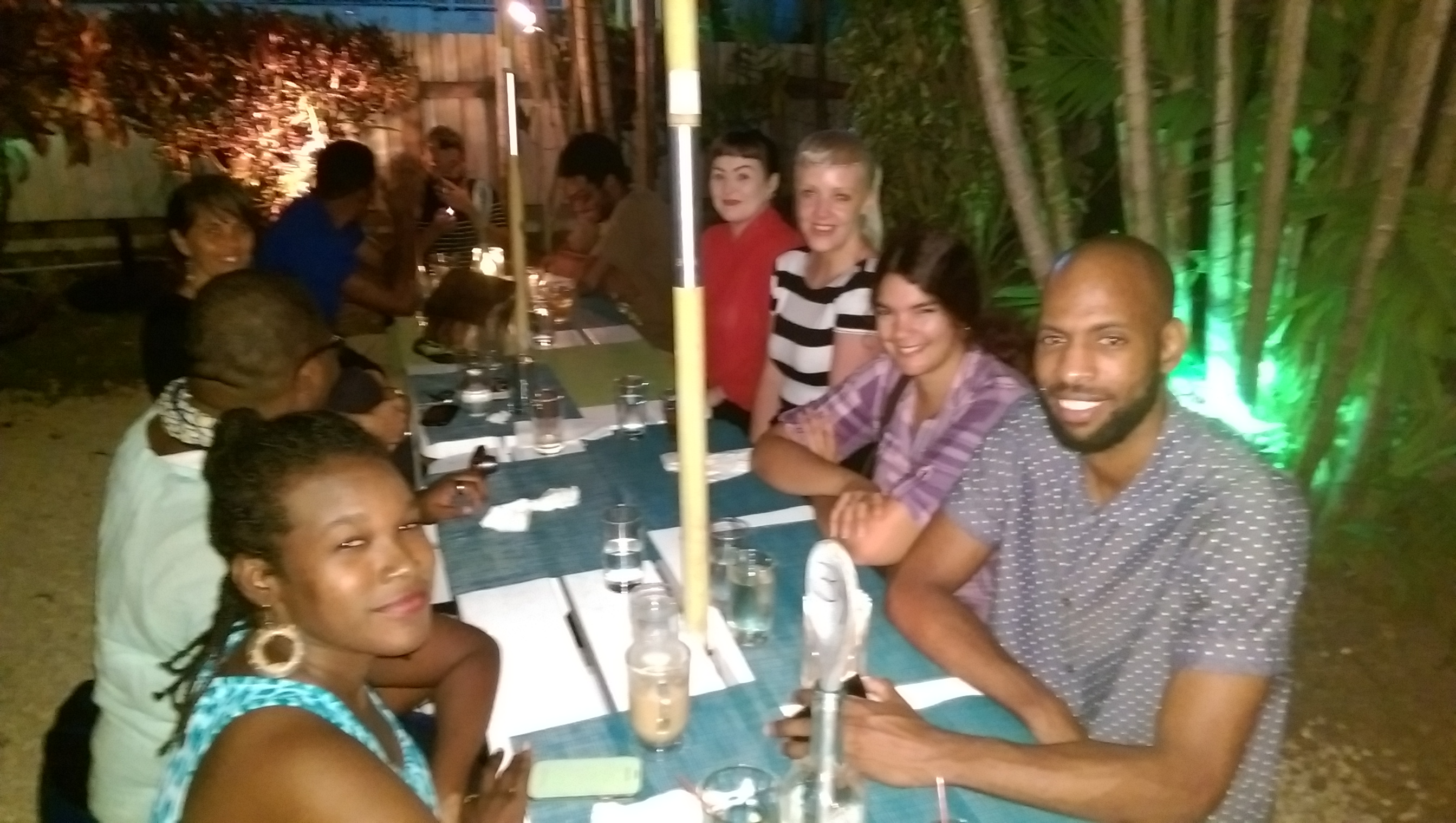
Creatives gathering at Mojo's on the south coast.

We also took a trip into the capital of Bridgetown, and later in the week met with a group of local and visiting artists, Fresh Milk friends and the Fresh Milk Books group. After some rum punches at Mojo’s on the south coast, we had the chance to talk about our practice and our aspirations for the residency, as well as to connect with artists and discuss not only their work but their views on being Bajan practitioners. Among the artists we met was the wonderful Alberta Whittle, whom we have existing connections with from her studies and career in Glasgow. The evening was informal and provided a perfect introduction to the local arts community, before we set up further discussions in the weeks ahead.

For now, we are implementing all the planning the first week provided, and will spend our second week mostly outside the studio, meeting with practitioners, and looking towards our return UK project.

Fresh Milk welcomes Mother Tongue to the Platform

Fresh Milk is pleased to start the new year by welcoming Tiffany Boyle & Jessica Carden of the Mother Tongue curatorial project as our first international residents for 2015. They will be on the platform from January 26 – February 20. Read more below:

A Thousand of Him, Scattered: Relative Newcomers in Diaspora, Stills: Scotland's Centre for Photography | April - July 2014 | Yael Bartana | Richard Fung | Kiluanji Kia Henda | Bouchra Khalili | Maud Sulter | Milja Viita. Group Exhibition with accompanying events programme and publication in partnership with TrAIN: Transnational Research Centre for Art, Identity and Nation [UAL].

A Thousand of Him, Scattered: Relative Newcomers in Diaspora, Stills: Scotland’s Centre for Photography.

Mother Tongue  focuses on specific issues that are of ongoing significance for their research into northern Scandinavia and West African cultures. Although they have some knowledge of the Caribbean through the work of writers, diasporic artists and having exhibited work with connections to the region in the past, this exploratory research and writing residency with Fresh Milk will be their first visit to Barbados and the wider Caribbean.

During their stay, they will conduct a range of studio visits, archival research, meetings, interviews, etc, as initial groundwork, and as a way of grasping and getting to terms with a locale very different to their home territory of Scotland.

Previous residencies undertaken by Mother Tongue have proven to be equally intensive and productive periods of research, which have led to a number of subsequent projects. Their time at Fresh Milk will allow for the building of long term links and relationships with artists, writers, thinkers and institutions in Barbados, creating the potential for further collaborations regionally and internationally.

About Mother Tongue:

mother tongue

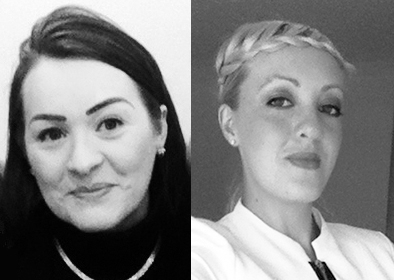
Tiffany Boyle (left) and Jessica Carden (right)

Mother Tongue is a research-led curatorial project formed by Tiffany Boyle and Jessica Carden, in response to individual periods of investigation in northern Scandinavia and West Africa. Our practice in exhibition-making intersects with research interests – including, but not limited to – (post)colonialism, language, heritage, ethnicity, whiteness, indigenousness, migration, movement, sexuality, and technology.

Since 2009, we have produced exhibitions, film programmes, discursive events, essays and publications in partnership with organisations such as the CCA: Centre for Contemporary Art Glasgow; Stills: Scotland’s Centre for Photography; Transmission Gallery; Africa-in-Motion Film Festival; Malmö Konsthall; and Konsthall C Stockholm, and undertaken residencies with HIAP in Helsinki, the Nordic Africa Institute in Uppsala, and CreativeLab at CCA Glasgow. ­Mother Tongue participated on the 2011/12 CuratorLab programme at Konstfack, and we are currently both undertaking individual PhD’s – Tiffany at Birkbeck and Jessica at TrAIN: Research Centre for Transnational Art, Identity and Nation, University of the Arts London. In 2015, Mother Tongue will continue to collaborate with Variant magazine, Framework Scotland and the Creative Futures Institute at UWS on the ongoing discussion series, ‘Curating Europes’ Futures.’

Season’s Greetings from FRESH MILK: 2014 in Review

FM christmas greeting v2 test

The FRESH MILK Team has grown in strength and numbers in 2014 – we would like to take this opportunity to sincerely thank all of our contributors, volunteers, artists and many fantastic supporters for all you have so generously given this year. We are truly blessed.

We look forward to engaging with you all in the coming year, and will continue to do our best to give back to our community by creating more points of opportunity and encounter for creatives in Barbados, the Caribbean and further afield.

As ever, we give you all our deepest gratitude and warmest wishes for the season, and invite you to take a look at…

2014 in review

___________________________

merry christmas-02 (1)

The Caribbean Digital: Fresh Art/Spaces

If you missed Fresh Milk‘s contribution to The Caribbean Digital conference, a Small Axe event that took place on December 4-5, 2014, you can watch the presentation archived online at Livestream.com, and read the transcription of the paper ‘Fresh Art/Spaces’ presented by Annalee Davis, Amanda Haynes and Yasmine Espert here:

Click here to watch the archived video presentation

Click here to watch the archived video presentation of Fresh Art/Spaces

Fresh Milk is an artist-led initiative based in Barbados that operates locally, regionally and internationally. It uses a model of social practice to engage with artists collectively, stimulating and fostering individual aesthetic practices, critical thinking and community bonding. When we speak about social practice we refer to the social engagement between people as an art in and of itself. In the spirit of social practice, Fresh Milk hosts “IRL/in real life” events at our working studio, and maintains a digital presence on WordPress, Tumblr, Twitter, Skype and Facebook.

We’ve built digital platforms to meet specific, immediate, and ongoing needs.

Fresh Milk’s most visible project to date is our freely accessible, interactive online map delineating the Caribbean’s brick-and-mortar art spaces from the nineteenth century till now. When sharing the updated map in April, the post reached 10,940 people on Facebook in 24 hours, and was reshared on Facebook by others from our website 684 times. This map is a work in progress and addresses the lack of available information about Barbadian and Caribbean arts at the formal, informal and educational levels. The map is not only a pivotal information hub and educational tool, but a place to witness Edouard Glissant’s poetics of relation manifest across linguistic spaces and epistemic virtues. Fresh Milk sees this as a collectively owned resource where we all become responsible in keeping it current. Suggestions for additions of new and emerging spaces are accepted through our multiple social media outlets. The map reinforces that the art world we see and experience in the Caribbean is a polyphonic arena with multiple centres, undoing the hegemonic discourse that places major metropolitan centers in the north at the pinnacle of artistic production.

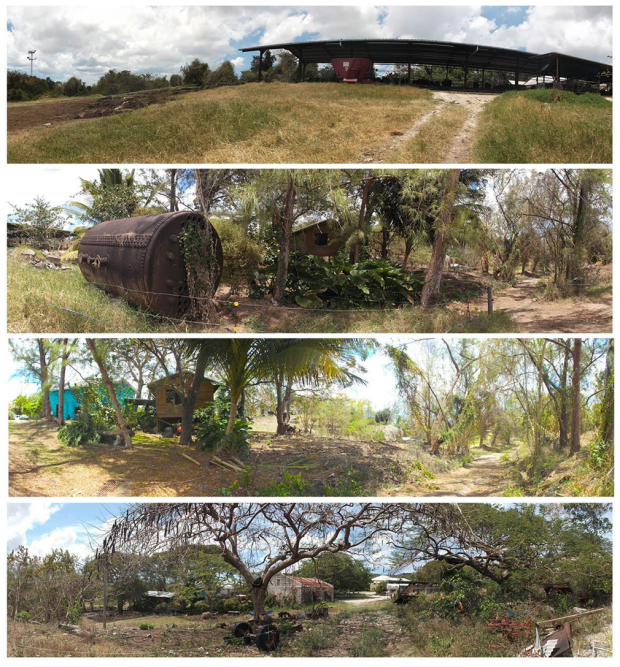
Fresh Milk operates out of a dairy farm on the site of a former plantation. I am inspired by the scientific process of phytoremediation which refers to the capacity of some plants’ root systems to absorb toxins from a polluted field and restore harmony to the soil. Similarly, through programming and building relationships, Fresh Milk works to alter the very chemistry of our own soil stained by the traumatic legacy of our colonial history. Located on a former plantation that was once closed, Fresh Milk is now open, a site that was once exclusive is now inclusive, and what was a place of trauma is moving toward a place of nurturing.
walkers dairy

Although we work to shift the ground we  operate on, we are aware that the history of Walkers Dairy as a former sugarcane plantation where Fresh Milk is based continues to influence the ways in which some interact with or understand our social practice. Matters of privilege inherent to the plantation economy in some ways reflect our concerns about in/accessibility in the digital realm. For example, who regulates the internet and its protocols? How can non-profit organizations like Fresh Milk use digital platforms to meet the needs of artists in the Caribbean/diaspora?

As we draw lines from one human being to another in real life and on line, Fresh Milk’s programming reinforces Glissant’s poetics of relations, becoming sensitive to and sometimes unlearning the linguistic, racial, classed, and gendered boundaries that have historically separated us. A counterpoint to the master narrative, the network weaves new affinities, confirming multiple states of emergence while employing infinite possibilities of connection even from within the plantation as a network in a continual state of emergence.

While operating out of a very small island has its limitations, the digital platform has become a catalyst, allowing us to participate in communities beyond the limitations of our physical space. Access to the Internet as a creative commons space is opening fields of possibilities which elicit serendipitous encounters continually transforming into tangible relationships and projects.

Amanda Haynes is joining me today to speak about the Colleen Lewis Reading Room and her role in the birth of Fresh Milk Books. We are not unaware of the history of plantations outfitted with bars serving rum rather than outfitting libraries providing books. And although I am sure your NY audience might appreciate some good Bajan rum to warm yourselves with this evening, I’d like to hand over to Amanda who will speak with you all, not about rum, but about the ‘spirit’ of reading.

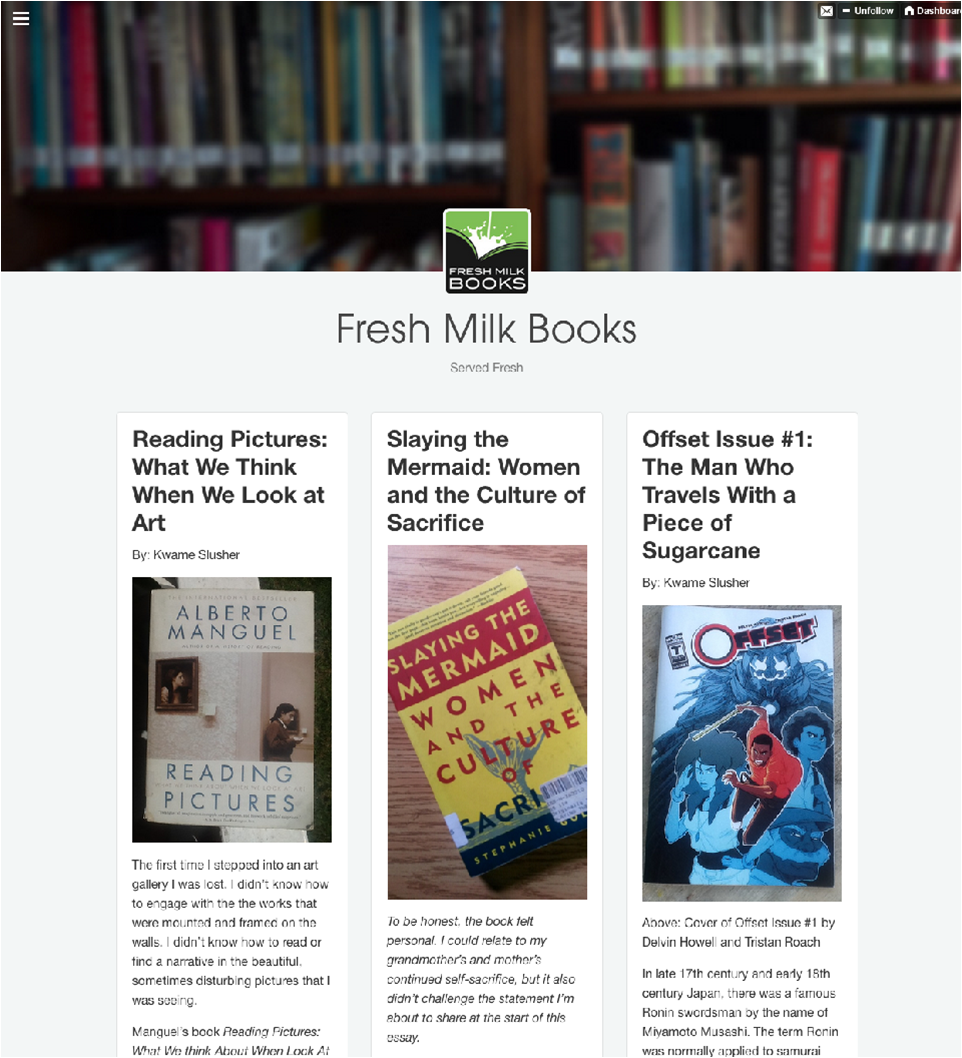
Fresh Milk Books came into existence to activate the Colleen Lewis Reading Room set up to keep the memory of the art historian, Colleen Lewis, alive. The reading room is free and open to the public.

In an age where most of our ideas about the world are shaped by the media we consume, our ability to read images and decode the ideas they represent is vital. Though the dominant collective of our mediated online and offline communications is the marketplace, and ideas transmitted through them, FMBs similarly demonstrates the creative potential allowed by virtual geographies. As an expanded critical space, Fresh Milk Books is reimagining who and what we consider art/spaces/identity to be.

Since the soft launch of the Fresh Milk Books experiment in May 2014, Glissant’s rhizome has been flickering through the ‘tags’ and ‘likes’ of its Tumblr and Facebook. The digital nature of Fresh Milk Books is very much like our Caribbean; a space of relations, diversity, linkages and cross-fertilisation. Our review series #CCF Weekly encourages short, collaborative, multi-media responses to diverse texts in Fresh Milk’s on-site reading room. This initiative propels literacy beyond its linguistic application, to an awareness of the trans-media literacy that digital spaces demand. The connections this online initiative has unveiled in its seven months of existence is proving that the geography of online spaces has radical potential to foster a community of spirit—and a tangible Diaspora. The less optimistic realities of this digital geographic arena will be discussed later in this paper.

Fresh Milk Books

While visitors to the FMBs site are from every age group, the target audience is in the 18-24 age range. CCF Review contributors have included recent literature and arts students, educators and publishers. We’ve even received publications from a wide variety of international donors. Most recently, we received a journal from a Mexican poet and editor living and working in Palestine. He heard about FMBs through the Cyprus Dossier and sent a copy of his London-published journal, Dolce Stil Criollo to us.

The success of this on-going experiment that is FMBs is best seen in the steady, diverse and always personal nature of book donations we have received since the initiative was officially launched in May 2014. The response to our email circulated Summer Wish list, which focused on growing our Caribbean History/Theory collection, allowed us to secure over 80% of the texts requested.

We are mapping connections with anyone who ‘identifies’ with the cause–FMB’s identifiers include ‘#creative’, ‘#Caribbean’, ‘#reader’, ‘#human’, subverting polemic notions of identities circulated by popular media. We are living connections. Like any other social network, FMBs activities are driven, mapped and remembered by the Big Data of the internet. The notion of apparent agency afforded by digital publishing raises critical questions about the intangible economics of e-governance, regulation and digital cultural production.

Yet, the internet’s existence as a tangible, global and personal space presents radical potential to connect and engage ‘Caribbeans’ – wherever we are, whoever we are- and wider audiences. It is also vital to note that the digital is just a tool.Through the digital space of FMBs we are channeling our social connections and relationships into socially productive, communal activities within the ‘real’/physical world. This complimentary use of ‘borderless’ digital space and ‘on-the-ground’ work symbolises how we should be thinking about sustainable development today. Increasingly, millennials are identifying more as digital citizens first, and citizens of a nation second. The digital is no longer just a convenient method of mapping, anticipating and participating in social change, it is a necessary one.

Picture4

Fresh Milk works with partners to create exhibiting, professional development and residency opportunities for artists to show their work to wider audiences, increasing their visibility and allowing them to make valuable connections, enriching their practices and continually expanding the local space. We have had residency applications from places that we can only reach through the internet – Russia, Poland, Afghanistan. At this time, I’d like to share examples of three digitally born projects- one local, one regional and one international.

Fresh Stops is a collaborative partnership with the local initiative Adopt A Stop, a Barbadian company that builds benches for bus stops and bus shelters, to bring art into the public space. The collaboration began in an informal chat on Facebook between me and Barney Gibbs, the owner of Adopt A Stop. We have commissioned six young Barbadian artists to produce original artwork for benches which have been popping up around the island from October.
Picture6


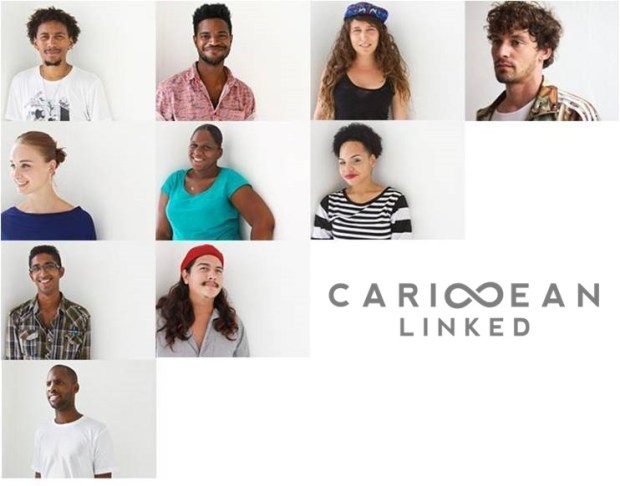
An example of a regional project born online is the Caribbean Linked Artist Residency Program – it is a crucial space for building awareness across disparate creative communities of the Caribbean by finding ways to connect young and emerging artists with each other in Aruba.

This residency exposes Dutch Antillean, Anglophone, Francophone and Hispanic artists to each other through the residency programme and is a collaboration between Ateliers ‘89, ARC magazine and Fresh Milk, currently funded by Stitching DOEN and the Mondriaan Fund.

Fresh Milk participated in an international digitally born project during the summer of 2014 called International Artist Initiated (IAI) coordinated by the Glasgow based artist led network – the David Dale Gallery and Studios. The project coincided with the Glasgow 2014 Commonwealth Games. David Dale learned of Fresh Milk through their online research. The project acted as a catalyst for discussion and collaboration between six Commonwealth based artist initiated projects including Fillip from Canada, Cyprus Dossier from Cyprus, Clark House Initiative from India, RM from New Zealand and Video Art Network Lagos from Nigeria.

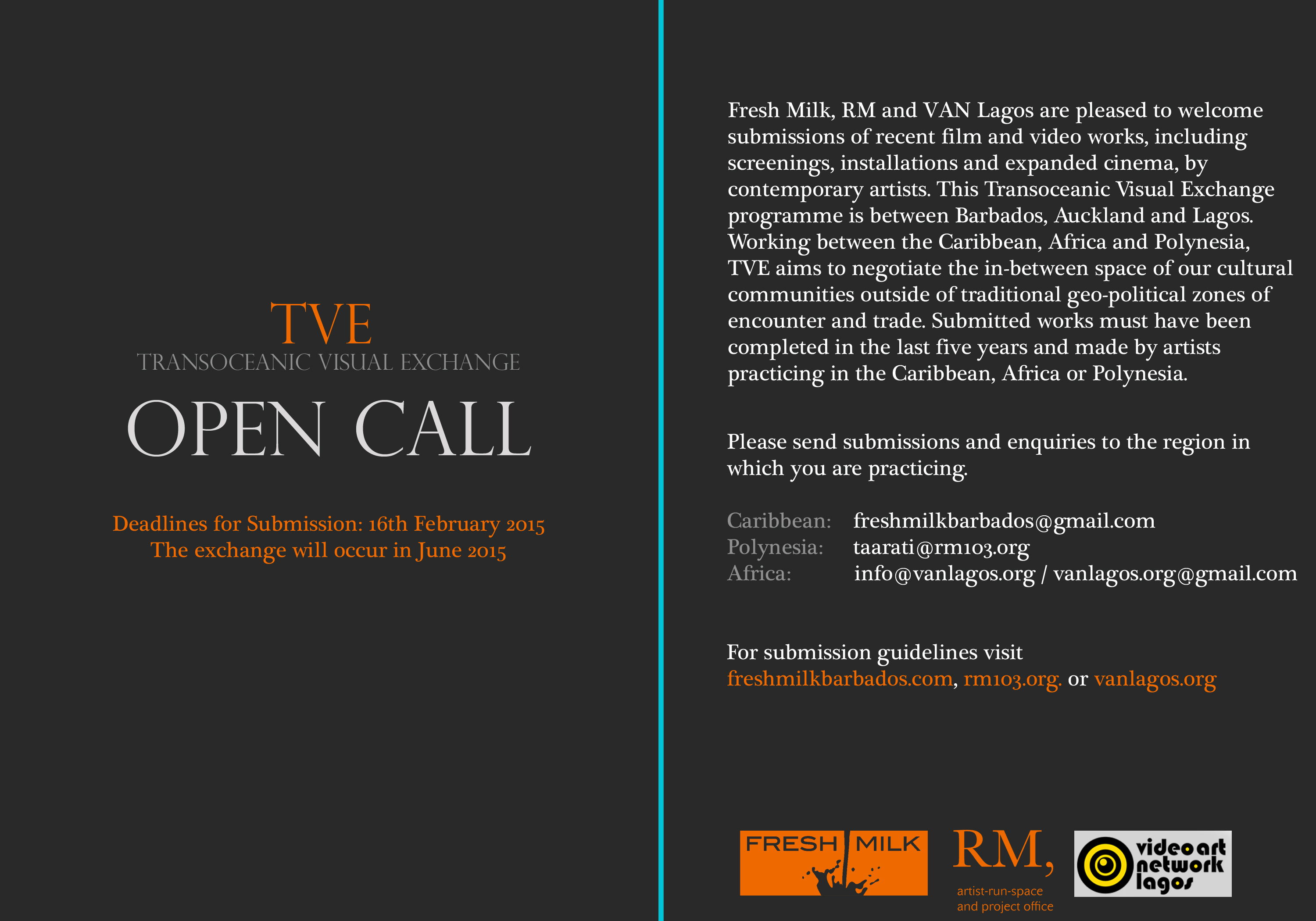
The IAI project has since led to a co-curated artistic exchange currently in development between three of the spaces – Fresh Milk, RM and Video Network Lagos. Transoceanic Visual Exchange or TVE will select video shorts and feature films for an online exhibition of works from the Caribbean, Polynesia and Africa. As a web-based project, it stretches beyond fixed geo-political frameworks, allowing non-traditional relationships to mature, in this case between Barbados, New Zealand and Nigeria.

TVE flyer Final

While proud of our accomplishments and aware of the potent possibilities provided by the digital archipelagos, we are somewhat cynical of the notion of a pure emancipatory digital infrastructure. We must remain cognisant of the need to protect our material, ideas and futures as collectives of artists. Part of our social practice means being responsible about and open to discussing some of the darker realities associated with trusting and functioning in the online space.

While motivated by the digital iteration of Glissant’s poetics of relations and sprawling rhizomatics floating in the air, we consider what it means to have complete faith in something we cannot see or fully understand. The active participants maintaining FM’s online platforms are trying to understand what makes this whole thing work – it’s an ongoing learning process and there is so much that we are not aware of.

On one hand, corporations “allow” us to create projects and communicate fluidly while on the other, companies are not always fully transparent with their users. Governance of the internet is a new and evolving political issue. It is important for us to be aware of the back end so that the potential we so readily embrace and rely on, on a daily basis, does not become a replica of the way some physical spaces and tangible assets have become inaccessible.

CONCLUSION

We close with some questions to be considered:

How do we define an online commons and what is at stake for the individual in the common virtual space?

What entities fund the sites we use on a daily basis and rely on, and what are the ethical implications of these partnerships that may be invisible to us users?

Why is it so important to think in the collective zone instead of the individual?

Why is the digital platform so important to the younger artists and to artistic practice in the Caribbean?

While we continue to make Glissant inspired connections through online platforms, we need to remember that it is our work as creatives that drive some of these engines and be aware of the economics and social engineering behind the engines.

We are witnessing a collective engagement among a community of artists advancing against the failure of national projects like the brick-and-mortar national gallery, which has not yet manifested in Barbados to serve a younger generation of artists.

The internet, as a proactive space, allows us a different perspective on our own cultural environment. Traveling to the moon allowed human beings access to the first image of the pale blue planet seen from afar, spawning the birth of our environmental movement. Similarly, the internet allows us different perspectives on the world in which we live and work. It facilitates increasingly daring digitally born cultural projects that foster human connection, thereby altering the very chemistry of our own soil, bit by bit.

Picture5

WINDOW HORSES: Interview with Ann Marie Fleming and Sandra Oh

While in residence as a ResSupport Fellow at Akademie Schloss Solitude, Katherine Kennedy interviewed former fellow of the Akademie, Ann Marie Fleming, and actress Sandra Oh about their upcoming feature length animation WINDOW HORSES. Created by Fleming and starring/co-produced by Oh, the story follows Rosie Ming – a Canadian poet of Chinese and Persian heritage – as she journeys to Iran to take part in a poetry festival. This culturally rich film celebrates the beauty of diversity, and how it can be used to bring people together and affirm communities that are often under-represented.

WINDOW HORSES is seeking support through an Indiegogo campaign, which runs until December 20, 2014. Click here to donate to this worthwhile project.

Katherine Kennedy: WINDOW HORSES was originally conceptualized during your fellowship at Akademie Schloss Solitude. What did this residency do for your creative process, and how did your stay inspire the story?

Ann Marie Fleming: When I was in Solitude, it was a difficult time for me. I felt very isolated. I was one of the only residents not to be living in Europe, and would find myself alone for days at a time in the winter. I was there as a filmmaker, but I was in the writer’s wing – I met an exiled poet from China, a film festival director who had parents from different countries that both spoke different languages, another poet who would only speak his own language; and here I was, trying desperately to learn German. I truly understood how much language is culture. It was also in Germany that I was introduced to the poetry of Rumi through adaptations by the American poet Coleman Barks.

window horses 3

As an immigrant to Canada, I had always felt like an outsider, but when I lived in Germany, I felt truly Canadian for the first time. Suffice to say, why people leave and why people come was heavy on my mind. [The founding director of Akademie Schloss Solitude] Herr Joly, himself, spoke of the Jewish diaspora in Germany growing, especially through the arrival of Russian, Ukrainian or Belorussian Jews. Around the time of my fellowship, there was also discussion surrounding the returning of the German Jewish diaspora. This idea of belonging had an impact on me, and I actually base a character in WINDOW HORSES on Herr Joly.

I have been working with these same themes for almost two decades since then. I did two installations in Solitude about the unspoken stories of women, particularly mixed race immigrants, and about the metaphysics of Sufi poetry juxataposed against the rituals of womanhood: woman as daughter, lover, bride, wife, ex-wife and mother. That being said, the original script forWINDOW HORSES was conceived as a live action film: a father-son relationship(!) about the German diaspora, particularly to North America after the Second World War, and the alienation of families.

I wrote the song WINDOW HORSES while at Solitude – it is in the book I also wrote during my fellowship, Breathless: the book of Anne, which is about my oldest friend who had killed herself. I performed it with my guitar out by the horses one magical candlelit night. I wish I had a picture. I spent a lot of time looking out the window at those horses. Literally.

K.K.: In addition to the intersection of cultures, Solitude can foster openness to collaboration and working with kindred spirits, even beyond the fellowship period. Can you and Sandra please tell me how you came to work together, and for Sandra, what about this particular project struck a chord with you?

A.M.F.: I first met Sandra back in the early/mid 90’s, when we were supposed to make a feature film together, Dog Days, which was a kind of ghost story about a Chinese immigrant family in the wilds of British Columbia… coincidentally, with a missing father and a dead mother. That project fell through, and I was invited to attend Akademie Schloss Solitude. It’s what I did instead of the feature, I guess. Sandra and I kept in contact over the years, but she went on to a very successful and busy career in the U.S. and, after many years of development, I reached out recently to see if she was available and interested in playing the role of Rosie Ming, and she said yes. More than that, she loved the project and wanted to come on board as a producer.

Sandra Oh: There are several reasons why I fell in love with this project – firstly, I’ve known Ann Marie for years now, and we’ve been trying to work together off and on for all that time. I love [Ann Marie’s avatar] Stickgirl and all she represents, and to voice her in such a heartfelt and deep emotional story was something I knew I had to do. WINDOW HORSES hits all the things that are important to me – it’s pro girl, pro tolerance, pro diversity and PRO ART!

K.K.: The style and animation that we have seen so far is fantastic, and I think Stickgirl is perfectly positioned as the leading lady because she has the ability to be autobiographical yet universal through her simplicity and charm. Tell me more about how Ann Marie, Sandra and Stickgirl as creator, actress and avatar will bring the film’s protagonist Rosie Ming to life.

A.M.F.: It’s a big step for me. Stickgirl (who plays Rosie Ming) has been my avatar since the 80’s and she has always had my voice. So giving her to Sandra to play is an act of trust and respect. It’s like a Bunraku, really, there are three people bringing Rosie Ming to life… me, through my words and original character, Kevin Langdale through his drawings, and Sandra Oh through her voice.

K.K.: Something else I find compelling and relatable about WINDOW HORSES is that the narrative transcends specific cultures. For example, I don’t have personal ties to China, Canada or Iran, but as a multi-racial woman from the Caribbean – an intrinsically hybrid and culturally complex region – the protagonist Rosie Ming’s journey of discovery, exchange and understanding still resounds with me. Can you both share your thoughts about the cathartic effect a film like this could have across the world’s many cultures and diasporas?

A.M.F.: Omigod, Katherine. This is exactly what you are supposed to take from the story. In its specificity is its universality. This is a story that takes place in Iran, and is steeped in that culture, but is about everybody’s stories.

S.O.: My nieces are mixed race, and it’s very important to me that they see themselves represented in this society. It cannot be understated how important it is for people who do not see themselves reflected, either at all or negatively on a regular basis, to know that there is a place for them to exist, truthfully and in a whole, complex way.

A.M.F.: WINDOW HORSES speaks from the place of all people: immigrants, people who are of mixed heritage, people who know nothing about their culture, people who have never left their village and are deeply embedded in their histories. It’s about what we share, and how important it IS to share. It’s about listening to each other’s stories. In WINDOW HORSES, it is poetry that bridges those gaps between generations and cultures. It is the same moon in the Tang Dynasty poem Quiet Night Thought by Li Bai that we see when we look up at the sky and miss our own home.

K.K.: “Distances and differences keep us apart, and we forget to remind each other of our own stories.”

This is a line from the beautiful graphic memoir The Magical Life of Long Tack Sam, an epic, cross-cultural tale you unearthed about your great-grandfather. This statement stood out to me in relation to WINDOW HORSES because of the emphasis on hearing the stories of others, and using memories and experiences as cultural unifiers rather than dividers. The Indiegogo campaign offers forums for us to share our stories, poetry and music, creating a sense of community among those invested in the project. How has the public reaction been to this participatory approach?

A.M.F.: The most amazing thing about the Indiegogo campaign has been the response we have received from the public… all over the world. They say exactly what you say…that the story IS them, or the story TOUCHES them. And there have been people who just want to support us, who have been doing outreach in their communities, trying to spread the word, looking forward to the film. It’s amazing. Of course, we still are trying to raise more money, that’s the goal, but we’ve been rewarded in so many ways. There is another line fromThe Magical Life of Long Tack Sam which is continued in WINDOW HORSES: “history is relatives.” You know that it’s true.

Support the WINDOW HORSES campaign on Indiegogo here. Read the original post on the Akademie Schloss Solitude Blog.

window horses 8