FRESH MILK XVII Review

Kwame Slusher, writer and current team leader of Fresh Milk Books, shares a review of our final event for 2014, FRESH MILK XVII which took place on December 19. The event featured presentations by resident artists, overviews of past and upcoming projects & activities, and a potluck celebration dinner to close out our year. 

All photography by Dondré Trotman.

IMG_0016

…so we jewel the edges of his body

With shattered bottles, then bear him
to the foot of the casuarinas in order that his born
silhouette may freely flash and prance—

– Christian Campbell
Goodmans Bay II

The game described in Campbell’s poem, which he read at the event FRESH MILK XVII that took place on December 19, 2014, is known as Moon Shine Baby/Dolly—a traditional game played by children in the Caribbean and West Africa. One person is chosen or chooses to be the ‘baby/dolly’ and they lie down on the ground, while the other children outline the ‘baby/dolly’ with limestone and broken shards of glass. When the other children are finished, ‘baby/dolly’ gets up and their silhouette of found things would glitter in the moonlight. The game in Campbell’s poem is reminiscent of the Ancient Greek girl that wanted to preserve the memory of her lover who, after a time, had to return to his homeland. As the story goes, she made her lover stand still while she traced the outline of his shadow, then later, got her father to fill it in with clay. Inadvertently, like the game in Campbell’s poem, she not only created a space to remember someone by, but where something new can be developed.

FRESH MILK XVII was not just a space for the latest two resident artists to formally present on their work and experiences, but also an opportunity for members of the Fresh Milk platform to recount recent activities and to look to the future. In the wake of not having a National Art Gallery, Fresh Milk’s director Annalee Davis stated in her opening remarks that “…we live in an era necessarily of self-organization. Civil society must self-organize and build the spaces we want and need for ourselves.” Like the gathered bits of limestone and glass on the beach and the outline of the lost lover, Fresh Milk is  attempting to reimagine a historical space that fosters creativity.

The first presenter, Barbadian arts writer Natalie McGuire, spoke about the Transoceanic Visual Exchange, which is a project Fresh Milk is working on in conjunction with two other art communities: RM in New Zealand and Video Art Network (VAN) Lagos in Nigeria. McGuire said that the project was about upending traditional notions of geo-political space and cultural exchanges. The project is looking for submissions from filmmakers, video artists or artists that work between these spaces—those whose works don’t quite qualify to be shown in a gallery or in a cinema —to go about creating a digital sphere where these cultural exchanges can take place.

Barbadian visual artist and writer Katherine Kennedy then spoke about her experiences at Akadamie Schloss Solitude in Germany, where she had been selected to participate in the ResSupport Fellowship Programme offered by Res Artis on behalf of Fresh Milk from September 1st to December 1st. In her presentation, Kennedy looked at the different connections and encounters that she made with a diverse cross-section of people from around the world. In addition to the interconnection of ideas in a single space, she said that it was good to be able to find the familiar in an unfamiliar environment. She spoke about attending the opening of an exhibition in Memmingen, which focused on carnival, and seeing the work of Trinidadian visual artists Marlon Griffith and Barbadian visual artist Ewan Atkinson. Kennedy pointed out that what was interesting about the exhibition is while the theme was carnival, it was looking at both European and Caribbean depictions instead of just focusing on one locale.

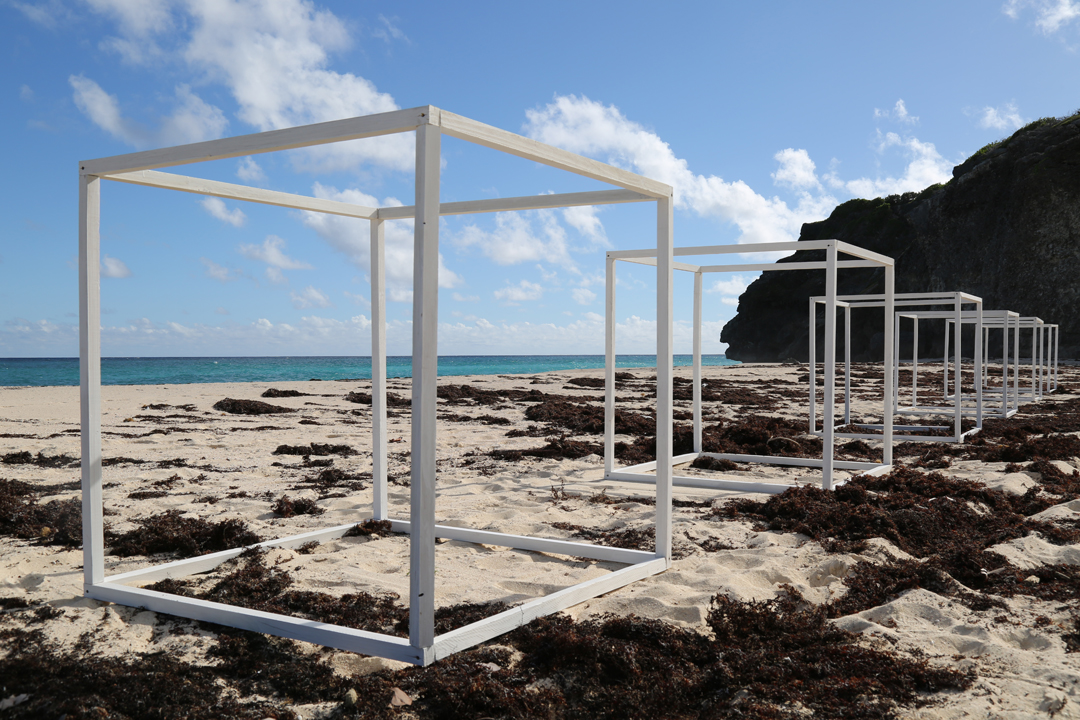
In the second half of the evening, the two artists in residence – Toronto-Based, Bajan-Jamaican industrial designer and visual artist Kara Springer and Toronto-based, Trinidadian-Bahamian poet and cultural critic Christian Campbell – presented their work and what they had accomplished during the residency. Kara talked about her project, Repositioned Objects, which involved the building of 4x4x4ft wooden structures that create tension between the controlled and the uncontrollable. Kara, with the assistance of Christian, went around different points of the island installing the cubes and photographing them. In some cases the structures were left overnight, and in others she only had a short time to construct, photograph and break the structures back down again. What she did not expect was to not only have to deal with destructive natural elements, but also with people who went out of their way to destroy her structures. She was forced to then contend with the intersection of creation and destruction; the difficulty of trying to create order in a chaotic environment.

The final address was given by Christian Campbell, who began by speaking a little about the workshop he led titled ‘The Art of the Essay/The Essay on Art’. The workshop focused on ekphrasis, which has traditionally been a creatively written description on a visual work of art, however for the purposes of the workshop the definition was expanded to include any art form responding to another. Christian’s presentation, unlike the others, was really a series of readings. The first was Martin Carter’s Till I Collect to commemorate the 17th anniversary of Martin Carter’s death, which would have been on the second and last day of the critical writing workshops, held on December 13th. He also read Till I Collect because the last two lines of the poem, “till I collect my scattered skeleton/till I collect…” seemed to correlate with Jean Michel Basquiat’s X-Ray-like self portrait. Campbell read what he considered the ‘most important’ thing that he achieved during the residency, an essay on Jean Michel Basquiat, before adding to the selection with three poems from his own collection ‘Running the Dusk’: Goodmans Bay II, Curry Powder and Iguana. The last poem he read was one of his newer pieces, Names.

In his piece on Basquiat, Campbell read that the Haitian-American artist tried to collect everything, “…the way the Caribbean is the cross-cultural crossroads for the whole damn world”. In many ways that represents what art communities such as Fresh Milk, RM and VAN Lagos are and try to be with projects like the Transoceanic Visual Exchange; to create spaces with what is there, so that something new can develop. This makes it possible for artists like Katherine to go to places like Akadamie Schloss Solitude to work with and connect with other artists from all over the world.

After the presentations were over, and the rain that threatened to drown them had petered out, everyone gathered on the veranda to partake in the Christmas Potluck; to create a new space filled with the holiday spirit and hope for the New Year.

Kara Springer’s Residency – Final Blog Post

One of Fresh Milk’s resident artists from December, 2014, Barbadian-born, Toronto-based industrial designer and visual artist Kara Springer, shares her final blog post reflecting on her residency and the different ways reorienting herself in Barbados has forced her to consider her practice:

Slide 14 - Foul Bay

Back in cold Toronto now, it’s bittersweet to reflect on our time in Barbados.  It was both nourishing and profoundly productive to have the freedom as well as all of the constraints of our experience there.  The constraint of too little time, of learning and relearning the landscape, of moving ourselves and these project materials around, of building under the hot hot sun.  In the end it was the uncontrollable elements that became the most interesting part of the experience, and of the work itself.

Six 4 x 4 x 4 ft structures, set in the East coast seascape were violently destroyed overnight (by unknown human hands, a truck). Bound and let float in the sea, another form was taken down by the waves, the pieces violently ripped apart, scattered in the ocean, and then re-collected, reassembled again on the beach.  There was something satisfying in connecting the human destruction to that of the sea. It reminded me that we’re built this way – to both build and destroy, to come apart.  It was helpful too in offering new directions for me and for my work.

The last images are from our last night at Fresh Milk.  The structure is made from those re-collected pieces – with not quite enough time, and not quite enough materials (useless screws, too damaged to be reused), the structure couldn’t quite stand on the uneven ground of this former plantation, now dairy farm and gathering place for artists. Christian steps in so I can at least capture an image of what it might have been. And then as it caves in on itself, I find this other more interesting form, that pushes against my compulsion to be precise and orderly in my making. This residency was in many ways a collection of happy accidents – wrong turns that opened up new and unexpected paths, and constraints that pushed me to think in new ways about freedom.

FRESH MILK XVII Video

Check out our video from FRESH MILK XVII, which took place on December 19, 2014 at The Fresh Milk Art Platform, Barbados.

FRESH MILK XVII was our last public event for 2014, and featured visual artist Kara Springer and poet / critical writer Christian Campbell speaking about their residency experiences, Katherine Kennedy sharing news about her three month fellowship at Akadamie Schloss Solitude in Stuttgart, Germany and Natalie McGuire addressing TVE – a Transoceanic Visual Exchange between Barbados, Nigeria and New Zealand.

Thanks to Sammy Davis for shooting and editing this video!

Christian Campbell’s First Blog Post: Begin Again

One of Fresh Milk’s current resident artists, Toronto based, Trinidadian-Bahamian writer Christian Campbell, shares his first blog post about what he has been working on during his time in Barbados. Read more from Christian below:

It feels like either we just got here yesterday or we’ve been here for six months. But it’s neither—time is a good Anansi like that. Or maybe not Anansi, but something more sinister. A real thief of too-much, this mythical creature called “time.” Time has been the big subject of all I’ve been working on here—revising a book project, putting the finishing touches on another, working on new essays, new poems.  The pain of time, the problem of beauty, the problem of representation itself. I’m also developing a crick in my neck from listening to D’Angelo’s new genius joint—his first album in 14 years. Or maybe is just chikungunya.

In addition to being a trusty assistant for Kara’s Repositioned Objects installations, I had the pleasure of teaching two workshops at Fresh Milk on “The Art of the Essay/The Essay on Art.”  I always try to cultivate a kind of community of ideas when I teach. But this was different; we had that and something else. After all, this wasn’t a classroom—it was a dairy farm, in the open air, with life happening regardless. So whether or not the cows, roosters, key lime-coloured lizards, secretish rats, vicious mosquitoes and welcome committee of dogs were also doing the writing exercises, I can’t be too sure. But some of them were certainly participating in the discussion.

My workshoppers were very timid at first, terrified even, and then, gradually, open, courageous, brilliant and deeply honest. We were working on the “essay,” which means “to try,” but we were also working on transgression, “creolization” (of forms), translation, and, as always, freedom.  I challenged them in big ways to completely re-think “criticism” and they responded by testing their own limits, taking risks and beginning to slay the demon of doubt.  Most of them (maybe all) are millenials—anxious, lost, savvy, luminous and seriously talented. I’m very inspired by Tristan Alleyne, Khalid Batson, Kaz Fields, Versia Harris, Amanda Haynes, Katherine Kennedy, and Kwame Slusher.

Fresh Milk Wkshp

We landed in Barbados just before Independence Day and I could see my students (and myself) very clearly as the afterlives of Independence—its gains and its many, many failures. They were pretty clear about the ways they don’t fit into prevailing paradigms in “Caribbean” literature and culture. Teaching them also forced me to confront my own doubts and fears, my own need to be far more courageous. All of them are all over social media and tech-savvy. I’ve been thinking about the ways I’m a bit old-fashioned about my relationship to technology as an artist and critic.

On December 13, partly inspired by my students, I initiated what I’m tentatively calling “The Martin Carter 70 Project.” December 13 was the 17th Anniversary of the death of Martin Carter (7 June 1927-13 December 1997), one of my great, guiding spirits. I decided that, beginning with December 13, I would record a poem by Martin Carter every day for the next 70 days, one day for each year of life Carter spent on earth. Here is the first recording, “This is the Dark Time, My Love”:

I see this project as a way to honour Carter through “Shango Electric” (to reference David Rudder), new technology; to be possessed by his words; to test my endurance and commitment; to create a ritual of renewal. After my first post, I learned that I should record on garageband for better sound, then upload to soundcloud and finally upload to my Facebook page. Each recording archives my thanks to him and the ghost of his voice through mine, as well as the traces of my life at a given time—the hoarseness of my voice in the morning, the tiredness of my voice at night, the vocalizing choices I make in relation to the text, the sounds of the world all around me. My poem-choices spring from a range of urges, sometimes to comment anew on the events of the globe and sometimes to comment on my interior.

Gratitude to D’Angelo, my students and Martin Carter for reminding me that you can always begin again.

WINDOW HORSES: Interview with Ann Marie Fleming and Sandra Oh

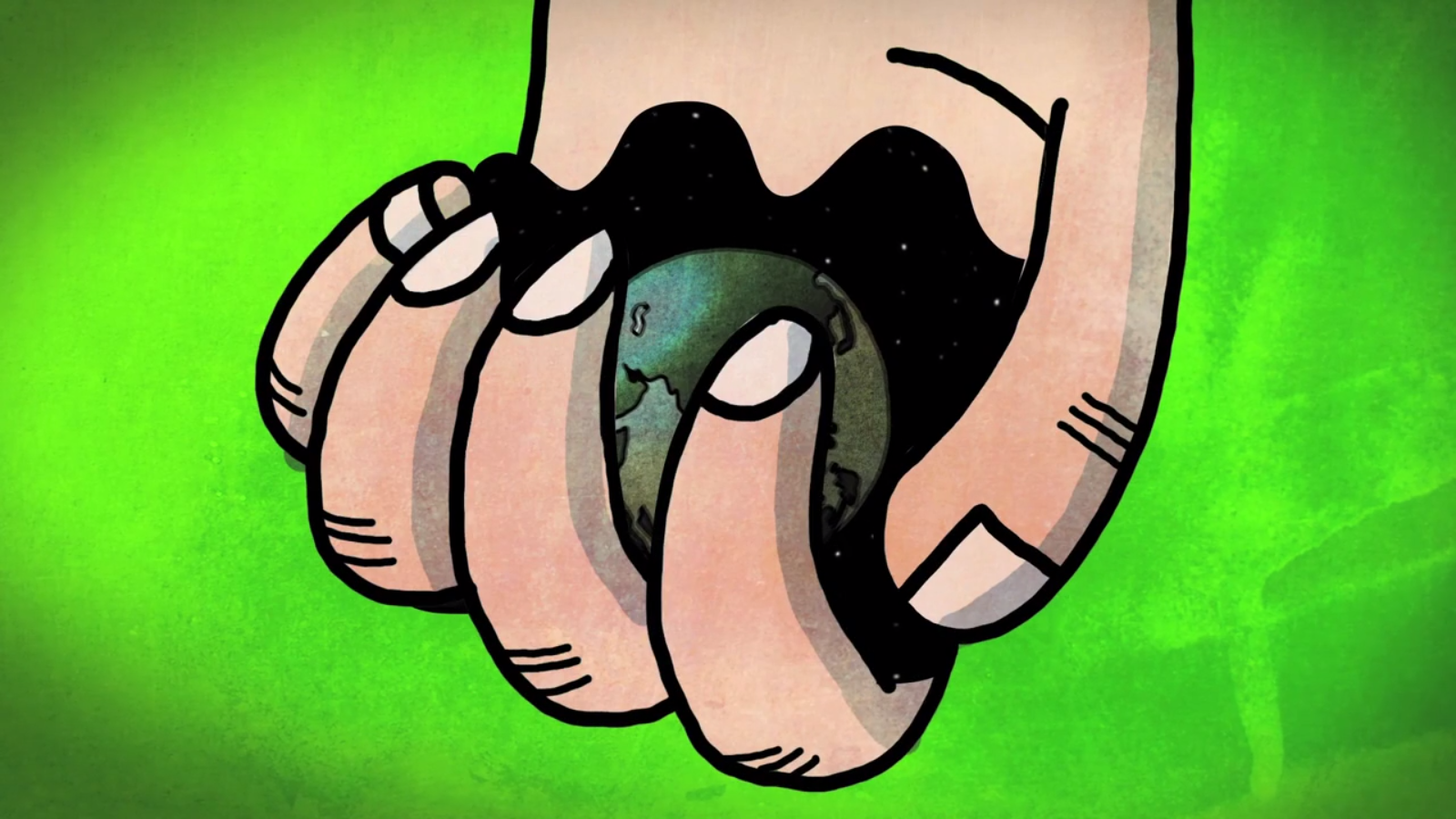
While in residence as a ResSupport Fellow at Akademie Schloss Solitude, Katherine Kennedy interviewed former fellow of the Akademie, Ann Marie Fleming, and actress Sandra Oh about their upcoming feature length animation WINDOW HORSES. Created by Fleming and starring/co-produced by Oh, the story follows Rosie Ming – a Canadian poet of Chinese and Persian heritage – as she journeys to Iran to take part in a poetry festival. This culturally rich film celebrates the beauty of diversity, and how it can be used to bring people together and affirm communities that are often under-represented.

WINDOW HORSES is seeking support through an Indiegogo campaign, which runs until December 20, 2014. Click here to donate to this worthwhile project.

Katherine Kennedy: WINDOW HORSES was originally conceptualized during your fellowship at Akademie Schloss Solitude. What did this residency do for your creative process, and how did your stay inspire the story?

Ann Marie Fleming: When I was in Solitude, it was a difficult time for me. I felt very isolated. I was one of the only residents not to be living in Europe, and would find myself alone for days at a time in the winter. I was there as a filmmaker, but I was in the writer’s wing – I met an exiled poet from China, a film festival director who had parents from different countries that both spoke different languages, another poet who would only speak his own language; and here I was, trying desperately to learn German. I truly understood how much language is culture. It was also in Germany that I was introduced to the poetry of Rumi through adaptations by the American poet Coleman Barks.

window horses 3

As an immigrant to Canada, I had always felt like an outsider, but when I lived in Germany, I felt truly Canadian for the first time. Suffice to say, why people leave and why people come was heavy on my mind. [The founding director of Akademie Schloss Solitude] Herr Joly, himself, spoke of the Jewish diaspora in Germany growing, especially through the arrival of Russian, Ukrainian or Belorussian Jews. Around the time of my fellowship, there was also discussion surrounding the returning of the German Jewish diaspora. This idea of belonging had an impact on me, and I actually base a character in WINDOW HORSES on Herr Joly.

I have been working with these same themes for almost two decades since then. I did two installations in Solitude about the unspoken stories of women, particularly mixed race immigrants, and about the metaphysics of Sufi poetry juxataposed against the rituals of womanhood: woman as daughter, lover, bride, wife, ex-wife and mother. That being said, the original script forWINDOW HORSES was conceived as a live action film: a father-son relationship(!) about the German diaspora, particularly to North America after the Second World War, and the alienation of families.

I wrote the song WINDOW HORSES while at Solitude – it is in the book I also wrote during my fellowship, Breathless: the book of Anne, which is about my oldest friend who had killed herself. I performed it with my guitar out by the horses one magical candlelit night. I wish I had a picture. I spent a lot of time looking out the window at those horses. Literally.

K.K.: In addition to the intersection of cultures, Solitude can foster openness to collaboration and working with kindred spirits, even beyond the fellowship period. Can you and Sandra please tell me how you came to work together, and for Sandra, what about this particular project struck a chord with you?

A.M.F.: I first met Sandra back in the early/mid 90’s, when we were supposed to make a feature film together, Dog Days, which was a kind of ghost story about a Chinese immigrant family in the wilds of British Columbia… coincidentally, with a missing father and a dead mother. That project fell through, and I was invited to attend Akademie Schloss Solitude. It’s what I did instead of the feature, I guess. Sandra and I kept in contact over the years, but she went on to a very successful and busy career in the U.S. and, after many years of development, I reached out recently to see if she was available and interested in playing the role of Rosie Ming, and she said yes. More than that, she loved the project and wanted to come on board as a producer.

Sandra Oh: There are several reasons why I fell in love with this project – firstly, I’ve known Ann Marie for years now, and we’ve been trying to work together off and on for all that time. I love [Ann Marie’s avatar] Stickgirl and all she represents, and to voice her in such a heartfelt and deep emotional story was something I knew I had to do. WINDOW HORSES hits all the things that are important to me – it’s pro girl, pro tolerance, pro diversity and PRO ART!

K.K.: The style and animation that we have seen so far is fantastic, and I think Stickgirl is perfectly positioned as the leading lady because she has the ability to be autobiographical yet universal through her simplicity and charm. Tell me more about how Ann Marie, Sandra and Stickgirl as creator, actress and avatar will bring the film’s protagonist Rosie Ming to life.

A.M.F.: It’s a big step for me. Stickgirl (who plays Rosie Ming) has been my avatar since the 80’s and she has always had my voice. So giving her to Sandra to play is an act of trust and respect. It’s like a Bunraku, really, there are three people bringing Rosie Ming to life… me, through my words and original character, Kevin Langdale through his drawings, and Sandra Oh through her voice.

K.K.: Something else I find compelling and relatable about WINDOW HORSES is that the narrative transcends specific cultures. For example, I don’t have personal ties to China, Canada or Iran, but as a multi-racial woman from the Caribbean – an intrinsically hybrid and culturally complex region – the protagonist Rosie Ming’s journey of discovery, exchange and understanding still resounds with me. Can you both share your thoughts about the cathartic effect a film like this could have across the world’s many cultures and diasporas?

A.M.F.: Omigod, Katherine. This is exactly what you are supposed to take from the story. In its specificity is its universality. This is a story that takes place in Iran, and is steeped in that culture, but is about everybody’s stories.

S.O.: My nieces are mixed race, and it’s very important to me that they see themselves represented in this society. It cannot be understated how important it is for people who do not see themselves reflected, either at all or negatively on a regular basis, to know that there is a place for them to exist, truthfully and in a whole, complex way.

A.M.F.: WINDOW HORSES speaks from the place of all people: immigrants, people who are of mixed heritage, people who know nothing about their culture, people who have never left their village and are deeply embedded in their histories. It’s about what we share, and how important it IS to share. It’s about listening to each other’s stories. In WINDOW HORSES, it is poetry that bridges those gaps between generations and cultures. It is the same moon in the Tang Dynasty poem Quiet Night Thought by Li Bai that we see when we look up at the sky and miss our own home.

K.K.: “Distances and differences keep us apart, and we forget to remind each other of our own stories.”

This is a line from the beautiful graphic memoir The Magical Life of Long Tack Sam, an epic, cross-cultural tale you unearthed about your great-grandfather. This statement stood out to me in relation to WINDOW HORSES because of the emphasis on hearing the stories of others, and using memories and experiences as cultural unifiers rather than dividers. The Indiegogo campaign offers forums for us to share our stories, poetry and music, creating a sense of community among those invested in the project. How has the public reaction been to this participatory approach?

A.M.F.: The most amazing thing about the Indiegogo campaign has been the response we have received from the public… all over the world. They say exactly what you say…that the story IS them, or the story TOUCHES them. And there have been people who just want to support us, who have been doing outreach in their communities, trying to spread the word, looking forward to the film. It’s amazing. Of course, we still are trying to raise more money, that’s the goal, but we’ve been rewarded in so many ways. There is another line fromThe Magical Life of Long Tack Sam which is continued in WINDOW HORSES: “history is relatives.” You know that it’s true.

Support the WINDOW HORSES campaign on Indiegogo here. Read the original post on the Akademie Schloss Solitude Blog.

window horses 8