Brass Tacks: A Workshop on the Nuts & Bolts of Building a Writing Life by Naomi Jackson

Brass Tacks: A Workshop on the Nuts & Bolts of Building a Writing Life is an afternoon session which will be hosted by writer Naomi Jackson at Fresh Milk on Saturday, July 16, 2016 from 2-5 pm. Naomi will lead participants in conversations and activities designed to help refine their writing goals, support the creation of productive and satisfying writing lives and address the commercial aspects of breaking into the business.

Brass Tacks_Naomi Jackson Flyer

Some topics to be addressed include:

✔ Setting and achieving goals for your writing
✔ Developing writing routines
✔ Preparing writing submissions (i.e., drafting query letters)
✔ Approaching potential editors, agents, and/or publishers
✔ Building a community of support and trusted readers to advance your work

To register, please send a letter of interest to freshmilkbarbados@gmail.com. This one-page statement must outline your current writing projects, your short and long term writing goals, and why you wish to participate in this programme.

There will be an attendance fee of $15.00 BBD, and spaces will be limited to 12 participants.

________________

About Naomi:

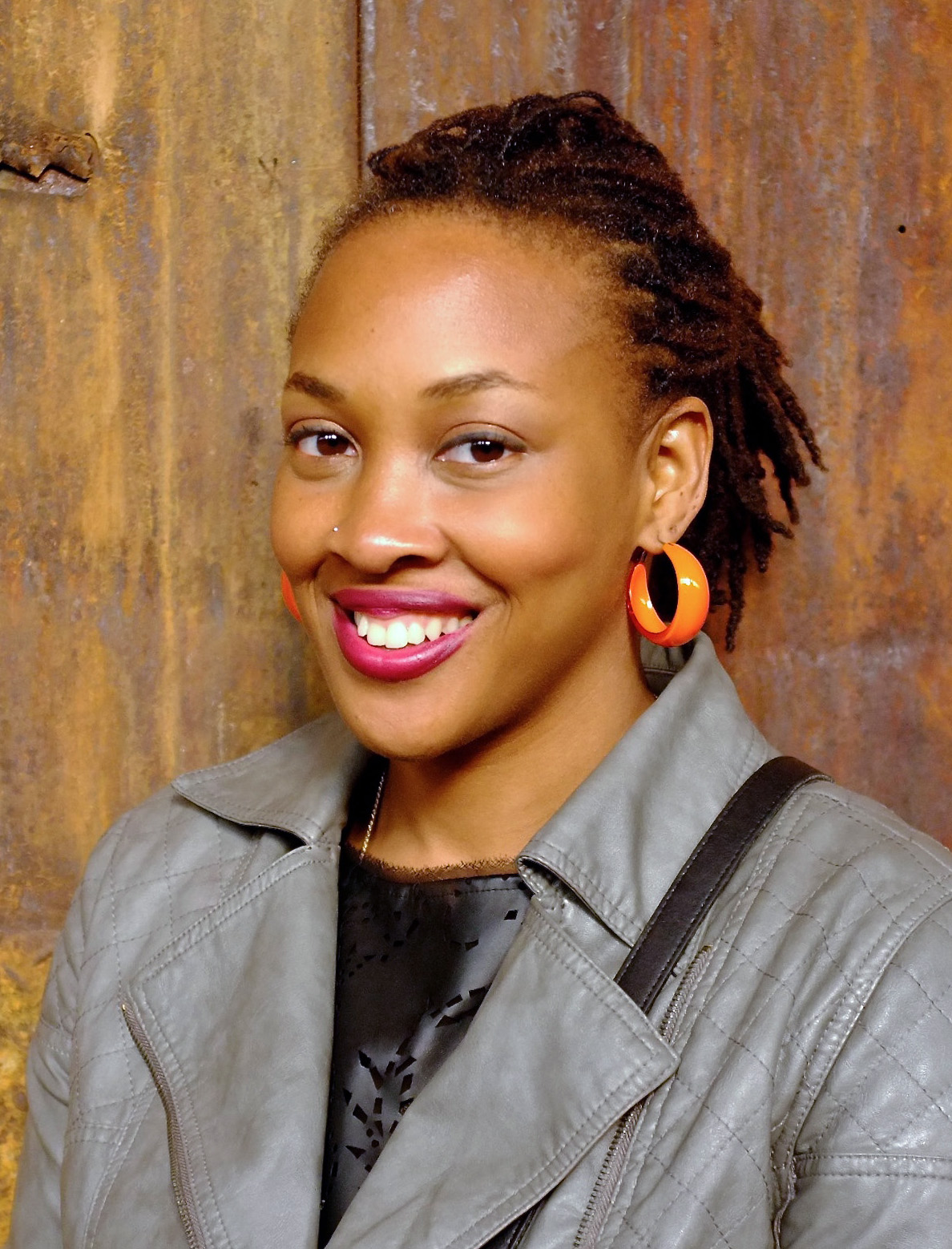
n.jackson_headshot

Photo credit: Lola Flash

Naomi Jackson is author of The Star Side of Bird Hill, published by Penguin Press in June 2015. The Star Side of Bird Hill was nominated for an NAACP Image Award and longlisted for the National Book Critics Circle’s John Leonard Prize as well as the Center for Fiction’s First Novel Prize. It was also selected for the American Booksellers Association’s Indies Introduce and Indies Next List programs. The book has been reviewed in The New York Times, The New Yorker, Kirkus Reviews, NPR.org and Entertainment Weekly, which called Star Side “a gem of a book.” Publishers Weekly named Jackson a Fall 2015 Writer to Watch.

Jackson studied fiction at the Iowa Writers’ Workshop. She traveled to South Africa on a Fulbright scholarship, where she received an M.A. in Creative Writing from the University of Cape Town. A graduate of Williams College, her work has appeared in literary journals and magazines in the United States and abroad. She is the recipient of residencies and fellowships from the Kelly Writers House, Hedgebrook, Vermont Studio Center, and the Camargo Foundation.

Jackson has taught at the University of Iowa, University of Pennsylvania, and The City College of New York. She is a Visiting Assistant Professor of Creative Writing at Oberlin College for spring 2016 and will be Visiting Writer at Amherst College beginning in fall 2016. Jackson was born and raised in Brooklyn by West Indian parents.

Sonia Farmer’s Residency – Week 1 Blog Post

One of Fresh Milk‘s residents for the month of March, Bahamian artist and writer Sonia Farmer, shares her first blog post. Arriving in Barbados at a time in her life when several things are shifting, this residency marks the beginning of  a number of new journeys, including her recent acceptance into the MFA programme in Book Arts at the University of Iowa for later this year. Her first week also kicked off The Art of the Book workshop, which Sonia is leading each Friday during her stay. Read more below:

What a joy to finally be in Barbados, and how quickly this first week has breezed by in a whirlwind of new faces and places. When I applied to the International Residency opportunity almost six months ago, I was in a strange place: frustrated and defeated by events out of my control at the disastrous hotel development Baha Mar, and overall uninspired and lacking in the drive to pick up and start over. All I knew was that I wanted to change my context and find inspiration again, so I applied to the open call at Fresh Milk; designed a several month odyssey to visit Book Arts Centers across the United States; and put my hat in the ring for an MFA in Book Arts at the University of Iowa—all things I had always wanted to pursue, but found circumstances contradictory to taking those steps. Rock bottom is a great foundation for building the life you want, and I’m glad I found the courage and support to pick up the sledgehammer. Because here I am, finally in Barbados, the first leg of the next chapter in my creative life, with an exciting schedule of travel to look forward to afterwards, and finally, acceptance into the graduate program of my dreams just three days ago.

Fresh Milk is a true blessing.  I already feel as though I have been made new. Every morning I enjoy my coffee outside while I work on my artist pages, listen to the sounds of the farm, and enjoy cuddles from resident cat Tiger or dog Rudy. Then I head to the breezy studio and work on one of several writing projects at a cheerful blue desk, or surrounded by books in the Colleen Lewis Reading Room. A writer’s dream! I’m already working my way through their fiction and poetry section in my spare time. Though this first week has been more about finding my “sea legs” in a new context than diving full on into my own work, I’m so overjoyed to have this space to tap into my writing more fully now that I feel truly settled.

I spent most of my time in the studio this week preparing for my first class in many years. As part of my residency, I had committed to teaching a four-part workshop on the Art of the Book, whereby I give my students a crash course in handmade book structures and the ways they can drive or interact with narrative. It’s similar to the course I took during my junior year at Pratt Institute with Miriam Schaer that changed my trajectory. I’d like my students to walk away after every class with a new perspective on books and narrative and how these things can function in their own creative practices. But it’s been ages since I have taught a workshop, so I was very nervous! Not only is my class over capacity—already a great sign!—but it is composed of a fantastic cross-section of artists eager to see how Book Arts can function in their creative lives. If the success of our first class is any indication, I am going to have a great time with them this month.

For week one, I started with a quick slideshow examining book arts throughout various art movements, including a few contemporary examples, in order to broaden their understanding of books and how much control they can have over narrative. We also covered resources for book artists, including vendors for supplies, book arts centers around the world to visit, and retreats and fairs should my students ever want to explore more.

Then we shifted into hands-on practice, breezing through the one sheet/8 page “Instabook” structure as well as the accordion fold, which they nailed. Since my workshop is also about narrative, we explored several experimental writing challenges to engage with the forms they just learned. We started with an erasure of “A True and Exact History of Barbadoes”—a vintage text by Richard Ligon from the Colleen Lewis Reading Room that I’ve become a little bit obsessed with—whereby students erase parts of the existing text to reveal a new poem. Then we all took part in an “exquisite corpse” poetry exercise where each of us contributed a line to a poem in response only to the line before ours, which will be turned into a group accordion fold book at a later date since we ran out of time before the end of class. The theme, fittingly drawing upon the current environmental crisis in Barbados, was “The Drought”, and I think you can see how much we are all in sync by the final product. I’m looking forward to spending more time with them next week when we engage with simple sewn structures and chapbook culture!

The week closed with a very exciting island adventure with a group of wonderful artists and creative thinkers from the Bajan community. We were quite ambitious in our itinerary—visiting a couple of the Fresh Stops benches as well as key sightseeing points at literally every corner of this beautiful island—however we managed to cover enough that I have a good sense of the gorgeous expanse of Barbados as well as feel connected to some dynamic individuals who call this place home.

Hailing from a Caribbean island myself, I find visiting other islands an exercise in magical realism: familiar elements approached with the same level of wonder as every encounter in a foreign land, a welcome strangeness in some alternative universe of our lives. In every Caribbean island lives another version of a history which we all share, expressed in our industries and infrastructure and shared ghosts. I am most struck by the ubiquitous old sugar mill here, haunting its rural and suburban landscapes alike. I feel confronted so boldly by a path of colonial history we have not experienced in The Bahamas, and also fascinated by how this has informed the trajectories of our island’s individual histories and subsequently our social identities today. How do we intersect, how do we divide? And how does this exercise, in exploring these differences, actually help us as a region to overcome our internal prejudices? The Bahamas occupies a strange role in this conversation. One of my students told me what other Caribbean people have told me before: that they don’t consider The Bahamas a part of the Caribbean. I think things are shifting though, especially through the exciting amount of region-driven cross-cultural platforms and conversations taking place, and I’m thrilled to be a Bahamian artist taking a seat at the table.

The Art of the Book: Book Binding Classes with Sonia Farmer

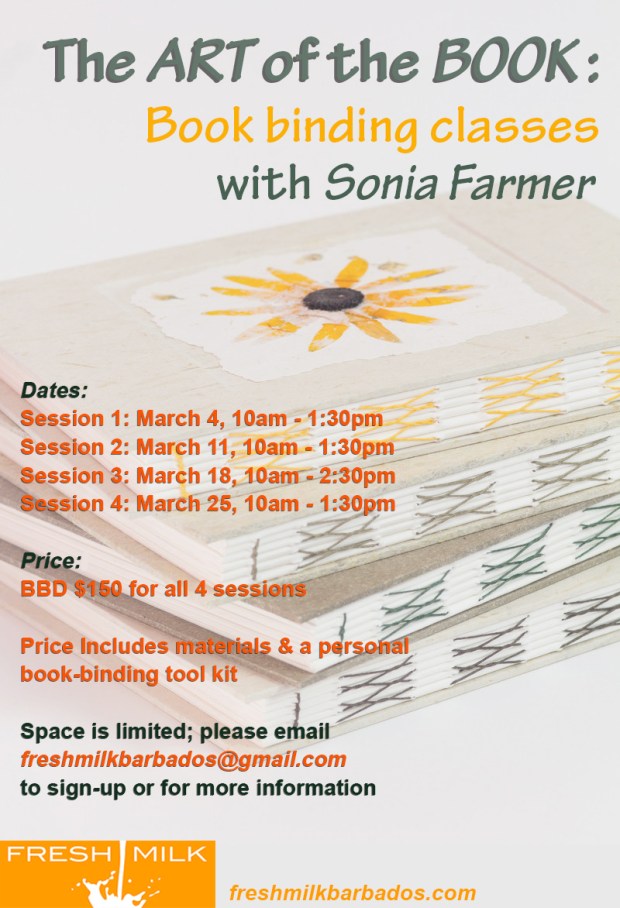
Fresh Milk’s upcoming resident, Bahamian writer and artist Sonia Farmer, will be offering a series of four workshops on different methods of book binding and design at Fresh Milk in March, 2016. This four week course will examine the intersection of text and the book form. Covering a range of book structures, participants will be encouraged to consider the book as an active part of their storytelling practice rather than as simply a vessel. Each class will build upon the former to provide students who wish to take all four classes with a thorough beginner knowledge in making handmade books and book objects and fresh ideas on how to approach narratives.
Sonia Farmer_Art of the Book Flyer2

Participants can also take individual classes to explore a particular structure or group of structures that appeal to them. Included in registration for all four classes will be a book-binding kit to continue their practice outside of these workshops.

You can learn more about each of the sessions below. Spaces will be limited, so please email freshmilkbarbados@gmail.com to register your interest. Applications should include a brief bio and reasons for wishing to participate in the course, based on which Sonia will make the final selection of participants. Please indicate when signing up which sessions you wish to attend.

Registration is now closed.

Number of participants per class: Up to 7

Preparation: All materials will be provided for binding, but students are encouraged to bring any decorative papers, magazines or found materials they may want to explore and include in their practice. Each participant will get a basic book-binding kit with a bonefolder, awl, needles, thread and materials/suppliers list if they wish to explore the medium further. Students will also receive how-to worksheets to reference later at home. Other special tools that will be used together in classes, and the correct PVA adhesive will also be provided.

Tea, coffee and drinks will be available during the short breaks, but participants should bring their lunch as the workshops will be 3-4 hours long, depending on the content of the session.

Participants must understand that if they register for Week Two, they must provide a poem by February 15 to include in the class anthology so it can be laid out and printed on the pages that will be bound together before the session. It can be a poem you wrote yourself or just a poem you like.

Week One: Experimental Poetry and Folded Structures
March 4, 10:00am – 1:30pm

Participants will be led through simple binding structures using only folds and adhesives. Considering the “exquisite corpse” exercises of the surrealists, we will explore the accordion book through a collaborative poem and collage, while use of found text will drive an examination of folded books using a single sheet of paper. Participants will leave with two book structures to reference at home and a variety of new approaches to storytelling.

Week Two: Limited Editions, Zine Culture & Chapbooks
March 11, 10:00am – 1:30pm

Moving into book structures using needle and thread bindings, participants will explore simple softcover books and their many applications. Everyone will be encouraged to share a poem of their choice before class (by February 15) that they would like to appear in a class anthology, bound into a limited edition chapbook using the elegant Japanese stab binding. Then, we will explore zine culture through collecting found language and materials into a pamphlet stitch book. The technicalities of edition bindings will be discussed so that participants will be encouraged to explore making their own editions at home in the future.

Week Three: Hardcover Notebooks & Leather Journals
March 18, 10:00am – 2:30pm

In this class participants will leave with two small blank notebooks to fill with their written inspirations. Utilizing the basic cross-stitch, participants will build two multi-signature textblocks to use in two different casing-in methods: a hardcover notebook wrapped in decorative papers with an exposed spine, and a fully cased-in leather journal with rounded spine.

Week Four: Book Sculptures, Objects & Alternative Narratives
March 25, 10:00am – 1:30pm

In this final class, participants will think about how books can challenge their traditional form and become three dimensional storytelling objects. They will explore playful and alternative structures such as simple pop-up techniques, the tunnel book, and the flag book, and consider how alternative materials and unconventional processes can open up new possibilities in narrative structures.

Price: $150 BBD for all four sessions, which includes materials and a personal book-binding tool-kit.

* Persons may choose to sign up for individual classes rather than the full suite, but there is a base cost of $70 BBD for the book-binding kit, and an additional cost of $10 per chosen class (with the exception of Week 3’s session on hardcover & leather bound journals, which will be $50).

___________________
IMG_9023

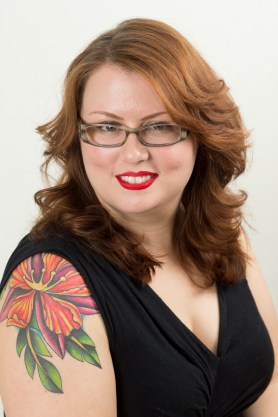
About Sonia Farmer:

A Bahamian writer who uses the crafts of book binding, letterpress printing, hand papermaking and printmaking, Sonia’s work is intimately tied to the Caribbean landscape and identity. Often her work engages with contemporary Bahamian society through the lens of history and mythology, specifically in the realms of feminism and the tourism industry. She is the founder of Poinciana Paper Press, a small and independent press located in Nassau, The Bahamas, which produces handmade and limited edition chapbooks of Caribbean literature and promotes the crafts of book arts through workshops and creative collaborations. Her artwork has been exhibited throughout Nassau including at the National Art Gallery of The Bahamas, Doongalik Studios, The Hub, & the Central Bank Art Gallery. Her poetry has won the 2011 Prize in the Small Axe Literary Competition and has appeared in tongues of the ocean, The Caribbean Writer, Poui, The WomanSpeak Journal, and Moko Magazine. She holds a BFA in Writing from Pratt institute. Visit poincianapaperpress.com to learn more.
Immanuel Hunte shares his experience with Ask Kæreby’s experimental sound workshops

During the month of November, Fresh Milk resident artist Ask Kæreby held a series of three workshops looking at experimental ways of working with sound. One of the participants, Immanuel Hunte, wrote about his experience with the workshops, as well as sharing two of the pieces he created based on what was discussed in the sessions. Read more below:

I attended a 3 day workshop, which was held by Fresh Milk via their Artist Residency Programme. Ask Kæreby, a Danish composer and sound designer was the chief facilitator of this particular project, being that it was about sound and sound design. I have to say that in my opinion, even though only a few people attended the workshop, it was AWESOME. Ask helped me to open my eyes to how sound can be used in unconventional ways to express one’s self creatively.

Over the course of 3 days we looked at the technical aspects of sound and talked about the the artistic and philosophical aspects of it as well. During that time, I gained an understanding about sound and sound design; ie. that sound does not only come from musical instruments, or an orchestra, or notes and pitches. Sound is present in our everyday surroundings and in our everyday lives, whether it is natural ( eg. wind, water, trees, animals) or generated/man-made (eg. engines, machines, traffic, interaction of objects). To sum it all up, I was informally introduced to the world of sound art: Sound art is a contemporary art form in which sound (natural or artificial) is utilised as a medium or a form of expression. Sound art comprises of different elements that are often intertwined eg. audio media, electronic synthesizers, noise music, acoustic or psychoacoustic art, to name a few. Sound art tends to be experimental in that it gives the artist a chance to stretch his/her imagination. I got to learn about the people who were pioneers in this sound art movement, such as Luigi Russolo, who composed for noise machines (which he created) and had members of a London-based orchestra play them, …….which did NOT go down too well with the traditional audience! Russolo at that time wanted to escape the confines of what his generation called traditional music.

There was also Pierre Schaeffer, who was into experimental sound in the 1940s and developed musique concrète. We listened to one of his manipulated recordings of trains. My favourite part was learning about Delia Derbyshire, a woman who was instrumental in the early days of the BBC in London in the BBC Radiophonic Workshop. She has been revered for being a pioneer in electronic music. This unique workshop consisted only of oscillators and various analogue machines. Music for radio and television was scored using only these machines, including sound effects. One famous example is her electronic rendition of Ron Grainer’s theme to Doctor Who, one of the first television themes to be created and produced by entirely electronic means.

Immanuel Hunte’s Soundscape

Also, during this time, the group was given assignments to record our environments, and to manipulate them in an artistic manner. The sounds I used were recordings of my toilet flushing, the washing machine, doors, a spray-can and my voice. Using what I learned in the workshop, plus my experience in making music on computers, I got some satisfyingly interesting results. I edited parts of the audio from my raw recordings and I applied some delay and reverb effects, as well as vocoder effects. The recordings were made using my phone, and the finishing touches were done in digital audio workstations called Propellerhead Reason and FL studio.

Immanuel Hunte’s Desert  Scape

_________________

Thanks to all of those who participated in the sessions, including Annalee Davis, Adrian Green, Immanuel Hunte, Katherine Kennedy, Jesse Phillips, Melanie Springer and Andre Woodvine.

Maj Hasager & Ask Kæreby – Week 3 Blog Post

Danish artists Maj Hasager and Ask Kæreby reflect on the third week of their Fresh Milk residency. They continued their public outreach programming and visiting each coast of the island to record the varying sounds of the ocean, as well as their investigation into the country’s complex history. Trips to loaded sites such as Gun Hill Signal Station and St. Nicholas Abbey raised questions not only about the island’s past, but how it is presented and reckoned with in contemporary society. Read more below:

Falling into the rhythm of spending a quiet Monday in the studio. Ask is giving an artist talk at Barbados Community College (BCC) today, and gets interesting questions in return. The quiet morning turns into an unrhythmical dance with different institutions in the Barbadian system. Nothing moves forward and I (Maj) am almost bursting with impatience. It seems like there is a lot of historical footage that is stuck in the back of government archives, and not accessible at all. Someone mentions over the phone that all the material prior to the independence in 1966 belongs to the British government, and every year the Barbadian government purchases some of its past… colonial powers apparently linger on when negotiating heritage.

Tuesday morning is Maj’s second teaching session at Barbados Community College (BCC) – a failed Internet connection at the college leads to an improvised session anchored in conversation and text on paper with a group of very engaged students. Connections are made between critique, history from below and individual praxes, and opening even more layers in the complexity of place, authorship and subjectivity. Tuesday evening is spent at Tiki Bar at Accra beach for a Fresh Milk lime, where artist Alicia Alleyne, Therese Hadchity, Annalee Davis, Katherine Kennedy, Natalie McGuire, Ask and Maj all meet – as well as director of the national trust Lennox Honychurch who comes by with his laptop to share his research on the Panama canal.

We can see one of the former signal stations in Barbados – named Gun Hill – from where we live. On a small hill top the red building seems far away. When we finally look at a map the distance is less than two km, and it becomes the morning walk up the steep hill – really appreciating the clouds’ mercy as we are making our way to the top. The view from the top is indeed splendid, and we have been told the Barbados National Trust is also trying to make use of the site for weddings and other special occasions, but we wonder who would want a backdrop such as this, which was built primarily to alert in case of more slave uprisings, two years after the 1816 revolt. Adding insult to injury, enslaved labour was also used during the construction of the signal station, and the British West India Regiments bought slaves to supplement their normal recruiting until 1807, when slave trade was abolished in the British Empire – though outside of the army, slavery itself was upheld until 1838.

The week slowly disappears – halfway through we visit more museums in Bridgetown, and Thursday Ask holds the second sound workshop, which adds to the layers of last weeks conversation. At dusk when we leave the studio at Fresh Milk. The colour palette of the landscape suddenly has similarities with old paintings of the Danish landscape. An odd sense of overlapping moments and time appears as the daylight fades.

The bus route 1A seems to have vanished into thin air, forcing us to reshuffle our tightly packed daytrip schedule on Friday. After 3 hours of rumbling we reach the north most part of the island and visit the beautiful site of Animal Flower Cave, named after the sea anemones that live there. It’s still quiet so we get a personal tour of the area from Don – including a climb down (and back up) the cliffs to immerse the hydrophone, which we later take out in the waters of the West Coast, completing its travel to the four corners of this microcosm.

It is noon and the sun is merciless as we are waiting for the bus in an attempt to find alternative routes to reach the old sugar plantation of St. Nicholas Abbey in the parish of St. Peter – which is rumoured to present a somewhat controversial interpretation of colonial history. The bus never shows up, but instead a kind person is offering us a ride back to Speightstown. It turns out that the driver is the artist Victor Collector, who is known for his realist landscape paintings of Barbados. Somehow he has been documenting the changes of the Bajan Landscape over the past twenty years, and on our way back to the city he stops along the way to describe the changes in the landscape, and how it looked when he painted different sites. He leaves us in Speightstown, and we manage to get across to St. Nicholas Abbey just in time to get a tour of the house. Almost through the tour, we are both baffled by the fact that there hardly is any mention of slavery.

When we raise it with the owner who happens to suddenly appear, he dismisses the lack of addressing slavery in their official tour by saying the world is built on exploitation, and that he is the descendant of white indentured labour in Barbados. Our claim is then why not take this as the point of departure to discuss the conflicted and colonial history, instead of whitewashing the present by only describing the architecture and current production, relegating any mention of slavery to witty subtleties from the tour guides? The film claimed to demonstrate the history of the plantation is a 1935 home video, with a voice over from 2000 that is so completely devoid of any sensitivity towards the past or the present, let alone empathy, that we are left dazed and frustrated from the deadpan voice, worthy of an auctioneer at a fish market.

We walk across the fields of the sugar plantation as the daylight fades – to catch another bus to continue our journey.

_____________________________

DanishArtsFound_LOGO_CMYK

This residency is supported in part by the Danish Arts Foundation