Fresh Milk shares the second blog post by US-based international resident artist Daisy Diamond. Inspired by material in the Colleen Lewis Reading Room, Daisy has continued to research the Caribbean, Barbados, and Judaism’s role in society. She has been reflecting on the tremendous effects of complex histories on contemporary realities, and questioning how we can acknowledge this impact while reclaiming, reinventing and growing through our lived experiences and practices. Read more below:

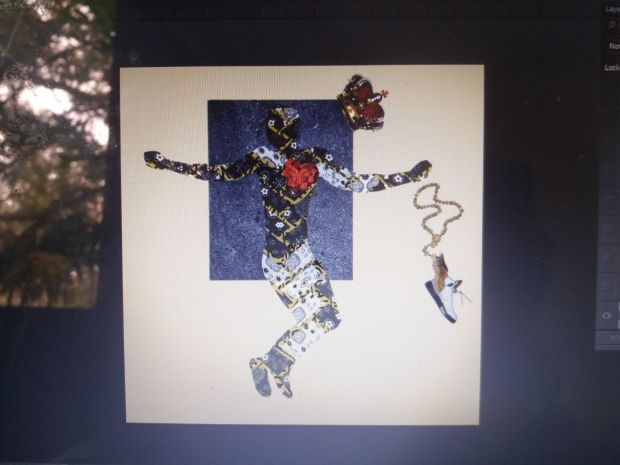
My notebook and sketches from the synagogue and visual motifs from the graveyard
As a medium that lends itself more to imperfect (incomplete) exploration, drawing doesn’t allow for erasure or concealment. To draw could mean to visually conjure something from will or to extract something (meaning, guidance, connection) from a source (history, art, conversation). ‘Drawing’ is a tool, a verb, to pull on a thread and weave together thematic threads gradually. Midway through this residency at Fresh Milk, I continue to build on the ‘spine’ of my visuals and learn more about Barbados beyond what can be discovered at the easel.
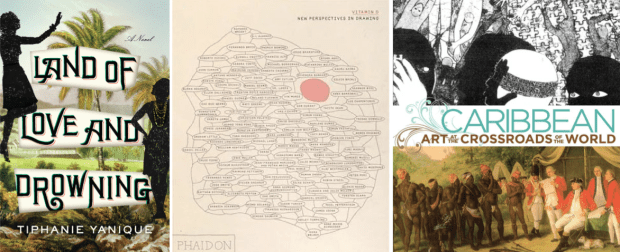
Books I’ve been reading from the Colleen Lewis Reading Room collection
One of the books I’ve been reading is The Land of Love and Drowning by Tiphanie Yanique, an author from St. Thomas, an island in the U.S. Virgin Islands. Annalee Davis, artist and founder of Fresh Milk, recommended this incredible work of magical realism and generational family sagas when I asked for an introduction to contemporary Caribbean literature. The novel is a collage of ideas and experiences with shifting perspectives and a variety of writing styles.
Here are two quotes I’ve been thinking about from this book:
“History could do that, change a person’s name. History was something so simple and insistent that none of us has escaped it.”
“People can need each other like water.”
The water that surrounds each island shapes and serves as a witness to its history. A collective history “so simple and insistent that none of us has escaped it,” not our own, each other’s, or the one being written now. In what ways do acts of artistic creation and consumption situate us in a dialogue with history? Rather than in a position of repression or swallowing the legacies of colonialism? The water that swallows the lives of several characters in this story is impartial to their guilt, innocence, or their value to the people who depend on them, who might “need each other like water.”
I recommend this book for its poetic language and thought-provoking, critical analyses of intersecting family histories as Dutch rulers gave way to American ones in the early 1900s in the Virgin Islands. Here is a video of Yanique reading from a passage about protests, beaches, tourism, and so much more.

I also spent one morning this week walking on Bathsheba beach alongside a few swimmers who seemed intimately knowledgeable about the water’s tides and sweeping currents. We were all there, but had acutely different relationships to the waves cyclically consuming themselves. But perhaps not? Maybe they were visitors and in awe just as I was (the limitations of projection). I was reminded of a quote by Hilton Als from an essay, “Islands,” published in 2014. “The sky’s largeness and generosity reminded me of how pitiful I can feel on islands, where one’s ideas about the place amount to so much sentimental or ideological bullshit.” Similarly, Barbados occupies an active place in many imaginary realms as a ‘paradise.’ I have found powerful counterexamples to this homogenous narrative daily through literary, political, and artistic communities and news while at Fresh Milk.
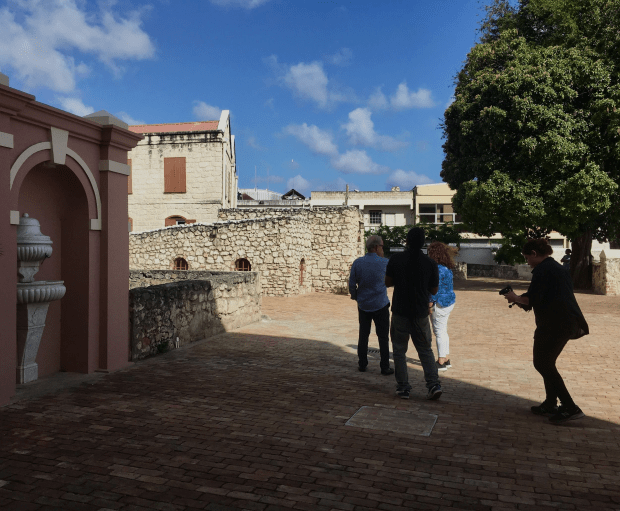
Sir Paul Altman (left), walking on the grounds by the cemetery during a filmed interview
Later in the week, I returned to the Nidhe Israel Synagogue to listen in on an interview of Sir Paul Altman, a leading advocate for the restoration efforts of the synagogue that began in 1986, by Judy Dennison, a cinematographer from Trinidad, and her film crew. Sir Altman described his efforts with the restoration of the synagogue as a “labor of love.” It was fascinating to learn more about the Altman family’s advocacy for the Jewish community and their dedication to preserving history.
During the interview, I also learned more about connections between Barbadian Jews and synagogues in the United States. America’s oldest synagogue, the Touro Synagogue in Rhode Island, where I spent eight months this past year as a student, was founded by Jewish settlers from Barbados. A synagogue in Philadelphia, where I grew up, was financially supported by and had a rabbi who spent years in the Jewish community in Barbados. Again, I was reminded of how this small group of individuals has had a disproportionately large impact across time and geography.
Sir Altman also discussed his horror at the city’s one time plan to build on top of the sacred land where the Jews are buried outside the synagogue. This notion raised a lot of questions for me about how to memorialize sacred land within and beyond this graveyard that was also the site of so much historic trauma and violence – slavery, mass murders, and the displacement of communities. How does the absence of a memorial to this terrible legacy get in the way of a community’s understanding of their ties to history and prevent healing? I have so many questions about how echoes of colonialism and political control are used as justifications for ownership (of land, people, and history) in Barbados and across the world.
In this landscape of sand, sun and sea, I can’t help but think of other ancient land with thousands of years of conflicted ownership and migrations from stolen land to stolen land. Here, we are witnesses through our screens to the horror of the deaths and injuries at ongoing protests in Palestine against the jarring backdrop of formalities performed at the opening of the new US Embassy in Jerusalem.
I am reminded over and over again of Tiphanie Yanique’s insight that “history was something so simple and insistent that none of us has escaped it.” I am thinking of the ongoing protests in Palestine and the land theft justified in the legacy of colonialism and in the name of religion. Reconstructionist Judaism at its core acknowledges our history as one religious civilization among many with parallel histories. It also explicitly seeks to reinterpret and reject Jewish thought that has been historically used to justify the oppression of others. My background in this relatively recent branch of Judaism (founded in 1968) has spurred my interest in ways to engage with spiritual traditions to bring meaning, understanding, and community into daily, and perhaps even explicitly secular, life.
I hope to explore and experiment with religious techniques outside their original contexts to draw meaning and everyday relevance from a text we collectively decide on (poetry, short story, essay, etc.) this Thursday evening, May 17th from 6-8pm, at the Fresh Milk studio space in St. George. Information about this Sacred Practices Reading Group can be found here. Please be sure to RSVP to freshmilkbarbados@gmail.com if you are interested or have any questions! Again, no religious practice or belief is required, just an open curiosity! Hope to see you there.