Review of ‘The Art of the Essay/The Essay on Art’ Workshop – Part 1 & 2

As part of his residency at Fresh Milk, Toronto based, Trinidadian-Bahamian writer Christian Campbell hosted a workshop titled The Art of the Essay/The Essay on Art on December 6 & 13, 2014. The two days focused on critical essays on art, not only as a form of criticism but also looking at the essay as an art form in itself. Fresh Milk Books team leader Kwame Slusher shares a two part review of the workshop below:

tumblr_inline_ngf3k1W8Ba1sdx8um

Part 1

The word origami means folding paper. For it to be authentic the paper folder is expected to create a paper sculpture without cutting, gluing or marking the paper in any way. Despite these restrictions, the possibilities of paper sculptures from a simple flat piece of paper are inexhaustible.

On Saturday December 6th, the Fresh Milk Art Platform hosted the first half of a two day workshop titled, ‘The Art of the Essay/The Essay on Art’. Led by the Toronto based, Trinidadian-Bahamian poet and cultural critic, Christian Campbell, the workshop was geared toward encouraging us, as artists and writers, to rethink and reexamine our idea of the essay. Campbell demonstrated to us that, like a flat piece of paper, the essay can also take many different forms.

In our first activity we were challenged to analyze an elegiac essay titled Etta James: Her Lonely Sound by Hilton Als. We looked at how his piece deviated from the traditional form of the essay while simultaneously maintaining an analytical authority—how Als expertly weaves the personal with the analytical.

After that, we watched Janis Joplin’s very dark rendition of Summertime on YouTube, and wrote a paragraph long response, bearing in mind the techniques used in Hilton Als’s essay. When we were finished we all read our responses aloud, and Campbell critiqued them. Some of us he encouraged to put more of ourselves in the essay and others to be a little more analytical, but on a whole it was clear that we all were beginning to understand the potential elasticity of the form.

At the end of the session Campbell passed out printed copies of Elizabeth Bishop’s ‘The Map’ to be read for the next session, which will be held on Saturday December 13th, from 10 to 12. As we packed notebooks and pens or pencils away, Fresh Milk Director Annalee Davis served slices of cake/pudding, while we were locked in lively discussion on what it means to be a “…millennial in the Caribbean right now”, and the inexhaustible shapes in which we can sculpt the space/s around us.

Jean-Michel Basquiat, Self-Portrait, 1982

Jean-Michel Basquiat, Self-Portrait, 1982

Part 2

In a recent interview, a Guyanese art student at the Barbados Community College said that she was given an assignment where she had to do an abstract self portrait of herself. She decided to focus on her origins, and the result was an overhead topographical map of Guyana. She wanted the art work to show a landscape with all of the bumps, hills and groves that correlate with the complexity of a person’s emotional layers.

The second and final session of The Art of the Essay/The Essay on Art was really about creating maps. Like the art student, we were challenged to move away from the established contours and chart emotive and critical pathways with our writing. Christian challenged us to navigate our own ways through perilous territory—ourselves.

The first thing we did was to review the reading assignment that we were given from the previous week, The Map by Elizabeth Bishop. After a not too close reading of Bishop’s poem, Christian brought up a map of Barbados on his Mac and asked us respond to it, keeping the poem in mind. The result was the charting of emotional territory as we found unique ways of connecting with the familiar landscape; from immediately coherent political statements to abstract, but poignant, word associations.

After that we looked at another reading assignment that we got during the week via email. It was an essay called Never Trust a Big Butt with a Smile by Greg Tate, which explored implications of the phrase ‘Black Comedy’ amongst other things. What was immediately apparent, even before the subject matter of the article became clear, was Tate’s use of colloquialisms. After discussing the reading, we were encouraged to make a list of all the colloquial words and phrases we could think of within a given amount of time.

Next, Christian brought up the image of Jean Michel Basquiat’s Self-Portrait on his Mac and challenged us to respond to it using some of the same colloquialisms that we had written down, or any others that we could think of during the free writing exercise. This proved problematic, because the use of dialect and colloquialisms seemed to peel away the seriousness of our responses to Basquiat’s work. We had mapped ourselves into awkward territory and tried to laugh it off. This exercise really forced us consider our relationship with standard English and dialect, and the existing linguistic hierarchy that privileges the former over the latter, ultimately considering our own identities.

There is always that fear of transgressing an existing border, but the workshop showed us that we need to untangle ourselves from preexisting imaginary lines. We need to toss our compasses, and form our own Keys and Legends, and really try to chart our own personal geographies.

Mother Tongue’s Residency – Week 1 Blog Post

Mother Tongue, the curatorial duo of Jessica Carden and Tiffany Boyle, share their first blog post about their Fresh Milk residency. Coming from Scotland and never having been to the Caribbean before, they describe their introduction to the Barbadian art scene and share some of their evolving plans for engaging with the creative community over the next few weeks. Read their blog post below:

Our first week at Fresh Milk simultaneously marks our first week in the Caribbean; a region whose artists and writers we have been engaging with from a distance for some time now. We arrived with a mix of anticipation and genuine excitement at the opportunities that lie ahead. We had previously met with Fresh Milk’s director Annalee Davis on her visit to Glasgow for the 2014 Commonwealth Games cultural programme, at the ‘International Artist Initiated’ panel discussion at David Dale Gallery, Glasgow, and had been in dialogue since then. Fresh Milk played a central role in the critical discussions unpacking the commonwealth as a loaded cultural event and its enduring impact for the Caribbean, whilst also representing artist-led activity in Barbados.

Our first day at the Fresh Milk residency space took the form of an introduction to the impressive collection within the Colleen Lewis reading room. Annalee talked us through the collection’s categories, and picked out for us seminal texts and exhibitions catalogues which have been helping to give us an overview of not only the current artistic activity and infrastructure in the region, but also the history of artistic practice in Barbados and its ties with elsewhere.

The Fresh Milk ArtBoard featuring work by Ronald Williams.

We were then introduced to the Fresh Milk Books team. After introducing our practice and discussing a number of our curatorial projects, we started to informally talk with the group about their experience of making work in Barbados, the support the Fresh Milk Books group provides for them, and the manner in which they position their work in relation to specialised interests pursued through this meeting point. The discussion then went off in a number of tangents, from notions of whiteness, skin and beauty ideals, both historically and contemporary. We’re going to be discussing with the group a format for understanding curatorial practice this week, which will lead to a kind of workshop in Week 3, the same week that we will be re-screening our 2012 Afrofuturism artist film and video programme for students at the Barbados Community College.

We were also delighted to bring with us a collection of publications generously donated from UK based organisations and individuals, which now call the Colleen Lewis Reading Room their new home. These include Map Magazine; Variant Magazine; Chelsea Space publication archive; University of the Arts London Graduate School; TrAIN Research Centre for Art, Identity and Nation; Flat Time House London; Lyndsay Mann, and Alex Hetherington’s Modern Edinburgh Film School. We hope these publications will be a welcome connection between the UK and Barbados.

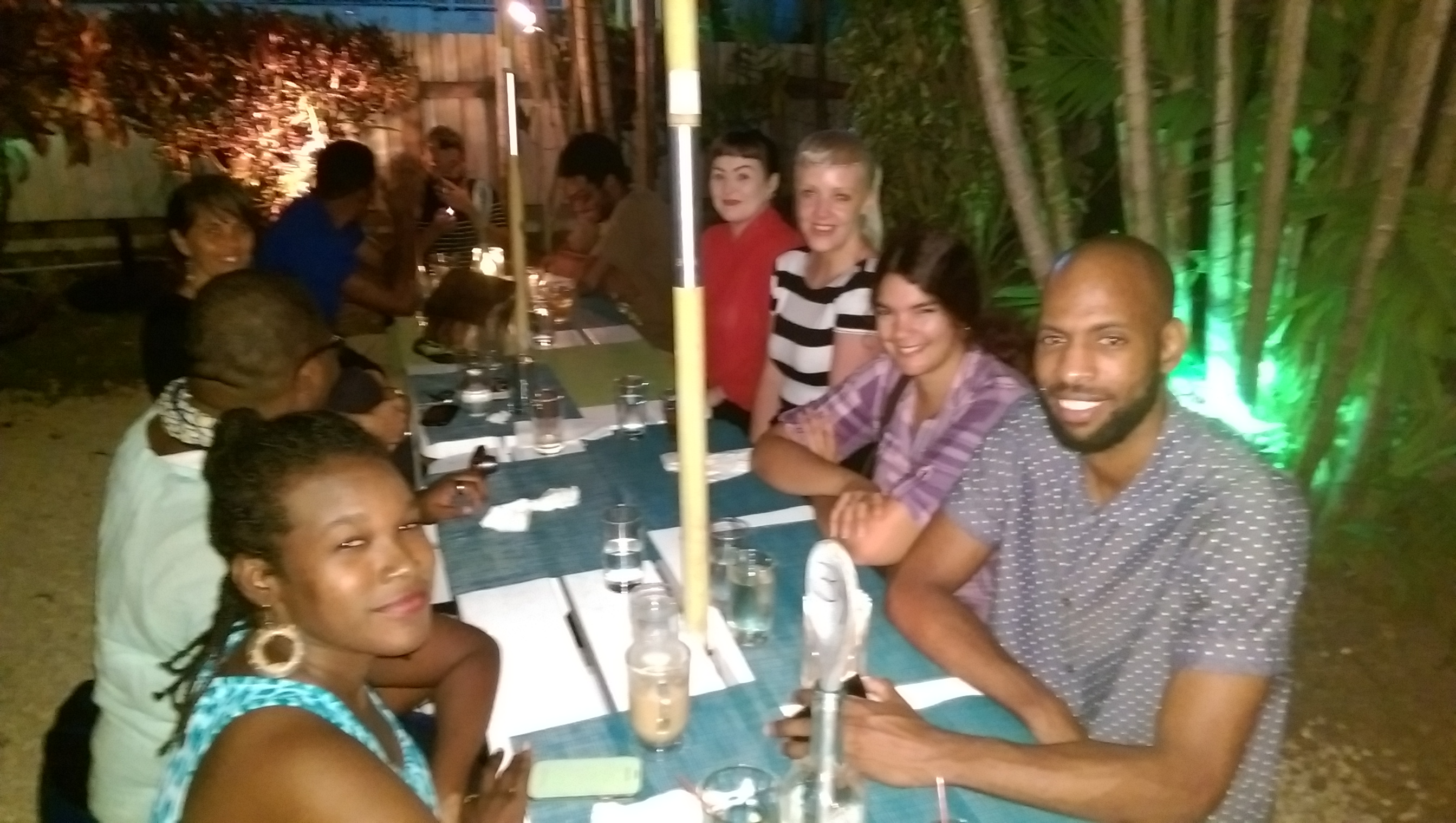
Creatives gathering at Mojo's on the south coast.

We also took a trip into the capital of Bridgetown, and later in the week met with a group of local and visiting artists, Fresh Milk friends and the Fresh Milk Books group. After some rum punches at Mojo’s on the south coast, we had the chance to talk about our practice and our aspirations for the residency, as well as to connect with artists and discuss not only their work but their views on being Bajan practitioners. Among the artists we met was the wonderful Alberta Whittle, whom we have existing connections with from her studies and career in Glasgow. The evening was informal and provided a perfect introduction to the local arts community, before we set up further discussions in the weeks ahead.

For now, we are implementing all the planning the first week provided, and will spend our second week mostly outside the studio, meeting with practitioners, and looking towards our return UK project.

FRESH MILK XVII Review

Kwame Slusher, writer and current team leader of Fresh Milk Books, shares a review of our final event for 2014, FRESH MILK XVII which took place on December 19. The event featured presentations by resident artists, overviews of past and upcoming projects & activities, and a potluck celebration dinner to close out our year. 

All photography by Dondré Trotman.

IMG_0016

…so we jewel the edges of his body

With shattered bottles, then bear him
to the foot of the casuarinas in order that his born
silhouette may freely flash and prance—

– Christian Campbell
Goodmans Bay II

The game described in Campbell’s poem, which he read at the event FRESH MILK XVII that took place on December 19, 2014, is known as Moon Shine Baby/Dolly—a traditional game played by children in the Caribbean and West Africa. One person is chosen or chooses to be the ‘baby/dolly’ and they lie down on the ground, while the other children outline the ‘baby/dolly’ with limestone and broken shards of glass. When the other children are finished, ‘baby/dolly’ gets up and their silhouette of found things would glitter in the moonlight. The game in Campbell’s poem is reminiscent of the Ancient Greek girl that wanted to preserve the memory of her lover who, after a time, had to return to his homeland. As the story goes, she made her lover stand still while she traced the outline of his shadow, then later, got her father to fill it in with clay. Inadvertently, like the game in Campbell’s poem, she not only created a space to remember someone by, but where something new can be developed.

FRESH MILK XVII was not just a space for the latest two resident artists to formally present on their work and experiences, but also an opportunity for members of the Fresh Milk platform to recount recent activities and to look to the future. In the wake of not having a National Art Gallery, Fresh Milk’s director Annalee Davis stated in her opening remarks that “…we live in an era necessarily of self-organization. Civil society must self-organize and build the spaces we want and need for ourselves.” Like the gathered bits of limestone and glass on the beach and the outline of the lost lover, Fresh Milk is  attempting to reimagine a historical space that fosters creativity.

The first presenter, Barbadian arts writer Natalie McGuire, spoke about the Transoceanic Visual Exchange, which is a project Fresh Milk is working on in conjunction with two other art communities: RM in New Zealand and Video Art Network (VAN) Lagos in Nigeria. McGuire said that the project was about upending traditional notions of geo-political space and cultural exchanges. The project is looking for submissions from filmmakers, video artists or artists that work between these spaces—those whose works don’t quite qualify to be shown in a gallery or in a cinema —to go about creating a digital sphere where these cultural exchanges can take place.

Barbadian visual artist and writer Katherine Kennedy then spoke about her experiences at Akadamie Schloss Solitude in Germany, where she had been selected to participate in the ResSupport Fellowship Programme offered by Res Artis on behalf of Fresh Milk from September 1st to December 1st. In her presentation, Kennedy looked at the different connections and encounters that she made with a diverse cross-section of people from around the world. In addition to the interconnection of ideas in a single space, she said that it was good to be able to find the familiar in an unfamiliar environment. She spoke about attending the opening of an exhibition in Memmingen, which focused on carnival, and seeing the work of Trinidadian visual artists Marlon Griffith and Barbadian visual artist Ewan Atkinson. Kennedy pointed out that what was interesting about the exhibition is while the theme was carnival, it was looking at both European and Caribbean depictions instead of just focusing on one locale.

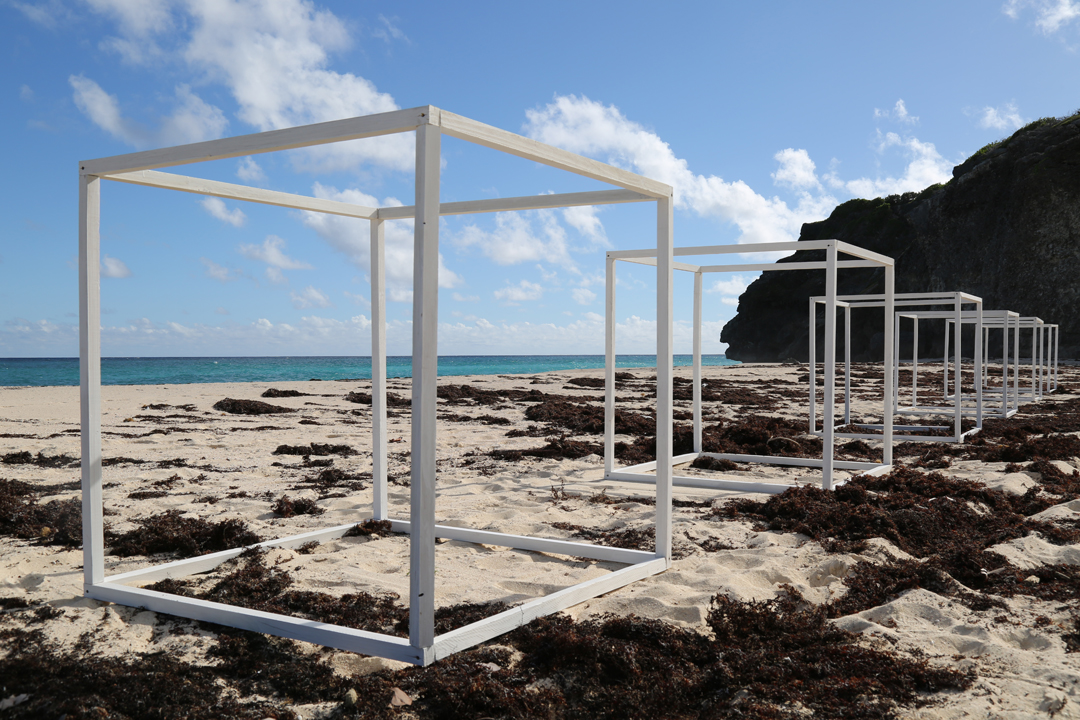
In the second half of the evening, the two artists in residence – Toronto-Based, Bajan-Jamaican industrial designer and visual artist Kara Springer and Toronto-based, Trinidadian-Bahamian poet and cultural critic Christian Campbell – presented their work and what they had accomplished during the residency. Kara talked about her project, Repositioned Objects, which involved the building of 4x4x4ft wooden structures that create tension between the controlled and the uncontrollable. Kara, with the assistance of Christian, went around different points of the island installing the cubes and photographing them. In some cases the structures were left overnight, and in others she only had a short time to construct, photograph and break the structures back down again. What she did not expect was to not only have to deal with destructive natural elements, but also with people who went out of their way to destroy her structures. She was forced to then contend with the intersection of creation and destruction; the difficulty of trying to create order in a chaotic environment.

The final address was given by Christian Campbell, who began by speaking a little about the workshop he led titled ‘The Art of the Essay/The Essay on Art’. The workshop focused on ekphrasis, which has traditionally been a creatively written description on a visual work of art, however for the purposes of the workshop the definition was expanded to include any art form responding to another. Christian’s presentation, unlike the others, was really a series of readings. The first was Martin Carter’s Till I Collect to commemorate the 17th anniversary of Martin Carter’s death, which would have been on the second and last day of the critical writing workshops, held on December 13th. He also read Till I Collect because the last two lines of the poem, “till I collect my scattered skeleton/till I collect…” seemed to correlate with Jean Michel Basquiat’s X-Ray-like self portrait. Campbell read what he considered the ‘most important’ thing that he achieved during the residency, an essay on Jean Michel Basquiat, before adding to the selection with three poems from his own collection ‘Running the Dusk’: Goodmans Bay II, Curry Powder and Iguana. The last poem he read was one of his newer pieces, Names.

In his piece on Basquiat, Campbell read that the Haitian-American artist tried to collect everything, “…the way the Caribbean is the cross-cultural crossroads for the whole damn world”. In many ways that represents what art communities such as Fresh Milk, RM and VAN Lagos are and try to be with projects like the Transoceanic Visual Exchange; to create spaces with what is there, so that something new can develop. This makes it possible for artists like Katherine to go to places like Akadamie Schloss Solitude to work with and connect with other artists from all over the world.

After the presentations were over, and the rain that threatened to drown them had petered out, everyone gathered on the veranda to partake in the Christmas Potluck; to create a new space filled with the holiday spirit and hope for the New Year.

Kara Springer’s Residency – Final Blog Post

One of Fresh Milk’s resident artists from December, 2014, Barbadian-born, Toronto-based industrial designer and visual artist Kara Springer, shares her final blog post reflecting on her residency and the different ways reorienting herself in Barbados has forced her to consider her practice:

Slide 14 - Foul Bay

Back in cold Toronto now, it’s bittersweet to reflect on our time in Barbados.  It was both nourishing and profoundly productive to have the freedom as well as all of the constraints of our experience there.  The constraint of too little time, of learning and relearning the landscape, of moving ourselves and these project materials around, of building under the hot hot sun.  In the end it was the uncontrollable elements that became the most interesting part of the experience, and of the work itself.

Six 4 x 4 x 4 ft structures, set in the East coast seascape were violently destroyed overnight (by unknown human hands, a truck). Bound and let float in the sea, another form was taken down by the waves, the pieces violently ripped apart, scattered in the ocean, and then re-collected, reassembled again on the beach.  There was something satisfying in connecting the human destruction to that of the sea. It reminded me that we’re built this way – to both build and destroy, to come apart.  It was helpful too in offering new directions for me and for my work.

The last images are from our last night at Fresh Milk.  The structure is made from those re-collected pieces – with not quite enough time, and not quite enough materials (useless screws, too damaged to be reused), the structure couldn’t quite stand on the uneven ground of this former plantation, now dairy farm and gathering place for artists. Christian steps in so I can at least capture an image of what it might have been. And then as it caves in on itself, I find this other more interesting form, that pushes against my compulsion to be precise and orderly in my making. This residency was in many ways a collection of happy accidents – wrong turns that opened up new and unexpected paths, and constraints that pushed me to think in new ways about freedom.

Christian Campbell’s First Blog Post: Begin Again

One of Fresh Milk’s current resident artists, Toronto based, Trinidadian-Bahamian writer Christian Campbell, shares his first blog post about what he has been working on during his time in Barbados. Read more from Christian below:

It feels like either we just got here yesterday or we’ve been here for six months. But it’s neither—time is a good Anansi like that. Or maybe not Anansi, but something more sinister. A real thief of too-much, this mythical creature called “time.” Time has been the big subject of all I’ve been working on here—revising a book project, putting the finishing touches on another, working on new essays, new poems.  The pain of time, the problem of beauty, the problem of representation itself. I’m also developing a crick in my neck from listening to D’Angelo’s new genius joint—his first album in 14 years. Or maybe is just chikungunya.

In addition to being a trusty assistant for Kara’s Repositioned Objects installations, I had the pleasure of teaching two workshops at Fresh Milk on “The Art of the Essay/The Essay on Art.”  I always try to cultivate a kind of community of ideas when I teach. But this was different; we had that and something else. After all, this wasn’t a classroom—it was a dairy farm, in the open air, with life happening regardless. So whether or not the cows, roosters, key lime-coloured lizards, secretish rats, vicious mosquitoes and welcome committee of dogs were also doing the writing exercises, I can’t be too sure. But some of them were certainly participating in the discussion.

My workshoppers were very timid at first, terrified even, and then, gradually, open, courageous, brilliant and deeply honest. We were working on the “essay,” which means “to try,” but we were also working on transgression, “creolization” (of forms), translation, and, as always, freedom.  I challenged them in big ways to completely re-think “criticism” and they responded by testing their own limits, taking risks and beginning to slay the demon of doubt.  Most of them (maybe all) are millenials—anxious, lost, savvy, luminous and seriously talented. I’m very inspired by Tristan Alleyne, Khalid Batson, Kaz Fields, Versia Harris, Amanda Haynes, Katherine Kennedy, and Kwame Slusher.

Fresh Milk Wkshp

We landed in Barbados just before Independence Day and I could see my students (and myself) very clearly as the afterlives of Independence—its gains and its many, many failures. They were pretty clear about the ways they don’t fit into prevailing paradigms in “Caribbean” literature and culture. Teaching them also forced me to confront my own doubts and fears, my own need to be far more courageous. All of them are all over social media and tech-savvy. I’ve been thinking about the ways I’m a bit old-fashioned about my relationship to technology as an artist and critic.

On December 13, partly inspired by my students, I initiated what I’m tentatively calling “The Martin Carter 70 Project.” December 13 was the 17th Anniversary of the death of Martin Carter (7 June 1927-13 December 1997), one of my great, guiding spirits. I decided that, beginning with December 13, I would record a poem by Martin Carter every day for the next 70 days, one day for each year of life Carter spent on earth. Here is the first recording, “This is the Dark Time, My Love”:

I see this project as a way to honour Carter through “Shango Electric” (to reference David Rudder), new technology; to be possessed by his words; to test my endurance and commitment; to create a ritual of renewal. After my first post, I learned that I should record on garageband for better sound, then upload to soundcloud and finally upload to my Facebook page. Each recording archives my thanks to him and the ghost of his voice through mine, as well as the traces of my life at a given time—the hoarseness of my voice in the morning, the tiredness of my voice at night, the vocalizing choices I make in relation to the text, the sounds of the world all around me. My poem-choices spring from a range of urges, sometimes to comment anew on the events of the globe and sometimes to comment on my interior.

Gratitude to D’Angelo, my students and Martin Carter for reminding me that you can always begin again.