Irish artist Marianne Keating shares her second blog post about her ongoing Fresh Milk residency. Outlining events which have provided rich research content and have helped to shape her project – such as the exhibitions Arrivants: Art and Migration in the Anglophone Caribbean World and Insurgents: Redefining Rebellion in Barbados, both held at the Barbados Museum and Historical Society – Marianne continues to reflect on the history of Irish migration to Barbados in the 17th century. She also addresses popular misconceptions about this migration, and the problematic trend of equating indentureship with the transatlantic slave trade. Read more below:

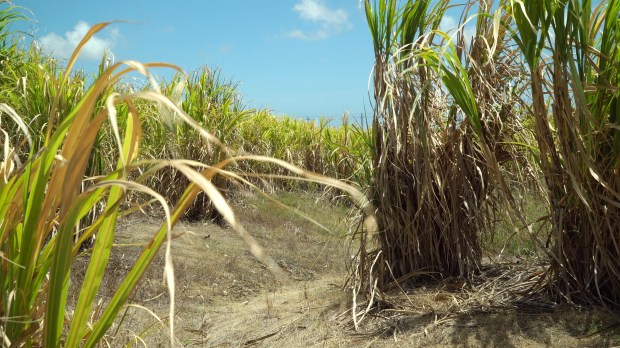
Vanishing Villages – In search of Irish Town, Barbados, April 2019.
The focus of my research in Barbados addresses the subaltern non-elite white community on the East Coast of the island, who are believed to be descendants of indentured labourers – both voluntary and involuntary from Ireland, England, Scotland and Wales. Since their arrival in the seventeenth century, the creolisation process now makes it difficult to determine their exact origins. During my residency at Fresh Milk, I seek to examine conflicting existing narratives relating to their arrival and subsequent positioning in Barbados during the 17th Century.

Studio View at Fresh Milk – The Colleen Lewis Reading Room
Today, the ‘poor white’ communities can be predominately found in villages of the parish of St John along with other sites of importance including the “vanishing villages” of Irish Town and Below Cliff. The analyses of this material and sites are fundamental to my research and development of my practice-based output, which involves the gathering of oral histories through interviews, film footage, research and documentation.
My initial onsite investigation in Barbados began in November 2018 during my first visit to the island for an exhibition I was part of called Arrivants: Art and Migration in the Anglophone Caribbean World. The exhibition, curated by Veerle Poupeye and Allison Thompson at the Barbados Museum and Historical Society, featured a powerhouse of artists including Eddie Chambers, Hew Locke, Keith Piper, Veronica Ryan, Ewan Atkinson and Cosmo Whyte to name a few. During this time, I spent many days researching at the Barbados Museum and Historical Society’s Shilstone Memorial Library which has a rich collection of over 6,000 books, journals and pamphlets, covering subject areas such as the Caribbean, Barbadian and African history, archaeology, natural and social history amongst many more.

The Barbados Museum and Historical Society featuring Eddie Chambers Untitled (1994), flag.
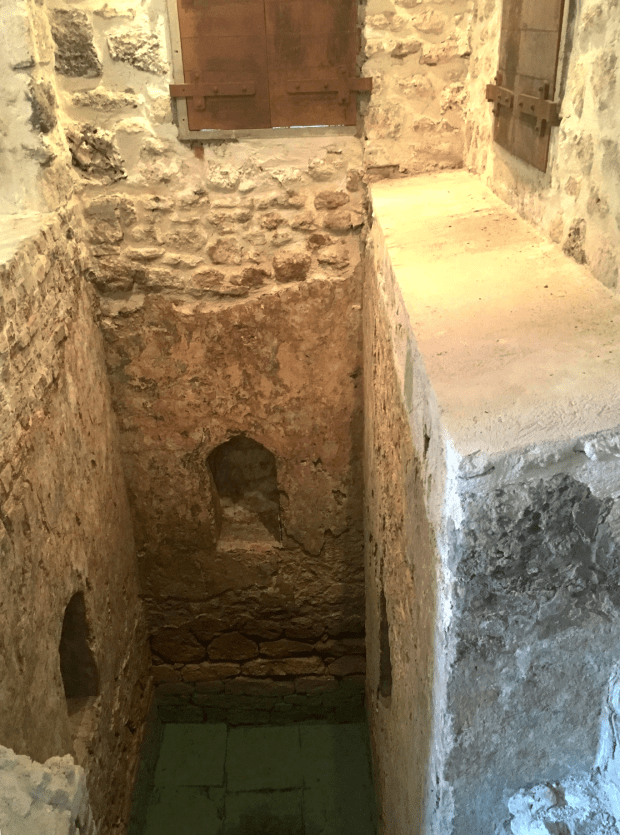
The museum and library are housed in historic buildings which were used initially as the military prison at St. Ann’s Garrison. With the support of Librarian Ms. Harriet Pierce, I trawled through old copies of the Journal of the Barbados Museum and Historical Society dating from 1933, publications such as Richard Ligon’s, A True and Exact History of the Island of Barbados 1657 and copies of old newspaper clippings. These resources greatly helped to established secondary sources about the arrival of Irish indentured labourers and political prisoners to Barbados in the seventeenth century. I also spent many days at the Barbados National Archives exploring their records and the 1715 census which lists many Irish names within the document, leaving more questions than answers.
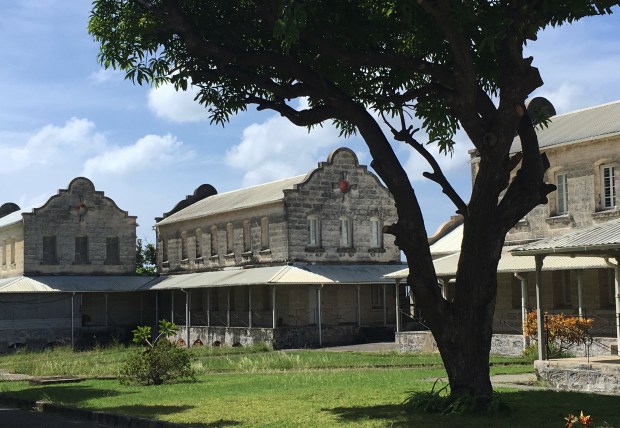
The National Archives of Barbados.
On my return to the island in March, I attended the opening of the exhibition Insurgents: Redefining Rebellion in Barbados curated by Natalie Batson in collaboration with Life in Leggings: Caribbean Alliance Against Gender Based Violence and Barbados Youth Development Council at the Barbados Museum and Historical Society. The exhibition challenges the popular belief that Barbadians are and have been passive when it comes to acts of resistance against injustices.


Amongst the many protest images within the exhibition stood a 390-year timeline which documented insurrection in Barbados including accounts of Irish rebellion against the British Colony. The first post-dated 1655 mentioned the following referencing historian Sir Hilary Beckles, A History of Barbados: From Amerindian Settlement to Caribbean Single Market, 1990.
It is reported that “several Irish servants and negroes out in Thicketts and thereabout, plundered estates systematically”.
And the second mention of the Irish was listed for 1661
Master and Servants Code of 1661 and the ‘Act for the better ordering and governing of Negroes’ slave code drawn in response continued unrest by Irish indentured servants and enslaved Africans.
When discussing Irish migration to the Caribbean in the 17th – 19th century, it is important to discuss the vast difference between indentured labourers/servants and African enslavement or chattel slavery and to address the incorrect use of the term ‘white slave’.
Since the early 2010’s the ‘white slave’ narrative has received more traction, frequently popping up on online platforms and social media across Ireland and throughout the Irish diaspora, a narrative supported by the far right in the United States amongst others, to support a racist political agenda. This narrative is spread in relation to the discussion of Irish migration to the Caribbean when attempting to nullify the differences between indentured labour and African enslavement or chattel slavery. This narrative has been devised to remove race as an aspect of slavery, “the ‘white slavery’ narrative stresses a sense of shared victimisation; this sentiment then serves to discredit calls for reparations from descendants of enslaved Africans in the U.S. and the former British West Indies.”[1]
These false narratives continue to grow online through the constant referencing of many poorly researched books and publications resulting in the misconception, misinterpretation and misappropriation of the reality of the terms of Irish indentureship. There are many distinctions between indentureship and enslavement, with articles such as Contesting “White Slavery” in the Caribbean: Enslaved Africans and European Indentured Servants in 17th Century Barbados by Jerome Handler & Matthew C. Reilly offering a detailed examination on the socio-legal distinctions between servitude and slavery.[2]
The differences are extreme, and although many are aware of these inaccurate narratives, it has effectively complicated the already convoluted story of the subaltern non-elite white in Barbados. And the history of Irish migration to the Caribbean becomes intrinsically linked to this narrative, leaving it impossible to address this history without also addressing this false narrative.
Through my research, I am exploring all aspects of this complex history, as to leave an area untouched threatens the recording of this history through a clouded lens. Many researchers have written articles correcting these falsities, and one of the areas I will focus on is addressing the impact of this narrative on the history of Irish migration. In this way, I will attempt to separate it from the clutches of this racist political agenda which has become click bait for readers as they scroll through their posts on social media.
In Jamaica, Irish Indentured labour began in the years after abolition. Under colonial rule, the Irish poor had few opportunities in a country with high unemployment and ongoing food shortages resulting in limited funds to rent land to grow provisions for the landless workforce. Irish migrants seized opportunities offering a better life and voluntarily signed contracts where they signed a bond to work for a term of up to three years in return for passage, housing and provisions in Jamaica, becoming the legal property of the planter for the duration of the contract to pay off their debt. At the end of their contract, depending on the planter, they had the option to continue working under a new contract with new terms or leave the plantation free from any obligation. Alternatively, they could begin a new life elsewhere in Jamaica or, if funding permitted, in another country by signing up to a new emigration scheme.
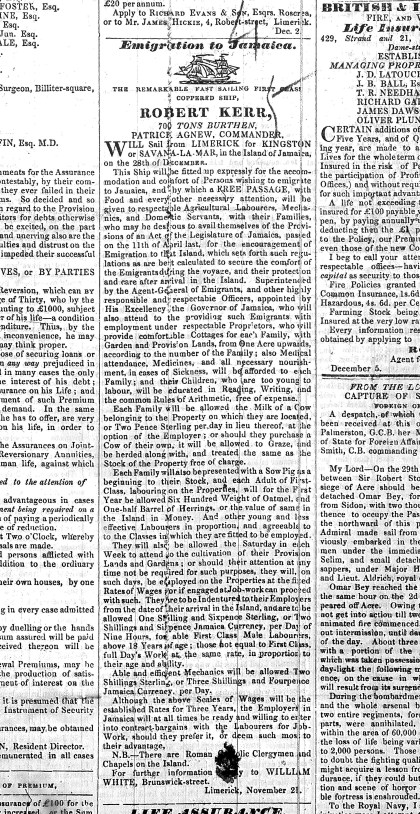
Advertisement Emigration to Jamaica on board the SS Robert Kerr.
This is not to say that the promised conditions were always in place on arrival or that the plantation owners met the agreed terms. Agents and sub-agents working for the West India Immigration Scheme or on behalf of private planters were known to have exaggerated or mislead migrants regarding the opportunities available or working and living conditions in their need to recruit large numbers of labourers.
In the years that followed the abolition of slavery in 1834, the Jamaican sugar cane industry became less lucrative and Jamaican planters struggled to maintain their economic position in the global economic market. With a reduced labour force unwilling to work under the proposed conditions, crops failed due to a lack of manpower required to bring the crops to fruition, and bankruptcy ensued amongst the Jamaican plantocracy. Increasing numbers of labourers chose to sail to Jamaica, where legislation had not yet been put in place and conditions varied from plantation to plantation. The scheme to recruit Irish indentured labourers ran without controls implemented by the legislators until after the controversy of the S.S. Robert Kerr–the last ship to sail to Jamaica under the scheme in 1841.
Although the exact number is unknown due to limited records, there are accounts of the Irish indentured succumbing to diseases such as yellow fever as they were held in low lying areas more prone to illness or death resulting from poor working and climate conditions. However, if a labourer became dissatisfied with their terms and ran away, they were often not tracked down. There are many possible reasons for this, including the scale and rugged terrain of the country and the dwindling resources of the plantocracy. There is a case of a group of Irish causing such uproar they were returned to Europe to stop the unrest spreading to others on the island. Another example is of a woman from Galway who was prosecuted for running away and abandoning her contract. Indicted before the court, her mistreatment by the planter was discussed publicly with the resulting decision unknown. Some who ran away became homeless and destitute in Kingston, whereas others completed the term of their indenture and quickly moved up the ranks of society by taking advantage of their whiteness, privileged in a society driven by race. Through this manipulation of their whiteness, former peasant workers transitioned from bonded workers to positions of authority in the militia, the police force and later into the ranks of politics.
In Barbados–a new area of research for me–the conditions varied significantly from those in Jamaica. Recruitment there began in the mid-seventeenth century where different terms were applied and which were extremely different from the Africans who were enslaved under chattel slavery. Here contracts of indentureship lasted up to seven years if the signing was voluntary, or varied in length if brought to Barbados as a political prisoner. The working conditions of the indentured or political prisoners often led to their preliminary death as a result of mistreatment or harsh working and climatic condition. However, unlike chattel slavery, the terms of indenture lasted for a specific time and did not pass from adult to offspring or their descendants. Furthermore, the indentured had certain rights that the enslaved did not. These differences are addressed very clearly in the aforementioned article Contesting “White Slavery” in the Caribbean[3] and in the article The Irish in the Anglo-Caribbean: Servants or slaves? Why we need to confront the ‘Irish slave myth’ and how terminology is not simply semantics[4], an extract of which is seen below.
the differences and commonalities between these two forms of unfree labour are of fundamental importance to our understanding of the development of racialised perpetual chattel slavery in the British colonies. The term ‘indentured servitude’ is not a denial of their suffering or unfree situation but rather an accurate term to describe their legal status, few rights and harsh reality. Colonial servitude in the Anglo-Caribbean was temporary and non-hereditary, with legal personhood, while chattel slavery was perpetual and hereditary with sub-human legal status. It is inevitable that if we refer to these two different statuses in the same historical context using the same term (‘slave’) these profound distinctions are erased. The refusal to differentiate often reveals a motivation to equate indentured servitude for Europeans with African chattel perpetual slavery to claim spuriously that slavery had nothing to do with race.[5]
Over the next few months, I will focus on making two short films (which may later merge into one), investigating this history of Irish migration to Barbados and the complex environment in which this history sits. My research is looking at these multi-vocal approaches to the past, exploring sites of importance while tracing oral histories and physical fragments remaining in the landscape. As I begin to address this history through practice-based research, I will concurrently address false narratives within this history and their impact on contemporary understanding of the histories of Irish migration to the Caribbean.
—
[1] The Irish in the Anglo-Caribbean: Servants or slaves? Why we need to confront the ‘Irish slave myth’ and how terminology is not simply semantics by Liam Hogan, Laura McaTackney and Matthew C. Reilly p19
[2] Contesting “White Slavery” in the Caribbean: Enslaved Africans and European Indentured Servants in 17th Century Barbados by Jerome Handler & Matthew C. Journal of the Barbados Museum and Historical Society, Vol 63 p156- 187
[3] Contesting “White Slavery” in the Caribbean: Enslaved Africans and European Indentured Servants in 17th Century Barbados by Jerome Handler & Matthew C. Journal of the Barbados Museum and Historical Society, Vol 63 p156- 187
[4] The Irish in the Anglo-Caribbean: Servants or slaves? Why we need to confront the ‘Irish slave myth’ and how terminology is not simply semantics by Liam Hogan, Laura McaTackney and Matthew C. Reilly p18-22
[5] The Irish in the Anglo-Caribbean: Servants or slaves? Why we need to confront the ‘Irish slave myth’ and how terminology is not simply semantics by Liam Hogan, Laura McaTackney and Matthew C. Reilly p19
________________

This residency is supported by the Arts Council of Ireland






 fresh milk barbados