Open Call: FRESH MILK ‘My Time’ Local Residency 2015

FM My Time Residency 2015 Final

Following last year’s local residency programme, which was awarded to Barbadian artist Cherise Ward, Fresh Milk is pleased to announce that we have again received generous support to host the second edition of the ‘My Time’ Local Residency for 2015.

One Barbadian artist will be selected from this open call to undertake a one-month residency, and will receive a stipend of $1,000.00 BBD towards their production costs. Visual artists working in a variety of disciplines (sculpture, installation, painting, drawing, performance, photography, new media, interdisciplinary) are invited to apply.

Duration of Residency:  4 weeks

FRESH MILK will provide:

– A $1,000.00 BBD stipend to the artist
– Wireless internet
– A 15.5 x 14 ft studio space
– A wide expanse of rural land
– Access to the Colleen Lewis Reading Room on site
– A varied network of creatives to connect with
– The option to participate in a public event showcasing the outcome of the residency

Eligibility criteria:

–  Artist must be a resident of Barbados
–  Artist must not have taken part in an on-site Fresh Milk Residency within the last 2 years

Expectations of the Artist:

–  Artist must come out to the studio a minimum of four days per week between Monday and Friday. Studio access is between 7 am and 6 pm.
–  Artist must supply their own materials and equipment
–  Artist must complete some form of public outreach in relation to the work created during the residency (artist talk/presentation, workshop, exhibition, etc.)
–  Artist will be required to keep a weekly blog of their activities and processes, and submit a report to Fresh Milk at the conclusion of the residency
–  Artist will be required to donate a piece of work to the donor who made this residency possible

Application Process:

To be considered, please submit the following to freshmilkbarbados@gmail.com with the subject line ‘My Time Local Residency 2015 Proposal’:

–   The completed application form which can be downloaded here (includes applicant’s contact information, an artist statement, and full residency proposal)
–  An up to date Curriculum Vitae (CV)
–  A numbered portfolio of 5-10 images (or 2-3 short videos as the case may be) of recent work
–  An index of the portfolio pieces in numerical order, with the title, medium and date listed

Incomplete applications will not be considered.

The deadline for submission is March 13th, 2015. Residency dates will be negotiated with the artist after they have been selected, and may commence as soon as March 23rd. The residency must be completed by June 12th, 2015.

TVE Open Call – Deadline Extended

TVE (transoceanic visual exchange) is making an open call in search of recent artists’ films and videos to be included in an exchange between Fresh Milk (Barbados), RM, (Auckland) and VAN Lagos (Nigeria). The deadline for submissions has been extended until February 27, 2015.

TVE flyer Extension

Fresh Milk, RM and VAN Lagos, are pleased to welcome submissions of recent film and video works – screenings, installations and expanded cinema – by contemporary artists, to be included in programmes for exchange between Barbados, Auckland and Lagos. Submitted works must have been completed in the last five years and must be made by artists practicing in the Caribbean, Africa or Polynesia.

The foundation of this transoceanic visual exchange (TVE) will be a collection of recent artist’s film and video from each region. However, the final shape and content of the programme will be informed by an open workshop process, which aims to involve and promote discussion within the wider arts communities of each arts initiative.

Working between the Caribbean, Africa and Polynesia, TVE aims to negotiate the in-between space of our cultural communities outside of traditional geo-political zones of encounter and trade. Fresh Milk, VAN Lagos and RM first met as participants of International Artists Initiated, a programme organized and facilitated by David Dale Gallery, Glasgow, in July 2014. TVE intends to build upon relations established during this initial encounter and open up greater pathways of visibility, discourse and knowledge production between the artist run initiatives and their communities.

Submissions:  

  • Must be work from artists practicing in the Caribbean, Africa or Polynesia.
  • Must be work that has been completed/made in the last five years.
  • Can be films of any length (shorts, experimental, features and video artworks)
  • Can be in any language (films originally produced in regional languages are welcome) with English subtitles.
  • Multiple submissions are welcome
  • Must be accompanied by a description of the work (500 words max), a bio (200 words max) and detail of any technical requirements i.e. audio, installation, equipment required, preferred setting etc.
  • Works must be in the form of mp4 files no larger than 10MB, or private Vimeo / Youtube links

The new deadline for submission is February 27, 2015 for all regions.

The exchange will occur in June/July 2015

Please send submissions and enquiries to the region in which you are practicing:

Caribbean: freshmilkbarbados@gmail.com
Polynesia: taarati@rm103.org
Africa: info@vanlagos.org / vanlagos.org@gmail.com

About the Spaces

Fresh milk colours

The Fresh Milk Art Platform Inc. is a Caribbean non-profit, artist-led, inter-disciplinary organization that supports creatives and promotes wise social, economic, and environmental stewardship through creative engagement with society and by cultivating excellence in the arts. Fresh Milk bridges the divides between creative disciplines, generations of creatives, and all linguistic territories in the region. It functions as a cultural lab, fostering critical, creative practices through local, regional and international programming. The platform transforms into a gathering space for contemporary creatives who are thirsty to debate ideas and share works through residencies, lectures, screenings, workshops, exhibitions, projects etc.

van lagos logo

The Video Art Network, Lagos (VAN, Lagos) is a Lagos based New Media art organization, established by the collaborative efforts of artists Emeka Ogboh, Jude Anogwih and cultural producer Oyindamola Fakeye. The organizations objectives are to develop educational and public programmes that promote and create new media art awareness in Nigeria. This is realized through curated screenings and exhibitions of both established and emerging New Media artists.

RM

RM is an artist-run space, project office and (gradually developing) archive. Based in Auckland, New Zealand, RM is a gallery that places the work of local emerging artists alongside more seasoned practitioners. RM seeks to engage with the practices, discourses and modes of presentation that aren’t well-supported or easily accessible in Auckland. Though we might look like a white cube, we are more interested in the potentials of an empty room – a space to gather, to think, to talk, to make, to share… Established in 1997, RM is the country’s longest running artist-run-space. The co-directors are Eleanor Cooper, Melanie Kung, Ziggy Lever, Fleur Sandbrook, Taarati Taiaroa, and co-founder Nick Spratt. Previous incarnations of the rm project have included rm3, rm212, rm401 and rm103.

Mother Tongue’s Residency – Week 2 Blog Post

Mother Tongue, the curatorial duo of Jessica Carden and Tiffany Boyle, share a blog post about their second week at Fresh Milk, which kept them busy with a number of meetings and visits. These sessions were not only with artists, but also focused on the island’s history, geography and social environment; topics that feed into a number of the art practices they have encountered so far, and contribute to Mother Tongue’s overall understanding of the space. Read their report below: 

photo(7)

Whilst our first week in Barbados took the form of an introduction to Fresh Milk, the reading room collection and the studio space, our second week has been a flurry of meetings, studio visits and trips around the island to meet with various individuals, museums and organisations. It has been a week of connecting with a whole host of people who are instrumental to the arts scene here on the island – both in the past and in the present – with established and emergent practitioners. We have also consciously widened our scope to look at the rich histories outside of the arts, but which have been preoccupying local artists, such as the sugar industry, tourism and the colonial role in the horticulture of the island.

photo(5)

On Monday we met with the Barbadian artist Alberta Whittle, who we were originally introduced to in Glasgow whilst she was studying at Glasgow School of Art. Alberta gave us a tour of the National Museum of Barbados, and provided a brilliant insight into her position as a Barbadian artist who has become established outside of the island but returns regularly to make work here as an invested member of the arts community. Alberta also introduced us to our very first Caribbean snow cone, which consists of crushed ice, sugar syrup and condensed milk; perfect for a Scottish sweet tooth! We attended a lecture at the museum which was focused on the evolution of the tourist industry here in Barbados from the early 19th century onwards, and how it has become central for the islands’ economy, which was for such a long time monopolised by sugar cane.

Having become aware of their work through various Caribbean art publications in the Fresh Milk reading room, Director Annalee set-up studio visits with the artists Ewan Atkinson and Mark King. We were really lucky to have caught a sneak preview of Ewan’s exciting new work for the Havana Biennial which he will be taking over later this year. He also gave us some really interesting background information to his recent series ‘The Neighbourhood Report’, which comprises of several fictional characters exploring notions of identity, sexuality and gender representations. In our conversation with artist Mark King, he charted his journey from the US and Holland, and why he has chosen to return to Barbados to make it his base, while he continues to exhibit internationally.

This week we have also been really fortunate to spend some time with the artist Holly Bynoe, who is also the Co-Founder and Director of Caribbean Arts and culture magazine ARC. Throughout her career as an artist, researcher, curator and writer in the Caribbean, Holly has been an invaluable source in providing references and links to artists and projects across the region. We were able to discuss the role ARC magazine has been taking as a platform for many projects – written and beyond – over dinner with Holly and Assistant to the Director Katherine Kennedy, who is also an artist and an integral member of the Fresh Milk team.

On Friday we were introduced to the artist Denyse Menard Greenidge, who founded Dayrells Art Gallery in Barbados in the 70s, and continues to curate the work of Barbadian artists locally and internationally. Talking us through documentation from the 70’s and 80’s, Denyse was able to provide us with an overview of how governmental support for the arts has changed over the years and how this has impacted the current activity on the island. We visited her husband Newlands Greenidge‘s self-founded Springvale Indigenous Folk Museum, which is located in the Scottish district on the east of the island. The museum hosts a collection of artefacts which describe what life would have been like on the island in the early 19th century. Created through a labour of love by Newlands and Denyse, their passion for the island’s history is clear through the wealth of information they provided about the collection and its significance for Barbados.

In our second week, we were also visited in the Fresh Milk studio by Sean Carrington, Professor of Plant Biology at the University of the West Indies, Cave Hill Campus. We had a really stimulating conversation about the importation of species into the island, indigenousness and plant life, and the problems language causes between islands in the region, in terms of classification and keeping track of plant populations. Following our meeting with Sean, we went to meet Dr. Anthony Kennedy, Director of the West Indies Central Sugar Cane Breeding Station. The station is one of the most successful breeding centres in the world, whose work and research helps to develop sugar industries across the Southern Hemisphere. During our visit we were talked through the history of sugar on the island, and how it formed and influenced the way we see not just the agricultural formations but the human geography and architecture of the island too. This history is so significant for any attempt to understand the island, and it’s something that we’re trying to grasp as best as we can during our visit.

We look forward to a busy third week that will include two presentations at Barbados Community College on curating, and a re-screening of our ‘Afrofuturism’ programme, originally developed for the Africa in Motion Film Festival 2012.

Open Call: FRESH MILK International Residency 2015

FM International open call 2015

FRESH MILK is seeking proposals from artists working outside of Barbados to apply for our international residency programme in 2015. Available dates for the residencies to take place are between March 23 – June 12, 2015 and November 2 – 30, 2015.

This residency aims to support visual artists, writers and curators by offering a peaceful working space for a minimum of 4 weeks for creative production, the opportunity to interface with contemporary practitioners living and working in Barbados, access to the on-site Colleen Lewis Reading Room, the chance to broaden understanding of the work being produced locally and regionally in the Caribbean, and to strengthen international networks and relationships. For more information on the residency, application process and associated costs, please visit our International Residency Opportunity page.

The deadline for applications is March 13, 2015.

Review of ‘The Art of the Essay/The Essay on Art’ Workshop – Part 1 & 2

As part of his residency at Fresh Milk, Toronto based, Trinidadian-Bahamian writer Christian Campbell hosted a workshop titled The Art of the Essay/The Essay on Art on December 6 & 13, 2014. The two days focused on critical essays on art, not only as a form of criticism but also looking at the essay as an art form in itself. Fresh Milk Books team leader Kwame Slusher shares a two part review of the workshop below:

tumblr_inline_ngf3k1W8Ba1sdx8um

Part 1

The word origami means folding paper. For it to be authentic the paper folder is expected to create a paper sculpture without cutting, gluing or marking the paper in any way. Despite these restrictions, the possibilities of paper sculptures from a simple flat piece of paper are inexhaustible.

On Saturday December 6th, the Fresh Milk Art Platform hosted the first half of a two day workshop titled, ‘The Art of the Essay/The Essay on Art’. Led by the Toronto based, Trinidadian-Bahamian poet and cultural critic, Christian Campbell, the workshop was geared toward encouraging us, as artists and writers, to rethink and reexamine our idea of the essay. Campbell demonstrated to us that, like a flat piece of paper, the essay can also take many different forms.

In our first activity we were challenged to analyze an elegiac essay titled Etta James: Her Lonely Sound by Hilton Als. We looked at how his piece deviated from the traditional form of the essay while simultaneously maintaining an analytical authority—how Als expertly weaves the personal with the analytical.

After that, we watched Janis Joplin’s very dark rendition of Summertime on YouTube, and wrote a paragraph long response, bearing in mind the techniques used in Hilton Als’s essay. When we were finished we all read our responses aloud, and Campbell critiqued them. Some of us he encouraged to put more of ourselves in the essay and others to be a little more analytical, but on a whole it was clear that we all were beginning to understand the potential elasticity of the form.

At the end of the session Campbell passed out printed copies of Elizabeth Bishop’s ‘The Map’ to be read for the next session, which will be held on Saturday December 13th, from 10 to 12. As we packed notebooks and pens or pencils away, Fresh Milk Director Annalee Davis served slices of cake/pudding, while we were locked in lively discussion on what it means to be a “…millennial in the Caribbean right now”, and the inexhaustible shapes in which we can sculpt the space/s around us.
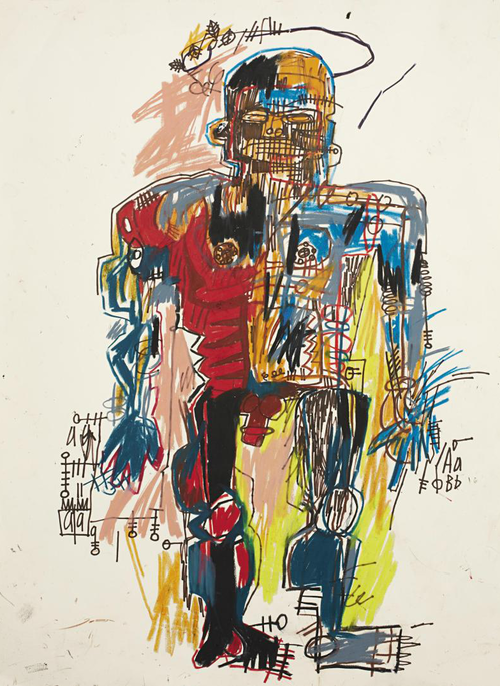
Jean-Michel Basquiat, Self-Portrait, 1982

Jean-Michel Basquiat, Self-Portrait, 1982

Part 2

In a recent interview, a Guyanese art student at the Barbados Community College said that she was given an assignment where she had to do an abstract self portrait of herself. She decided to focus on her origins, and the result was an overhead topographical map of Guyana. She wanted the art work to show a landscape with all of the bumps, hills and groves that correlate with the complexity of a person’s emotional layers.

The second and final session of The Art of the Essay/The Essay on Art was really about creating maps. Like the art student, we were challenged to move away from the established contours and chart emotive and critical pathways with our writing. Christian challenged us to navigate our own ways through perilous territory—ourselves.

The first thing we did was to review the reading assignment that we were given from the previous week, The Map by Elizabeth Bishop. After a not too close reading of Bishop’s poem, Christian brought up a map of Barbados on his Mac and asked us respond to it, keeping the poem in mind. The result was the charting of emotional territory as we found unique ways of connecting with the familiar landscape; from immediately coherent political statements to abstract, but poignant, word associations.

After that we looked at another reading assignment that we got during the week via email. It was an essay called Never Trust a Big Butt with a Smile by Greg Tate, which explored implications of the phrase ‘Black Comedy’ amongst other things. What was immediately apparent, even before the subject matter of the article became clear, was Tate’s use of colloquialisms. After discussing the reading, we were encouraged to make a list of all the colloquial words and phrases we could think of within a given amount of time.

Next, Christian brought up the image of Jean Michel Basquiat’s Self-Portrait on his Mac and challenged us to respond to it using some of the same colloquialisms that we had written down, or any others that we could think of during the free writing exercise. This proved problematic, because the use of dialect and colloquialisms seemed to peel away the seriousness of our responses to Basquiat’s work. We had mapped ourselves into awkward territory and tried to laugh it off. This exercise really forced us consider our relationship with standard English and dialect, and the existing linguistic hierarchy that privileges the former over the latter, ultimately considering our own identities.

There is always that fear of transgressing an existing border, but the workshop showed us that we need to untangle ourselves from preexisting imaginary lines. We need to toss our compasses, and form our own Keys and Legends, and really try to chart our own personal geographies.