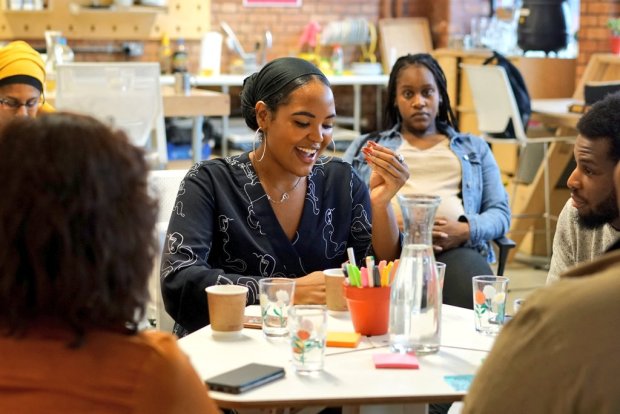
UK-based writer and curator of Bajan and Jamaican heritage, Aliyah Hasinah, shares her first blog post about her Fresh Milk international residency. Using this time primarily for research into the art scene and cultural policy in a Barbadian context, Aliyah kicks off her blogs by reflecting on some of the texts she has immersed herself in to ground her knowledge and understanding of the space, and looks forward to having more in-person discussions with artists, creatives and cultural practitioners as the weeks progress. Read more below:
It’s been a week since I started my residency at Fresh Milk with the intention of immersing myself in study to learn more about the art world and cultural policy in Barbados. Having not had the means to attend university, I’m always profoundly grateful for moments to study away from the day-to-day grind of trying to pay your rent in London, so hearing monkeys (my favourite animals) on the library roof has been a well welcomed change. I’d also like to thank Arts Council England for funding this residency because I’ve been LEARNING, I’ve been learning *Beyonce voice*.

Prior to this, I met with Annalee Davis last year when starting my research into ‘Decolonising the Curatorial’, as funded by Arts Council England. My research was looking at the role of Crop Over as a space for exhibition outside the white walls of the gallery, a topic Claire Tancons discusses well in her essay ‘Curating Carnival’, and how galleries can never do justice to the embodied experience of carnival.
Through my research, I sought to further understand the colonial history and how rebellions birthed art practices – or continued them – as we’ve always found ways to make art. Having only scratched the surface last year, I was keen to take more time to understand the layers and nuance of Bajan Art and cultural expression, outside of what was familial and familiar to me.
Just to prefix, I’m a loud mouth when it comes to explaining or calling out the manifestations of coloniality in the modern day in England. However, I’m very aware of my positionality as a curator from Britain researching in Barbados. My gaze does not come from one of authority but is an opinion formed from the research and conversations had with some of the island’s artists, art producers, essays as well as what I observe.
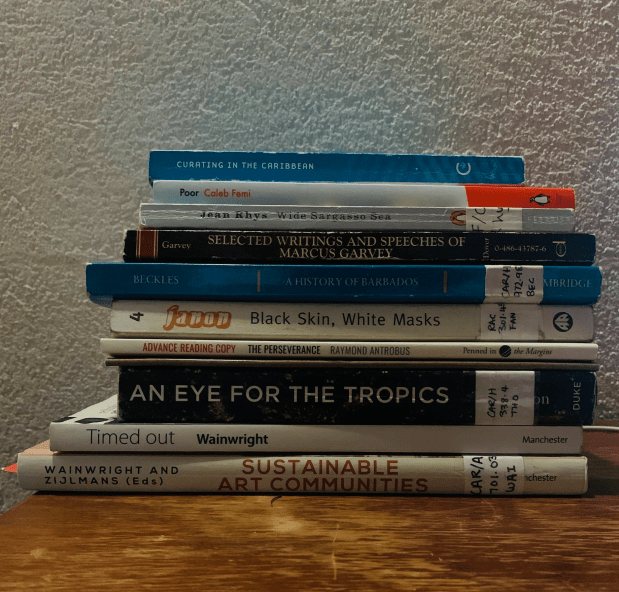
One of the writings I’ve been reading this week that deeply resonated with me was Winston Kellman’s ‘Between A Rock And A Hard Place’ published in Sustainable Art Communities, as edited by Leon Wainwright and Kitty Zijlmans. Kellman explores several historical threads to bring us to the modern day, including the relationships with the UK and US following Barbados’ independence in 1966.
Kellman’s particular highlighting of how western modernity has shunned Caribbean art practice of landscape painting and sculpture, alluding to it being devoid of conceptual fervour is, in my mind, linked to a colonial mindset that deems ‘conceptual art’ in a particular way.


This perspective ignores the context of the space and time that these artworks were created in, and instead attributes an archetypal aesthetic to the notion of contemporary art as opposed to understanding that sculpture and painting of the island has a deeper rooted contextualisation in the resources i.e. clay, and historical craftsmanship of the land – and is therefore contemporary if it is being made in the present. This disregard for painting and sculpture subconsciously alludes to artworks, often by Black artists, specifically in the Caribbean, being inferiorized because of a lack of contextual understanding of how the work came into being, and is additionally sidelined in national and international discourses surrounding contemporary conceptual art. All due to a lack of understanding of the context of the work.
Anywho, I could go on for days about the learnings of the last week, all to say I’m very excited to deepen my study and continue learning about policy, sustainability and the hopes/dreams of emerging artists on the Island. The culture is very much being pushed forward by multiple artists. It is with thanks to those who have laid the foundations that younger artists today are scoping out what is possible in the process of building visual arts communities and infrastructures across Barbados that do not solely privilege the tourist economy (more on that real soon, hold tight tourism as neo-colonialism and insert Mo the Comedian saying ‘Barbados’).
I’m excited to start my new week, meeting more artists, collectors and academics. I may also post some of my readings and thoughts on my instagram (@aliyahhasinah) as I jump into my second week at Fresh Milk.
To end lightly here are 5 songs I’ve had on loop this week:
- Dreams by Fleetwood Mac – thanks to the PMSplash boys
- Confidential by Lagoon Wavey
- Fall On Me by Sonny Meraki
- Long Time Love by Krisirie
- Made in Lagos (all of the album) by Wizkid
Until next week.
Lots of love and take care
Aliyah xx
P.s. Here’s some of what I’m reading / have been the last week and will continue to delve into this week, and hold tight Caleb Femi on the release of his new poetry book ‘Poor’ which everyone should cop if they can. (Feel free to send me reading and art recommendations on twitter @aliyahhasinah)


 fresh milk barbados