International Artist Initiated

IMG_8546

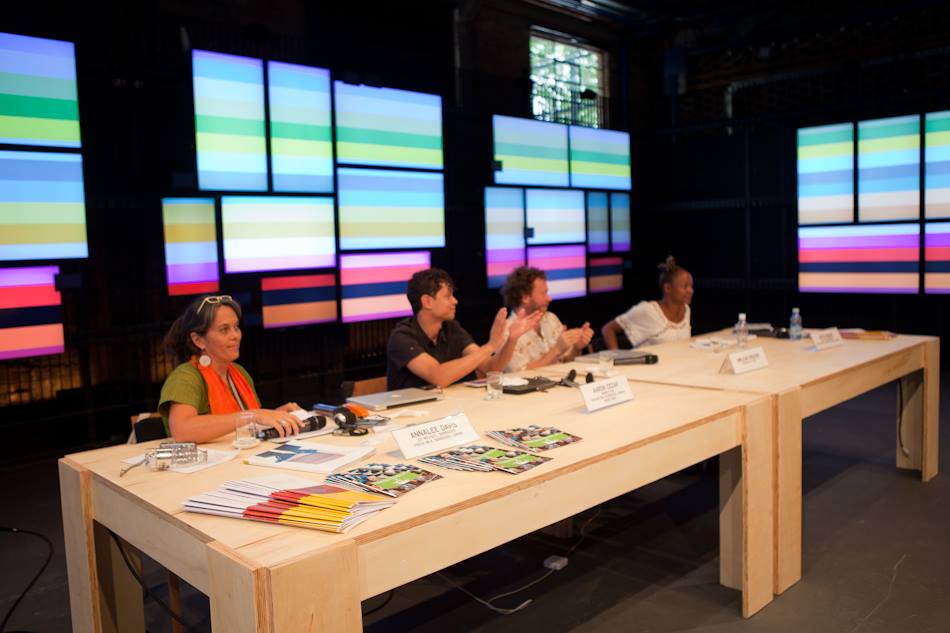
Fresh Milk was very excited to travel to Glasgow this July to participate in the International Artist Initiated (IAI) project, presented by the David Dale Gallery & Studios as part of The Glasgow 2014 Cultural Programme which took place alongside this year’s Commonwealth Games. See below for more information and images from the project.

All photos taken by Rayanne Bushell.

About IAI:

International Artist Initiated is a programme of exhibitions and events devised by David Dale Gallery to coincide with the Glasgow 2014 Commonwealth Games. Developed over the past year, the project acted as a catalyst for discussion and collaboration between artist initiated projects internationally. The structure of the project was designed to be malleable and open source, in that it can be taken and applied elsewhere with different organisations.

Working with artist initiated, or focussed, organisations from across the six Commonwealth territories, the programme consisted of a series of exhibitions and events by the invited organisations that responded to either the context of the Commonwealth Games within Glasgow, or was representative of contemporary culture within their nation through the lens of an artist-led organisation.

The contributors to the programme were:

Fresh Milk, Barbados
Fillip, Canada
Cyprus Dossier, Cyprus
Clark House Initiative, India
RM, New Zealand
Video Art Network Lagos, Nigeria

Take a look at some picture from the opening night of IAI here:

Fresh Milk’s contribution to IAI was in two parts. The first saw the installation of works by three emerging artists on billboards, on railings and on the surface of the sidewalk. The artists include a recent graduate from the Barbados Community College, Ronald Williams, whose crisp digital montages critique the stereotype of the black athlete and were installed on an extended billboard, while Mark King’s temporal, geometric, site specific work was installed on a pavement. Alberta Whittle’s fête (party) posters show the artist masquerading as both man and woman in her critique of gender stereotypes through her engagement with the local fête posters often seen posted throughout Bridgetown, Barbados’ capital city. The posters were reproduced and displayed throughout the streets of Glasgow.

Ronald Williams

Ronald Williams’ Artist Statements:

My collages investigate the role that sports and the black athlete play in society. I manipulate popular based imagery to compose computer-generated images that explore sports, perceptions, stereotypes and fantasies about the black athlete or figure, conceptually becoming deliberately self-contradictory as the stereotype is simultaneously celebrated and criticized. The work is designed as a large-scale poster to be installed on a billboard as an adhesive decal similar to how the image of the modern sportsman is represented. The titles of the three images being exhibited are Swagga, The Phenomenon and Wild Thing.

Swagga

Sprinter Usain Bolt provides the inspiration for Swagga, a piece meant to capture the frivolous and boastful nature of celebration. The boa, hat, glasses and shoes combine to promote this ‘showy’ spectacle but are also linked to the Jamaican bling culture. While the animal skins on the legs hint at the relationship to fashion, it also indicates an inherent animalistic/ physically superior nature. The shirt, deliberately muted and understated, bears a statement from Marcus Garvey about knowledge of oneself and identity. As the African mask is obscured by the bright glasses and hat, the true significance of important sporting events—such as those of the Olympic Games which were of supreme importance in ancient Greece to a sporting hero as well as his city—is often lost amongst the glamorous festivity which accompanies it.

The Phenomenon

Jessie Owens’ performances at the 1936 Berlin Olympic Games were the catalyst for this piece. Owens defied Hitler’s claims about Aryan supremacy and the attitudes towards blacks in his own country by winning four gold medals. In America, the infirm and mortality rates of black children were high due to their lack of proper health care and social structure, but the common notion was that the blacks were just diseased and weaker in general. With Owens’ victory the narrative soon changed, and the now widely accepted stereotype of blacks being more athletically and physically gifted emerged. The idea of blacks being super or sub-human alternated between those two points and Owens was subjected to various tests to find what the secret was. To reflect this change, the head of the character and its arms indicate a non human entity with the study of eugenics paramount to the discussion. To highlight the use of the ‘sub-human’ black body for scientific and medical use, the Tuskegee experiments are included. Attached to the leg of the sprinter is the anti-slavery coin ‘Am I Not A Man And A Brother’ which serves as an anchor ball and chain. It symbolises the apparently never ending struggle for the black person to bee seen as equal, not super nor sub-human.

Wild Thing

Serena Williams’ bold fashion choices and trailblazing attitude helped inspire Wild Thing. Her 2002 attire, dubbed ‘the catsuit’, was such a huge talking point that it overshadowed the tennis being played. Comments about her ample curves, bulging muscles and inhuman speed and agility placed her in a highly sexualized yet animalsitic category. The character wears an exaggerated version of a catsuit, referencing the stereotypical association between African women and felines, while images of the Hottentot Venus place the fascination with her body to the fore. The black power racket and raised middle finger is a testament to her uncompromising and at times aggressive attitude, which is occasionally adverse to the demure nature of the sport.

_____________________________________________________________________________

Mark King

Mark King’s Artist Statement:

My contribution to the Glasgow 2014 Culture Programme is a site-specific work made possible by the access provided by technology. Through virtual and interactive maps I embarked upon an exercise in way-finding from a computer thousands of miles away in Barbados. Through mechanisms such as Google Maps I selected forms present in the architecture and manipulated them to create artworks that draw upon the location where my work will be presented.

I have chosen chalk as my medium due to its ephemeral qualities. The resulting artwork is temporary much like the Commonwealth Games in Glasgow. My hope is that spectators from across the globe will come into direct contact with the piece with chalk from the artwork sticking to their shoes and hitching a ride to the neighboring sports venues. The combination of the elements and foot traffic will slowly eat away at the pigment and ultimately return the site to a state prior to my temporary intervention.

It is unknown whether the work will last for an hour, a day or the duration of the Commonwealth Games.

 _____________________________________________________________________________

Alberta Whittle

Alberta Whittle’s Artist Statement

I am interested in the conflict between historical images of the Other and the African Diaspora’s notions of the Self. The spectacle of racial differences relies on a language of bleak oppositions to confirm stereotypes. In Black Skin / White Masks, Frantz Fanon, observed that in colonial discourse “native” peoples are not positioned within the psychoanalytic structure of the Self and Other, but are relegated to the universe of objects, where they remain beyond the limits of cultural intelligibility.Focusing on the concept of subjective portraiture, both as art historical genre and public identity, my research has prompted me to interrogate the potential of Barbadian fete posters as a means of regaining subjectivity.

Whilst undertaking a residency at Fresh Milk in 2012, I began a series of digital collages, exploring the production and distribution of fete posters in Barbados. Fete posters are a platform for social commentary, highlighting the acute disparity between gender roles in Barbados, where these representations appear frozen. The posters advertising these “fetes” set the tone and introduce the hosts / hostesses.  Each poster must present a selection of portraits of the hosts / hostesses, who enact a series of set poses, often sexually provocative or stereotypically hypermasculine. There are exceptions to this trope, where we are presented with more family-oriented fetes or fetes, which present a more Afro-centric or Rastafarian ideology. However, despite attempts to present themselves as rigidly heterosexual, there are elements of homoeroticism, identified through pose, adornment and dress. Designed to reflect certain ideals, these posters have evolved to reflect a specific format, which typically utilises certain poses, typography, set design and phrases, presenting a fantastical landscape punctuated with exotic animals, signifiers of wealth, including mansions, enormous bundles of cash money, expensive liquor, cars and motorbikes. They are papered on walls throughout the urban and pastoral landscape and also use Facebook as a stage. Drawing from Dancehall and Hip Hop culture, they have become sites to define identity and project capitalist ideals.

_____________________________________________________________________________

Fresh Milk’s second contribution was a discursive project called “Notions of common/wealth versus single/wealth”. This dialogical component provided a platform for representatives of the seven specially invited networks to participate in conversations with each other and the Glaswegian audience. The aim of the conversations was, in part, to unpack ideas related to the Commonwealth of Nations – the association under which countries gather every four years to celebrate sport in Glasgow in the summer of 2014. The intention was to explore the context of the IAI, as a gathering of Commonwealth Nations, and delve into how that relates to the work we all do as artist led initiatives. The concern was to investigate the Commonwealth as a macro, historical entity and understand our relationship to it, if any, and all that entails. Interrelated are ideas about the definition of wealth and value, both single and common, in our local contexts.

View the panel discussion archived online here.

FRESH MILK XVI Video

Check out our video from FRESH MILK XVI, the Barbados book launch for Robert & Christopher Publishers‘ (R&C) latest title, See Mere Here: A Survey of Contemporary Self-Portraits from the Caribbean, edited by Melanie Archer and Mariel Brown.

The event presented a small exhibition and panel discussion with the Barbadian artists featured in the publication – Ewan Atkinson, Annalee Davis, Joscelyn Gardner and Sheena Rose – and editor Melanie Archer, moderated by Barbadian artist Russell Watson.

Thanks to Sammy Davis for shooting and editing this video!

FRESH MILK XVI: Book Launch and Conversation for ‘See Me Here’

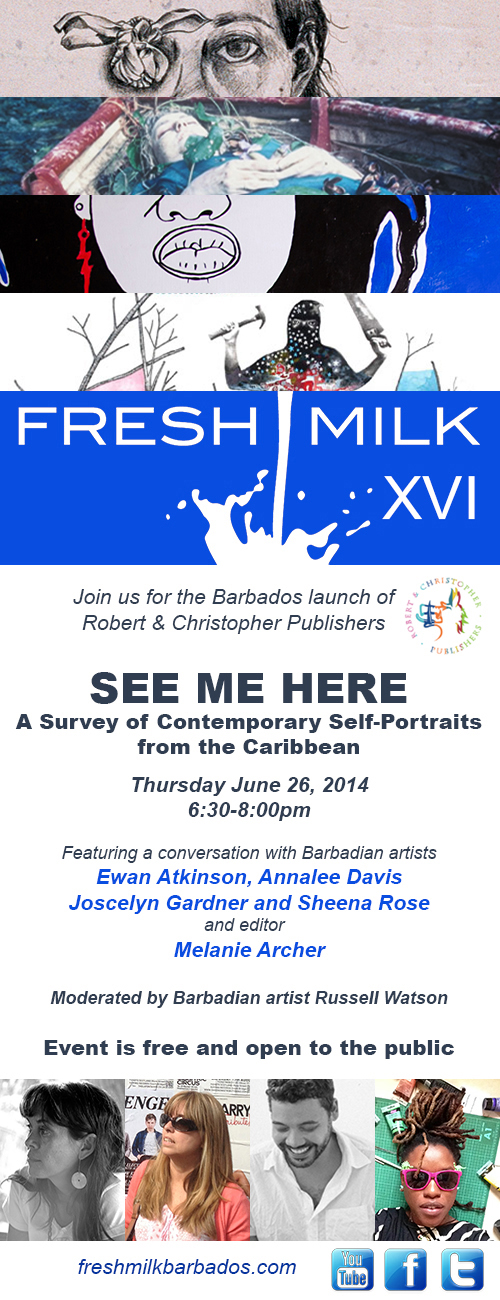
FM XVI Flyer - Final

The Fresh Milk Art Platform is pleased to invite you to our last public event before our summer break, FRESH MILK XVI – the Barbados book launch for Robert & Christopher Publishers’ (R&C) latest title, See Mere Here: A Survey of Contemporary Self-Portraits from the Caribbean, edited by Melanie Archer and Mariel Brown. The event will feature a small exhibition and panel discussion with the Barbadian artists featured in the publication – Ewan Atkinson, Annalee Davis, Joscelyn Gardner and Sheena Rose – and editor Melanie Archer, moderated by Barbadian artist Russell Watson.

See Me Here will be available for purchase at Fresh Milk on the night of the launch at a discounted price of $100 BBD, and thereafter at $110 BBD. The book has also been added to the collection in the on-site Colleen Lewis Reading Room (CLRR). In the spirit of celebrating this ever expanding archive of beautiful and critical publications, there will also be a short presentation on our new initiative Fresh Milk Books, introducing the team and sharing ways in which the public can get involved with this space for the interactive exploration of the CLRR.

FRESH MILK XVI takes place Thursday, June 26, 2014 from 6:30-8:00 pm at the Fresh Milk Studio, St. George (directions can be found here) and is free and open to the public.

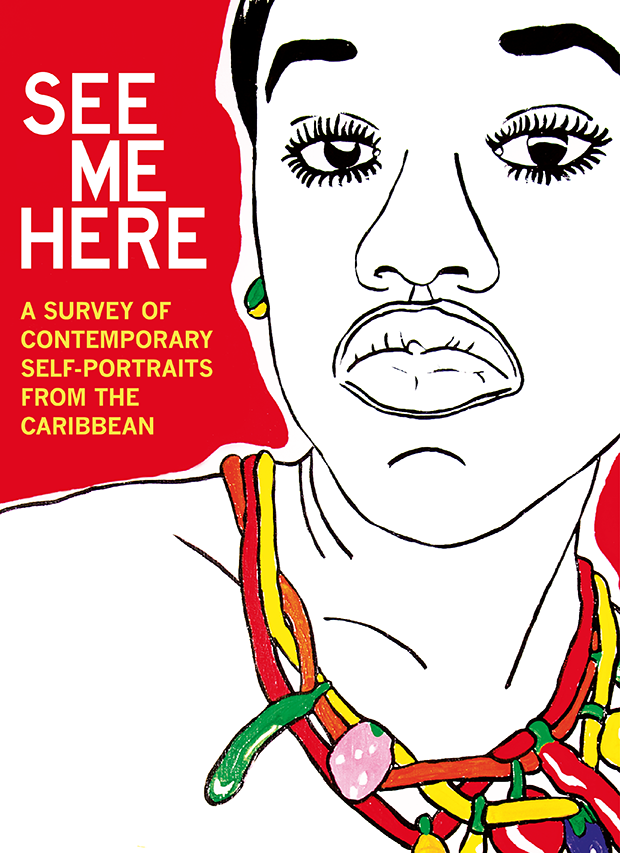
See Me Here_book cover 720

About See Me Here

See Me Here is the second book in R&C’s thematic explorations of contemporary art in the Caribbean – it follows the imprint’s successful first title, Pictures from Paradise (2012), which was picked up for distribution by North America’s most prestigious art book distributor, and is also being made into a major exhibition in Toronto, Canada, in May.

See Me Here calls attention to recent directions in self portraiture throughout the region, by focusing on artists who frequently or significantly use their physical selves, or those to whom they are linked by blood or significant experience, as an avenue for exploration and expression. In so doing, the book asks: How do we really see ourselves? How accurate is the image we present? What formative roles do our cultures and upbringings play? And, what role does the Caribbean as a physical and mental space have in the creation and perception of our own personal, visual identities?

Edited by Melanie Archer and Mariel Brown, See Me Here features a critical essay by Marsha Pearce, and more than 380 images from 25 artists. These works range across a variety of media, from drawing and painting to photography, sculpture, installation and performance. Eleven of these artists – Akuzuru, Ashraph, Susan Dayal, Michelle Isava, Jaime Lee Loy, Che Lovelace, Joshua Lue Chee Kong, Steve Ouditt, Irénée Shaw, Roberta Stoddart and Dave Williams – are from or are based in Trinidad & Tobago. The book’s other artists – Ewan Atkinson, James Cooper, John Cox, Renee Cox, Annalee Davis, Laura Facey, Joscelyn Gardner, Lawrence Graham-Brown, Anna Ruth Henriques, Nadia Huggins, O’Neil Lawrence, Olivia McGilchrist, Sheena Rose, and Stacey Tyrell – are either based in the Caribbean or have ties to the region, which are addressed through their works selected for the book.

About the Presenting Artists


Ewan Atkinson:

Ewan Atkinson was born in Barbados in 1975. He received a BFA from the Atlanta College of Art and an MA in Cultural Studies at the University of the West Indies, Cave Hill.  He has exhibited in regional and international exhibitions including the 2010 Liverpool Biennial, “Wrestling with the image: Caribbean Interventions” at the Art Museum of the Americas in Washington DC, and “Infinite Islands” at the Brooklyn Museum in New York.

Atkinson is the coordinator of the BFA in studio art at the Barbados Community College where he co-founded the Punch Creative Arena, an initiative for creative action based in the college gallery. An arts educator for over a decade, he is also on the executive board of Fresh Milk, a Caribbean non-profit, artist-led, creative support organization. Atkinson also works as a freelance illustrator and designer.

Annalee Davis:

Annalee Davis is a Visual Artist living and working in Barbados. She has been exhibiting her work regionally and internationally since 1989. She works part-time as a tutor in the BFA programme at the Barbados Community College.

Her explorations of home, longing and belonging question parameters that define who belong (and who doesn’t) in contemporary Caribbean society, exposing tensions within the larger context of a post-colonial history while observing the nature of post-independent (failing?) Caribbean nation-states.

In 2011, Annalee founded and now directs the artist-led initiative The Fresh Milk Art Platform Inc. An experiment, a cultural lab and an act of resistance, Fresh Milk supports excellence among contemporary creatives in the Caribbean, its diaspora and internationally.


Joscelyn Gardner:

Joscelyn Gardner was born in Barbados and lived there until 2000 when she moved to Canada. She now teaches Fine Art at Fanshawe College in London, Ontario, and works as an artist between Canada and the Caribbean. She holds an MFA degree from the University of Western Ontario and her work has been exhibited widely in solo exhibitions in the USA, Canada, Spain, and the Caribbean, and in numerous international exhibitions including the Sao Paulo Biennials and major European and Latin American printmaking biennials.

Recent awards include the Biennial Grand Prize at the 7th International Contemporary Printmaking Biennial in Quebec (2011), awards at the Open Studio National Printmaking Awards (Toronto, 2012) and the 22nd Maximo Ramos International Biennial Award for Graphic Arts (Spain, 2012), and a Canada Council for the Arts grant for a major research project in the UK (2013). Gardner’s work is found in many public and private collections and can be viewed on her website.

Sheena Rose:

Born in 1985, Sheena Rose has a BFA from the Barbados Community College. Rose’s work is comprised of hand drawn animation combined with photographs, mixed media, transfers and comic strips. The animations have a surreal quality and deal with daily life, space and the stereotype of her country.

Rose has exhibited extensively, both regionally and internationally. Her work has been shown at Real Art Ways, Hartford Connecticut, Queens Museum, New York, Uitnodiging Amsterdam, Holland, Havana Biennial, Cuba, ACIA, Madrid, Spain, Art Museum of the Americas, Washington, D.C, Greatmore Art Studios, Cape Town, SA, International Curator Forum, Bristol, England, CMAC, Martinique, Museo de Arte, Contemporaneo de Puerto, Puerto Rico, Kentucky Museum of Art & Craft, Kentucky, US, Aruba Biennial, Aruba, Panama Biennial del Sur, Panama and Alice Yard, Port of Spain, Trinidad.

_________________________________________________

About Robert & Christopher Publishers

Robert & Christopher Publishers (R&C) is a Trinidad-based art book imprint. R&C’s primary concern in its art series is to produce quality books that document and elucidate our Caribbean story, as seen through the eyes of Caribbean artists. R&C aims to produce the highest quality of relevant art books that will be accessible to a wide reading and creative audience in Trinidad and Tobago, the Caribbean and internationally.

Robert & Christopher’s mission is to help open up critical dialogue for and amongst Caribbean people, and to explore and record the work of regional artists from a local perspective. By keeping a low price point on all their titles, R&C aims to create go-to texts that are accessible to artists, students of art, art lovers, and critics within the region. And, by maintaining high intellectual and production standards, R&C aims to appeal to international art and publishing markets.

In addition to See Me Here, Robert & Christopher has also published: Pictures from Paradise: A Survey of Contemporary Caribbean Photography, Che Lovelace: Paintings 2004 – 2008, Meiling: Fashion Designer and Barbara Jardine: Goldsmith.

Profile: Fresh Milk, Barbados – by Mariam Zulfiqar

Mariam Zulfiqar interviews Fresh Milk’s founding director Annalee Davis, getting some insight on the motivation behind the organization, some of its current and upcoming activities, challenges around its sustainability and the vision for Fresh Milk’s future. Read more below:

studio1-lo-res.jpg

The Fresh Milk Studio. Photograph by Mark King.

Annalee Davis’ practice deals with a number of social issues around race, identity and migration. Her artworks have been exhibited nationally and internationally in group shows and Biennials.

The artist started Fresh Milk in 2011, the only contemporary art organisation in Barbados. The organisation offers a platform for international dialogue between artists, curators and writers working in the field of contemporary art and collaborates with organisations across the globe to provide national and international residencies for artists and curators.

Offering a Library in the form of the Colleen Lewis Reading Room, a project space for artists and curators, and a programme of screenings and talks, Fresh Milk provides a platform for critical discourse to expand and support contemporary art production in Barbados.

I spoke to Annalee Davis during my two-month curatorial residency in Barbados about Fresh Milk and the challenges faced by artists in Barbados and the wider Caribbean.

45_The Fresh Milk Studio - Photo by Annalee Davis, 2012

The Fresh Milk Studio Space. Photograph by Annalee Davis.

MZ: What made you decide to start Fresh Milk and what type of space were you hoping to create?

AD: I’ve been teaching since the early 90s at Barbados Community College (BCC), off and on, for about 10 years. When I returned to Barbados from Trinidad a few years ago I realised that the attrition rate for our students was almost 100%, meaning that within a year of graduating almost none of the graduates were making art. There were no formal spaces for artists and as a result graduates were starting to find other jobs and their practice was dwindling.  I felt that a support mechanism was needed to allow them to continue making work.  I also felt that expanding the critical arena in Barbados was important and wanted to contribute to this.

The notion of creating a nurturing space was important. Given the traumatic history of the Caribbean, it’s not a region that necessarily connotes being nurtured. So I often think of Fresh Milk as both a nurturing environment and an act of resistance.  Offering a space that is safe for people to experiment and innovate, and to gather, talk, think and make, is an act of resistance.  So that’s the impetus out of which it came.

MZ: It’s interesting that you use the word nurturing because in my discussions with artists, one of the areas we discussed is their frustration in the lack of structural support for the arts in Barbados.  Does Fresh Milk receive any support, financial or otherwise, on a Government or official level?

AD: Fresh Milk received small grants from the Maria Holder Memorial Trust, and the Art and Sport Promotion Fund which falls under the Ministry of Finance. This allowed us to hire an assistant for a couple of days a week and host four local residencies.  We are currently in conversation with the Ministry of Culture and the Art and Sport Fund to see whether we can request a yearlong subvention. We are also keen to develop relationships with the National Cultural Foundation. We have had support from the US Embassy in terms of bringing in two artists from the US in support of their residency on the platform, contributing to the expansion of the reading room, and ascribing a Dewey decimal system to the collection so it can function more professionally.  We are trying to develop partnerships across a number of different sectors to contribute to sustainability in the arts.

We’ve been able to demonstrate some measure of success by putting a real dent into that attrition rate as we work with at least 50% of recent graduates. So if the state continues its funding of the BFA programme, Fresh Milk offers the type of support necessary post graduation. In that respect it becomes a partnership where collaborators are working towards similar goals.

Photo by Dondré Trotman.

Photo by Dondré Trotman.

MZ: In terms of global partnerships with contemporary art organisations and practitioners, who are you working with?

AD: The Barbados Government hosted a symposium in April called e-Create, inviting people from the visual arts and music industries in Brazil to Barbados.  Fresh Milk presented a platform of young artists to the delegates and that started a relationship with Videobrasil, a 30-year-old institution in Sao Paulo founded by Solange Farkas. My trip to Brazil cemented a relationship with Casa Tomada, an informal network in Sao Paulo similar to Fresh Milk. We are in conversation with a curator at the Perez Art Museum in Miami  (PAMM) regarding collaborative programming.  We have been invited by an artist-run space in Glasgow, The David Dale Gallery to present a project in July 2014. Glasgow is hosting the 2014 Commonwealth Games and the Gallery has invited six informal spaces from Cyprus, Nigeria, New Zealand, India, Canada and Barbados to collaborate.

We also have a very close relationship with ARC Magazine, a significant publication showcasing the work of Caribbean practitioners in the region and the diaspora. We work together to create opportunities for creatives and generate awareness of their practice.  It’s all really happened because of the Internet! That’s how we are beginning to foster relationships with entities in the Dutch Caribbean including the IBB in Curaçao and Ateliers‘89 in Aruba.

From left to right: Alison Sealy-Smith (NCF), Katherine Kennedy (Fresh Milk), Thereza Farkas (Videobrasil), Diandra Martins (Casa Tomada), Flora Leite (Brazilian artist), Tainá Azeredo (Casa Tomada), Andrea Wells (NCF), Shanika Grimes (Barbadian artist) in Sao Paulo for the 'fresh casa' project - Photo by Simone Codrington

From left to right: Alison Sealy-Smith (NCF), Katherine Kennedy (Fresh Milk), Thereza Farkas (Videobrasil), Diandra Martins (Casa Tomada), Flora Leite (Brazilian artist), Tainá Azeredo (Casa Tomada), Andrea Wells (NCF), Shanika Grimes (Barbadian artist) in Sao Paulo for the ‘fresh casa’ project – Photo by Simone Codrington

MZ: Fresh Milk’s location on a dairy farm is quite unusual.  Can you tell me about how the space was created?

AD: It actually was my studio – I built it 7 years ago at my house located on a dairy farm dating back to the mid 1600s. I decided, stupidly, to marginalise myself outside of my own studio and use that as a space for Fresh Milk. The name obviously connects to our location on a dairy farm and the notion of Fresh Milk supporting young practitioners with fresh ideas, fresh work, fresh thinking, fresh collaborations. It is also connected to the idea of women turning their blood into milk to nurture their young. At first I felt concerned that the location was rural and not centrally located, but what I’ve since learned is when resident artists come, they exhale, absorb the environment – and feel ‘ahhh’….it’s a moment of calm. Located under a grove of mahogany trees surrounded by grass and cows, the quiet space allows focus and inspires reflection.

MZ: You also provide a reading room, named after Colleen Lewis.  Can you tell me how the reading room came around?

AD: Colleen was my best friend who succumbed to breast cancer in September of 2006.  She was a collector and an art history graduate. She had a library that she gave to me, and I wanted to keep her memory alive. She was an extraordinarily generous person, and I wanted to find a way to build on her collection and make it publicly available.  Now I want to expand, acquiring publications that are not available at BCC or the University of the West Indies.  We are filling a void by offering publications related to critical thinking and contemporary practice.

We also want a younger audience. We would like to work with art teachers at secondary schools to integrate critical discourse into their curriculum.  Students at that level have to do research papers and we want to offer our reading room and work with students and teachers, in support of their work.  We welcome workshops and events that involve sharing the books, talking about artists and inciting inspiration.

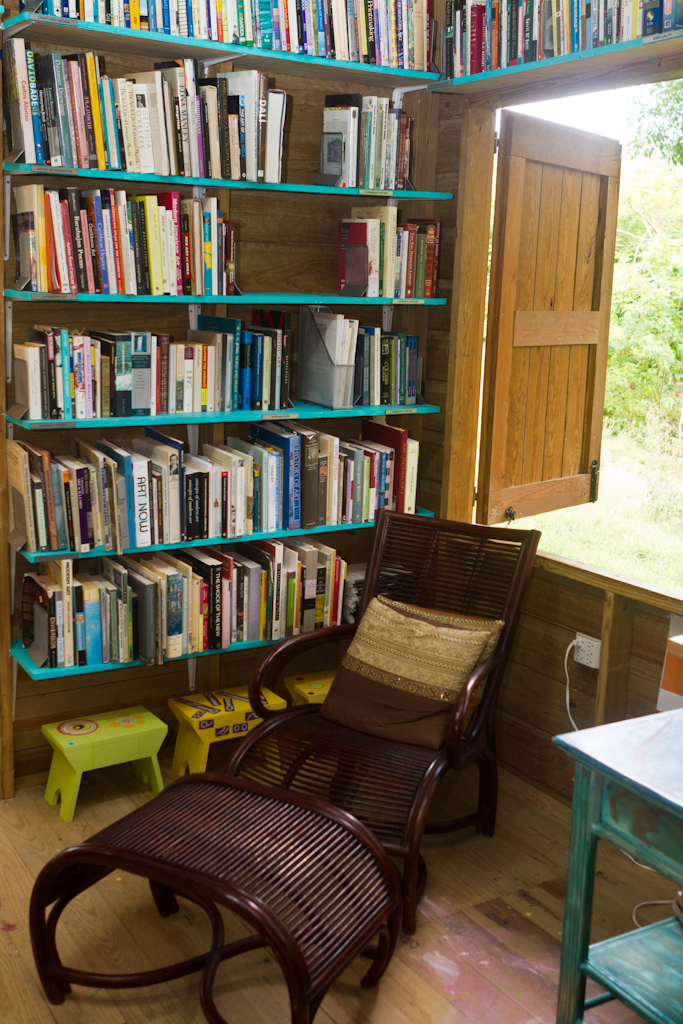
The Colleen Lewis Reading Room. Photo by Annalee Davis.

The Colleen Lewis Reading Room. Photo by Annalee Davis.

MZ: So, in a sense the reading room offers a platform for skills’ development for young people, where they see the work of emerging artists like Sheena Rose on your wall, who is now doing residencies worldwide.  So you’re trying to create that bridge between school and BFA, and BFA level onwards.

AD: Right.  And also challenge what they would normally see. Some years ago when I was teaching, my students were talking about Braque and Picasso as though this was current. The documents we select for the reading room reflect the most contemporary, cutting edge art production. Students should be exposed to current practices all over the world today, from Europe or North America, to Africa, Asia and Australia.

MZ: How big is your team?

AD: It’s very small. Katherine Kennedy is my dream assistant! We also have a board that meets periodically consisting of Ewan Atkinson, Simone Mangal, Yasmine Espert, Holly Bynoe and Natalie McGuire. We also have volunteers:  Kriston Chen, Dondré Trotman, Sammy Davis, Alicia Alleyne and Versia Harris.

MZ: What are the challenges that artists from Barbados are currently facing nationally and internationally?

AD: I think issues around sustainability. It seems as though it’s paramount in everyone’s mind. We don’t have a fully developed creative industry including formal arts institutions, museums, galleries, auction houses, biennials, prizes, fairs, collectors, curators, historians and dealers.  Artists often multi-task by writing, documenting, promoting and creating opportunities.  It’s the challenge of functioning outside of a developed creative economy.  Also, trying to create visibility around your work can be tough, which is why the Internet has changed so much for a lot of us by providing visibility.

MZ: Fresh Milk is very active online, how useful has an online presence been for you?

AD: It changed everything.  It’s made so much more possible.  My most common meetings are on Skype with people all over the world.  Fresh Milk is being approached for all kinds of projects as a result of our online presence.

Alberta Whittle, performance still from 'Hustle de Money a performance by Bertie aka Big Red aka General outta Glitter Zone', 2012. Photo by Dondré Trotman.

Alberta Whittle, performance still from ‘Hustle de Money a performance by Bertie aka Big Red aka General outta Glitter Zone’, 2012. Photo by Dondré Trotman.

MZ: Who are the artists that you have hosted at Fresh Milk?

AD: This year we had Mark King who generally works in photography but started the residency breaking out of that and doing drawings that were influenced by Origami, working with algorithms and fractals inspired by the North American ‘banking bubble’ and financial crisis. He started doing some really interesting work and experimented for the duration of the residency. We want to encourage resident artists to step outside oftheir comfort zone and not be pressured to have a final product at the end, to really challenge their practice. Prior to that we had Versia Harris, an animation artist, followed by a playwright Matthew Kupakwashe Murrell. We’ve had two Canadian artists, Conan Masterson and Marla Botterill, who worked collaboratively making puppets and video shorts.  Malaika Brooks-Smith-Lowe, a photographer and video maker from Grenada worked with local actress Varia Williams to produce an experimental four-minute video short.  Alberta Whittle was here for two months last November/December and she worked with traditional fete or party posters that you would see in the urban landscape, produced her own posters and closed with a performance work.

We have also supported off site projects including Fresh Performance with NY based Damali Abrams who has produced six videos linking Caribbean based and NY based performance artists speaking about their practices as well as Caribbean Linked II– a project in collaboration with ARC Inc., Ateleirs ’89 in Aruba which saw ten artists from the region spend two weeks in Aruba on a residency project.

MZ: How have people responded to Fresh Milk?

AD: For the first event, I imagined we would get an audience of 10 or 20 people. Over 100 people came – I didn’t know most of them. A lot of young people were interested to see what was happening. I think the time is right, there has been a lot of interest and we are being observed with great interest globally through our online presence.

Audience at Fresh Milk X - Photo by Dondré Trotman

Audience at Fresh Milk X – Photo by Dondré Trotman

MZ: How has running this organisation affected your practice?

AD: That’s funny! What practice?  I’ve done a couple of pieces in the last 2 years and I’ve just spent the last 6 weeks trying to get back into the studio.  It’s slowed down my own production, but it’s been absolutely fantastic and completely worth it. I felt really isolated and I wanted to have a more rigorous and stimulating environment to work in.

MZ: And a DIY approach has made it happen?

AD: Yeah for sure.  I think partly it’s the absolute fear of growing older and feeling that nothing is changing, so let’s do something about it!

MZ: In terms of the future, how do you see Fresh Milk developing as an organisation?

AD: What I would like to do is make myself completely irrelevant within Fresh Milk. The organisation needs a young fresh team to run it. The baton should be passed on and my hope is that Fresh Milk becomes a sustainable entity in its own right.  And then I’ll get to spend more time in my studio.

Written: August 2013

The Fresh Milk Map of Caribbean Art Spaces

* Since our conversation, Fresh Milk has launched their online interactive map which is available here.

Article commissioned by Curating Contemporary Art Department, Royal College of Art

_________________________________________________

About Mariam Zulfiqar

DSC00074_2

Mariam graduated from the Curating Contemporary Art Inspire MA in 2012 during which time she was based at Art on the Underground where she continues to work in a curatorial capacity. Mariam recently curated the online Kurt Schwitters inspired project, MerzBank with Steven Bode for Film and Video Umbrella and is currently on a research residency in Barbados. Her research will culminate into a forthcoming exhibition that explores the impact of plant migration on the Barbadian visual and social landscape.

Unrecognised Affinities: Reflections from Videobrasil

The founding director of The Fresh Milk Art Platform Inc., Annalee Davis, was invited to participate in the 18th International Contemporary Art Festival Sesc_Videobrasil – 30 Years + Southern Panoramas in Sao Paulo, Brazil.

Videobrasil has established itself as one of the most important organizations for video and contemporary art practices in the geopolitical South and included a cross section of curators and critics from arts institutions worldwide, and artists largely from the global South. Davis presented in the 3rd Focus group of the festival’s public programming, which centered on artist residencies. The following is an edited version of her presentation ‘Unrecognised Affinities’ delivered at the panel titled ‘Hospitality and the Politics of Mobility’, originally published on ARC Magazine’s website.

Panel on Hospitality and the Politics of Mobility. Participants from L-R: Annalee Davis, Aaron Cezar, Amilcar Packer and Koyo Kouoh. Image courtesy of Sabrina Moura.

Panel on Hospitality and the Politics of Mobility. Participants from L-R: Annalee Davis, Aaron Cezar, Amilcar Packer and Koyo Kouoh. Image courtesy of Sabrina Moura.

I was asked to speak about my work as a creative activist in Barbados and the formation of the artist led initiative called The Fresh Milk Art Platform Inc., of which I am the founding director. As a tutor at the Barbados Community College in the BFA programme, I decided some years ago to respond to the fact that none of our graduates continued making work after graduation. This is, in part, because there is not a developed creative economy that can provide a supportive space for emerging practitioners. Fresh Milk was born in 2011 to foster young talent and is named such because it is located on a dairy farm, as well as relating to the act of women turning their blood into milk to nurture their young.

The network responded to a specific local need to harness the talent of our young creatives – to be a safety net to catch artists as they fall into the real world after art school. Now, two and a half years later, graduates are continuing to make work because Fresh Milk is opening up opportunities and doors of exchange.

Fresh Milk is located on the premises of a former plantation built in the mid-1600s. It has been functioning as a dairy farm for several decades. My home and studio are located on the farm, and I have turned my studio into Fresh Milk’s headquarters. Due to the island’s brutal history rooted in indentureship and the slave trade, the physical location of Fresh Milk has raised concerns as to whether it is a legitimate or appropriate setting to carry out its work. Traditionally, the plantation was an exclusive venue, hospitable only to a white elite planter class who oversaw the inhumane treatment of an enslaved and indentured population.

The Fresh Milk Studio. Photograph by Mark King.

The Fresh Milk Studio. Photograph by Mark King.

I am interested in this debate about the plantation as a fixed space, defined perpetually by conflict and division. I see this location as a site for investigation; an environment which I am unpacking from the ground up. By literally digging into the soil to find ceramic remains, reading through documents related to the former plantation, including conveyances, wills and deeds from the early nineteenth century, I am thinking about the potential for transformation and reconciliation. Through creative intervention via my own practice as well as the development of critical programming at Fresh Milk, the historical divisions within the plantation are reconsidered.

The idea of transformation is linked to hospitality, which originates from the Latin word ‘hospes’ meaning “guest” or “stranger’.  I am concerned about the stranger or enemy among us and within our national boundaries, the region and the wider world. Certainly, there has been much debate within the insular Caribbean about belonging and ownership, which plays itself out most disturbingly at many of our national borders. There is a precedent of xenophobia which has come to define how Caribbean people think about citizenship and the landscape. The failure of CARICOM to provide a conduit for real integration after forty years of operation attests to this. For real change to occur, we need to be hospitable to ourselves first, work to ‘to open ourselves up, share ourselves out’ with the stranger in our midst, which we can do through the arts, creating safe, critical settings for exploration, innovation, connection, excellence and production.

Fresh Milk reacts to our needs at the moment in Barbados and the wider Caribbean by building  a robust creative community within the local context. Our geographic consideration of the Caribbean is always shifting. The normative definition is the archipelago that stretches from The Bahamas in the North, to Trinidad in the South, moving on to Suriname and the Guianas. Its extension into the coastal rim of Central and South America and out to the diasporic outposts including Amsterdam, London, Toronto, Vancouver, NYC etc is evidence of the Caribbean as a broad and dynamic area.

Annalee Davis introducing the Fresh Milk Map of Caribbean Art Spaces. Image courtesy of Sabrina Moura.

Annalee Davis introducing the Fresh Milk Map of Caribbean Art Spaces. Image courtesy of Sabrina Moura.

What is radical about this notion of hospitality in our Caribbean context, is the relationship to the history of plantations. By transforming this territory once grounded in hostility and prejudice into a welcoming, creative, critical arena, Fresh Milk is indeed a defiant undertaking. Our programming works in opposition to the traumatic history of abandonment and points to new possibilities by offering harmonious acts rather than ones of obstruction. Instead of reading Fresh Milk’s presence on this site as problematic, we propose an alternative reading, and suggest that an adjustment is both necessary and possible.

I see the work I am doing as an artist, unpacking and redefining the plantation, as work which is altering the very chemistry of our own soil. This practice is rooted in scientific ideas around phytoremediation. Phytoremediation is the removal of toxins from the earth by cultivating plants whose roots have the capacity to extract toxins from the soil, thereby allowing the soil to be replenished and to grow something again.

I believe that we have the ability and the responsibility to alter the course history, contributing to a healthy cultural ecosystem by nurturing creative production and producers. By establishing the Fresh Milk platform and executing its programming, functioning locally, regionally and internationally with inclusive and open projects, we are building relationships with other human beings and offering a real connection to a known locale of isolation and privilege that has been timed out of opportunity and significance.

Being hospitable in the historical context of the Caribbean is a radical gesture. To nurture one another, to consciously reject what we were taught by the colonial past and a consumer oriented present, to choose to convert these historical sites of abuse, torture and neglect into sanctuaries that revel in the creative imagination, to take care of and look after the emerging talent; these are all revolutionary actions. I have faith in the capacity we all have as human beings to envision and manifest alternate possibilities through the forging of relationships with others which may offer something beyond perpetual conflict.

The building of the Colleen Lewis Reading Room, which provides free and accessible research material to the Barbadian public, is a critical statement in a region where reading is not always a popular activity. This is a testament to the powers of the colonial system where bars for the consumption of rum were more common on the plantation than libraries. The availability of the reading room allows a way for us to think about using knowledge and scholarship to open and challenge minds, inspiring intellect while developing new modes of thinking.

The Colleen Lewis Reading Room. Photograph by Dondré Trotman.

The Colleen Lewis Reading Room. Photograph by Dondré Trotman.

The interactive Fresh Milk Map of Caribbean Art Spaces contests the ways in which the hegemonic powers historically segmented the region linguistically and created artificial boundaries to separate us from fully understanding our similarities. This is a myth and one that should be denounced categorically from a cultural and political perspective. The construction of this virtual map reinforces linkages across linguistic and geographic divides in the region, insisting that we are indeed interconnected.

Fresh Milk is building connections with other human beings through residencies, the Colleen Lewis Reading Room, the Map of Caribbean Art Spaces and its activities, contributing to our goal of transformation – all the while believing that we can alter the chemistry of our own soil, creating new paradigms of thinking and behaving, engaging in hospitable acts, or the most radical gesture of all – loving each other.

I close with a quote from the author Theodore Zeldin which inspires what we do at Fresh Milk – “The meeting of ideas which have never come together before…the art of making life meaningful and beautiful, which involves finding connections between what seems to have no connection, linking people and place, desires and memories…discovering unrecognized affinities between humans holds out the prospect of reconciliations and adventures which have so far seemed impossible.”

See the original article on ARC Magazine.