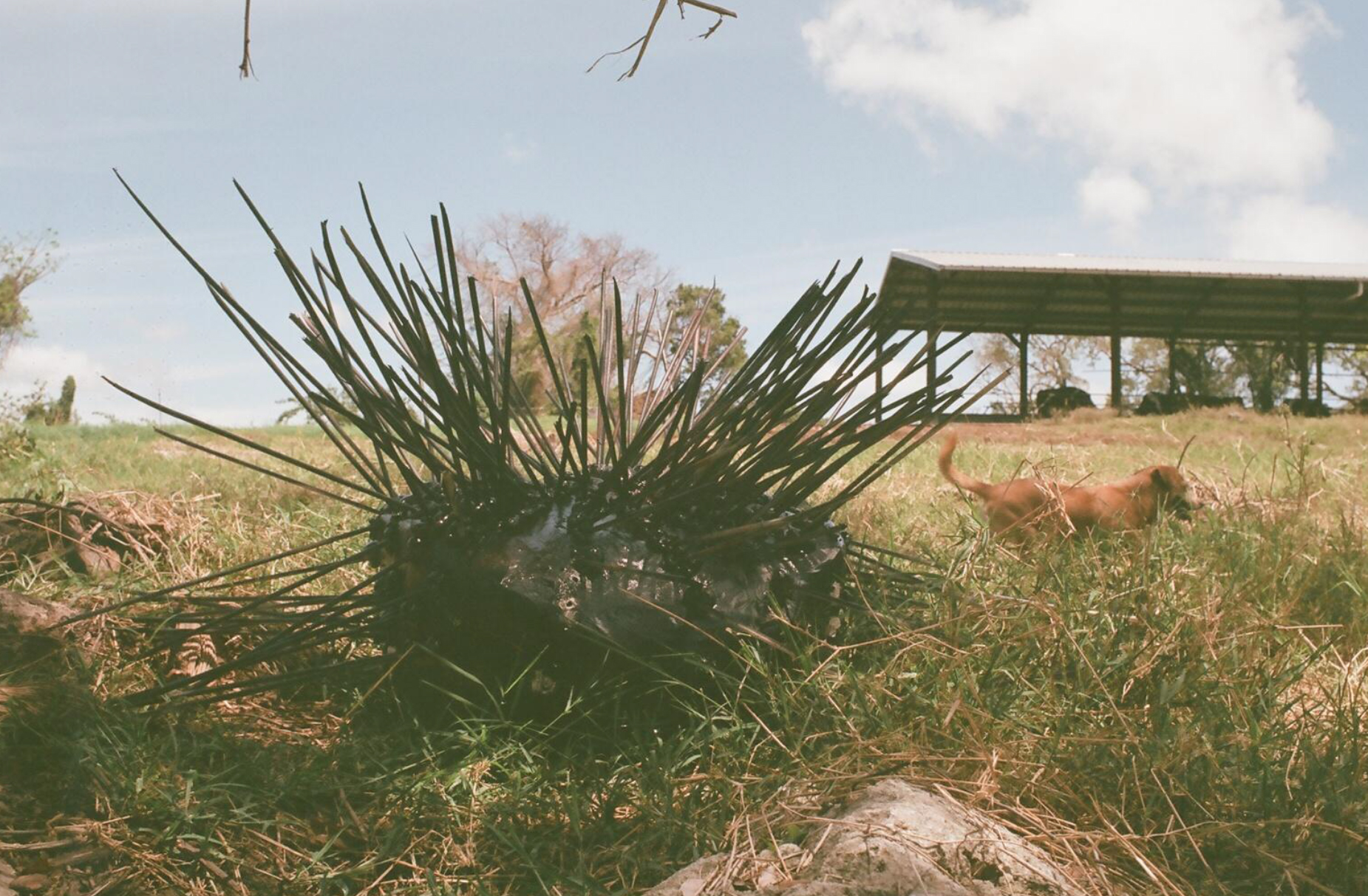
London-based Barbadian artist Ada M. Patterson spent some time in the Colleen Lewis Reading Room earlier this year, which provoked ‘Echidna’, a performance work carried out at various locations across Barbados and expanded on in this accompanying photo essay. See documentation from this performance and read Ada’s full essay below:

Ada Patterson, Echidna, Performance. Speightstown, Barbados, 2016.
THE URCHIN
Home may easily always be “elsewhere”, by which I mean a place that is
recognised as not quite yet, at every moment in which one’s feet touch
ground. [1]
In the reclamations of one’s plot (in land and self) of the Caribbean, there is a continued
wading against colonial influence. In the contemporary Caribbean, touristic intervention has worked as an impediment against the formation of identity, while recognising one’s self situated in the oppressed dialogue. The Antillean is left flailing and thrashing in doubled attempts of rejection and hasty grasps of European and imagined African ideals; all in the hope of refinement and reparation of those shreds and scraps of identity into something new. This complicated resistance (which keeps itself open to the entry of desired culture) is a Caribbean wrestle – the crux of open-mouthed resistance. [2]
Humans are not so hardy that we can thrive in our bodies as castles – we are spoiled or
tasked with building shells [homes] as lines of defence and emblems of territory, property and
personal space. Sea Urchins are not so fragile. They are the perfect model for the Antillean openmouthed resistance – the performance of clinging to this land, claiming dominion, absorbing what is truly ours – overcoming dispossession – with a back of thorns to deflect assimilation and imperialism.
Each can return to the Skin without any inhibitions imposed by the exterior
attributes of the Castle. [3]
This invocation, rather than accessory, of the Urchin is a tactic of the Paradise Militant,
through which we must mobilise ourselves toward ingestive interpretation – the posture faced
downwards, mouth to dirt, consuming landscape as analysis – followed by the excretion of culture – the production and establishment of culture as waste-product of our analytical ingestion. We spend so much time, as a people, directing our mouths upward / outward, hoping to be quenched by food that falls from a colonised sky, one never thinks to look at their feet – downward to the land that grounds them as Caribbean.
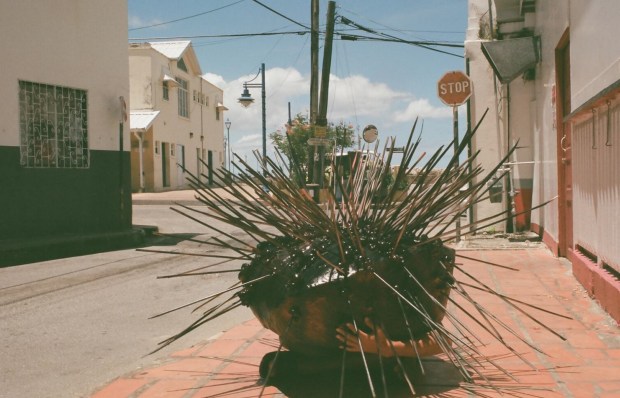
Ada Patterson, Echidna, Performance. Speightstown, Barbados, 2016.
THE HERMIT
To invoke the Urchin is to invoke the ability of the Hermit – that which involves a capacity
for meditative and defensive states in similitude. The pursuit of identity, as experienced by the
Antillean (in their wake of Postcolonial reflection and neocolonial encounter), is arguably a
hermitage insofar as it requires a submergence into the Atlantic pool of memory, a self-burial beneath the soil of plantations ruined – of long erased Amerindian bone yards – alongside a negotiation against the gale-force battering ram of contemporary foreign visitation / consumption [a tourism as formidable as Sargassum]. A hurricane may only devastate what it can see as penetrable – the Hermit / Urchin is, fortunately, invisible and hardy in their decision to be laid locked in stubborn refusal of the storm’s incessant knocking. A land already ravaged by a history of storms need not be mourned but rather reinterpreted and analysed. As long as we of the Antilles remain, persistent in a culture of resistance, a storm may be discarded as trivial as the seasons and bracing it, the same.
In advocating a collective hermitage, what must take emphasis is the sublimation and fluidity between manoeuvring states – that is, a mastery of the Hermitic approach in their proverbial ascent up the mountain / into the cave [a marronage] whereby through a gaining of insight, in a meditation and a protective negligence against the Outside [the Foreign / the Overseas / the Abroad], an almost alchemical transformation occurs by which the Hermit descends or emerges graced with a nation language, [4] a language and cultural negotiation sophisticatedly illegible to the will of the coloniser. To reword this, an importance lies in the Antillean Hermit’s capacity to be present as a factor of influence in their society and culture, while still invisible and impenetrable to the touristic gaze and will; an Urchin who may face their island without risking their sanctity to the West of whom he backs. [5]
All music born in the West Indies […] were born from silence. Because it was forbidden to speak aloud and to sing. It was born from silence and in silence. One of the common cultural points of music in all the plantation areas of the Americas was the necessity to sing without being heard by somebody else, by the master or another person. The art of silence is fundamental in this kind of music. [6]

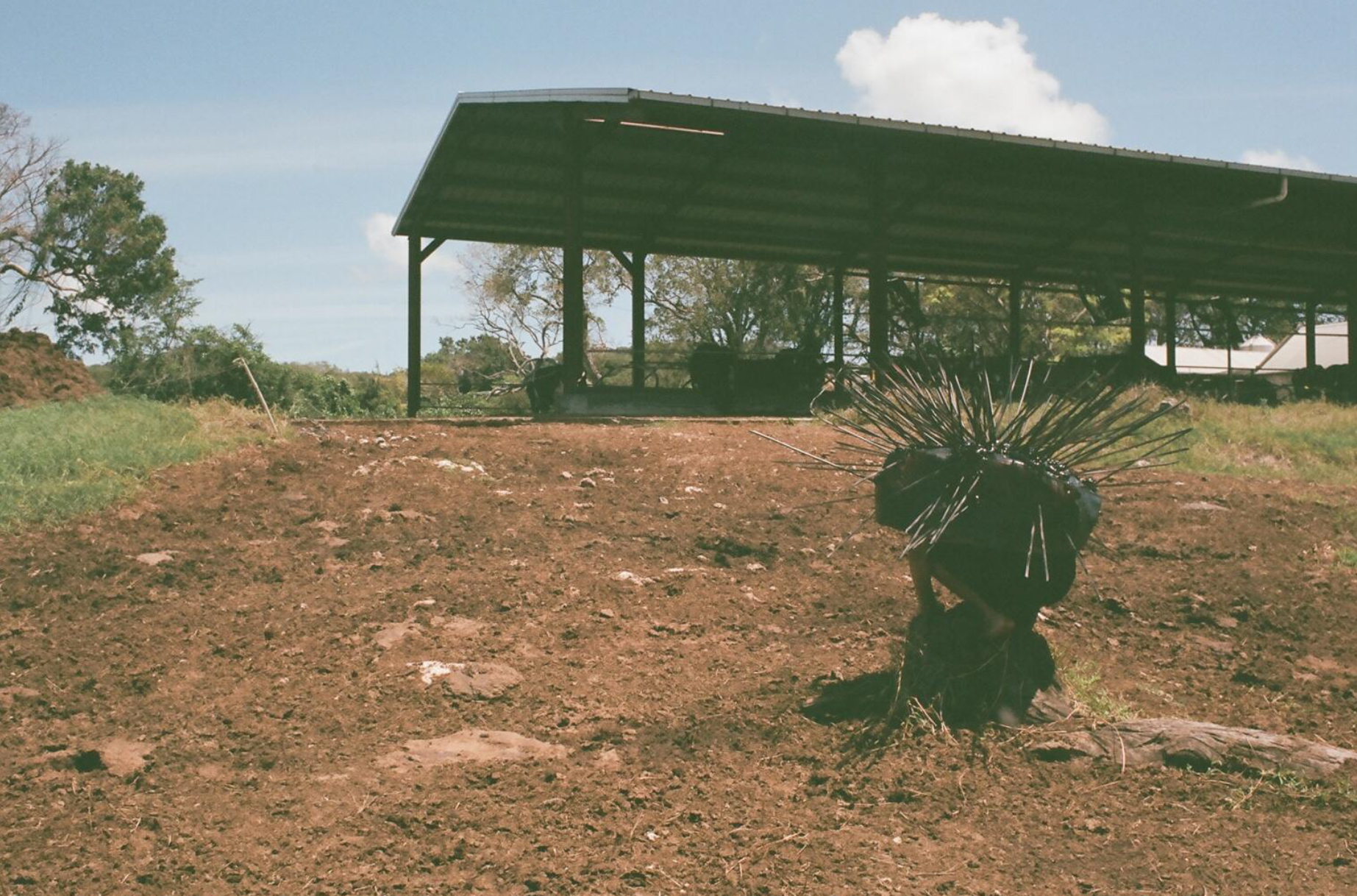
Ada Patterson, Echidna, Performance. Walkers Dairy, Barbados, 2016.
[Aside] Let it be made clear that this proposition is not instigating a historical rejection or denial
of colonial rule or Western influence in the Caribbean, like proposals before that seek to restore a lost Africa untouched by history [impossible]. This is, instead, a proposition that bears a
consciousness and hypersensitivity to the European presence and is hereby worn and embittered by its ongoing injection. Frankly, this Urchin has had enough. How may an island stand to look at itself if still knelt to a stature of servitude? How may an island stand to care for itself if still bent in gape to the prick of Empire? This Urchin’s flesh is tired of being picked by transatlantic flies who see an idyllic charm in the poverty and immobility of Caribbean people.
And so we collapsed into the ocean, creating a catastrophe of sunken memory and leaving only the sunken tips of these volcanic memories, the islands of the Caribbean. It is my impression that even now, a million years later, we still hear the echo of that catastrophe, and much of our work relates to that memory. We somehow lost the sense of the mainland, the sense of wholeness and we became holes in the ocean.[7]
The weight of contemporary Western influence sinks us and forbids us any time for the contemplation of culture and identity. The faces of our islands have been shaped – now is the time to learn and assert them – the continued treading of the visitor’s foot will only recede our shores further back towards uncertainty and dispossession; towards something that will only be ours in memory, in passing, in mourning, towards something that is taken from us once again – everything that constitutes we as a people.

Ada Patterson, Echidna, Performance. Walkers Dairy, Barbados, 2016.
THE MONSTER
Following the previous articulation of the Hermit, it must be clarified that this notion is an appropriation and adaption made suitable for Caribbean thought. Any quality or connotation of solitude produced by the Hermit archetype should be discounted in favour of a collective hermitage. What is meant by this is a mass transformation and movement of the Antillean community towards the posture of the Urchin, therefore a communal assumption of the nation language in an effort to deflect and resist touristic and outside persuasion. A cast of strewn islands erupting and foresting a black spiny cloud, every Antillean’s mouth to their own soil, each foot inter-crossed and woven to spin a net fat and soaking with an identity unhindered, uttering a salt language amongst itself, too spicy, too flavourful, too explosive, too excessive to ever be reduced to the limits of foreign interpretation – a harmony of resistance raised by a choir of cobblers. It is miraculous to see a rock pool or a coral plain coated in urchins – such a sight beckons fright and caution in the knowledge that no tread may pass, no foreign body may step nor land nor claim nor possess nor own nor colonise nor nothing. The miracle lies in the utterance of which the symbol of the sea urchin represents, “Doan cum ’round me!”
[…] another monster, irresistible, in no wise like either to mortal men or to the undying gods, even the goddess fierce Echidna who is half a nymph with glancing eyes and fair cheeks, and half again a huge snake, great and awful [8]
In collective assumption of the Urchin posture, may we undergo another sublimation; the invocation of the Monster. The qualities and potential inherent to the Monster involve a negotiation of invisibility alongside the accessory of the Grotesque [excess]. To be monstrous is to manoeuvre rather mythological attributes – to maintain a sense of being hidden, while also exuding a weight or presence in excess. [9] Echidna, the monster of Greek Mythology, who is described in opposing dualities of irresistibility and awfulness, may be linked in character to our understanding of the notion of the Paradise Militant. [10]
For beauty is nothing but the beginning of terror which we are barely able to endure, and it amazes us so, because it serenely disdains to destroy us.[11]
The split characterisation of the Monster is one of both temptation and repulsion, highlighting the dangers of that which is desired. Beholding a sea urchin – the black silken glow of crimson that melts across its spines, wet with pearls of light that drip in its gyration – is exciting and seductive, comparable to the thistle, a thorny rose or even the rich candied blue of a man o’ war – legend is spun in tales of seeing, but fortified through an inability to grasp. Lay a naked hand on a thorn, spike, tentacle and your skin will break, bleed and sting. Admire the fruits of the Tropics but forever lay humble and restrained in the promise of their pluck; a Paradise lost.

Ada Patterson, Echidna, Performance. Gibbes Beach, Barbados, 2016.
THE CARNIVAL
The sort of bodily excess to which I am alluding is of the same nature as our Carnival. The mobilisation of this posture as a collective act of resistance, while maintaining invisibility through the nation language, conjures the urchin rock pool, the spiked archipelago, the islands crowned with thorns, the Monster that is seen and admired but may always hinder tangibility and exploitation. Excess, as observed in Caribbean culture, may be enacted through the expansion of the body in collective celebration of the flesh. The agency of celebrative transformation may involve the transcendence of the individual towards the potency of the community as well as the compensation of one another’s limitations so as to promise a rising of the whole. The spirit of the community, as emphasised and exaggerated in Carnival practices, seeks to transgress the idealised ‘individual’, overriding the competitive ethics and economic cannibalism associated with Western Capitalist thought. The concentrated effort of the mass body in celebration, the collective body in excess, the Antilleans’ decision to assume the Urchin posture in resistance, may counter the crisis of cultural exploitation faced in the Caribbean.
Earth at that time was so excessively heated that it broke into an enormous sweat which ran over the sea, making the latter salty, since all sweat is salt. If you do not admit this last statement, then taste of your own sweat.[12]
The transformative potential of the Carnival space is the optimal environment for invoking the Urchin posture. Given Carnival’s cyclical process – a rhythmical progression of inhaling the material and the bursting of one’s seams, a repeated mass death and rebirth in excess, exhaust and revival – the collective body dances in synonymy and similitude, consuming one another (not cannibalistically but in a sense of osmosis) and allowing one’s self to transcend towards [and to be transgressed by] the other. There becomes a radical materialisation of the world in which cultural negotiation is a material engagement whose discourse may only be understood in the participatory Antillean flesh.
When the body is freed (when day comes) it follows the explosive scream. Caribbean speech is always excited, it ignores silence, softness, sentiment. The body follows suit. It does not know pause, rest, smooth continuity. It is jerked along. […] He keeps moving; it can only scream. In this silent world, voice and body pursue desperately an impossible fulfilment.[13]

Ada Patterson, Echidna, Performance. Gibbes Beach, Barbados, 2016.
The membranous sublimation of the revelling bodies is a dance spoken in laughter. The performance of nation language, finding its climax in the laughter of participation, leaves the tongue and coats the Antillean in camouflage, reiterating the duality of invisibility and presence. [14] In the ambiguity of the shift of bodies – passing through one another – the sheer joy of it all, the mass smile and the earthquake laughter become the nation language. For this is a means of cultural relation and communication unique to the flesh of the participants, falling deaf to the oppressor. In the overlap of spikes, does the black of urchins seem to form a single source of beautiful terror – where does it begin or end? In the nesting embrace of the Carnival space, where bodies [shells] and limbs [spikes] crowd and cluster, does a culture emerge in sweat [the same sweat that kept a people from burning in the toil of the sun]. In the dissolution of our individual flesh, to its meshing concretion in unity, do our islands erupt into being.
I will raise up a cry so violent
that I will spatter the sky utterly
and by my shredded branches
and by the insolent jet of my solemn wounded bole
I shall command the islands to exist [15] (55-59)
“No longer shall our shores bend and gape to the prick of Empire. Let the black urchins on
our backs extend arms outstretched as barbs – behold our islands crowned with thorns. May the
empire who maims and reduces us to paradise run aground our coral teeth. By its sting, does a
nation rise from welts. By our sting, does paradise bloom and throb as floating terror.”
References:
[1] Forbes, C. “Between Plot and Plantation, Trespass and Transgression: Caribbean Migratory Disobedience in
Fiction and Internet Traffic.” Small Axe, 2012. 16(2 38), 2012. 23-42.
[2] The coining of ‘open-mouthed resistance’ is indebted to the anatomy of the sea urchin, whose mouth is a
central orifice situated at the base of the creature. The urchin ingests food, which is digested upwards and excreted through the anus located at the central peak of the urchin’s dome. This term is to refer to a practice of repossessing the Caribbean landscape and cultural identity by returning a focus to the land, itself, while backing the distraction, interruption and assimilation of foreign neocolonial forces, in resistance.
[3] Lamming, G. “The Pleasures of Exile.” Ann Arbor: University of Michigan Press, 1992. 159.
[4] Brathwaite, K. “History of the Voice: The Development of Nation Language in Anglophone Caribbean Poetry.”
New Beacon Books, 1984. 5-6.
[5] The eye of the foreign storm from which the Antillean as Urchin seeks to stay invisible, throws its gaze in vain. Scientific studies have shown that sea urchins have light-sensitive cells embedded throughout their body which allow them to detect light and its direction, so they may hide from it. The Urchin’s tendency towards invisibility is a quality we must adopt. See more: Yong, E. “Sea urchins use their entire body as an eye.” Not Exactly Rocket Science. Waukesha, WI: Kalmbach Publishing Co., 2011.
[6] Brathwaite, K. and Édouard Glissant. “A Dialogue: Nation Language and Poetics of Creolization.” Presencia Criolla en el Caribe y América Latina/Creole Presence in the Caribbean and Latin America. Ed. Ineke Phaf. Frankfurt am Main: Verveurt, 1996. 19-35.
[7] Ibid.
[8] Hesiod. “Theogony.” The Homeric Hymns and Homerica with an English Translation by Hugh G. Evelyn -White. Cambridge, MA., Harvard University Press; London, William Heinemann Ltd. 1914. 300-305.
[9] Excess in the realm of the Grotesque is to be read as an unquantifiable state of being – similar to the Sublime, yet based in the material, bodily world in flesh. The body when inflated to a plane of inconceivable physicality is an exaggeration of bodily potency and capability; a heightening of the body’s ability to expand and exhaust in fat, blood, sweat, excrement, etc. Moreover, in the case of the Monster, this capability may expand to the extent of cosmetic qualities; the excess of beauty or conversely, ugliness.
[10] This characterises the notion that Paradise is not passively beautiful – idyll in servitude – but may be activated to become Monstrous, resistant and autonomous in defence of paradisiacal natives and their culture against foreign exploitation.
[11] Rilke, Rainer M. “Duino Elegies.” Translated from the German by Stephen Cohen. Evanston, IL: Northwestern University Press, 1998. 21-43.
[12] Rabelais, F. “Gargantua and Pantagruel.” Translated from the French by M.A. Screech. London: Penguin Books Ltd, 2006.
[13] Glissant, E. and Dash, J. “Caribbean Discourse.” Charlottesville: University Press of Virginia, 1989. 120-150.
[14] Glissant, E. and Dash, J. “Caribbean Discourse.” Charlottesville: University Press of Virginia, 1989. 21-22.
[15] Césaire, A. “Lost Body.” The Oxford Book of Caribbean Verse. England: Oxford University Press, 2009. 39-40.
Work Cited:
– Brathwaite, K. “History of the Voice: The Development of Nation Language in Anglophone
Caribbean Poetry.” New Beacon Books, 1984. 5-6.
– Brathwaite, K. and Édouard Glissant. “A Dialogue: Nation Language and Poetics of Creolization.”
Presencia Criolla en el Caribe y América Latina/Creole Presence in the Caribbean and Latin
America. Ed. Ineke Phaf. Frankfurt am Main: Verveurt, 1996. 19-35.
– Césaire, A. “Lost Body.” The Oxford Book of Caribbean Verse. England: Oxford University Press,
2009. 39-40.
– Forbes, C. “Between Plot and Plantation, Trespass and Transgression: Caribbean Migratory
Disobedience in Fiction and Internet Traffic.” Small Axe, 2012. 16(2 38), 2012. 23-42.
– Glissant, E. and Dash, J. “Caribbean Discourse.” Charlottesville: University Press of Virginia,
1989. 21-22; 120-150.
– Hesiod. “Theogony.” The Homeric Hymns and Homerica with an English Translation by Hugh G.
Evelyn-White. Cambridge, MA., Harvard University Press; London, William Heinemann Ltd. 1914.
300-305.
– Lamming, G. “The Pleasures of Exile.” Ann Arbor: University of Michigan Press, 1992. 159.
– Rabelais, F. “Gargantua and Pantagruel.” Translated from the French by M.A. Screech. London:
Penguin Books Ltd, 2006.
– Rilke, Rainer M. “Duino Elegies.” Translated from the German by Stephen Cohen. Evanston, IL:
Northwestern University Press, 1998. 21-43.
– Yong, E. “Sea urchins use their entire body as an eye.” Not Exactly Rocket Science. Waukesha,
WI: Kalmbach Publishing Co., 2011.









 fresh milk barbados