FRESH MILK at the IBB: Blog Post I

On Friday, November 2nd, I was thrilled to finally be on my way to Curacao, where I am taking part in a collaborative project with the Instituto Buena Bista (IBB) on behalf of FRESH MILK. After two flights (and two security searches!), it was lovely to be greeted so warmly and enthusiastically by David Bade, visual artist and co-founder of the IBB – especially with the news that his fellow founder and artist Tirzo Martha had just become a father! From the airport, we traveled straight to the IBB headquarters, which is on the same compound as Klinika Capriles, a psychiatric clinic with which the IBB has a relationship. Some past students have been patients of the clinic, and some patients, while not being full-time students, still visit the studios and become involved. This itself can be a kind of art therapy, as it gives the patients an outlet for their thoughts and emotions, and a change of pace from their routine at the clinic.

Hearing David speak about this aspect of the IBB while he gave me a tour around the premises was an inspirational experience, as he and the IBB team are obviously very passionate about what they do, not only for the young students – with the mission to equip them with the tools they need to go on to further artistic studies as well as showing them viable outlets for their talents in the professional world – but to make a difference in society through the engagement with the clinic. In this way, the IBB becomes more than just an art school or a space to hold exhibitions; it is an ongoing vehicle for social change through the arts.

To this end, I also met Dutch artist Erik Habets, who is the current resident artist at the IBB, and my housemate during my stay. Alongside his own work, he is also very involved with the students, and is at present working with them to create a wooden installation in the courtyard of one of the long-stay wards of the clinic. This interaction between Erik and the students, combined with the curiosity and interest the patients had in this new hive of activity in their life, was a very moving sight, and highly indicative of the whole dynamic at the IBB; one of sharing, inspiring and supporting through open expression in the arts.

David then took me to the IBB Residency House, where I met Erik’s wife Marijn, and settled in. Erik and Marijn took me out to dinner that night, and I am so grateful to both them and David for making me feel welcome in Curacao. This continued into the weekend, when Erik, Marijn and I had a barbecue in our garden on Saturday, and on Sunday David took me for a drive around the island, briefly showing me the town and some places of interest (including the former sites of the IBB). Something I found fascinating about the island so far is how familiar, yet unfamiliar it feels; having never visited the Netherlands Antilles, I did not know what to expect. The distinctive Dutch architecture of some buildings made it feel like a different world, but then there were some areas we drove through, where people were ‘liming’ by what I would compare to Bajan rum shops – which of course is a typical part of the landscape I am used to at home. These kinds of differences were not only interesting for me as a spectator, but relate to the tension David mentioned is very much a part of the culture in Curacao, with their relationship to the Netherlands and the impact on Caribbean identity. I hope to get the chance soon to walk around the town and get to know it further – as well as take some pictures for you!

Today I was back at the IBB, where I discussed my segment of the residency in more detail. David gave me his input, and a list of key figures in the Curacao art scene to begin contacting to arrange interviews with. Tomorrow I will conduct the first interview, with art historian Jennifer Smit, who will visit the IBB headquarters. On Wednesday I will travel to the studio of visual artist Herman van Bergen. The last confirmed interview so far will happen on Thursday, with curator and director at the Bloemhof Gallery, Nicole Henriquez. These will be filmed and edited by two students at the IBB, and shared with you soon. Anxious to see what will come of these conversations! Also looking forward to the arrival of Holly Bynoe this Wednesday, after her unfortunate delay being stranded in New York during hurricane Sandy. We are all extremely relieved and thankful you are safely back in the Caribbean, Holly – and can’t wait for you to land in Curacao!

Look out for more updates and pictures from me soon!

Katherine Kennedy

Aruba Linked/Caribbean Linked

October 12 – 15 2012

BACKGROUND

Ateliers ’89 Foundation and the Fresh Milk Art Platform Inc. collaborated to create an international gathering of art experts which took place between October 12th and 15th 2012 in Aruba. Ateliers ’89 hosted the event which included bringing in the following persons to Aruba to participate in a symposium and a panel:

Rocio Aranda Alvarado – Curator, El Museo del Barrio, New York City, USA

Paco Barragan – Independent curator, Madrid, Spain

Holly Bynoe – Co-founder and editor of ARC magazine, St Vincent & the Grenadines

John Cox – Founder and director, Popop Studios, The Bahamas and co-curator, the National Art Gallery of the Bahamas

Annalee Davis – Founder and director, the Fresh Milk Art Platform Inc., Barbados

THE SCHEDULE OF EVENTS

During the course of the four days a symposium took place, a panel discussion, studio and gallery visits, the launch of ARC magazine and a series of meetings with stakeholders in the public and private sector. The symposium and panel discussion were streamed live via Ustream, allowing a regional and international audience to join the proceedings. Supporting the programme was the Youth Bienal organised by Ateliers ’89 as a way to exhibit the works of young Aruban and Dutch artists and expose those works to the visiting creatives. Two young Barbadian artists were also included in the exhibition.

The symposium gave the visiting creatives an opportunity to share their work as curators, publishers and founders of informal networks with the Aruban art community. It also gave the visiting creatives an opportunity to develop an understanding of the local art space. The launch of the ARC magazine created more awareness in Aruba of it’s art publication and web presence demonstrating how it functions as an integrative tool for the visual arts across the region.

Of critical importance was the series of meetings scheduled by Elvis Lopez, the Director of Ateliers ’89, which allowed us to meet Dr. Dumfries, the Director of Culture in the Ministry of Culture, Mr. Jonathan Viera, the Director of Cas di Cultura, Mrs. Lupita Gil, the Director of UNOCA, Vicki Arens, the Director of FDEC, the Weston Hotel Art Gallery and Insight Foundation.

As a result of these meetings we came to learn of the Ministry of Culture’s pending programme to promote the Rietveld Academy in Aruba and the 2013 launch of their preparatory visual arts programme that is open to art students from around the region and who want to enter a BFA course afterwards. The Ministry is keen to inform the region of this programme and ARC magazine will assist in promoting this programme through their website.

Also coming out of these events was the proposed idea of holding a Barbados Linked / Caribbean Linked programme at FRESH MILK in February 2013. The purpose of this gathering would be to extend the Fresh Milk/Ateliers ’89 conversation which took place at the Ateliers ’89 Foundation in Aruba, and to deepen the links further across the region while circulating ideas about sustainability within the creative economy of the Caribbean.

Stay tuned for more information on this venture!

Visit http://www.ustream.tv/channel/ateliers-89 to watch videos of the panel discussions.

Pictures from FRESH MILK VIII in collaboration with the Alliance Française de Bridgetown

Fresh Milk is delighted to share photographs with you all from FRESH MILK VIII, which was held in collaboration with the Alliance Française de Bridgetown. The evening began with a powerful spoken word performance by Adrian Green, followed by the heart wrenching and thought provoking documentary by Iara Lee, Cultures of Resistance. The reactions to the film by panelists France Langlois, Tatiana Flores and Adrian Green, not to mention the impassioned contributions from the audience, are testimony to the impact felt by all who attended.

All Photographs © Dondré Trotman http://www.dondretrotman.com/

Musings from the Milking Parlour Studio: The Launch of FRESH MILK – an artist led initiative in Barbados

For Barbados Today August 2011 

Annalee Davis

Photos Credit – Dondre Trotman   “The FRESH MILK platform”

Photos Credit – Dondre Trotman “The FRESH MILK platform”

On August 13th at the Milking Parlour Studio located in St. George, FRESH MILK, (www.freshmilkbarbados.com/) an artist led initiative offering an informal platform for exchanges among contemporary practitioners, writers and makers; was launched.  The inaugural event offered a rich programme including an artists’ talk, an exhibition and a screening of sixteen video shorts from around the region.  The focus of the FRESH MILK event was the launching of ARC III, a quarterly Caribbean art and culture print magazine published out of St. Vincent and the Grenadines by Holly Bynoe and Nadia Huggins.  (www.arcthemagazine.com)

But first, a bit of background – what is FRESH MILK?

The idea for FRESH MILK has developed over years of conversations with other practicing artists around the need for artistic engagement amongst contemporary practitioners living and working in Barbados who are concerned with a contemporary Caribbean space – which maybe in Bridgetown, Toronto, Port of Spain or East London.  My interest in founding FRESH MILK was renewed after having returned to teaching in the art department at BCC after a five year hiatus and realizing (again) that students with BFA degrees had no where to go once they graduated to share their ideas, be mentored or become part of a creative community that acknowledges their practice.

FRESH MILK’s aim is to support interactions across disciplines and contribute to an increasingly rich discourse surrounding creative production within the informal networks of the Caribbean.  Its seasonal programming will offer events in the Wet Season and the Dry Season in its commitment to bring people and ideas together.  This venture is connected in spirit to the increasingly rich informal artist-led networks spawning from the Bahamas in the North to Suriname in the South.

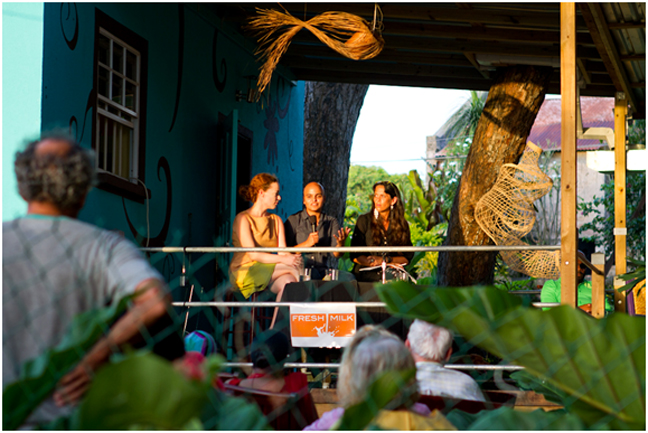
FRESH MILK is located in the Southern Caribbean, a region often referred to as a hybridized space, well known for its capacity to fuse various elements and remake itself over and over again.  In this tradition, FRESH MILK appears to be a singular space – a simple wooden deck used as a private eating area for a family but which on occasion transforms into a platform for ideas – bridging the divide between private and public, disciplines or territories; transformable into a gathering space for contemporary creatives who are thirsty to debate ideas and share works.

The humble FRESH MILK space straddles my residence with my working studio and gallery.  It is literally a wooden deck – a platform if you will, that connects my home with the place where I think, write, and make things; becoming a point of connection between living and working environments as well as between myself and others.

THE EVENT THAT LAUNCHED FRESH MILK

The evening’s proceedings began with my conversing with Holly and Nadia about the birth of ARC – a delicious magazine which “offers insight into current creative industries, while bridging the gap between established and emerging artists.”[i]  The founders spoke to their interest in creating something beautiful and worthwhile to showcase the work coming out of the region and also about their need to develop a collaborative project to mitigate isolation – especially for Holly who was returning to quiet Bequia from energetic NYC.  Their interest was to honour creative practitioners and provide a space for people to come together.  The founders acknowledged that embarking on the ARC project was a huge leap of faith.  Now into preparing the fourth issue, they feel as though they are being understood in the Caribbean and that their jump of faith has resulted in being ‘caught’ as manifested by the encouraging support they have received throughout the region.  Holly closed by speaking about our need to form a united front, to think about the power of coming together and the need to harness this energy right now and acknowledge the groundswell taking place.

Photo Credit – Dondre Trotman. From left to right – Holly Bynoe and Nadia Huggins, ARC Founders in conversation with Annalee Davis, FRESH MILK Founder – on the platform.”

The second component of the launch included Project and Space, founded by Barbadian artist, Sheena Rose.  This initiative was also born out of a need to mitigate isolation and to develop collaborative projects with others by using both her private studio space and public venues for monthly meetings with younger practitioners.  Having just returned from a three-month residency at the Tembe Art Studio in Suriname where she felt isolated at the programme’s deeply rural location, she felt surprised on returning to Barbados that the isolation was ever present here as well and decided to do something about it.  Sheena thought that the separate circles of artists, writers and filmmakers should come together “and make one big circle.”  Project and Space participated in the Fresh Milk launch by co-curating a small exhibition with ARC, to showcase the works of five Barbadian artists working in photography, mixed media, sculpture and painting.  This collaborative action was in keeping with ARC’s intention to inspire and give voice to a new generation of emerging artists, and provided the opportunity for the audience to see some of the new work evolving while alleviating the isolation many practitioners experience.

Photo Credit – Dondre Trotman. Sheena Rose, Project and Space Founder with Natalie McGuire, Art Historian

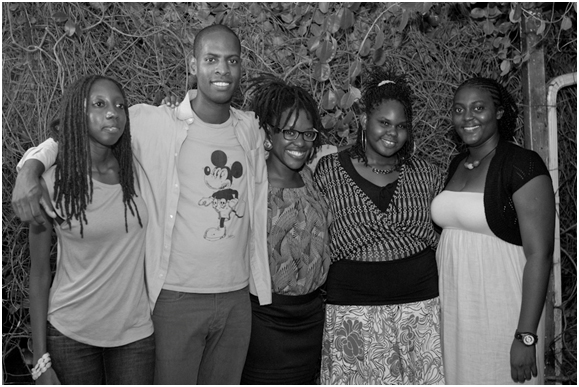
Photo Credit – Dondre Trotman. Barbadian artists from left to right – Alicia Alleyne, Mark King, Sheena Rose, Cindy Jackman and Joanna Crichlow

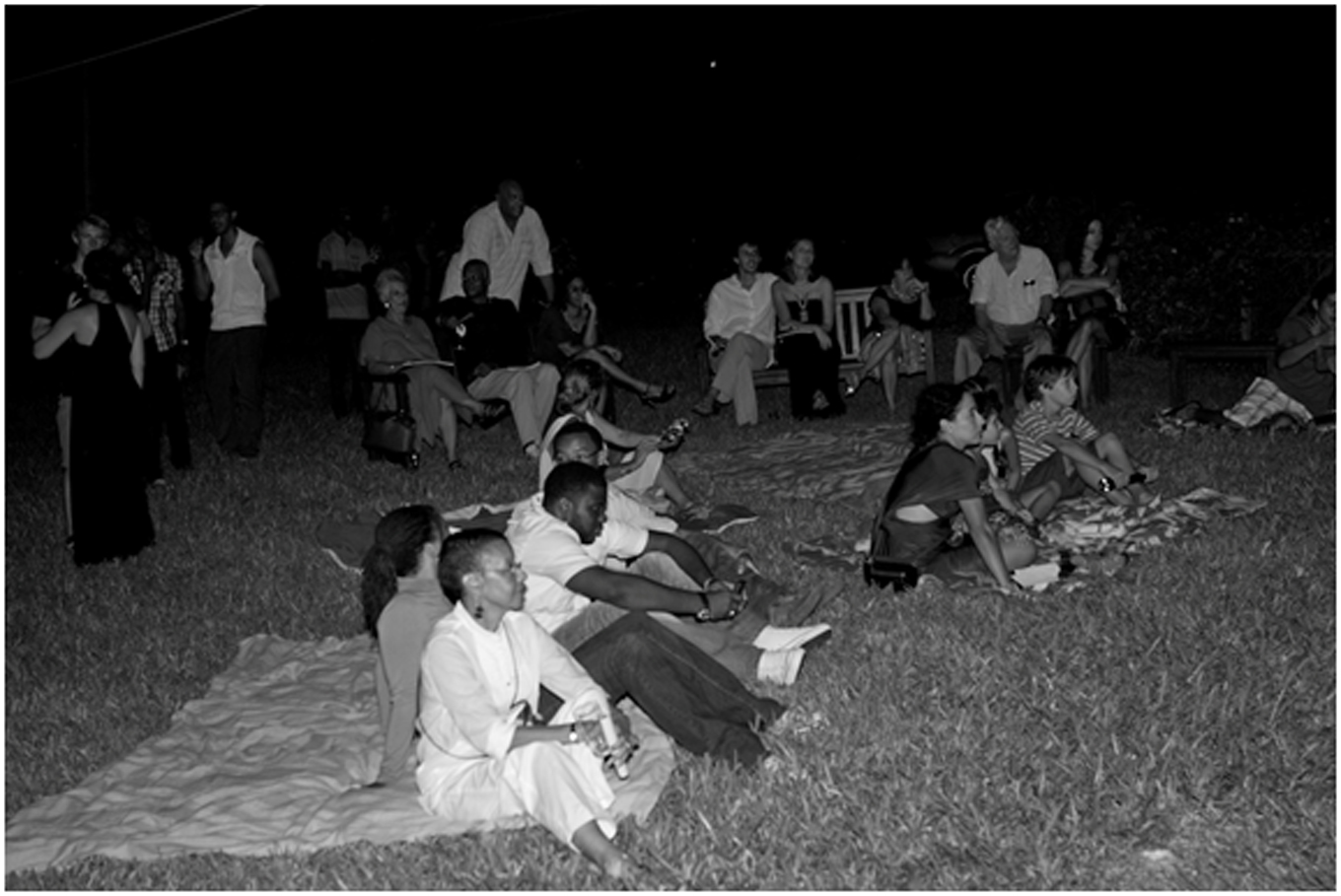
The third feature of the launch consisted of the viewing of video shorts produced by sixteen artists from the region.  A home made screen was suspended from my children’s very tall swing set, large blankets were laid out on the lawn, and more than seventy people viewed a fifty-one minute selection of video works curated by the ARC founders.

Photo Credit – Dondre Trotman. “The Theatre at FRESH MILK”

One of the artists who attended the event wrote to say that it was the arts event of the year.  I do not know where these people came from…many I did not know.  The audience spanned generations and the excitement felt by recent graduates and young practitioners was palpable.  Some confessed their eager anticipation about the event and everywhere someone was meeting someone else for the first time….we were getting to know ourselves….still!  A young animated Barbadian man is entering his second year in Arts Administration at Goldsmiths in London, an eager Art Historian returned to Barbados three weeks ago with degree in hand from the University of Leicester, a recent graduate from BCC is now in Kenya at an arts residency, another just back from one at Alice Yard in Trinidad.

As Holly suggested, there is a groundswell in the arts.  It is a moment to be harnessed and a time to be savored.  The shift is happening, and our challenge is to keep up the momentum.

Photo Credit – Dondre Trotman – Viewing the Video Shorts

Just as Holly and Nadia were leaving to return home and prepare for their next stop at the Trinidad and Tobago Film Festival where they will present a new media programme at this September event, my parting gift to them was copies of RA, a quarterly publication of the informal group, Representing Artists from 1993/1994.  RA was an artists’ union and watchdog organization, co-founded to, again, mitigate isolation, born out of the lack of acknowledgement and support expected from the formal art institutions.  Re-reading my editorials from that comparatively humble publication eighteen years ago reveals what has and has not changed in the region.  What has not changed is that many formal institutions are still dysfunctional and in dire need of rehab but are in denial about their failure to function properly….part of the general malaise and crisis of leadership we all know too well and which continues to mash up the region. The other thing that has not changed is that the oxygen being pumped into the art community continues to come from the blood of artists – not state institutions whose mandate it is to grow the arts.

What has changed is that the internet has democratized access to information and to each other, making it impossible for those who once controlled access to maintain absolute control.  I was reminded that the RA publications were reaching out to the region in the same ways that ARC is doing today…the six issues a precursor to the efforts of Holly and Nadia who are offering a much more sophisticated publication, carefully designed and printed so beautifully in a fancy art house printery in Iceland and not by a primitive machine in black and white.  ARC’s mission to “foster and develop dialogue and opportunities for individual and collaborative visual artists across the region and to stimulate sharing and creativity by providing an outlet for self-expression and uniqueness” was in essence the mission of RA.

The fact that visual artists are still working to alleviate isolation and build opportunities means that their own production wanes, making the efforts sweeter because the sacrifice is so great.  And it is this sacrifice that makes each of us complicit in the failure or success of all the artist led-initiatives throughout the region.  As an artist-led initiative, ARC magazine is made possible by the subscription and support of its readers.  In other words, if we don’t support it, it cannot sustain itself.  And isn’t this the question for the Caribbean as a whole?


Musings from the Milking Parlour Studio: What is contemporary art?

by Annalee Davis

April Article

A reader of my last article expressed confusion over the term contemporary art.  She wondered how it was that Joscelyn Gardner, (www.joscelyngardner.com) could be considered a contemporary artist even though she is working within the old tradition of lithography using stone.

Joscelyn Gardner, Mimosapudica (Yabba) Hand coloured Lithograph 2010

The use of the word ‘contemporary’ is confusing because it can suggest that all art made now is contemporary art.  But this is not the case.  The term ‘contemporary art’ has become a catch all phrase suggesting that there aren’t other movements happening and that all work produced conforms to some commonly understood manifesto.   The reality is more layered and the term ‘contemporary art’ both does and does not make things clear.

So what’s considered contemporary art?

I schooled in the USA in the eighties.  Although the work being produced at that time falls into what we still call ‘contemporary art’, there were many different kinds of work being produced at that time.  I spent weekends traveling mostly to NYC, as well as to Philadelphia, and Washington DC where I saw Appropriation Art, Video Installation Art, Graffiti Art, Postmodern Art, and Institutional Critique among other types of contemporary art.  The education I received visiting museums and galleries was supported by interacting with tutors who were very successful as contemporary visual artists, including Martha Rossler, Emma Amos and Leon Golub.  In addition we attended the MFA visiting artist class and were exposed to visiting luminaries such as Hans Haacke and Adrian Piper.

Since my return to the Caribbean throughout the nineties and the noughties I have witnessed the advent internationally of Internet Art, Digital Art, New Media Art, Information Art and the rise of the Young British Artists and more recently VJ Art, Videogame Art, Virtual Art and Relational Art, among others.

Does contemporary art include all of the above? Yes.  Does it include everything else being produced by all artists, everywhere, at the same time? No.  So what’s the difference?

Bottom Bay – Painting by Steve Bonner

Many museums of contemporary art state that their collections include works made after the second world war. In addition, one of the defining characteristics is that contemporary art refers to works that offer something new in terms of their ideas and/or technical manifestation.  In other words, there’s something unexpected and innovative conceptually and/or technically; the work makes us notice something in a fresh way.  In response to my reader’s question, contemporary artist Joscelyn Gardner uses the ancient art of stone lithography in a subversive way to explore her identity as a (white) Creole Caribbean woman, with a novel twist to the labour intensive medium she employs as a white woman visually acknowledging the historical toil of black female workers.

Contemporary Art in the Caribbean

There are many people in the Caribbean making artistic things at this particular moment in time, many of which are displayed in scores of art galleries throughout the islands.  This often includes watercolours and acrylic or oil paintings that portray the flora, fauna, land and seascapes and portraits of people in ways that may (or may not) stress the technical virtuosity of the practitioner.  Buyers of this work may enjoy the technical proficiency and beauty of these pictures.  Or, sometimes the images rendered are reminders of a beautiful location and buying this painting allows us to hold the memory in a more tangible way.  And yes, it might, on rare occasions, even include a lithograph portraying a riverside scene in a tropical forest.

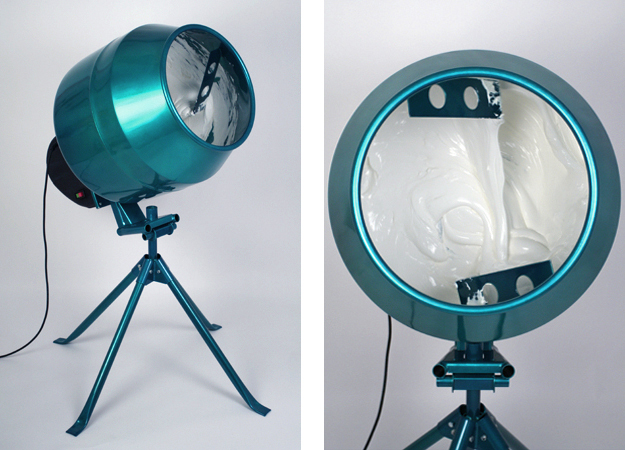
Work by artist Blue Curry using a customised cement mixer filled with sun cream for the 6th Liverpool Biennial.

This is emphatically different from the work contemporary art that I am interested in following and learning more about.  It’s work that surprises me when I see it because I have not seen the formula before.  Maybe I understand its reflection or its sentiment, not because I am already familiar with the particular image/performance/sound/installation/still or moving image but because it has a curious nature about it which resonates with my own inquiring mind.  I respond to this work at a visceral and an intellectual level – the work becomes an experience.  And it doesn’t happen often.

When we view the painting of Bottom Bay by English artist, Steve Bonner, those of us who have been to Bottom Bay on the east coast of Barbados, will recognize the rocky coastline and the wide expanse of beach.  Some might like this image because it’s familiar or because it evokes a fond memory even though it does not offer a new perspective on our reading of the beach.

Staying with the beach theme, we might view the subversive artwork by Blue Curry, a London based Bahamian artist, which was recently shown at the 6th Liverpool Biennial.

This installation uses an aquamarine coloured, customized cement mixer filled with twenty litres of sun cream.  The strong scent of the sun cream elicits memories of a tropical beach and relaxed moments of lying in the sun.   On closer examination, we understand that our tropical fantasy has been high-jacked and turned into a humorous even if frightening reflection on a region built as a playground for people from somewhere else, churning out all-inclusive, hedonistic getaways that local Caribbean people work at but don’t leisure in.

Both of these works were made in the same decade – Steven Bonner’s aged representation of a Caribbean seascape was painted in 2009, and Blue Curry’s satirical interpretation of tropical paradise was conceived and manufactured in 2010.  Although both art pieces were produced in a similar time about a similar space, they could not be further apart.  My sense is that a contemporary art museum might want to acquire only one of these works.  Which one do you think that may be?