Open Call: Fresh Milk Ecological Archives Fellowship

The Fresh Milk Art Platform is launching its pilot Ecological Archives Fellowship, granting $10,580 BBD for a local independent researcher to create a mixed-media bibliography and narrative of memory dedicated to the Barbadian landscape, its transformation over time, and a genealogy of the eco-critical activism carried out to protect the integrity of our various ecosystems.

Duration: 11 months [July 2026 — June 2027]
48 weeks @ 8 hours/week

Read more below, and see the application form here.
Background

This pilot fellowship is made possible with joint funding from Peter Lewis, through the Colleen Lewis Reading Room Slow Reading Programme, and from the Peter Moores Barbados Trust.

The 2026 Slow Reading Programme serves to activate Fresh Milk’s Colleen Lewis Reading Room (CLRR), in remembrance of Colleen Lewis and her legacy on the 20th anniversary of her passing. Colleen’s research, specifically her essay Pictorial Depictions of the West Indian Landscape in the 18th century and early 19th century: the sublime, the picturesque, the romantic (Barbados Museum & Historical Society Journal, Volume 50, 2004), invites us to pay particular attention to our landscape after centuries of artistic and ideological interpretation by foreign gazes and extractive interests.

The Colleen Lewis Reading Room, located in St. George, Barbados at The Fresh Milk Art Platform, is a site outfitted for accessing, cross-referencing and discussing thousands of texts relating to the genealogy of arts, literature, art history, theory, Caribbean history and critical thought — ranging from local, regional and international spheres. It provides an avenue to interrogate the social questions and challenges of our times.

The 2026 inaugural Ecological Archives Fellowship seeks to augment the library by establishing a collection of scholarly and creative materials focussed on the environment, which will also be facilitated in part on the Fresh Milk website.

This Fellowship stems from Ariella Aïsha Azoulay’s work Potential History: Unlearning Imperialism (2019), which presents the notion of “cocitizens” as those who “care for the common world they share with (…) others and are committed to dismantling the principle of differentiality that organises it”. The political principle of differentiality is recognised as being exemplary in the Barbadian historical context — citing Hillary Beckles’ work Britain’s Black Debt (2013) — as amongst the first legally constituted “offshore outpost” territories of the New World. She explains “People started to be governed differentially from others, by other people whose rights were inscribed in the worlds that the governed were forced to build and within which they were denied the right to feel at home.” This principle enabled people living in the mainland (Europe) “not to associate themselves with forms of brutal violence… even when they directly benefited from them.” (pg. 35-36)

Azoulay’s work, which aims to “reject imperialism’s conceptual apparatus altogether” presents an unorthodox approach to the archives, positioning it not as a neutral site, but as a technology. Potential history “is a form of being with others, both living and dead, across time, against the separation of the past from the present, and history from politics.” (pg. 43) The arts, and the archives of the development of the cultural ecosystem in the Caribbean, is indispensable to the work of defining the principles of our citizenship, working within this enmeshment of imperial history and politics: “Art should be understood as a world-building set of activities irreducible to the creation of discrete objects. Through these activities, people’s place in a shared world and their right to this place are carved.” (pg. 140)

This interdisciplinary archive seeks to counteract the generalised narratives of “passivity” in the Barbadian context, by highlighting the lineage of proactive and engaged ecological activism, demonstrating resistance to the touristification of the small island, both currently and historically.

It also seeks to include resistance to overdevelopment and usurpation of our land, through the eyes of scholars, educators, journalists, musicians, artists, poets, politicians, ecologists, biologists and activists cognisant of some of the island’s most compromised physical assets including:

  • Coastal areas
  • Mangroves
  • Parks
  • Public beach access points
  • Gullies and forests

Also considering the presence in our socio-economic matrix of artificial landscapes such as:

  • Agricultural lands
  • Wind and solar farms
  • Golf courses

Fellowship Goals

 Design a research framework that generates an inspiring perspective on the intersections of science, art and culture, in order to exalt our historical and current civic relationship to our natural environment.

 Consolidate an initial compilation of archival material related to the specific theme of Barbadian ecology, and its relevant socio-cultural and political-economic intersections.

 Including, but not limited to: public and community archival materials; informal oral histories and diaries; published academic articles; visual, musical, theatrical and literary arts; archival videos and photographs.

 •  Promote awareness of our historical and current civic relationship to our environment in a way that is broadly accessible and counteracts the isolated silo effect between both different generations, and different knowledge sectors.

As this is a pilot Fellowship, a desired outcome specific to this first iteration (developed in collaboration with the Fresh Milk team) is to determine an overarching understanding of i) how to best disseminate and publicly engage an Ecological Archive, and ii) what local conditions and approaches are necessary in order to guarantee continued independent research, including encouraging contributions from a community-led, citizen science approach.


Eligibility

  • Applicants must be 21 years of age or older.
  • Applicants must be based in Barbados.
  • Applications are welcomed from a variety of backgrounds, such as (but not limited to) environmental/conservation scientists; journalists; librarians; archivists; art researchers etc.
  • Applicants must possess research skills and integrity, as well as strong communication skills and tech literacy (Google suite, internet research, Zoom; ability to record audio preferred, but not required).
  • As the Fellowship is intended to support independent investigation, Applicants cannot use Fellowship funds to conduct research on behalf of another institution, corporation or nonprofit organisation.

Review Process

  • June 1st: Applications open.
  • June 26th [26/06 Midnight AST]: Applications close
  • July 7th/8th: Shortlisted candidates notified.
  • July 28th: Final decision made.
  • July 31st: Public Announcement of selected Fellow.
  • August 1st: Fellowship commences

The applications will be reviewed by the Fresh Milk team; Fresh Milk Advisory Board member, Peter Lawrence Thompson; and two external Experts: Dr. Robin Mahon, retired Director and Professor Emeritus at the Centre for Resource Management and Environmental Studies (CERMES), at the University of the West Indies (UWI); and Dr. Carla Daniel, Director of Public Awareness and Education with the Barbados Sea Turtle Project.

The applications will be evaluated based on the following criteria:

 Precedence of workThe Application should provide a concrete background of formal and/or informal: studies, work, and/or activities relevant to the themes of the Fellowship.

 CriticalityThe Application should demonstrate a reflexive perspective that leads through constructive questioning, curiosity and innovative contextual understanding.

 Eco-centric CreativityThe Application reflects a creative approach to the Fellowship goals which centres experimentation and a desire to re-think the role the Archives and storytelling can have in nurturing a relationship of stewardship to our land.


Timeline

Phase 1 — Gathering

[July/August/September/October]

  • Establish research plan
  • Conduct site visits and online research
  • Create a database of recorded oral accounts

Phase 2 — Organising

[November/December/January/February]

  • Determine and populate the technical and narrative structure to organise the materials gathered, thinking through the practical and aesthetic needs of hosting and using a mix-media and interdisciplinary archive as technology.

Phase 3 — Sharing

[March/April/May/June]

  • Generate and carry out an accessible format and strategy that can be used to disseminate the Ecological Archive, in a way that raises awareness, engagement and relevance for the general public and practitioners across the respective disciplines.

For example, this can include a public event, a video series, a printed zine, a community workshop series etc.


Commitments of Fellow

Schedule: The Fellow is available to work either 1 full day a week, or 2 half days a week for the 11 month period.

Site-based work: The Fellow’s work hours must be undertaken in the CLRR, or when appropriate, to the archival institutions or field work.

Reporting: The Fellow will commit to provide content once a month in the form of brief reflections and videos/photographs of their process, created in collaboration with Fresh Milk’s content specialist.


Release of Funds

  • Forty percent (40%) — $4,232 — will be awarded upon mutual completion of the grant agreement.
  • Twenty percent (20%) — $2,116 — will be awarded upon completion of phase 1.
  • Twenty percent (20%) — $2,116 — will be awarded upon completion of phase 2.
  • Twenty percent (20%) — $2,116 — will be awarded upon completion of final report submission.

The Fellowship funds are intended to be used at the Fellow’s discretion, as well as to cover expenses related to local travel to the CLRR and other locations of research.


How to Apply (Form)

To apply, please fill out the Google Form application form by midnight, June 26th.

Main questions:

1.In 250-500 words, describe your background and interest as it relates to the themes and work of ecology, eco-critical activism and archival practices in the Barbadian context?

2.In 400-800 words, describe your perspective as it relates to our historical and current civic relationship to our natural environment.

3.In 500—900 words, share your ideas to pursue the Fellowship goals, and vision for how the Archives and storytelling can be experimented with in order to nurture a relationship of stewardship to our land.
Announcing the inaugural Bocas Lit Fest Scholarship!

Fresh Milk is deeply pleased to share the results of our inaugural Bocas Lit Fest Scholarship, which has been made possible with the generous support of Peter Lewis as part of our 2026 Slow Reading Programme. This programme serves to activate Fresh Milk’s Colleen Lewis Reading Room (CLRR), and commemorate Colleen Lewis’s legacy on the 20th anniversary of her passing.

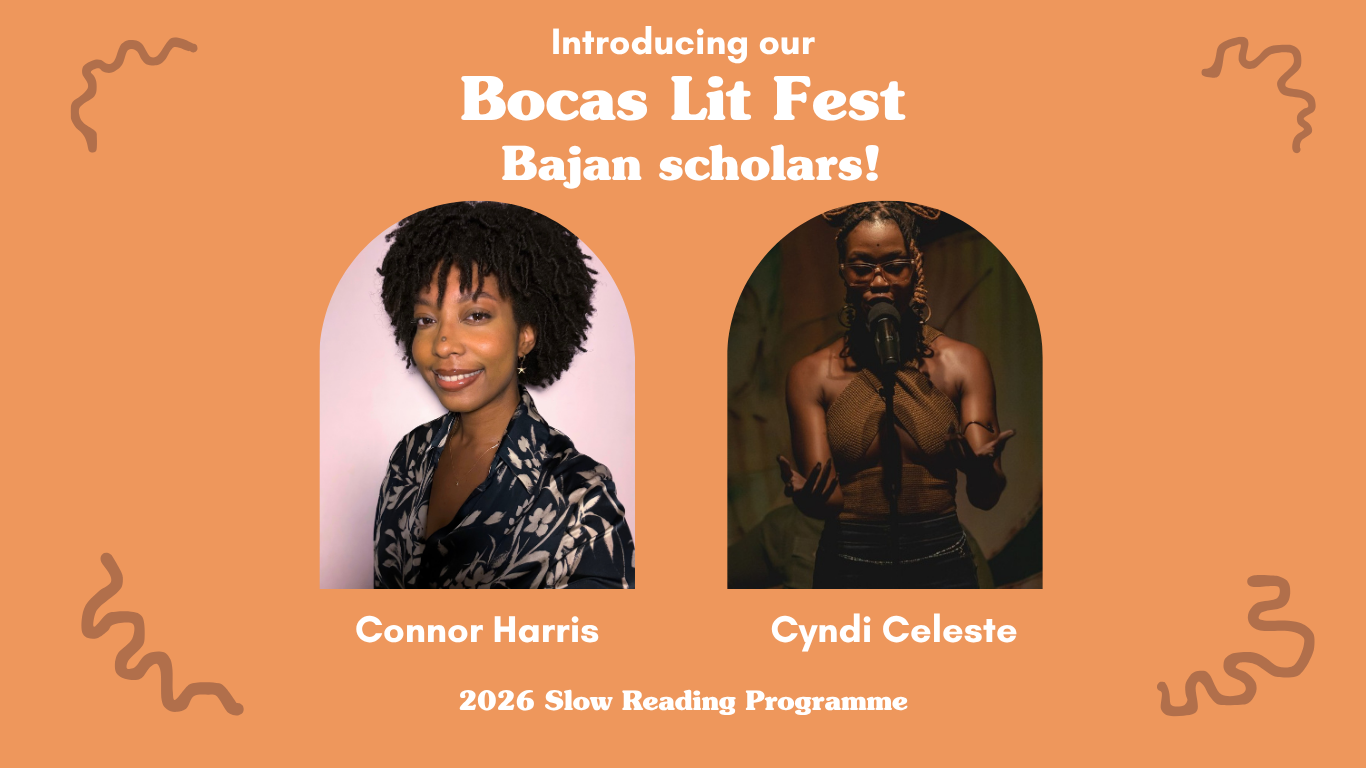
We are delighted to announce that the inaugural Bocas Lit Fest Scholarship has been awarded to Cyndi Celeste and Connor Harris! Congratulations!

Read the full jury report process below

The Bocas Lit Fest Scholarship was designed with three principal desires in mind: 

i) A programme designed by and for artists, writers, and cultural workers with the goal of drawing strength from, and consolidating an awareness across linguistic regions and generations. 

ii) A programme that exalts the civic function of the arts and art research by bridging cultural practices with the social contexts to which they are responding, as well as addressing the practical needs of doing this work. 

iii) A programme that activates and facilitates exchange of existing work, thought, and feeling between Barbadians and, more broadly, Caribbean people, in order to digest and counteract the prevailing sense of isolation and/or apathy our economic and social condition can perpetuate.

The Bocas Lit Fest — held annually in Port of Spain, Trinidad & Tobago — represents the most significant literary event in the Anglo-Caribbean. Held this year from April 30th to May 3rd, it generates a period of crucial enrichment, exchange and celebration for our region’s cultural sector. We determined sponsored attendance of this festival for a Bajan writer to be a necessary element of the Slow Reading Programme, in order to take part in the world-building activities and tools that literature, arts and archiving generate, helping to foster the imagination required to navigate the nuances of the Caribbean.

The Award Details

The Bocas Lit Fest scholarship includes:

  • Round-trip airfare to Trinidad and Tobago.
  • 4 nights of accommodation at the Kapok Hotel.
  • Airport transfers.
  • A daily allowance for the 4-day duration of the festival.

Candidate Requirements:

  • Candidates must be 21 years of age or older and based in Barbados.
  • Candidates must hold a passport valid for at least 6 months for travel to Trinidad and Tobago.
  • Candidates must be available to travel for the full duration of the festival (April 30th – May 3rd).
  • Upon completion, Candidates agree to collaborate with Fresh Milk to craft a journalistic reflection/report on the experience to be shared across our public platforms.

Procedure

On March 12th, Fresh Milk contacted three esteemed members of the local literary community:

  • Dr. Debra Providence, Lecturer at The Department of Languages, Linguistics, and Literatures.
  • Robert Sandiford, co-founder of ArtsEtc publishing company, writer, editor and part time faculty at the Barbados Community College Division of Fine Arts Department. 
  • Andy Taitt, owner of Black Rock Books book store and community hub for literary events. 

Providing the above mentioned background, we requested they collaborate as nominators, selecting 2 candidates each by the deadline of March 23rd. 

The nominators selected the following individuals as nominees: 

  • Cyndi Celeste 
  • Claudia Clarke
  • Christopher Cox 
  • Kemar Doughty 
  • Connor Harris 
  • Shondrell Meredith 

On March 25th the nominees were contacted to be notified of their candidacy, and were requested to submit a 500-750 word Letter of Motivation by April 3rd, articulating the following: 

  1. Why they are a suitable candidate for this scholarship.
  2. Describing the main themes or areas of interest in their literary craft, and if there are emerging themes in particular that they would like to further explore through attending Bocas LitFest.
  3. How attending Bocas LitFest will impact their professional development and area of interest.

All 6 Letters of Motivation were shared with and reviewed by the Fresh Milk team and Fresh Milk’s Board Members:

  • Natalie McGuire, Curator of Social History and Engagement at the Barbados Museum & Historical Society 
  • Rae Skinner, Founder of Caribbean Brushstrokes Gallery 

The decision making process was made through each board member representing one vote, and the Fresh Milk team representing a third vote. 

General Comments

Each candidate’s Letter of Motivation reflected exciting and compelling insight into their practice, their desires and some background to their work. 

Cyndi Celeste wrote of her keen dedication to exploring the themes of nation language, futurism, and “acts of re-membering as personal and collective repair”, with a special focus on the Caribbean Voice and orality. Their years spent organising events and opportunities for the broader literary and academic community, as well as for the general public, is reflected in their attention to innovating methodologies, and the social role that the literary arts must uphold. 

Claudia Clarke described her commitment to writing women-centric fiction, to assert the presence of nuanced mid-life experiences in contemporary Barbados, and bringing to life the multiple layers of an invisibilised demographic. She remarks on how the “All Together Now” theme of Bocas Lit Fest this year resonates strongly with the predominantly solitary nature of literary craft which, as an emerging middle-aged writer herself, is of particular importance to engage with opportunities for community and knowledge exchange.  

Christopher Cox shared his craft as dedicated to interrogations of the ills and virtues of the human psyche primarily through humorous story telling and plots of intrigue and conspiracy. He seeks to use these as vehicles to blend Caribbean History with new ways of storytelling, re-imagining past elements in exciting new settings like science fiction and modern fantasy. 

Kemar Doughty spoke of his keen interest in addressing Caribbean masculine identities and the intersection of religion and sexuality in the region, as well as his curiosity at the intersection of linguistics and literary criticism. Importantly, he touches on his position as an academic and creative from an urban working class Bajan background, working within an under-narrated area to which he dedicates his voice and talents.

Connor Harris described her deep interest in working through themes of magical realism, and her particular focus on the Caribbean gap within the global canon of encyclopedias of symbolism related to regional mythologies and folklore. She reflected a well-studied understanding of her craft and its relevance within our current context, dedicated to spiritual and religious themes pertinent to cultural rites of self-actualisation, touching on memory, death/rebirth and the shadow.   

Shondrell Meredith illustrated her journey from beginning as an avid reader using novels as a means to travel the world, and becoming acquainted with life in other Caribbean islands through fiction, to growing into a creator of her own stories that portray a fresh perspective of Barbadian life. She identified her motivation to bridge cultural gaps and portray our similarities in an engaging way, commenting on the value that attending Bocas Lit Fest would have for her to deepen not only her experience as an emerging writer, but also to gain a better understanding of the world of publishing and marketing. 

Results

It was a difficult process evaluating the candidates, as each writer presented compelling niches and interests that would undoubtedly benefit from the opportunity to attend Bocas Lit Fest. On the one hand this positively indicates that the literary talent in Barbados is growing ambitiously, and is responding creatively to the needs of our local context. However, it signals that the cultural infrastructure and opportunities to accommodate these ambitions needs to develop and expand in tandem, in order to adequately meet the needs and desires expressed by writers from different backgrounds and practicing diverse genres.  

We designed this scholarship with the initial intention of offering it to one candidate; however, upon evaluation of the top candidates we noticed that their profiles were very much complimentary and would benefit from close interaction. We therefore decided to adjust our Slow Reading Programme budgeting in order to grant the scholarship to two awardees. 

We are delighted to announce that the inaugural Bocas Lit Fest Scholarship has been awarded to Cyndi Celeste and Connor Harris. 

A huge thank you to Peter Lewis for making this scholarship possible, and to the nominators for their role in stewarding our local literary ecosystem.   

We strongly encourage you to follow and support the trajectory of all the candidates, each with unique merits: 

Claudia Clarke
Website: https://www.claudiaclarkewriter.com
Instagram: @claudiaclarkewriter

Shondrell Meredith
“These Fields and Hills” (2023) on Amazon
Instagram:  @pennedbyshondrell

Kemar Doughty
Inkitt: https://www.inkitt.com/kemjlu

Christopher Cox
Instagram: @hypothetical.arts

Cyndi Celeste
Website: https://cyndiceleste.com/home
Instagram: @cyndi.celeste

The CLRR Slow Reading Programme #1

Fresh Milk is excited to share with you our first activation to inaugurate our Slow Reading Programme, an initiative dedicated to “building intimacy with our books while shaping a community of readers locally and across our archipelago.”

In memory of writer and art historian Colleen Lewis — whose collection of publications dedicated to Caribbean literature, history and contemporary art form the foundation of the Fresh Milk reading room — this programme invites you to form a bridge that cuts through the noise of our current media landscape in order to engage deeply with the Caribbean literary landscape.  

Programme #1 – Reflecting on the Lucayan Archipelago Residency

From September to November of 2024, Poinciana Paper Press became home to the first participants of the Lucayan Archipelago Residency in The Bahamas, with the support of the Panta Rhea Foundation.

Barbadian writer Ark Ramsay joined forces with book artist Joko Viruet Feliciano from Puerto Rico to create a collaborative work that develops a critical cultural dialogue with the Bahamian ecosystems and resources.

Un Santo a la Vez/A Prayer in Motion” is the result of this inter-island encounter, materialised in a carefully hand-bound book conceptualised and crafted by Joko which houses Ark’s written reflections, and masterfully put together under the guidance of Sonia Farmer, founder of PPP.

To bring the nuances and depth of this work into view, Fresh Milk invited established Trinidadian poet, arts reporter and book blogger Shivanee Ramlochan to connect with Ark in an organically meandering conversation of like-hearted souls. We have the privilege of sharing the recording of this exchange with a public audience, inviting you to join in the thoughtful contemplation of the pressing issues that our region collectively confronts.

Joko joins in the reflective process asynchronously, sharing audio recordings and images that guide us through the residency experience from her perspective.

See the full programme here

Kia Redman’s Fresh Milk Residency – Week 4 Blog Post

Barbadian artist and aspiring writer Kia Redman shares her final blog post about her Colleen Lewis Research/Writing Residency at Fresh Milk. The last week was somewhat stressful as she prepared for her first public reading at the event FRESH MILK XXII, while also offering moments of relief through outings and interactions with her fellow residents, the Fresh Milk Team and the wider creative community. Spilling over into a 5th, unplanned week has been just the thing for Kia to comedown from the intensity of her performance, continue her research, and even embark on a new visual work to complement her written/spoken word piece. Read more below:

This last week was stressful. I spent the entire time completely dreading Friday night, when we would have to read what we wrote in front of people. It wasn’t the public speaking that bothered me. That is a necessary evil in life. I just had no idea what I would write. I tried for days, and I ran myself around in circles. Ideas would fly out of my brain, imprint themselves on a page and just as soon disappear when I scrapped them. I was embodying a clichéd rendering of writer’s block.

Eventually, I settled on a concept. I was spending a lot of time researching ‘How to Escape from Paradise’ and I knew I wanted to write something from the perspective of the island. When I thought of all the possible instances from history I could reference, there were so many players and so much turbulence and trauma surrounding them that it seemed like the island was having a series of terrible relationships. Initially, I was only going to have the island reminiscing about her past paramours, but the voices of her current lovers kept invading my mind. This is how “A Paradise Escape?” was born. I read the part of the citizen, and with the help of Ethan reading the tourist and my mother, Donna, reading the Island, we performed the piece.

While most of the week had me in a panic, the beginning was amazing. We had a town-adventure day and visited Israel Mapp at the incredible Union Collaborative space and Kraig Yearwood in the midst of setting up his installation “Retro-Future Landscapes” in Norman Centre. It is inspiring every time I witness contemporary art purposefully intertwined with everyday public life. Our adventure day was no letdown. Creativity ran rampant, in tune with the frenzied pulse of the city. The perfect day ended in much the same fashion. We sat upstairs Norman Centre, looking down at the city as we ate some delicious vegan food, family style.

I couldn’t have asked for a better final week. While it did incite a massive amount of stress, it also helped me get over the mental creative block I have had for a while. There’s nothing like the threat of public embarrassment to light a fire under your ass. I’m still humming from the thrill of that experience. So much so that I’ve now found myself back at Fresh Milk for another week, keeping Ark company as they finish up their final week.

My work for this time isn’t going to be strictly literary. I loved the way the performative-like presentation of “A Paradise Escape?” left room for me to incorporate this and other future literary works into my visual practice. This is what I’ll be experimenting with in my bonus week at Fresh Milk and back in my space in the time to come. But it hasn’t all been work. The stress of the last week really made me crave curling up with a good book. Earlier in the residency, Annalee had placed a copy of Jean Rhys’ “Wide Sargasso Sea” on my desk, telling me it was one of Colleen’s favourite books. It’s certainly been on my ‘to read’ list for a while and seemed like the perfect way to end off my time as the inaugural Colleen Lewis Research/Writing Resident. The addition of the beautiful, sweetheart Roo made it impossibly better.

I didn’t know how much I needed this residency until it came. The peaceful surroundings were a great escape from the bustle of my everyday life in the city, but it was the camaraderie that made it a truly unforgettable experience. Spending time connecting with Ethan, Ark, Katherine and Annalee has been healing in a way that’s as vital as it was unexpected. While I have been in the company of people who have encouraged my writing before, I have never been in a space so devoted to celebrating literature. It made me distinctly aware of how much I rely on the visual to translate my experiences, and how out of my comfort zone I was. It was great to be pushed. I’ve felt my perspectives broadening each day in the last few weeks. It almost feels like I have developed a new way of seeing…of being. I’m excited to explore this new addition to myself and see where it takes me. I’m sure it’ll be somewhere I could never imagine.

Thank you to all who made this journey possible. You are appreciated in ways I can’t express.

Kia Redman’s Fresh Milk Residency – Week 2 Blog Post

Barbadian artist and aspiring writer Kia Redman shares a blog post on her second week in residence at Fresh Milk. Deviating from carefully laid plans, this week saw a whirlwind of activity for Kia through studio visits, openings, workshops and bonding sessions with her fellow residents. She has been going with the flow and taking in the action, hoping to return to research, writing and production moving forward, with these experiences to reflect on. Read more below:

My favourite part about making plans has always been witnessing the innumerable ways life will set them off course. The futility of it all and the sense of powerlessness it instigates is nothing compared to the exhilarating sense of serendipity that just overwhelms every derailed plan. This is the state in which my week progressed.

I ended the first week with a clear vision in mind for the goals I was planning to achieve during my second week at the Colleen Lewis Research/Writing residency. I had planned to get a start on writing and tackle some of the topics I had narrowed down. Life had other plans for me. Monday morning I pitched my idea for my community outreach, and the rest of the week went by in a blur of activity, excitability and camaraderie: One moment you could find us chilling on the studio floor with Ewan, as he shared his work with us. The next I was beating everyone at Ewan’s “unwinnable” game Peregrination. There was the invention of our “fish cake crawl” and its strict judging criteria. Our visit to the opening of The Enigma of Arrival -The Politics and Poetics of Caribbean Migration to Britain at the Barbados Museum and Historical Society and our hyped up selfie session. It was a dynamic week.

When I wasn’t off learning and bonding, I planned and prepared for my workshop I called ‘The Time Capsule Project’. Geared toward the class 4 students who will soon be leaving Workman’s Primary School, I thought it would be both a fun and important exercise to create a digital time capsule with them. We are all shaped by our histories. Our past memories, decisions, interactions and tales are the building blocks that form our foundations and influence our personalities, and inform our futures. History is something to be respected, cherished and most importantly, documented. Who better to chronicle the stories of a time than those living in it?

Friday morning I arrived at Workman’s Primary with Ark and Ethan, who had agreed to help me out. We were escorted to a classroom and I greeted the kids the only courteous way you should approach children forced to sit in a classroom all day: with snacks – more specifically Shirley Biscuits. I played them my stop motion animation,“HOME”, in which the little house from a Shirley biscuit traverses obstacles in an effort to find its way home. It was an example to show them how I chose to record my personal history. What followed was a brief chat on the importance of documenting their personal histories and memories, during which they shared with me the best memories they have from their time at Primary School. Using the cameras donated by a past Fresh Milk resident, I set them free and they spent the next couple hours playing, exploring and capturing whatever they deemed most important.

I won’t say what I foresee for this upcoming week. Regardless of what happens, I’m sure it will be an enjoyable one. I do hope that I will get more reading and writing in though…I really miss my hammock time.