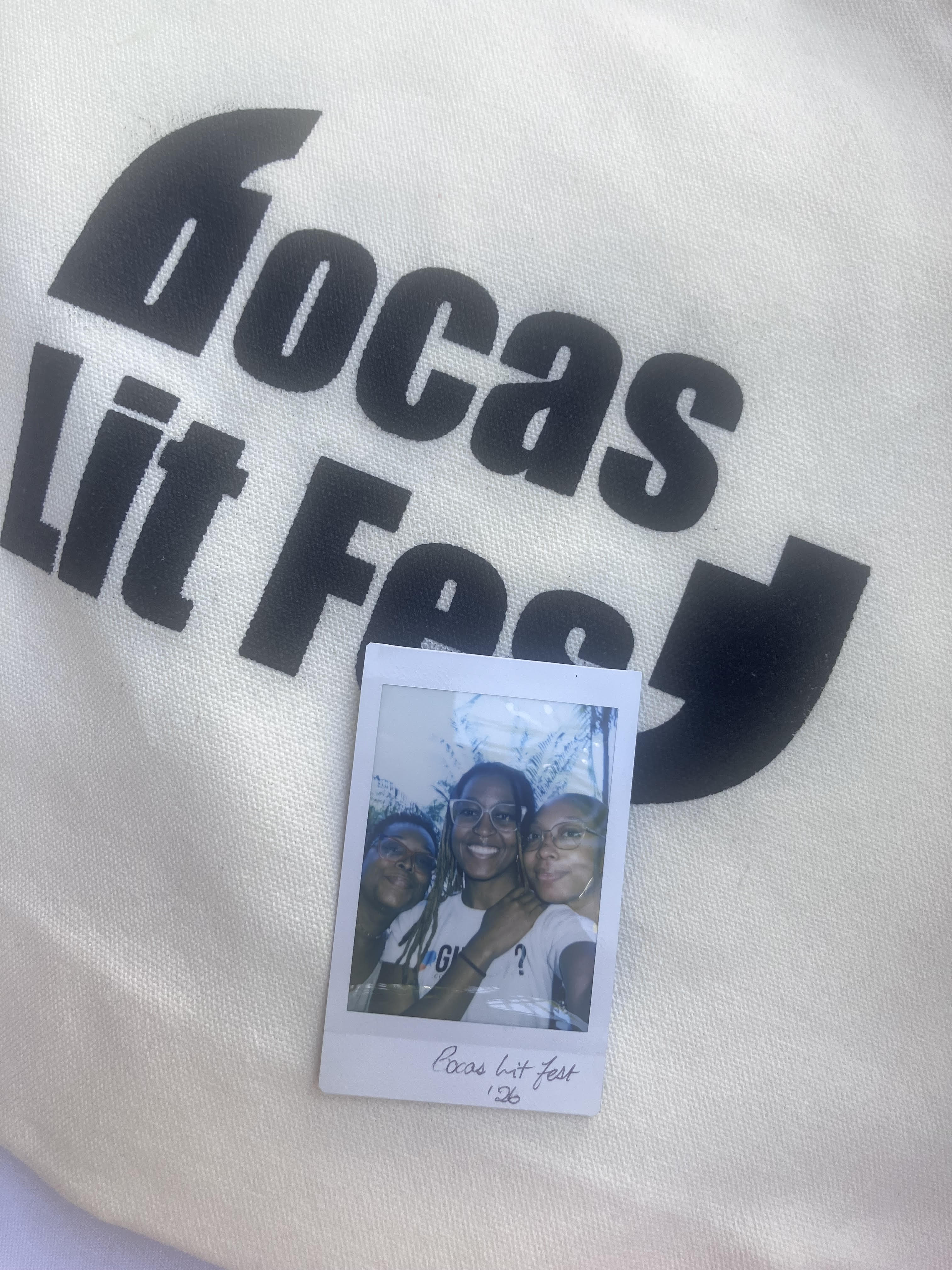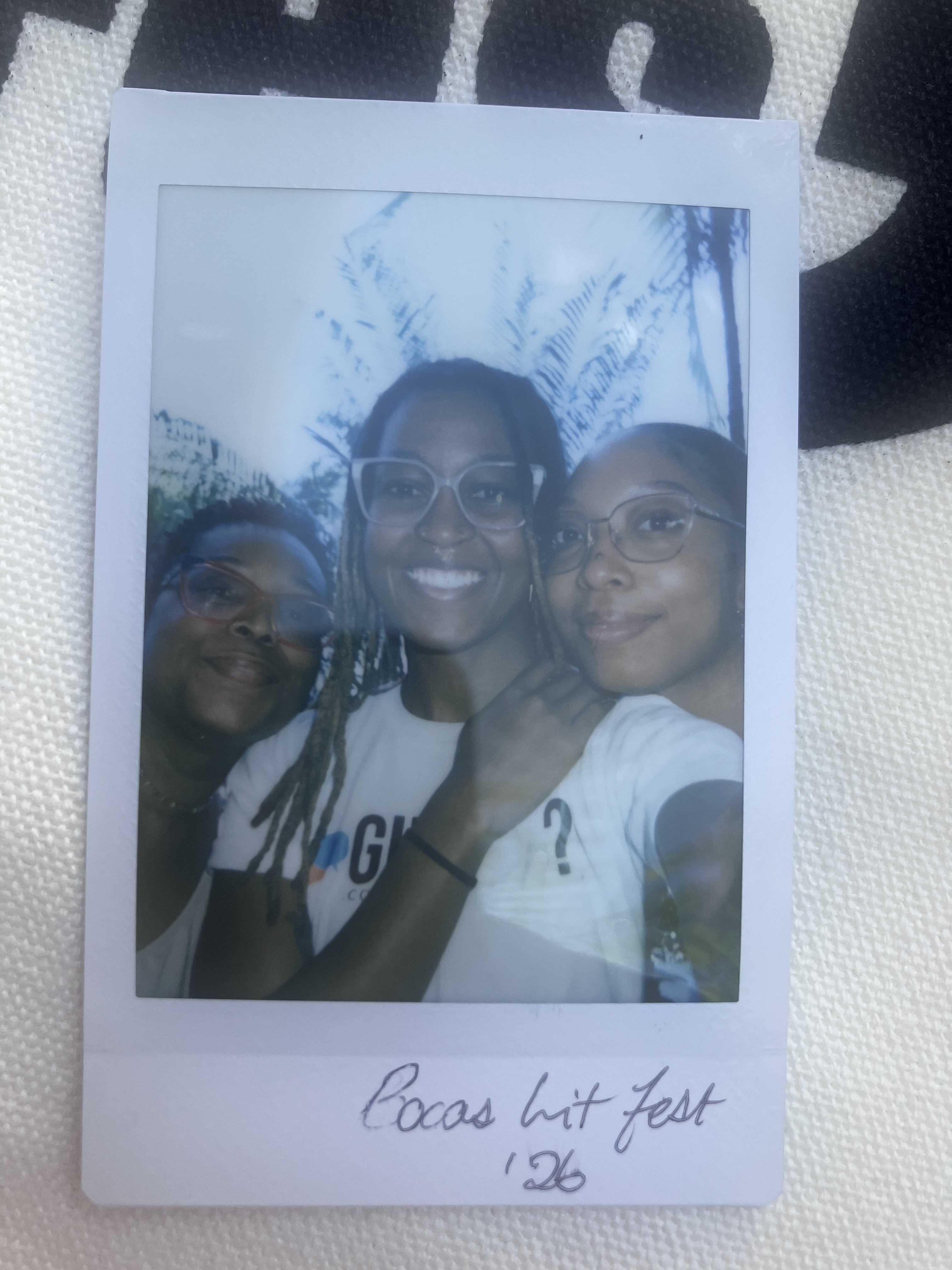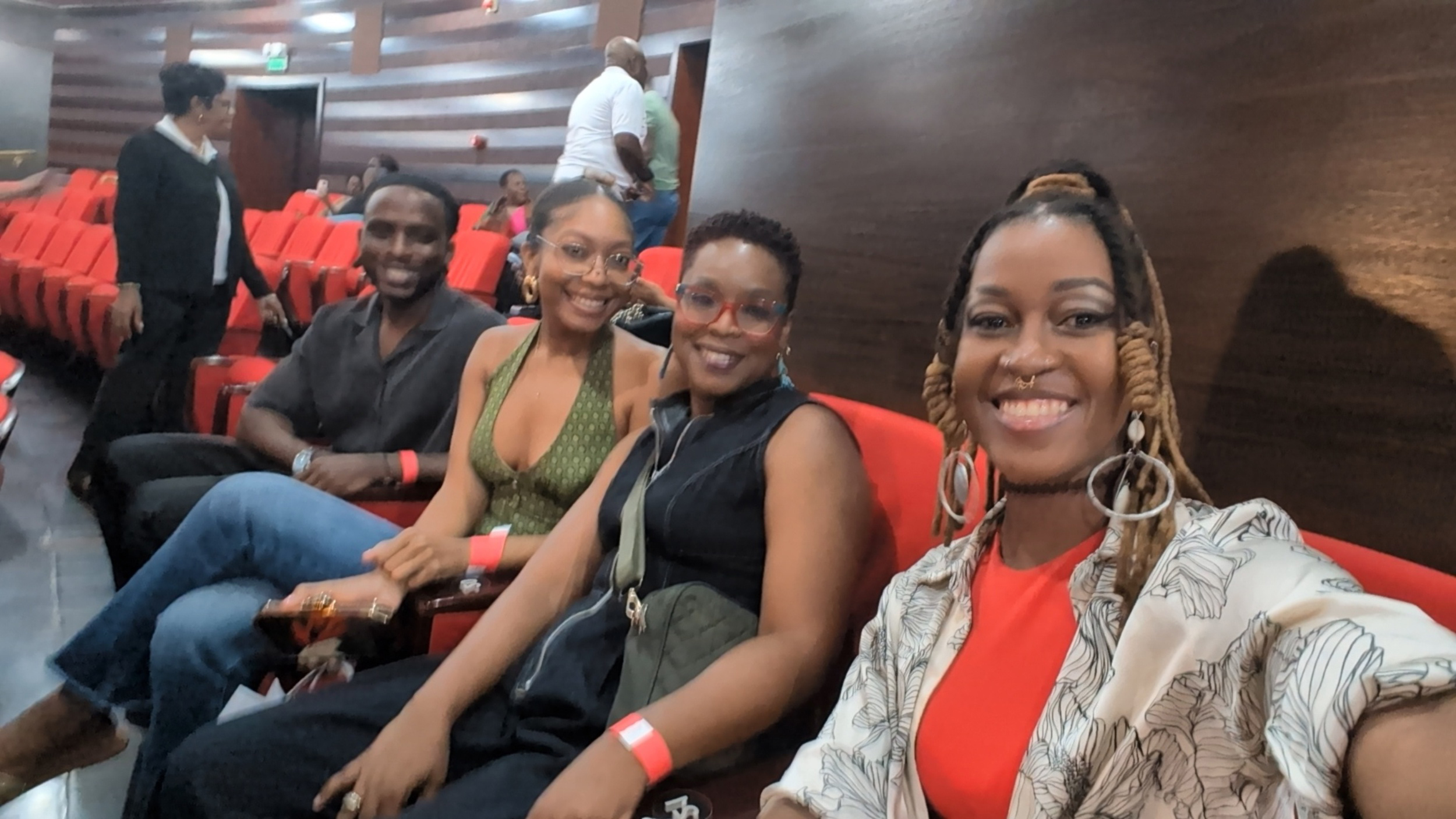
Reflections from Bocas Lit Fest 2026 by Cyndi Celeste

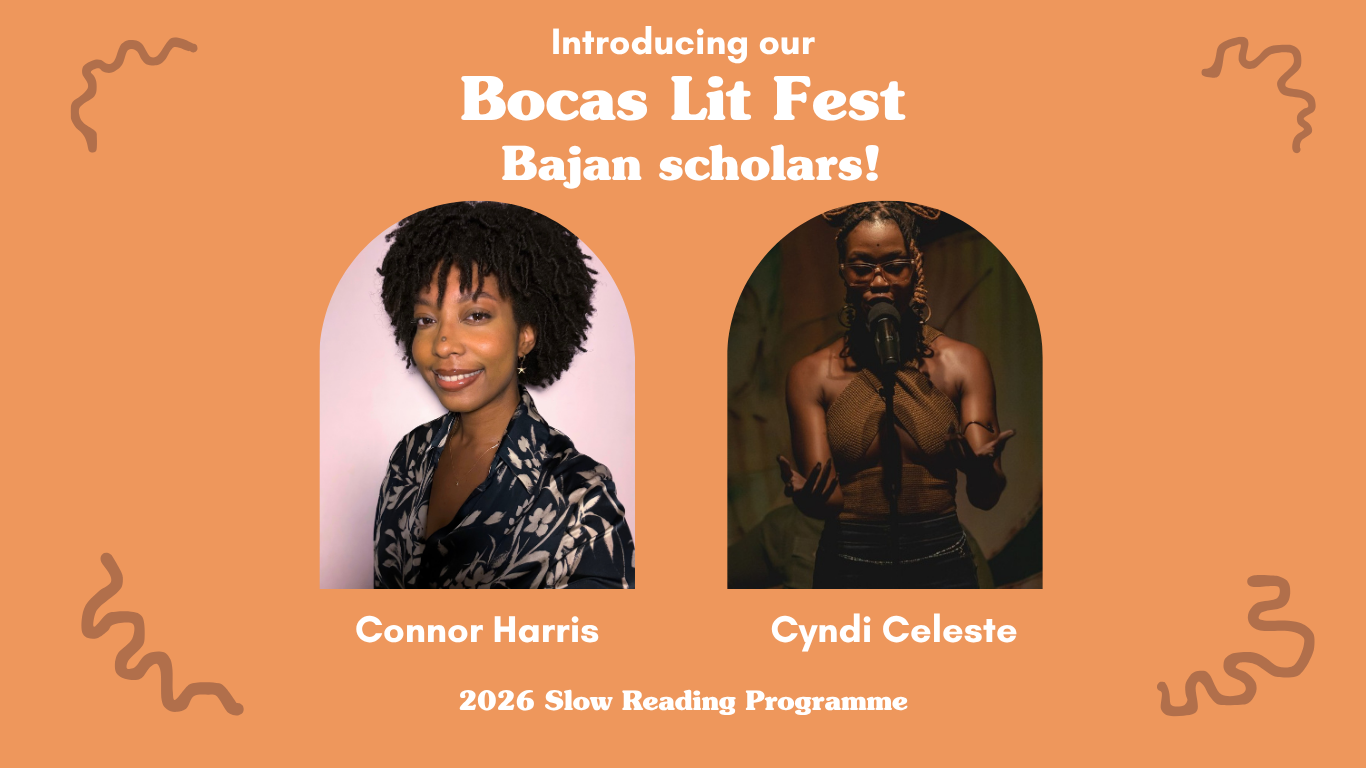
Fresh Milk is pleased to share a reflection by one of our inaugural Bocas Lit Fest Scholarship awardees, Cyndi Celeste, who alongside fellow Barbadian writer Connor Harris attended the 2026 edition of the festival in Trinidad & Tobago from April 30th – May 3rd.

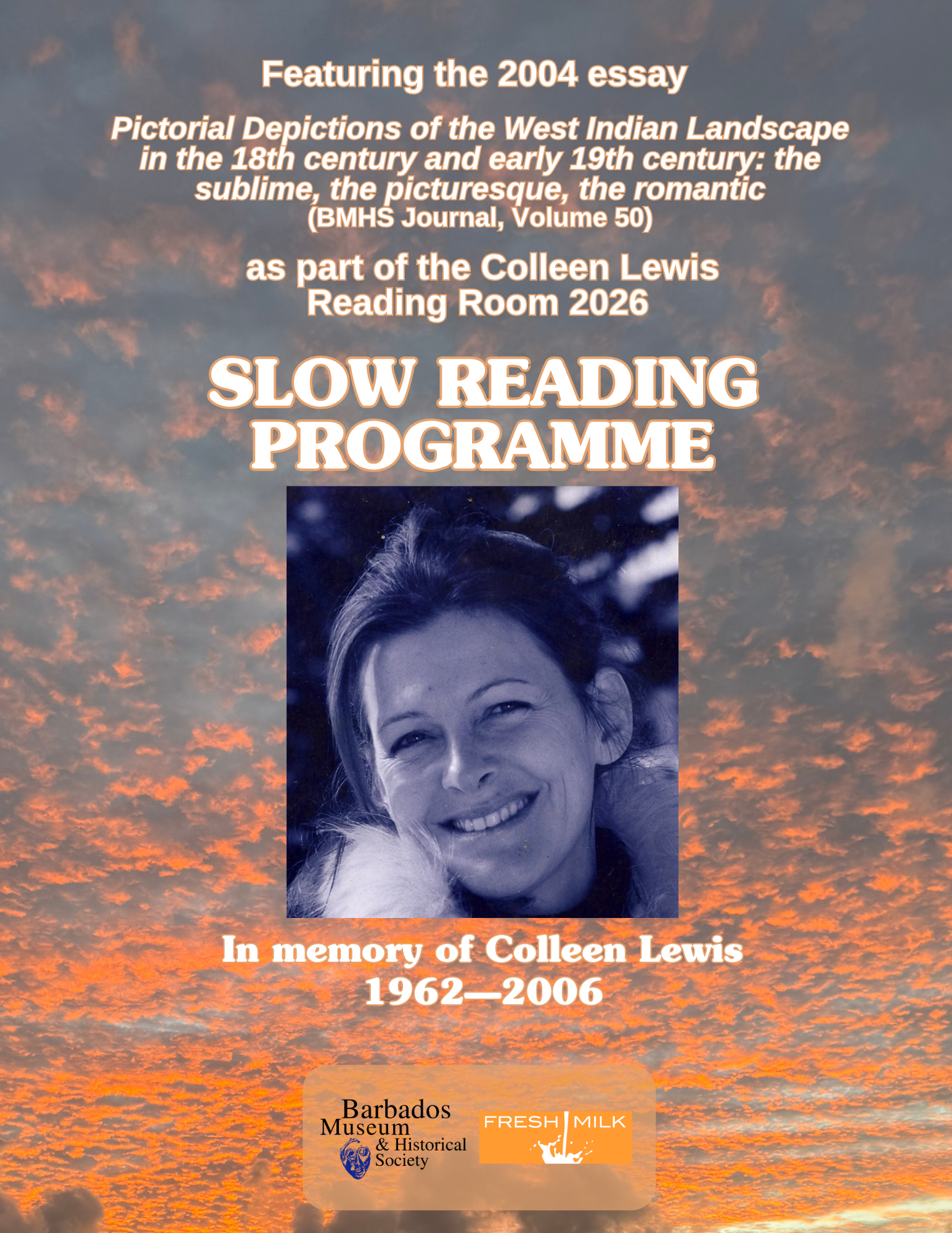
This scholarship was made possible with the generous support of Peter Lewis as part of our 2026 Slow Reading Programme. This programme serves to activate Fresh Milk’s Colleen Lewis Reading Room (CLRR), and commemorate Colleen Lewis’s legacy on the 20th anniversary of her passing.

Read Cyndi’s reflection below!


On Isolation, Exile, and Re-Membering…

Reflections from Bocas Lit Fest 2026

by Cyndi Celeste

Sometimes, it takes a step away to find words for the questions you are carrying in your subconscious.

I had always watched the Bocas Lit Fest starry-eyed and from the short yet somehow ever-uncrossable distance between Barbados and Trinidad. The twin-island republic is home to many of the poets who shaped my early days as a ‘serious’ spoken word artist – one who didn’t just perform for the sake of it, but mobilised the work to help others, one who thought and cared deeply beyond themselves. I was only 21 when I first encountered the likes of regional spoken word powerhouse Derron Sandy and the quiet storm that came to be known to me most affectionately as my ‘Twini’, Deneka Thomas.

When Fresh Milk named me one of the scholars, I rushed to notify them both – Derron, who I had seen by chance earlier this year as a workshop facilitator, guest judge, and keynote speaker at the Frank Collymore Literary Endowment Award Ceremony; Twini, who I hadn’t seen in person since 2018 but with whom I’d somehow managed to stay connected. I was overjoyed to finally be able to immerse in the landscape I’d for so long watched from a distance.

But there was something else.

Over the last nearly 13 years as a spoken word artist, three ideas have circled my practice with increasing urgency: isolation, exile, and re-membering. It was poetic, then, that the theme of the year I would finally attend Bocas Lit Fest would be “All Together Now”.

Isolation has often appeared in unexpected ways. As an artist rooted in oral tradition, I frequently experience an insidious form of imposter syndrome within literary spaces oriented toward print publication. Surrounded by those whose primary relationship to language lives on the page, I have sometimes felt as though my work occupies an uncertain category – neither fully literary nor fully performance. This tension produces a particular loneliness, a subtle dislocation where I feel simultaneously present within the literary community and unsure of my placement inside of it.

I sit in the Bocas award ceremony, listening to Canisia Lubrin read an excerpt from her Bocas Poetry Prize winning publication, The World After Rain, and the language is so visceral that my chest constricts and tears pool in my eyes. I whisper to Ayesha Gibson-Gill (there on behalf of FCLE) beside me:

“How could people ever call me a writer? I’m nowhere near her realm…”

Consequently, my foray into print is far newer – a mere four or five years. That means eight years of talking myself out of the ‘when are you going to publish a book?’ question with varying degrees of creativity. Eight years of trying and failing to convince myself that my legitimacy is historical, ancestral.

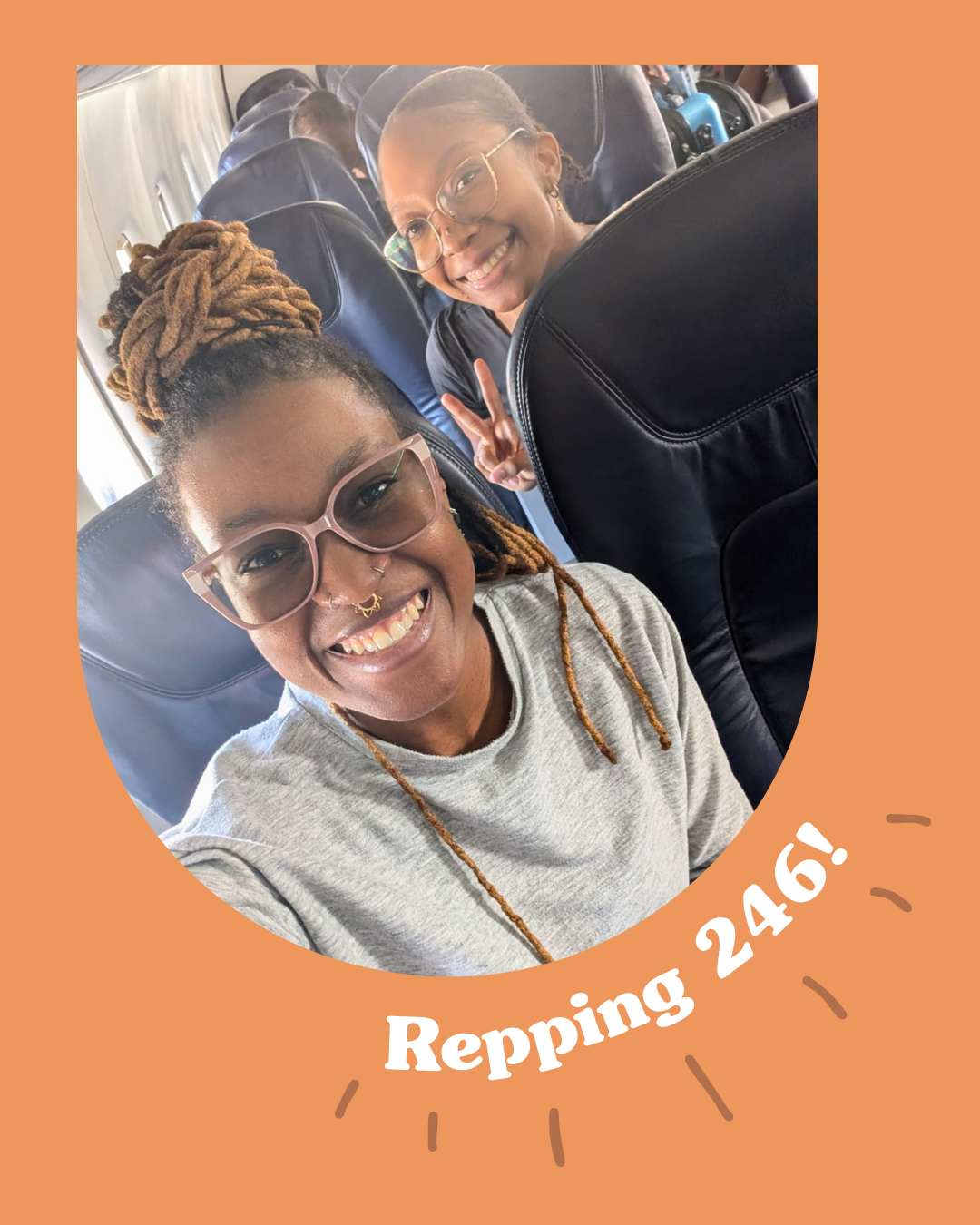
In the departure lounge of the Grantley Adams International Airport, Connor and I speak as though we have known each other forever. We talk about her work, my work, our aversions to very specific textures, our game plan for the festival, and something that has been sitting with me in quiet moments so much recently: exile.

As Caribbean readers and writers, we inherit a canon shaped by migration. How many of our writers existed in this specific isolation of leaving their country of birth and writing from beyond its borders? Connor asks me if I’m excited to perform. I say I am nervous, because I am. I tell her it is the first time in eight years that Deneka and I will see each other perform live. I tell her about how Trinidad is the mecca of spoken word in the Caribbean. I do not realise there is a longing sadness in my voice until hours later, as I’m rushing through the front doors of Kapok Hotel to speed to the performance venue.

After I perform, exile begins to speak to me in a different tongue. Twini somehow arranged for me to perform at BackChat, an LGBTQIA+ performance showcase and open mic. It is the first time I have ever touched a stage in Trinidad, and yet I experience a disorienting sense of belonging. I feel like someone who is already understood. The reception unsettles me precisely because it feels so natural.

Until now, isolation had been a familiar terrain. The community in Barbados exists as one still figuring itself out, and at some point dedication alone is no longer enough to overcome its structural limitations. I wondered if this feeling of “home, but elsewhere” was the same motivation that moved the greats. Throughout my festival experience, I run unsuspectingly into people reaffirming my BackChat performance.

“You are a juggernaut,” says Linzey Corridon, a Vincentian poet who resides in Canada. In his collection, West of West Indian, he writes:

There are no real words
only culpable emotions
funny bodies made into magic
pilgrims without (home)lands
our ancestor vagabonds
until now
(“Origins”)

Sitting beside him in Objects of Memory, my notion of exile transforms itself into an attempt to resist another form of isolation: remaining within a community that exists, yet often cannot meet the evolving needs of the artist. Exile begins to feel more like possibility than abandonment.

Onstage, Nicholas Laughlin explains the anatomy of the theme: All Together Now. He talks about how writing is so often a solitary process, about the need to be reminded that community exists and is here to hold us, and about why this particular moment when the world seems to want to devolve into chaos is so urgent. After the session, Linzey and I talk more about his doctoral work on the ‘nuance of the Queeribbean quotidian’. He asks what themes interest me.

“Isolation and exile,” I say initially, resisting the urge to elaborate my imposter syndrome. Then, as an afterthought: “And remembering.”

He mentions that it would make for interesting research if I ever decided to take that path. Later, I buy his book from the PaperBased bookstore stall. The title ties my sense of isolation in knots: West of West Indian.

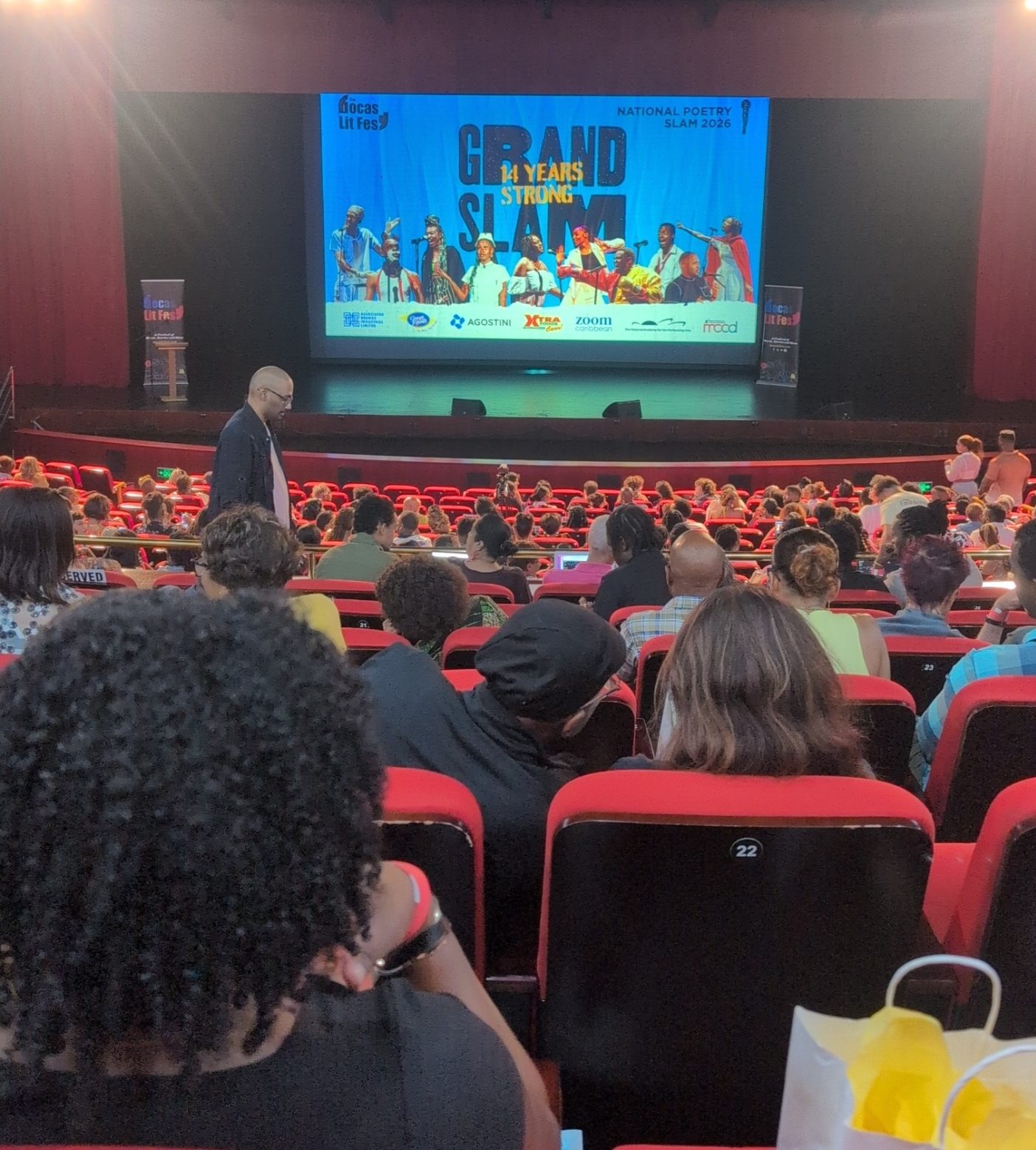
Admittedly, of all the events I was curious about, I was most enthralled by the notion of finally getting to witness the National Poetry Slam live. In the foyer of the National Performing Arts Centre, there is barely room to turn around. The glass ceiling is probably 200 feet above my head and still feels as though it can barely contain the excitement.

In the auditorium, the energy for every performer rivals the crowd support of T20 cricket. As each of the ten poets performs, I am reminded of an earlier version of myself. The excitement of discovering the art form. The way that spoken word can reshape a room, or a life. The possibility. I am passionately invested in each performer – those I’d seen before, and those entirely new to me.

After the top three are announced, another Trinidadian poet who I’d met in France in 2023 asks me to give him a rundown of my thoughts. Twini would eventually do the same via text the next morning while I am waiting for my flight. Sipping on hot chai from Rituals in Piarco Airport, I feel simultaneously filled and bereft.

Filled, because a four-day trip 45 minutes across the water by plane put me back together in ways I hadn’t realised I needed – reconstructed me, re-membered me. Bocas helped me to gather back my creative self piece by piece, restoring the emotional and imaginative coherence that artistic survival sometimes fractures.

Bereft, because I wasn’t ready for it to be over just yet. All Together Now ultimately became less of a festival theme and more of a quiet reassurance: ‘We are glad you came, you are all together now”.

The Fresh Milk team and the Colleen Lewis Slow Reading Programme recognised a need I had forgotten – the need for artists to step outside of their immediate environment and encounter their practice anew. I leave the experience recognising that isolation, exile, and re-membering are stages within an ongoing artistic cycle. Isolation produces the work; exile seeks the conditions for its growth; and re/membering restores the artist to themselves.

Announcing the inaugural Bocas Lit Fest Scholarship!

Fresh Milk is deeply pleased to share the results of our inaugural Bocas Lit Fest Scholarship, which has been made possible with the generous support of Peter Lewis as part of our 2026 Slow Reading Programme. This programme serves to activate Fresh Milk’s Colleen Lewis Reading Room (CLRR), and commemorate Colleen Lewis’s legacy on the 20th anniversary of her passing.

We are delighted to announce that the inaugural Bocas Lit Fest Scholarship has been awarded to Cyndi Celeste and Connor Harris! Congratulations!

Read the full jury report process below

The Bocas Lit Fest Scholarship was designed with three principal desires in mind: 

i) A programme designed by and for artists, writers, and cultural workers with the goal of drawing strength from, and consolidating an awareness across linguistic regions and generations. 

ii) A programme that exalts the civic function of the arts and art research by bridging cultural practices with the social contexts to which they are responding, as well as addressing the practical needs of doing this work. 

iii) A programme that activates and facilitates exchange of existing work, thought, and feeling between Barbadians and, more broadly, Caribbean people, in order to digest and counteract the prevailing sense of isolation and/or apathy our economic and social condition can perpetuate.

The Bocas Lit Fest — held annually in Port of Spain, Trinidad & Tobago — represents the most significant literary event in the Anglo-Caribbean. Held this year from April 30th to May 3rd, it generates a period of crucial enrichment, exchange and celebration for our region’s cultural sector. We determined sponsored attendance of this festival for a Bajan writer to be a necessary element of the Slow Reading Programme, in order to take part in the world-building activities and tools that literature, arts and archiving generate, helping to foster the imagination required to navigate the nuances of the Caribbean.

The Award Details

The Bocas Lit Fest scholarship includes:

  • Round-trip airfare to Trinidad and Tobago.
  • 4 nights of accommodation at the Kapok Hotel.
  • Airport transfers.
  • A daily allowance for the 4-day duration of the festival.

Candidate Requirements:

  • Candidates must be 21 years of age or older and based in Barbados.
  • Candidates must hold a passport valid for at least 6 months for travel to Trinidad and Tobago.
  • Candidates must be available to travel for the full duration of the festival (April 30th – May 3rd).
  • Upon completion, Candidates agree to collaborate with Fresh Milk to craft a journalistic reflection/report on the experience to be shared across our public platforms.

Procedure

On March 12th, Fresh Milk contacted three esteemed members of the local literary community:

  • Dr. Debra Providence, Lecturer at The Department of Languages, Linguistics, and Literatures.
  • Robert Sandiford, co-founder of ArtsEtc publishing company, writer, editor and part time faculty at the Barbados Community College Division of Fine Arts Department. 
  • Andy Taitt, owner of Black Rock Books book store and community hub for literary events. 

Providing the above mentioned background, we requested they collaborate as nominators, selecting 2 candidates each by the deadline of March 23rd. 

The nominators selected the following individuals as nominees: 

  • Cyndi Celeste 
  • Claudia Clarke
  • Christopher Cox 
  • Kemar Doughty 
  • Connor Harris 
  • Shondrell Meredith 

On March 25th the nominees were contacted to be notified of their candidacy, and were requested to submit a 500-750 word Letter of Motivation by April 3rd, articulating the following: 

  1. Why they are a suitable candidate for this scholarship.
  2. Describing the main themes or areas of interest in their literary craft, and if there are emerging themes in particular that they would like to further explore through attending Bocas LitFest.
  3. How attending Bocas LitFest will impact their professional development and area of interest.

All 6 Letters of Motivation were shared with and reviewed by the Fresh Milk team and Fresh Milk’s Board Members:

  • Natalie McGuire, Curator of Social History and Engagement at the Barbados Museum & Historical Society 
  • Rae Skinner, Founder of Caribbean Brushstrokes Gallery 

The decision making process was made through each board member representing one vote, and the Fresh Milk team representing a third vote. 

General Comments

Each candidate’s Letter of Motivation reflected exciting and compelling insight into their practice, their desires and some background to their work. 

Cyndi Celeste wrote of her keen dedication to exploring the themes of nation language, futurism, and “acts of re-membering as personal and collective repair”, with a special focus on the Caribbean Voice and orality. Their years spent organising events and opportunities for the broader literary and academic community, as well as for the general public, is reflected in their attention to innovating methodologies, and the social role that the literary arts must uphold. 

Claudia Clarke described her commitment to writing women-centric fiction, to assert the presence of nuanced mid-life experiences in contemporary Barbados, and bringing to life the multiple layers of an invisibilised demographic. She remarks on how the “All Together Now” theme of Bocas Lit Fest this year resonates strongly with the predominantly solitary nature of literary craft which, as an emerging middle-aged writer herself, is of particular importance to engage with opportunities for community and knowledge exchange.  

Christopher Cox shared his craft as dedicated to interrogations of the ills and virtues of the human psyche primarily through humorous story telling and plots of intrigue and conspiracy. He seeks to use these as vehicles to blend Caribbean History with new ways of storytelling, re-imagining past elements in exciting new settings like science fiction and modern fantasy. 

Kemar Doughty spoke of his keen interest in addressing Caribbean masculine identities and the intersection of religion and sexuality in the region, as well as his curiosity at the intersection of linguistics and literary criticism. Importantly, he touches on his position as an academic and creative from an urban working class Bajan background, working within an under-narrated area to which he dedicates his voice and talents.

Connor Harris described her deep interest in working through themes of magical realism, and her particular focus on the Caribbean gap within the global canon of encyclopedias of symbolism related to regional mythologies and folklore. She reflected a well-studied understanding of her craft and its relevance within our current context, dedicated to spiritual and religious themes pertinent to cultural rites of self-actualisation, touching on memory, death/rebirth and the shadow.   

Shondrell Meredith illustrated her journey from beginning as an avid reader using novels as a means to travel the world, and becoming acquainted with life in other Caribbean islands through fiction, to growing into a creator of her own stories that portray a fresh perspective of Barbadian life. She identified her motivation to bridge cultural gaps and portray our similarities in an engaging way, commenting on the value that attending Bocas Lit Fest would have for her to deepen not only her experience as an emerging writer, but also to gain a better understanding of the world of publishing and marketing. 

Results

It was a difficult process evaluating the candidates, as each writer presented compelling niches and interests that would undoubtedly benefit from the opportunity to attend Bocas Lit Fest. On the one hand this positively indicates that the literary talent in Barbados is growing ambitiously, and is responding creatively to the needs of our local context. However, it signals that the cultural infrastructure and opportunities to accommodate these ambitions needs to develop and expand in tandem, in order to adequately meet the needs and desires expressed by writers from different backgrounds and practicing diverse genres.  

We designed this scholarship with the initial intention of offering it to one candidate; however, upon evaluation of the top candidates we noticed that their profiles were very much complimentary and would benefit from close interaction. We therefore decided to adjust our Slow Reading Programme budgeting in order to grant the scholarship to two awardees. 

We are delighted to announce that the inaugural Bocas Lit Fest Scholarship has been awarded to Cyndi Celeste and Connor Harris. 

A huge thank you to Peter Lewis for making this scholarship possible, and to the nominators for their role in stewarding our local literary ecosystem.   

We strongly encourage you to follow and support the trajectory of all the candidates, each with unique merits: 

Claudia Clarke
Website: https://www.claudiaclarkewriter.com
Instagram: @claudiaclarkewriter

Shondrell Meredith
“These Fields and Hills” (2023) on Amazon
Instagram:  @pennedbyshondrell

Kemar Doughty
Inkitt: https://www.inkitt.com/kemjlu

Christopher Cox
Instagram: @hypothetical.arts

Cyndi Celeste
Website: https://cyndiceleste.com/home
Instagram: @cyndi.celeste

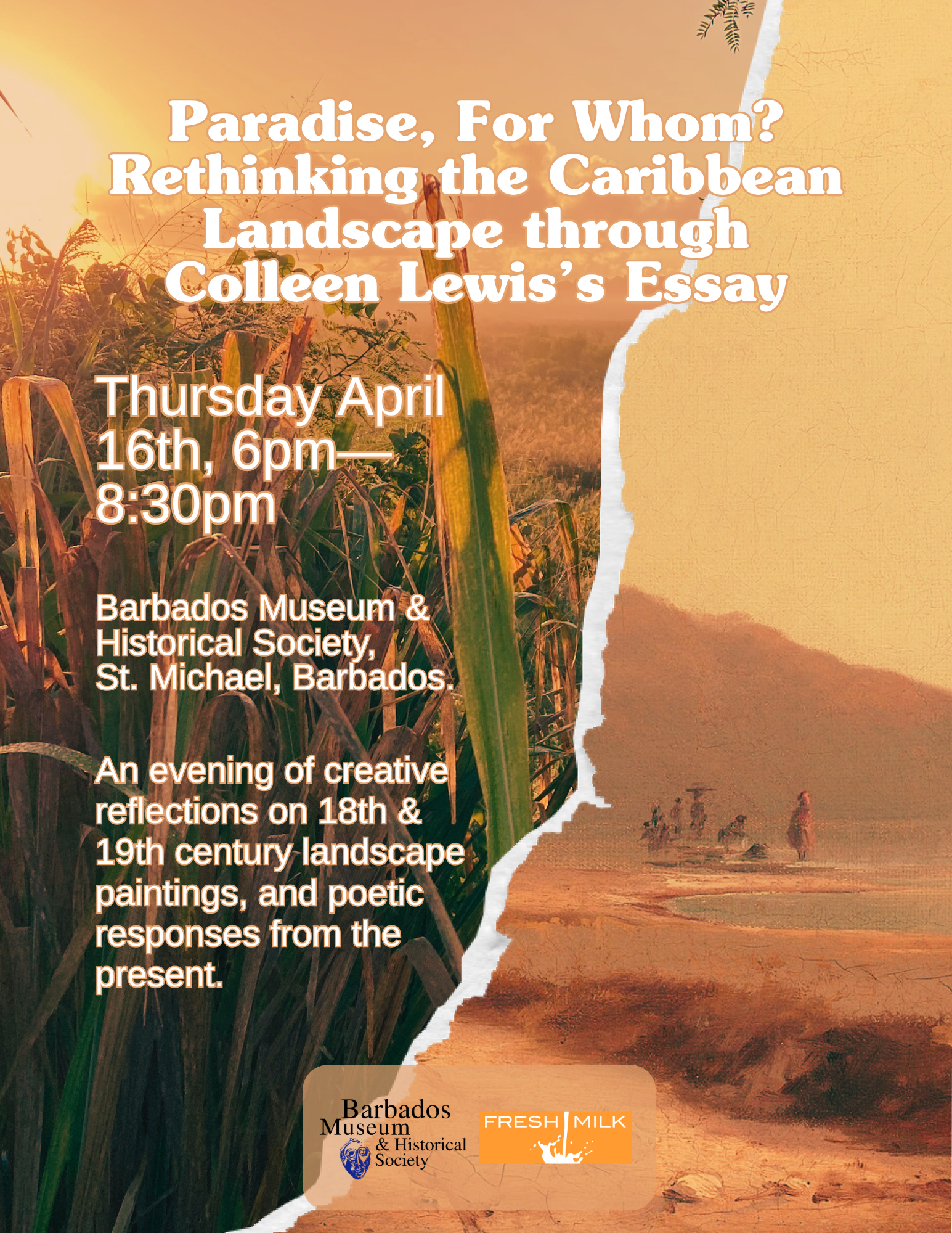
Paradise, For Whom? Rethinking the Caribbean Landscape through Colleen Lewis’s Essay

Fresh Milk and the Barbados Museum & Historical Society (BMHS) are honoured to invite you to an evening celebrating the memory of Colleen Lewis, and her enduring legacy in the Colleen Lewis Reading Room located at Fresh Milk, Walker’s Dairy, St. George.

Painting featured: “Deux femmes causant au bord de la mer, Saint Thomas” (Camille Pissarro, 1856. Accessed from wikicommons.

As part of the 2026 Slow Reading Programme, we will share critical reflections on the history of how our landscapes have been shaped by the foreign gaze, using Colleen’s 2004 essay ““Pictorial Depictions of the West Indian Landscape in the 18th century and early 19th century: the sublime, the picturesque, the romantic” as a point of departure.

RSVP HERE!

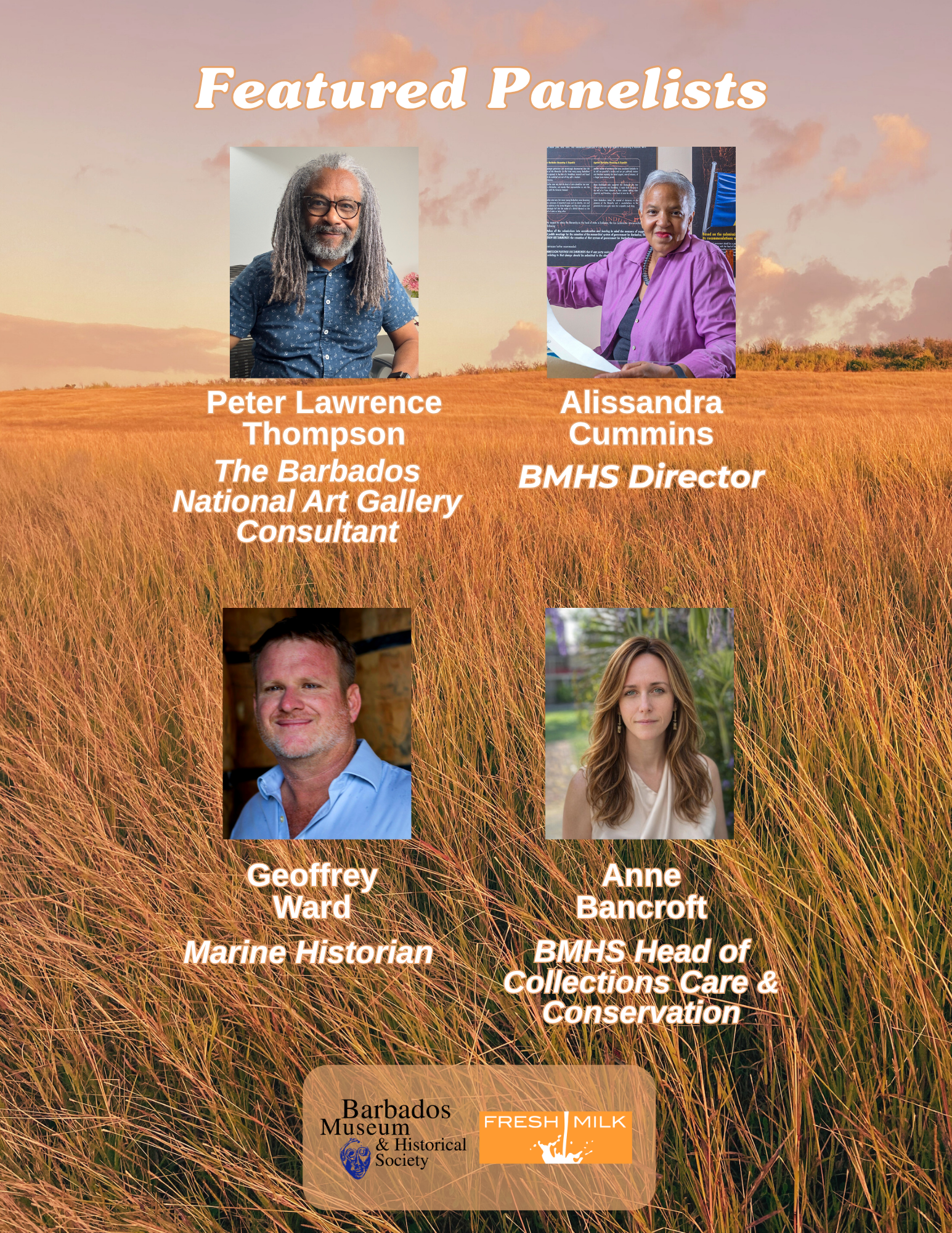
Hosted in the Sir Trevor Carmichael Walled Garden Theatre at the BMHS, panelists Dr. Geoffrey Ward, Peter Thompson, Anne Bancroft, and Alissandra Cummins will share a diverse cross-section of perspectives on the topic and its relevance both in our historical and current setting.  

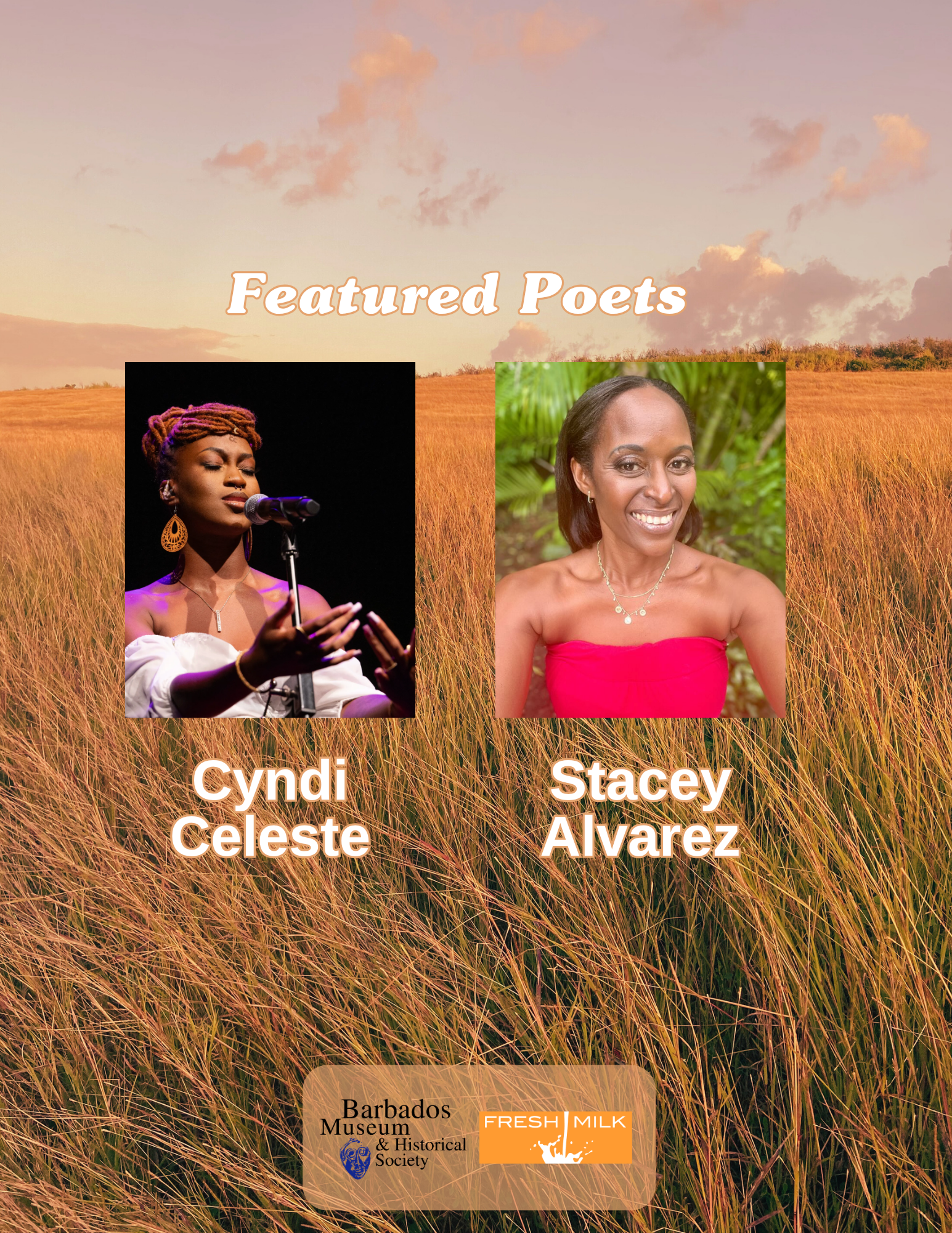
Creative responses crafted in Fresh Milk’s collective writing workshop in January, inspired by the calypsonian tradition and a guided walk through the Barbados Trailway in St. George, will be read by poets Cyndi Celeste and Stacey Alvarez. The full series of poems by all participants will be shared via a print fanzine. 

We invite you to take part in this Slow Reading Process; take the time to read Colleen’s article available to download in our RSVP form. We also ask for you to share any questions to panelists beforehand, which you can submit by writing to freshmilksocials@gmail.com.

Send us your RSVP by Monday April 13th! See you then! 


About the panelists:

Alissandra Cummins, GCM, FMA, is Director of the Barbados Museum and Historical Society and serves as Vice President of the International Coalition of Sites of Conscience as well as the Barbados National Commission for UNESCO. She was elected President of the International Council of Museums (2004-2010) having previously served as Chairperson of its Advisory Committee for six years. A recognized authority on Caribbean heritage, museum development and art, and was awarded the Barbados Governmen’s Gold Crown of Merit in 2005. She was elected a Fellow of the Museums Association (UK) and as a member of the Commonwealth Association of Museums’ eminent Cowrie Circle. Ms. Cummins lectures part time on Heritage and Museum Studies at the University of the West Indies. She has served as chair/vice chair and/or member in a number of regional and international heritage programmes and publications, instruments and entities, including President of the Executive Board of UNESCO (2009-2011) and Editor in Chief of the International Journal of Intangible Heritage.

Anne Bancroft is a collection care specialist with over 20 years’ experience in the heritage sector. She has worked internationally as a preservation and conservation consultant across the West Indies, India, Italy, and the UK. Anne currently serves as Head of Collection Care and Conservation at both the Barbados Museum & Historical Society and ROADs National Digitisation Programme. She holds two masters degrees in conservation from Camberwell College and the Courtauld Institute of Art, with a focus on technical art history. In addition she has a Bachelor’s of Arts from BCC. She has previously worked with leading institutions including the V&A Museum and Tate Britain. Her research focuses on sacred objects, and she brings a forensic, materials-based perspective to the understanding and preservation of cultural heritage.

Geoffrey Ward completed his undergraduate degree in History at the University of Western Ontario in Canada before returning home to Barbados. He was awarded his PhD from the University of the West Indies (Cave Hill Campus) in 2022, investigating the political, social and economic interactions between the Barbadian Populace and British naval personnel in the American Revolution. He recently completed an R.L. Seale / University of the West Indies post-doctoral fellowship, investigating the relationship between Rum and the Barbados plantation economy between 1775 and 1815.

Peter L. Thompson grew up in Barbados but fled the day after he wrote his last secondary school exam. He departed with the certainty and irrevocability of every teenage heartbreak… Yet even as Air Canada turned to the final north, affection strained, but space and time couldn’t snap it. He returned at last to his native land nine years ago, after a many decade long art gallery/management consulting career in Canada. He works now to understand how to take risks in the pursuit of meaning. His love affair with Barbados is unrequited, still.